

Marketing Automation for Dentists
What Is Marketing Automation?
Marketing automation does not replace personal relationships it enhances them. By automating routine administrative and communication tasks, your team gains more time to focus on meaningful conversations, exceptional patient care, and delivering a better overall experience.
Marketing automation is the process of using technology, predefined workflows, and strategic planning to deliver the right communication, at the right time, to the right patient or prospective patient. For dental practices, automation is not about replacing personal relationships.
Instead, it helps ensure that important communications, follow-ups, reminders, and internal processes happen consistently even when your team is busy providing patient care. Rather than relying on manual tasks for every interaction, automation helps streamline repetitive processes while allowing your team to focus on delivering exceptional clinical experiences.
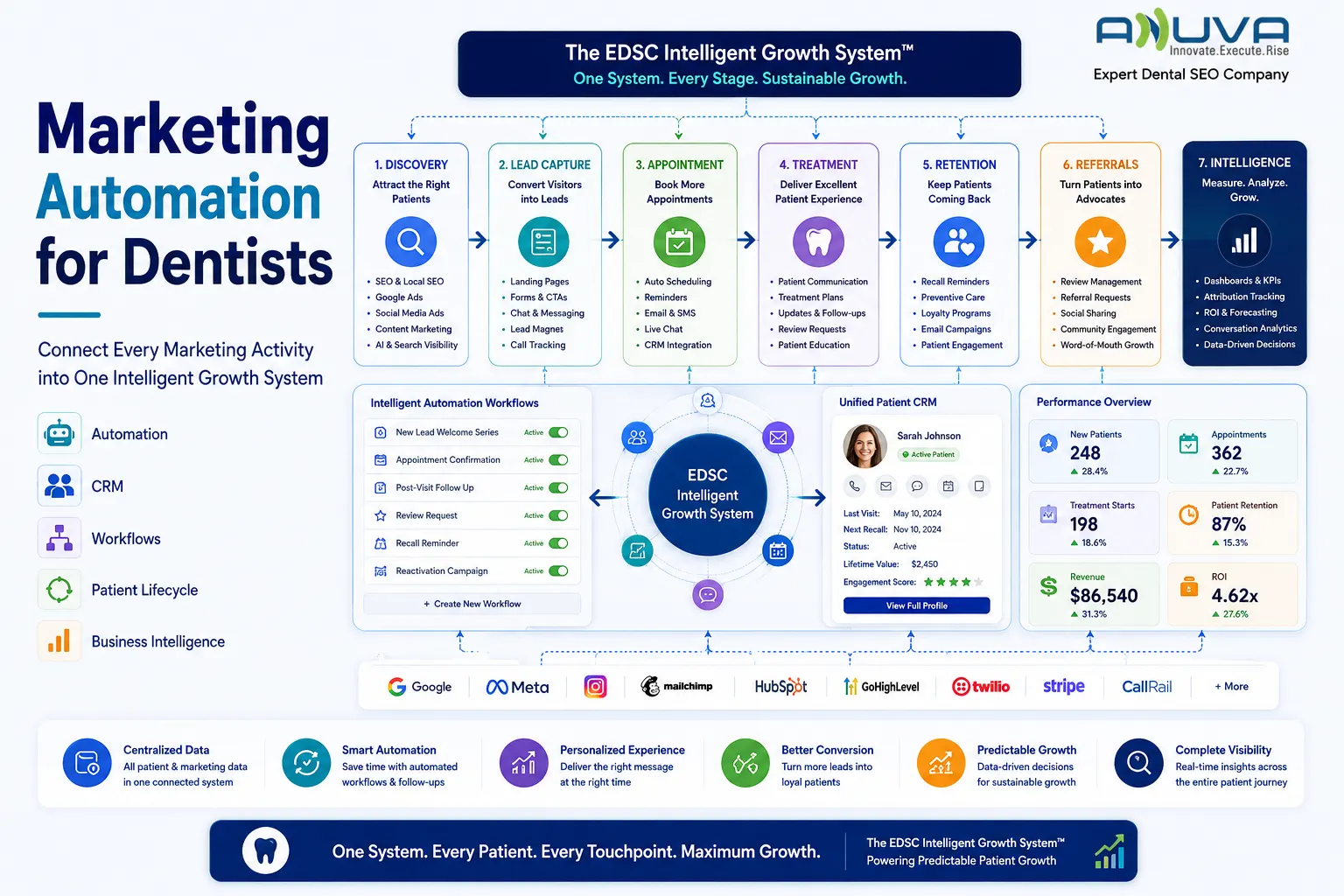
At Expert Dental SEO Company, we view marketing automation as the system that connects your marketing, patient communication, and operational workflows into one coordinated strategy.
Marketing Automation Can Support:
- New patient enquiries
- Lead nurturing
- Appointment confirmations
- Patient education
- Recall programs
- Treatment follow-up
- Internal team notifications
- Referral campaigns
- Performance reporting
- Long-term patient engagement
Automation strengthens consistency without replacing the human connection that patients expect from their dental provider.
Interested in reducing repetitive administrative work while improving patient communication?
Schedule a Marketing Automation Strategy Session, and we’ll identify opportunities to streamline your workflows while maintaining a personalized patient experience.
Why Automation Matters for Modern Dental Practices
Today’s patients expect timely, convenient, and personalized communication. At the same time, dental teams often manage multiple responsibilities, including patient care, scheduling, insurance coordination, treatment planning, and administrative tasks.
Marketing automation helps bridge this gap by ensuring that routine communications and workflow processes occur consistently without requiring constant manual effort. When thoughtfully implemented, automation can improve efficiency, reduce missed opportunities, and support a better overall patient experience.
Common Challenges Without Automation
Many dental practices encounter similar operational challenges as they grow.
Delayed Follow-Up
Prospective patients may submit a contact form or request an appointment outside normal office hours. Without a structured follow-up process, valuable opportunities can be delayed or overlooked. Automation can initiate timely acknowledgments, notify the appropriate team members, and ensure enquiries enter an organized workflow for prompt attention.
Inconsistent Patient Communication
Routine communication often depends on available staff time. As schedules become busier, educational emails, recall reminders, and follow-up messages may become inconsistent. Automation helps maintain a predictable communication schedule while allowing staff to personalize interactions when appropriate.
Manual Administrative Work
Many recurring tasks consume valuable administrative time.
Examples include:
- Sending follow-up emails
- Scheduling reminders
- Internal notifications
- Patient status updates
- Lead assignment
- Appointment confirmations
- Campaign tracking
- Reporting preparation
Automating repetitive processes allows team members to focus on higher-value patient interactions.
Limited Visibility Into the Patient Journey
Without connected systems, practices may find it difficult to understand how prospective patients progress from initial enquiry to scheduled appointment and long-term patient. Automation helps organize key touchpoints throughout the patient journey, making it easier to identify opportunities for improvement.
Disconnected Marketing Systems
Many practices use multiple tools independently:
- Website
- SEO
- Google Ads
- Social Media
- Email Marketing
- CRM
- Scheduling software
- Analytics platforms
When these systems operate independently, important information may become fragmented. Marketing automation helps coordinate these activities into a more connected workflow while reducing unnecessary manual effort.
The EDSC Intelligent Growth System™
Successful dental marketing involves much more than generating new patient enquiries. Long-term growth depends on connecting every stage of the patient journey—from the moment someone discovers your practice through ongoing communication, retention, referrals, and continuous improvement.
The EDSC Intelligent Growth System™ serves as the overarching framework that unifies every marketing discipline developed throughout the Expert Dental SEO Company methodology.
Rather than treating SEO, advertising, email, analytics, and automation as isolated services, this framework demonstrates how each component works together to support sustainable practice growth.
Stage 1 – Patient Discovery
Every patient journey begins with awareness.
Potential patients may discover your practice through:
- Google Search
- Local SEO
- Google Business Profile
- AI-powered search experiences
- Social media
- Online reviews
- Educational content
- Referrals
The objective is to ensure your practice appears wherever prospective patients begin researching dental care.
Stage 2 – Lead Acquisition
Once prospective patients discover your practice, the next objective is to encourage meaningful action.
Lead acquisition may occur through:
- Website contact forms
- Appointment requests
- Phone calls
- Live chat
- Google Ads
- Local SEO
- Landing pages
- Social media campaigns
- Referral programs
Automation helps organize these enquiries, route them to the appropriate team members, and reduce the risk of delayed follow-up.
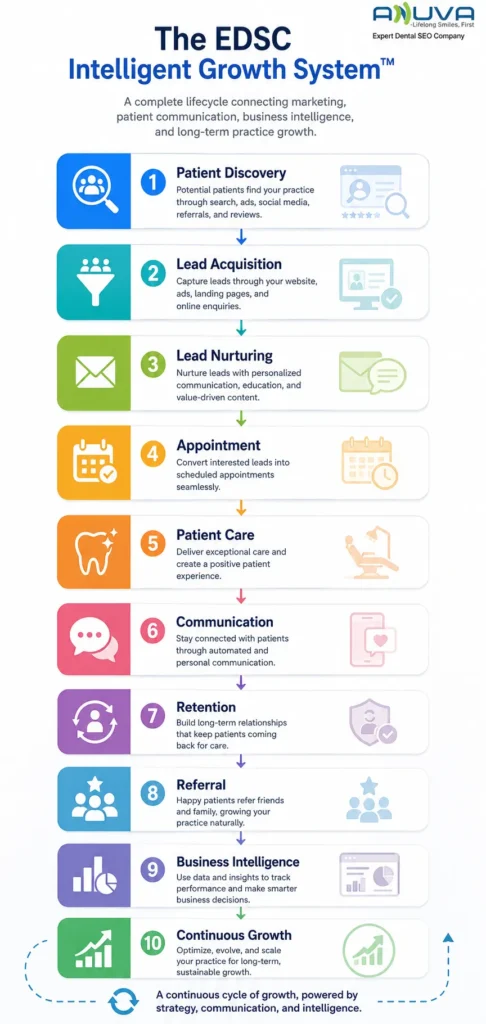
Stage 3 – Lead Nurturing
Not every prospective patient schedules an appointment immediately. Some may continue researching treatment options, compare providers, or need additional information before making a decision.
Lead nurturing workflows help maintain communication through relevant, timely content such as:
- Welcome emails
- Educational resources
- Frequently asked questions
- Treatment information
- Practice introductions
- Patient testimonials (shared with appropriate written consent)
- Financing information
- Appointment reminders
These communications help prospective patients stay engaged while allowing them to make informed decisions at their own pace.
Stage 4 – Appointment Scheduling
Once a patient decides to move forward, automation can support the scheduling process.
Depending on your systems and workflow, automation may assist with:
- Appointment confirmations
- Calendar updates
- Internal scheduling notifications
- New patient onboarding
- Required forms and documentation
- Preparation instructions
- Reminder sequences
The objective is to reduce administrative effort while providing patients with a smooth scheduling experience.
Stage 5 – Patient Care
Automation supports patient care by ensuring that important communications continue after treatment.
Examples include:
- Post-treatment instructions
- Home care guidance
- Recovery information
- Educational resources
- Medication reminders (where appropriate and compliant with applicable regulations)
- Follow-up requests
- Satisfaction surveys
These workflows help reinforce clinical recommendations while improving the overall patient experience.
Stage 6 – Ongoing Communication
Consistent communication helps maintain strong relationships between appointments.
Automation can coordinate recurring communications such as:
- Educational newsletters
- Oral health tips
- Hygiene reminders
- Practice announcements
- Community updates
- Seasonal campaigns
- Preventive care education
These workflows complement your broader email marketing strategy while ensuring communications are delivered consistently.
Stage 7 – Patient Retention
Long-term growth depends on retaining existing patients as well as attracting new ones.
Automation helps support retention through:
- Recall workflows
- Continuing care reminders
- Preventive education
- Missed appointment follow-up
- Reactivation campaigns
- Birthday greetings
- Milestone communications
- Personalized follow-up sequences where appropriate
Consistent communication encourages patients to remain engaged with your practice throughout their oral healthcare journey.
Stage 8 – Referral Growth
Satisfied patients often become advocates for your practice.
Automation can help identify appropriate moments to encourage referrals through:
- Patient appreciation campaigns
- Referral program communications
- Post-treatment follow-up
- Educational content sharing
- Community event invitations
- Practice milestone announcements
Referral workflows should always emphasize appreciation and patient experience rather than pressure.
Stage 9 – Business Intelligence
Automation also improves visibility into practice performance.
By connecting marketing activities with reporting systems, practices can better understand:
- Lead sources
- Appointment trends
- Campaign engagement
- Patient retention
- Workflow performance
- Follow-up completion
- Marketing effectiveness
- Operational efficiency
These insights support informed decision-making while identifying opportunities for continuous improvement.
Stage 10 – Continuous Growth
Marketing automation is not a one-time project. As your practice evolves, workflows should evolve alongside it.
Regular review helps identify opportunities to:
- Improve patient communication
- Refine marketing campaigns
- Simplify internal processes
- Reduce repetitive administrative work
- Enhance the patient experience
- Support sustainable long-term growth
Continuous optimization ensures your marketing and operational systems remain aligned with your practice goals.
Our Marketing Automation Services
Every practice has unique systems, workflows, staffing structures, and patient journeys. For that reason, successful automation should always be tailored to the way your practice operates rather than relying on generic templates. The objective is to simplify operations while maintaining a personal, patient-centered experience.
Every dental practice operates differently. Our automation solutions are designed around your existing workflows, technology, and patient communication needs rather than forcing a one-size-fits-all system.
Workflow Strategy
Every successful automation initiative begins with understanding how your practice operates today.
We evaluate:
- Patient journey
- Marketing channels
- Administrative workflows
- Communication processes
- Team responsibilities
- Existing software
- Practice goals
- Areas where repetitive tasks consume valuable time
This assessment helps identify opportunities where automation can improve consistency without disrupting your team’s workflow.
CRM Integration
A customer relationship management (CRM) platform becomes more valuable when it works seamlessly with the rest of your marketing ecosystem.
Where appropriate, we help connect your CRM with:
- Website enquiry forms
- Landing pages
- Email marketing platforms
- Scheduling tools
- Reporting systems
- Advertising platforms
- Lead tracking processes
The goal is to reduce manual data entry and provide a more complete view of the patient journey.
Lead Nurturing
Prospective patients often need additional information before scheduling an appointment. Lead nurturing workflows can provide timely, educational communication based on where a person is in their decision-making process.
Depending on your practice, these workflows may include:
- Welcome sequences
- Educational resources
- Treatment information
- Frequently asked questions
- Practice introductions
- Appointment reminders
- Follow-up communications
- Re-engagement campaigns
The objective is to provide relevant information while making it easier for prospective patients to take the next step when they are ready.
Internal Team Notifications
Marketing automation is not limited to patient-facing communication. It can also improve how your internal team responds to new enquiries, appointments, and important workflow events. Instead of relying on manual follow-up or verbal communication, automated notifications help ensure that the right people receive the right information at the right time.
Depending on your practice’s workflow, internal notifications may include:
- New patient enquiry alerts
- Appointment request notifications
- Contact form submissions
- Missed appointment alerts
- Lead assignment updates
- Treatment consultation requests
- Follow-up reminders for team members
- Task completion notifications
- Workflow status changes
- Reporting summaries
These notifications help reduce delays, improve accountability, and keep everyone aligned throughout the patient journey.
Reactivation Campaigns
Not every patient schedules appointments consistently. Some postpone routine hygiene visits, delay recommended treatment, or simply lose touch with the practice over time. Reactivation campaigns help reconnect with these patients through thoughtful, relevant communication that encourages them to resume their oral healthcare. Rather than relying on repeated promotional offers, successful reactivation campaigns focus on education, preventive care, and patient support.
Depending on your objectives, campaigns may include:
- Overdue hygiene reminders
- Missed recall follow-up
- Treatment continuation reminders
- Seasonal oral health campaigns
- Preventive care education
- Practice updates
- New technology announcements
- Welcome-back messages
- Special office events
- General oral health awareness
The purpose is to remind patients of the value of ongoing dental care while making it easy for them to reconnect with your practice.
Reporting Automation
Collecting marketing data is valuable. Automatically organizing that data into meaningful reports is even more valuable. Reporting automation helps consolidate information from multiple marketing channels so decision-makers can evaluate performance more efficiently.
Depending on your reporting environment, automated dashboards may include:
- Website traffic trends
- Lead generation performance
- SEO visibility
- Google Ads performance
- Social media engagement
- Email engagement
- Appointment enquiries
- Conversion rates
- Campaign comparisons
- ROI indicators
- Practice growth trends
Rather than manually assembling reports each month, automated reporting provides timely insights that support informed business decisions.
Workflow Optimization
Automation should never remain static. As your practice grows, workflows should evolve alongside changing patient expectations, technology, and business priorities.
Regular workflow reviews help identify opportunities to:
- Eliminate repetitive manual tasks
- Reduce unnecessary administrative effort
- Improve response times
- Simplify communication
- Strengthen patient experiences
- Improve lead management
- Increase operational consistency
- Support future practice growth
Optimization focuses on continuous improvement rather than simply adding more automation. The goal is to ensure every workflow continues to serve both your team and your patients effectively.
How does marketing automation help dental practices?
Marketing automation helps dental practices streamline repetitive marketing and communication tasks by using predefined workflows and technology. It can automate lead nurturing, appointment reminders, patient follow-up, recall campaigns, internal notifications, CRM updates, and performance reporting. When implemented strategically, automation improves operational efficiency, supports consistent patient communication, and allows the dental team to spend more time delivering quality patient care.
Marketing Automation vs. Email Marketing
Marketing automation and email marketing are closely related, but they are not the same. Email marketing focuses on creating and delivering valuable communication to patients. Marketing automation manages the rules, triggers, workflows, and integrations that determine when, why, and to whom those communications are delivered. Automation may include email, but it also extends to internal processes, CRM updates, lead routing, reporting, scheduling, and other connected workflows.
Feature | Marketing Automation | Email Marketing |
Primary purpose | Automate marketing and operational workflows | Communicate with patients through email |
Scope | Entire patient journey | Email campaigns and newsletters |
Uses triggers and workflows | ✔ | Limited |
CRM integration | Core capability | Optional |
Lead nurturing | Automated sequences | Individual email campaigns |
Internal notifications | ✔ | Not typically |
Reporting automation | ✔ | Campaign reporting only |
Patient communication | One component of the system | Primary focus |
Best outcome | Operational efficiency and scalable growth | Patient engagement and relationship building |
Email marketing is one important component within a broader marketing automation strategy. When combined, these systems help practices deliver timely, relevant communication while reducing repetitive administrative work.
Why Dental Practices Choose Expert Dental SEO Company
Marketing automation is most effective when it supports both patient experience and practice operations.
Implementing software alone does not create better workflows. Success comes from understanding how patients interact with your practice, how your team works, and how technology can simplify repetitive tasks while preserving meaningful human interactions.
At Expert Dental SEO Company, we design automation strategies that align with your marketing goals, operational processes, and patient communication needs.
We Design Automation Around Your Practice
Every dental practice has unique workflows.
Rather than forcing standardized automation templates, we begin by understanding:
- Your patient journey
- Existing communication processes
- Team responsibilities
- Marketing channels
- Software ecosystem
- Practice growth objectives
- Administrative challenges
This discovery process allows us to recommend automation that fits naturally into your day-to-day operations.
We Connect Marketing Systems Instead of Creating Silos
Modern dental marketing involves many moving parts. Patients may first discover your practice through SEO, paid advertising, AI search experiences, referrals, or social media before interacting with multiple communication channels.
Our automation strategies help coordinate these systems, including:
- Dental SEO
- Google Ads
- Facebook Ads
- AI Visibility
- Content Marketing
- Email Marketing
- CRM platforms
- Analytics and Reporting
- Online Reputation Management
- Landing Pages
The result is a more connected marketing ecosystem where information flows efficiently between systems instead of remaining isolated.
We Balance Automation With Human Relationships
Automation should never make communication feel impersonal. Our approach focuses on automating repetitive administrative tasks while ensuring patients continue to receive thoughtful, relevant, and personalized communication.
We believe automation should support your team not replace meaningful conversations between patients and dental professionals.
We Optimize for Continuous Improvement
Marketing automation is not a one-time implementation. As your practice evolves, new opportunities emerge to improve workflows, enhance communication, and simplify operations.
We regularly review automation performance to identify opportunities for:
- Better workflow efficiency
- Faster response times
- Improved patient engagement
- Enhanced reporting
- More effective lead nurturing
- Stronger patient retention
- Reduced manual effort
- Scalable long-term growth
Continuous refinement helps ensure your systems remain aligned with your business objectives.
Our Marketing Automation Process
Our structured process ensures that automation supports both operational efficiency and an outstanding patient experience.
Step 1 – Practice Discovery
Every engagement begins with understanding your current systems and workflows.
We evaluate:
- Marketing channels
- Patient journey
- Communication processes
- Administrative workflows
- Existing software
- CRM capabilities
- Reporting requirements
- Growth objectives
This assessment helps identify where automation can deliver the greatest value.
Step 2 – Workflow Mapping
Before implementing automation, we document how information moves through your practice.
This includes mapping:
- New patient enquiries
- Appointment scheduling
- Follow-up communication
- Recall programs
- Lead nurturing
- Internal approvals
- Reporting processes
- Patient lifecycle stages
A clear workflow map reduces complexity and helps ensure automation reflects real-world operations.
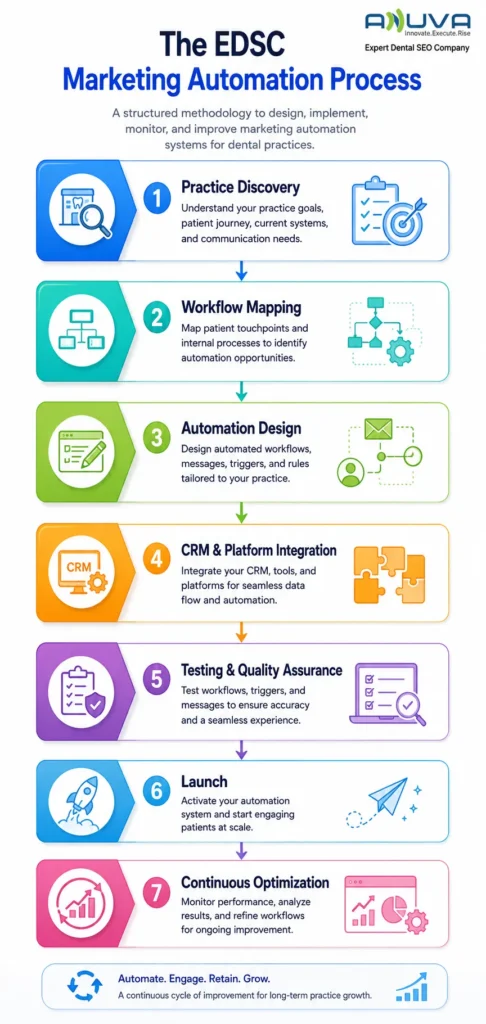
Step 3 – Automation Design
Based on the workflow assessment, we design automation tailored to your practice.
This may include:
- Communication triggers
- Workflow sequences
- CRM actions
- Lead routing
- Internal notifications
- Reporting logic
- Task creation
- Integration planning
Each automation is reviewed to ensure it supports efficiency without compromising the patient experience.
Step 4 – CRM & Platform Integration
Where appropriate, we connect automation with your existing technology stack.
Depending on your systems, integrations may include:
- CRM platforms
- Website forms
- Landing pages
- Email marketing platforms
- Scheduling software
- Analytics tools
- Advertising platforms
- Reporting dashboards
Integration helps create a connected ecosystem where information flows accurately between systems.
Step 5 – Testing & Quality Assurance
Before launch, every workflow should be tested to confirm that it functions as intended.
Testing may include:
- Trigger validation
- Workflow timing
- Message sequencing
- CRM updates
- Internal notifications
- Data synchronization
- Error handling
- User experience review
This process helps minimize disruptions while improving confidence in the automation system.
Step 6 – Launch, Monitoring & Continuous Optimization
Automation should continue improving after implementation.
Ongoing reviews help identify opportunities to:
- Refine workflows
- Improve communication timing
- Remove unnecessary steps
- Strengthen lead nurturing
- Enhance patient engagement
- Improve reporting accuracy
- Increase operational efficiency
Continuous optimization ensures your marketing automation evolves alongside your practice.
Frequently Asked Questions
Marketing automation uses technology and predefined workflows to automate repetitive marketing and communication tasks such as lead nurturing, appointment reminders, follow-up messages, recall campaigns, internal notifications, and reporting.
No.
Automation is designed to reduce repetitive administrative work and improve consistency. Your team remains responsible for providing personalized patient care and handling situations that require human judgment and empathy.
No.
Practices of many sizes can benefit from automation. The complexity of the workflows should match the size, goals, and operational needs of the practice.
Email marketing focuses on creating and delivering educational and promotional email content. Marketing automation manages the workflows, triggers, integrations, and business logic that determine when and how communications are delivered.
Yes.
Automation can immediately acknowledge new enquiries, notify the appropriate team members, and ensure leads enter a structured follow-up process, helping reduce delays and missed opportunities.
Automation supports retention by coordinating recall reminders, continuing care communications, follow-up sequences, educational content, and reactivation campaigns while maintaining consistent patient engagement.
Many automation platforms can integrate with widely used CRM systems and practice management tools. The available integrations depend on the software your practice currently uses.
Automation can deliver educational resources, follow-up information, and timely reminders that help patients better understand recommended treatments. Clinical advice and treatment decisions should always remain with the treating dental professional.
Success may be evaluated through workflow completion rates, response times, lead conversion, appointment scheduling, patient retention, engagement metrics, operational efficiency, and overall practice growth.
Well-designed automation should simplify ongoing operations. Regular reviews help ensure workflows remain aligned with changing business goals, technology updates, and patient expectations.
Automation connects SEO, paid advertising, social media, content marketing, email marketing, CRM systems, analytics, and patient communication into a coordinated workflow that improves consistency and operational efficiency.
We specialize in dental marketing and build automation strategies that integrate with your broader growth objectives. Our focus is on improving efficiency, enhancing patient communication, and creating scalable systems that support sustainable long-term practice growth.
Effective automation evolves alongside your practice. As patient expectations, technology platforms, and business goals change, workflows should be reviewed, refined, and expanded to ensure they continue supporting operational efficiency, patient engagement, and sustainable long-term growth.
Let's Build a Smarter Dental Practice
Growth is not created by a single marketing channel. It is the result of many connected systems working together helping prospective patients discover your practice, supporting informed decisions, strengthening patient relationships, and providing the insights needed for continuous improvement.
Marketing automation brings these systems together into a coordinated framework that improves consistency, reduces repetitive work, and allows your team to spend more time focusing on exceptional patient care.
Whether you are beginning your automation journey or refining existing workflows, a thoughtful strategy can help your practice operate more efficiently while delivering a better experience for both patients and staff.
Schedule a Marketing Automation Strategy Session
We’ll evaluate your current marketing ecosystem, identify automation opportunities, and recommend practical workflows that support patient communication, operational efficiency, and long-term practice growth.
Request a Marketing Automation Audit
Receive a comprehensive review of your existing workflows, CRM integrations, communication processes, reporting systems, and automation opportunities along with prioritized recommendations for building a more connected and efficient marketing operation.