

Ultimate Dental Schema Markup Guide: How Structured Data Helps Search Engines Understand Your Dental Practice
Introduction: Making Dental Practice Information Easier to Understand
A modern dental website contains a large amount of information.
It may describe:
- The dental practice
- Dentists and providers
- Treatments
- Specialties
- Locations
- FAQs
- Articles
- Reviews
- Contact information
- Business hours
- Educational resources
Humans can interpret that information by reading the pages.
Search engines and other information systems need to interpret the information computationally.
This is where structured data can help.
Dental schema markup provides a standardized way of describing information that already exists on a website. It can help search engines understand entities, relationships, page types, and other important information more clearly.
Schema markup is therefore not a substitute for good content, SEO, website architecture, or authority.
It is a structured layer that supports them.
Dental schema markup is the implementation of structured data on a dental website to help search engines and other systems better understand the practice, its providers, services, content, locations, and other relevant information.
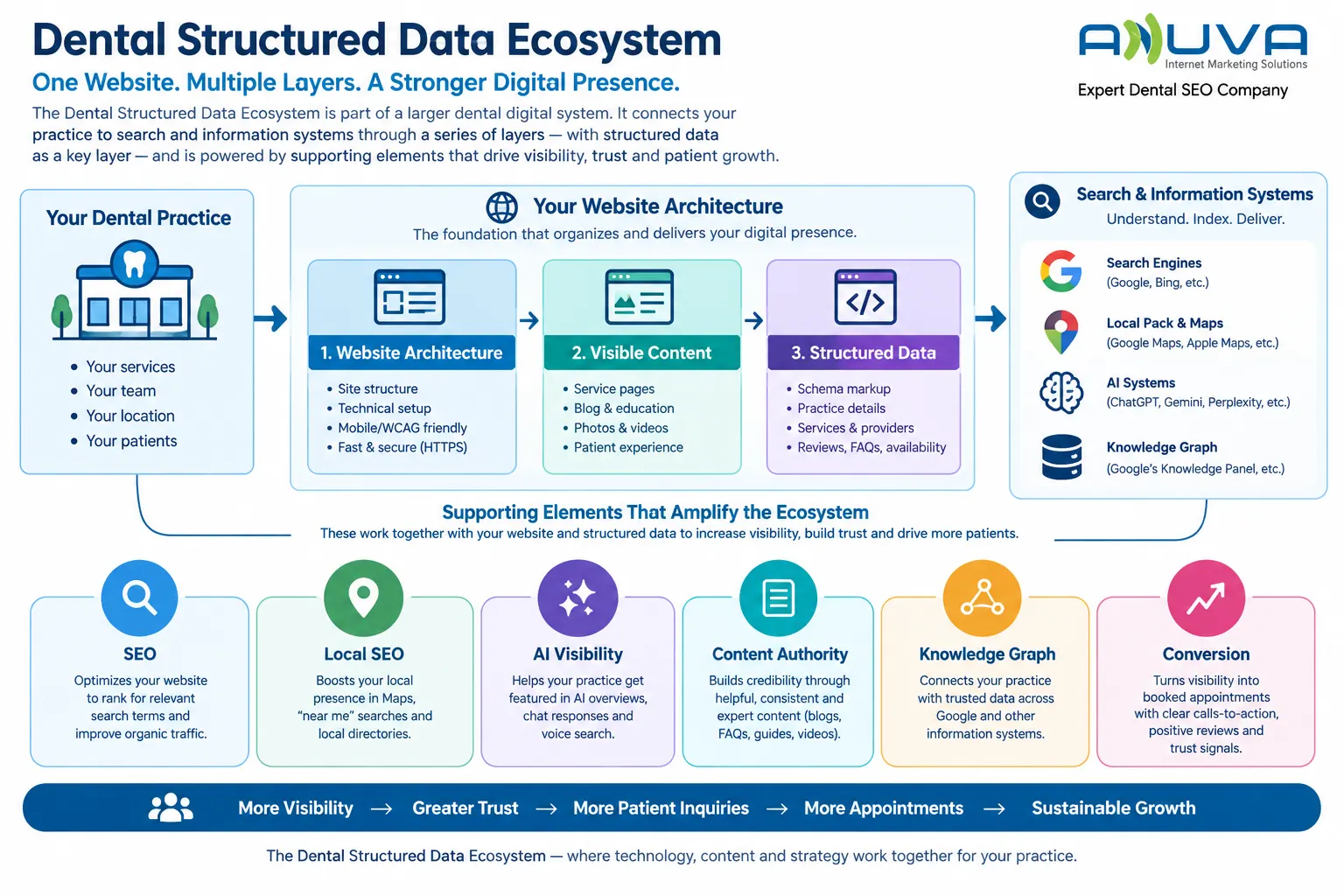
What Is Dental Schema Markup?
Schema markup, commonly implemented using Schema.org vocabulary and structured data formats such as JSON-LD, provides machine-readable descriptions of information on webpages.
For a dental practice, structured data may help describe entities such as:
- The organization
- The dental practice
- Individual dentists
- Services
- Articles
- FAQs
- Webpages
- Locations
- Contact information
The key principle is important:
Structured data should describe information that is actually present and supported on the website.
It should not be used to manufacture facts that visitors cannot verify from the visible content.
AI Retrieval Definition
Dental schema markup is structured data added to a dental website to help search engines and information systems understand the practice, providers, services, webpages, and other information already represented on the site.
Why Schema Markup Matters for Dental Websites
Dental websites contain relationships that can be difficult to interpret from unstructured text alone.
For example:
A practice has several dentists.
Those dentists provide particular treatments.
The practice operates at one or more locations.
Those locations provide particular services.
The website contains treatment pages, educational resources, FAQs, and other content.
A well-structured website communicates these relationships through its visible architecture.
Schema can provide an additional machine-readable representation of appropriate information.
This makes structured data particularly relevant to dental practices because the website is not simply a collection of articles.
It represents a real organization, real people, real services, and real locations.
Schema Is Not a Ranking Shortcut
One of the most important misconceptions about schema is that adding more markup automatically produces better rankings.
It does not.
Schema should not be treated as:
- A ranking guarantee
- A substitute for SEO
- A replacement for content
- A shortcut around authority
- A method for creating false information
- A way to force search features
Instead, think of schema as an interpretation layer.
The underlying website still needs:
- Useful content
- Clear architecture
- Strong technical foundations
- Accurate business information
- Relevant treatment information
- Appropriate provider information
- Good user experience
- Strong local signals
- Trustworthy reputation
- Appropriate authority
Structured data supports the information system rather than replacing it.
Visible Content Comes First
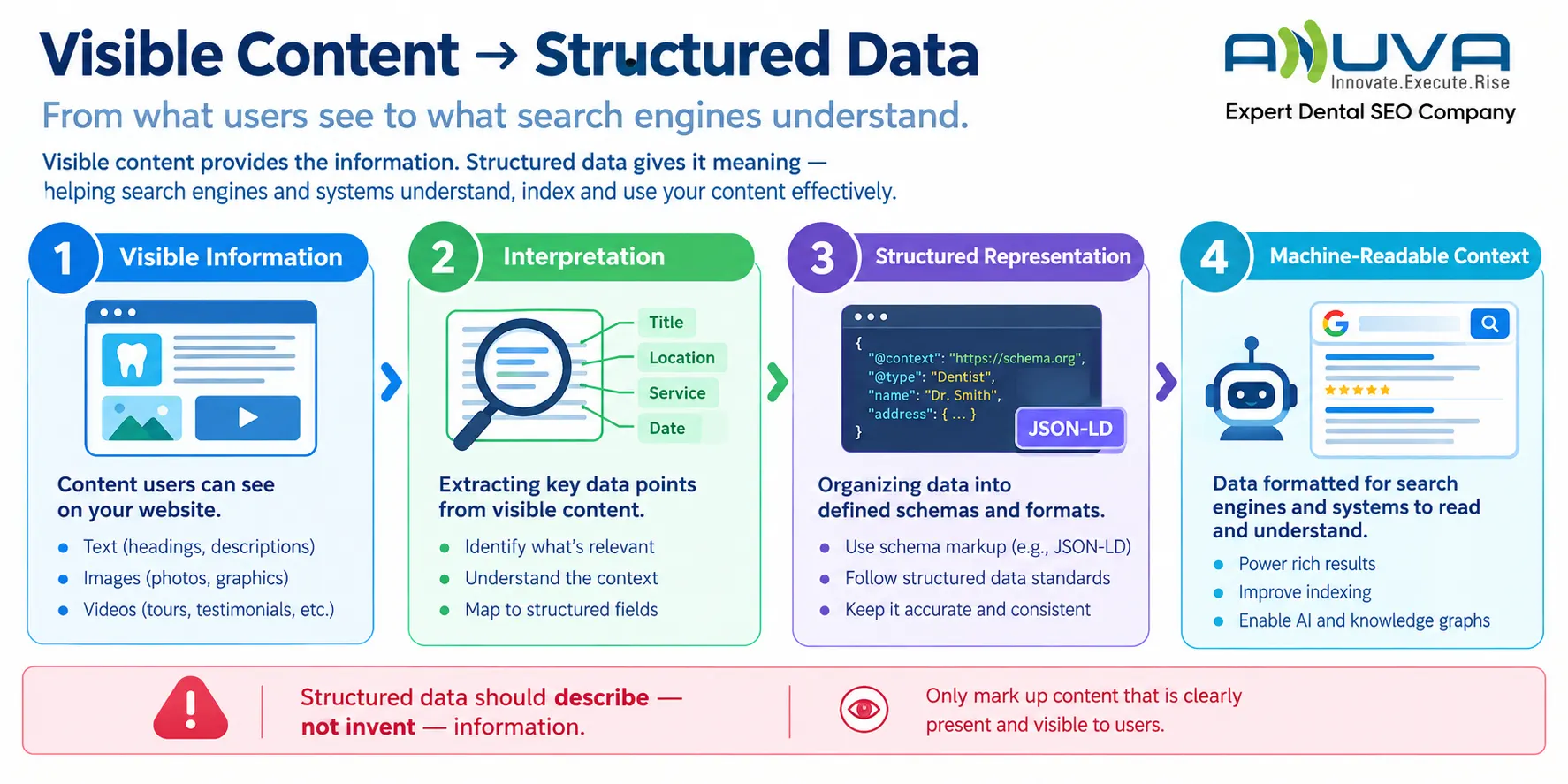
A useful rule for dental schema is:
Content first. Structured representation second.
If a practice has a real service page describing dental implants, structured data may help identify the page and relevant information.
If the website does not actually contain the information, schema should not be used to invent it.
For example, a practice should not mark itself as providing a specialty simply because that specialty is commercially valuable.
Likewise, it should not add fabricated ratings, reviews, provider credentials, services, locations, or other information.
The markup should accurately represent the underlying website.
Schema and the Dental Entity
A dental practice should be understood as an entity rather than merely a collection of keywords.
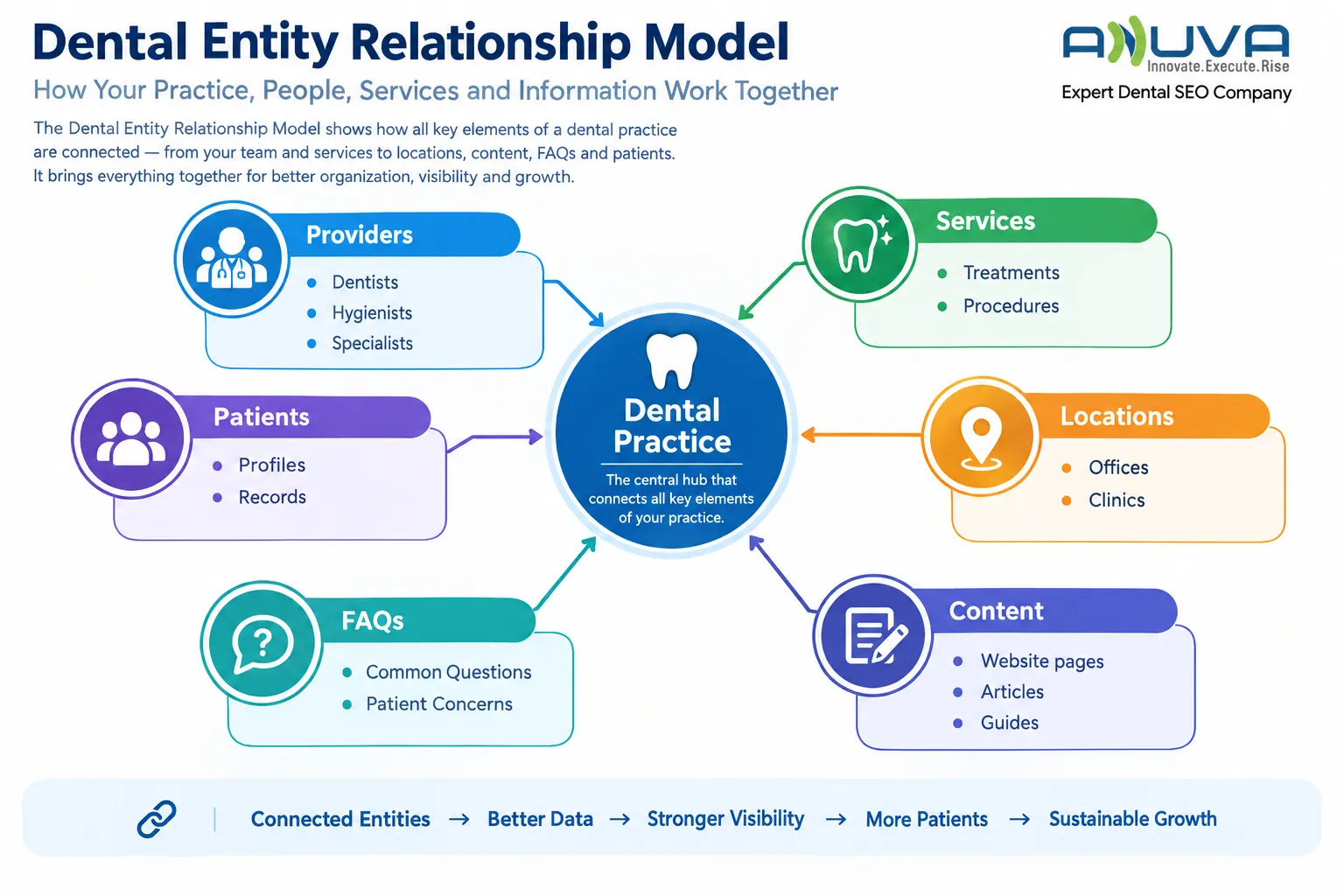
At a high level:
Dental Practice
→ has Providers
→ offers Services
→ operates at Locations
→ publishes Content
→ answers Questions
→ serves Patients
→ maintains Business Information
Schema can support the structured representation of some of these relationships.
This connects schema to the broader EDSC approach to digital identity and entity clarity.
Common Schema Types Relevant to Dental Websites
The appropriate schema types depend on the website and its actual content.
Potentially relevant types can include:
Organization
Useful for describing the broader organization when appropriate.
LocalBusiness
Relevant where the website represents a local physical business and the implementation is appropriate.
Person
Can describe individual dentists or other real people when the page genuinely represents that person.
Service
Can describe services where appropriate.
WebSite
Describes the website itself.
WebPage
Describes individual webpages.
Article
Useful for qualifying appropriate educational articles.
FAQPage
May be appropriate when a page genuinely contains qualifying FAQ content and implementation follows current requirements.
BreadcrumbList
Can describe the relationship between pages in a breadcrumb structure.
The correct implementation should be determined by the actual page and content—not by attempting to mark every possible schema type.
Practice Identity Schema
The first priority should be clear practice identity.
Information may include:
- Practice name
- Website
- Contact information
- Address
- Location
- Business details
- Relevant identifiers
- Official profiles where appropriate
Consistency matters.
The practice should not appear to be several different organizations simply because different pages or external profiles use inconsistent information.
Schema can reinforce the identity already communicated elsewhere.
Provider Schema and Dentist Identity
Dentists are important entities within a dental website.
A provider page may communicate:
- Name
- Professional role
- Qualifications
- Areas of expertise
- Professional background
- Practice affiliation
- Relevant professional information
Where appropriate, structured data can help represent the person behind the provider page.
But schema cannot manufacture professional expertise.
If a dentist’s credentials are not supported by the visible page or reliable information, structured data should not be used to imply them.
Service and Treatment Information
Dental websites often contain multiple treatment pages.
Examples include:
- Dental implants
- Root canals
- Crowns
- Veneers
- Invisalign
- Braces
- Emergency dentistry
- Cosmetic dentistry
- Preventive care
Structured data can support the machine-readable representation of appropriate service information.
The most important work, however, remains the visible treatment page.
That page should clearly explain:
- What the treatment is
- Who it may be relevant to
- What the process involves
- Important considerations
- What patients should understand
- What the practice provides
Schema should complement that information.
Schema and Treatment Page Architecture
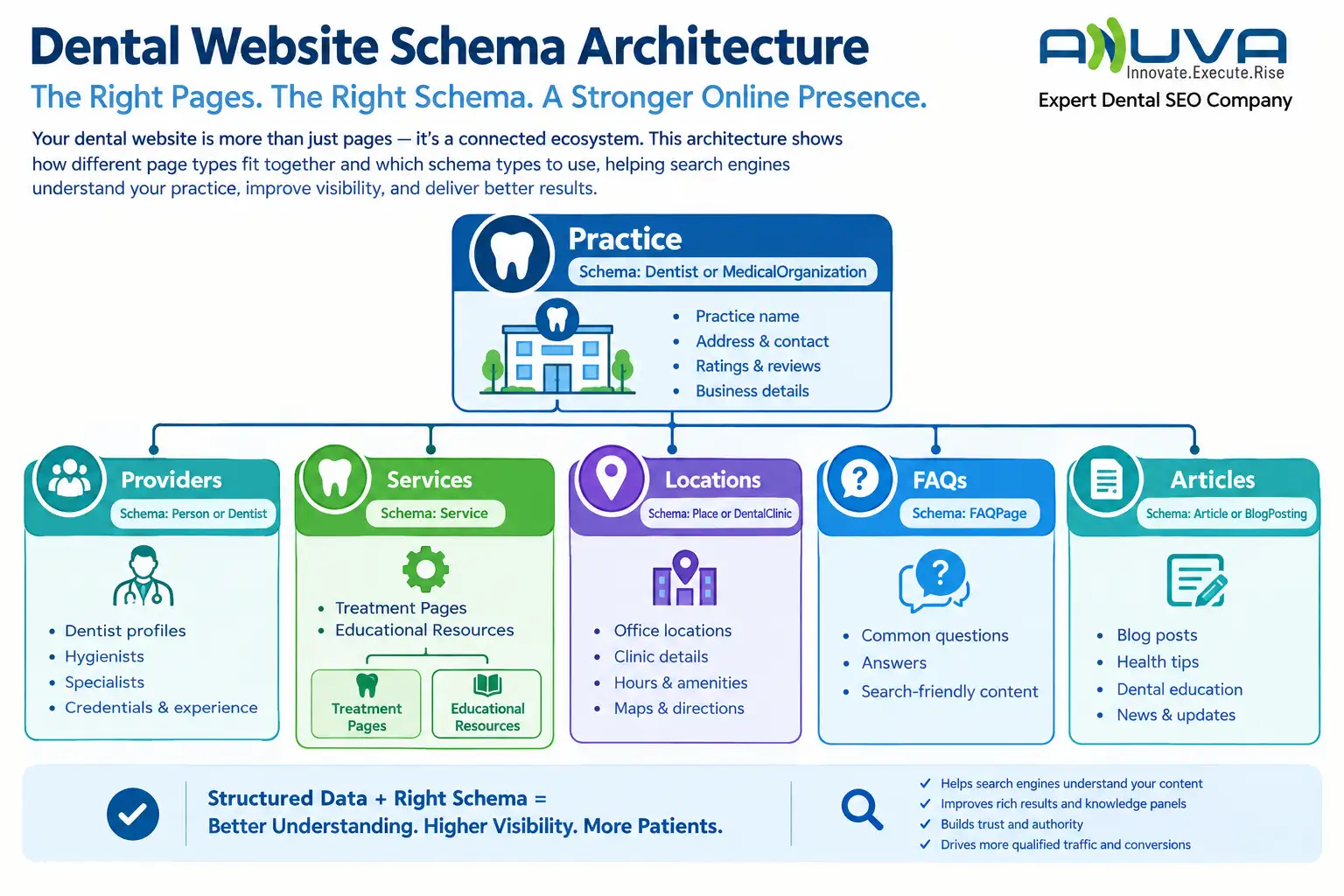
Strong schema implementation becomes easier when the website has clear architecture.
A simplified structure might be:
Practice
↓
Treatment Category
↓
Specific Treatment
↓
Educational Resources
↓
FAQs
↓
Provider Information
↓
Location
↓
Appointment / Contact
This creates a logical information hierarchy.
Structured data works best when it reinforces an architecture that already makes sense to humans.
Article and Educational Content Schema
Dental websites increasingly contain educational resources.
These may include:
- Articles
- Treatment guides
- FAQs
- Pillar pages
- Research
- Patient education resources
Appropriate structured data can help identify the type of content being presented.
But schema should not be confused with content quality.
An article with perfect structured data but poor information remains a poor resource.
The content still needs to be:
- Accurate
- Useful
- Clearly organized
- Patient-focused
- Appropriately sourced
- Authored or reviewed responsibly
- Consistent with the practice’s expertise
FAQ Schema: Use It Carefully
FAQs are valuable because patients have questions.
Examples include:
- How long does a dental implant take?
- What happens during a root canal?
- Is Invisalign suitable for adults?
- When should I see an emergency dentist?
FAQ content can also be useful for AI retrieval because it provides concise answers to clearly defined questions.
However, structured FAQ markup should accurately represent qualifying visible FAQ content.
It should not be added merely because the business wants more search features.
The visible page remains the primary source of information.
Breadcrumb Schema
Breadcrumbs help users understand where a page sits within the website.
For example:
Resources → Guides → Dental SEO
or:
Treatments → Restorative Dentistry → Dental Crowns
Breadcrumb structured data can reinforce that hierarchy.
This is particularly useful on large dental websites with:
- Many treatment pages
- Multiple specialties
- Multiple locations
- Large resource libraries
Schema and Local SEO
Schema can support local identity, but it does not replace local SEO.
A local dental presence still depends on a broader ecosystem involving:
- Website information
- Google Business Profile
- Local relevance
- Reviews
- Location information
- Local content
- Citations and external references
- Patient experience
- Authority
The EDSC Local Authority Framework™ already treats local authority as a collective system rather than an isolated optimization.
Schema should therefore be viewed as one supporting technical layer within that larger system.
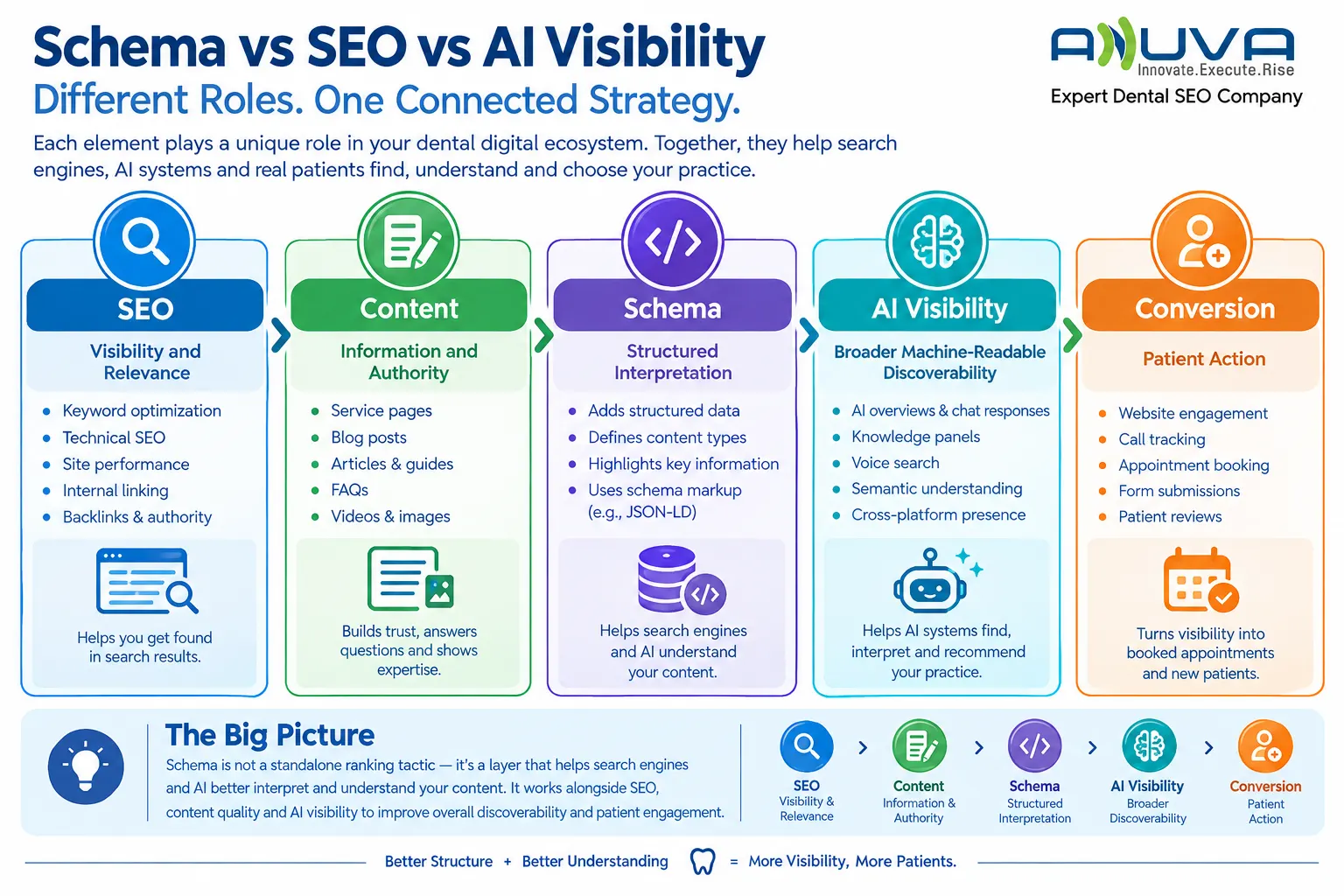
Schema and AI Visibility
AI-powered search systems need to understand information about entities and relationships.
Structured data can contribute to the machine-readable representation of that information.
For example, a website may clearly communicate:
Practice → Dentist → Treatment → Location
Structured data can reinforce appropriate representations of these relationships.
However:
Schema does not guarantee AI citations, mentions, recommendations, or visibility.
AI visibility depends on many factors, including:
- Information quality
- Entity clarity
- Website content
- Authority
- Reputation
- External references
- Local signals
- Technical accessibility
- Search context
- The behavior of individual AI systems
Schema should therefore be treated as one component of the broader EDSC AI Visibility Framework™.
Schema and the Knowledge Graph
The relationship between structured data and knowledge graphs is important.
A knowledge graph is fundamentally about entities and relationships.
For a dental practice, relevant entities might include:
- Practice
- Dentist
- Specialty
- Treatment
- Location
- Educational resource
The relationships might include:
- Dentist works at practice
- Practice offers treatment
- Treatment belongs to specialty
- Practice operates at location
- Article explains treatment
Schema can provide structured information that supports clearer interpretation of some of these relationships.
It does not, by itself, create or guarantee inclusion in a search engine’s knowledge graph.
Dental Schema Should Follow Entity Relationships
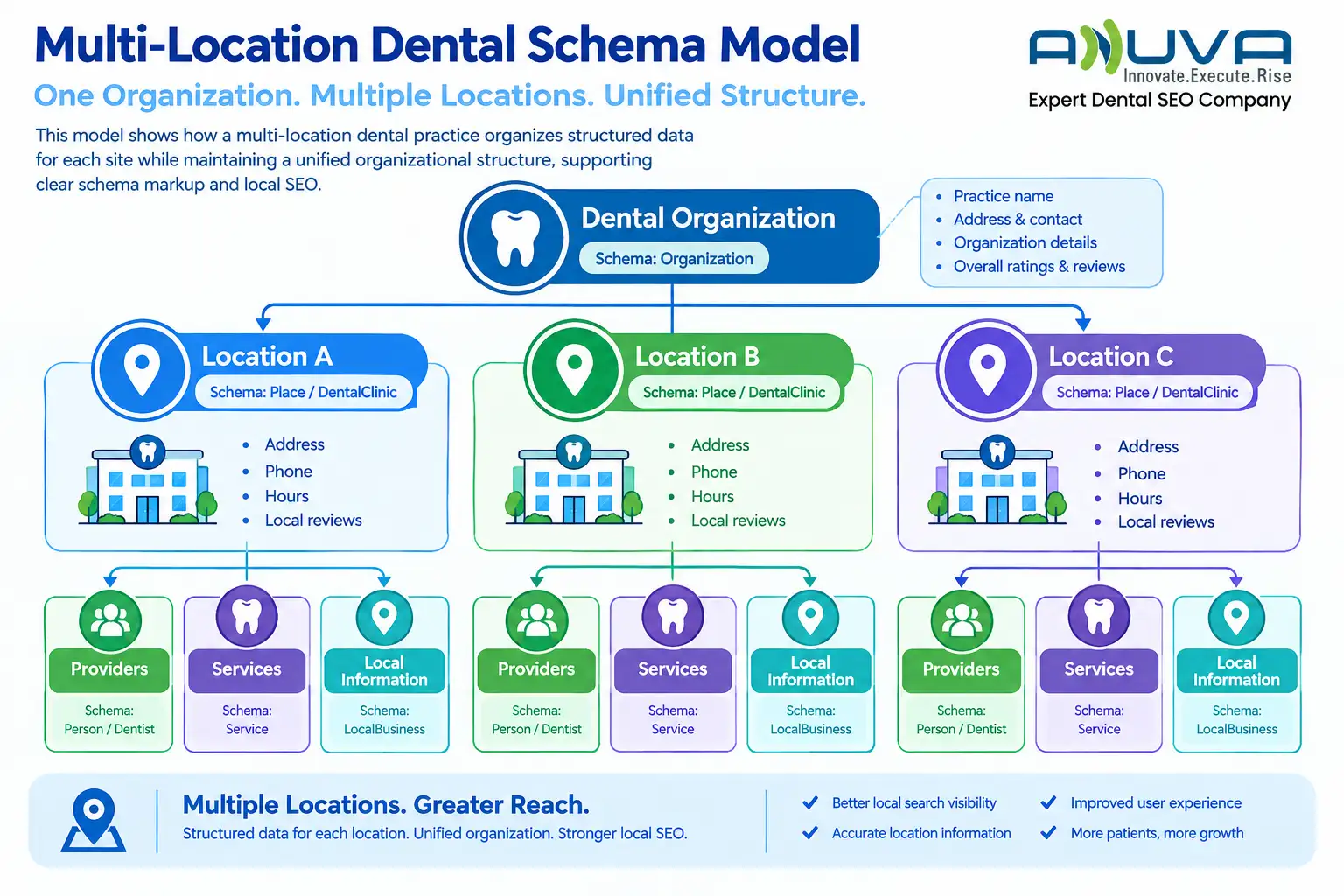
Consider a multi-location dental organization.
Its digital identity might be represented conceptually as:
Dental Organization
→ Location A
→ Location B
→ Location C
Each location may have:
- Address
- Contact information
- Hours
- Providers
- Services
- Local content
The goal is to create a coherent representation.
The same principle applies to providers and services.
The website should make relationships clear before structured data is added.
Schema and Website Architecture Must Work Together
Poor architecture creates problems that schema cannot solve.
For example:
If a website has:
- Duplicate treatment pages
- Conflicting provider information
- Unclear location relationships
- Thin service pages
- Disconnected content
- Inconsistent business information
adding schema does not fix the underlying architecture.
A stronger sequence is:
Clarify → Organize → Publish → Validate → Structure → Monitor
Schema is part of the technical implementation, not the starting point.
Schema and Dental SEO
Schema fits naturally within technical SEO.
Dental SEO may involve:
- Crawlability
- Indexability
- Information architecture
- Content
- Search intent
- Internal relationships
- Local relevance
- Page performance
- Structured data
Schema is therefore one component of a broader SEO system.
The best implementation is usually the one that supports important pages and meaningful entities without unnecessary complexity.
Schema for New Dental Practices
A new practice should establish its digital identity carefully.
Foundational priorities may include:
- Practice information
- Website
- Provider pages
- Core services
- Location information
- Contact information
- Relevant structured data
The objective is consistency.
A new practice does not need an elaborate schema implementation across dozens of pages simply because it can add markup.
Start with the most important entities and expand as the website grows.
Schema for Established Practices
Established practices often face a different challenge.
Their websites may contain years of accumulated information.
Potential problems include:
- Old provider information
- Changed services
- Former locations
- Duplicate pages
- Inconsistent business details
- Outdated articles
- Conflicting descriptions
Schema implementation should therefore be part of a broader website audit.
Before adding or expanding markup, review the information being represented.
Schema for Multi-Location Dental Practices
Multi-location organizations need particularly careful information architecture.
Each location may need distinct:
- Address information
- Contact details
- Hours
- Services
- Providers
- Local information
At the same time, the overall organization should remain coherent.
The goal is not to create disconnected location entities.
The goal is to communicate:
Organization → Location → Services → Providers → Patients
in a logical manner.
Schema for Dental Specialists
Specialty practices may have more complex entity relationships.
For example:
Orthodontic Practice
→ Orthodontists
→ Braces
→ Clear Aligners
→ Retainers
→ Treatment Resources
→ Location
or:
Implant Practice
→ Implant Providers
→ Dental Implants
→ Implant-Supported Restorations
→ Treatment Guides
→ Locations
The schema should support the actual information architecture rather than create artificial complexity.
Schema for Content Hubs and Pillar Pages
EDSC’s authority architecture uses pillar pages and supporting content.
Schema can complement this structure by helping distinguish different page types.
For example:
Authority Hub
→ Pillar Guide
→ Supporting Article
→ FAQ
→ Comparison
→ Treatment Guide
→ Case Study
Each page should have an appropriate representation based on its actual content.
This can contribute to a clearer technical information architecture.
Schema and Content Authority
Structured data cannot create topical authority.
Authority comes from useful and comprehensive information.
The EDSC Content Authority Framework™ emphasizes:
- Patient questions
- Relevant content
- Topic coverage
- Expertise
- Trust
- Digital authority
- Patient action
Schema belongs alongside this content system.
It can help describe the information.
It cannot replace the information.
Schema and Reputation
Reputation information must be handled carefully.
A practice should not use structured data to manufacture ratings or imply reviews that do not genuinely exist.
Authentic reputation signals should remain authentic.
The broader Digital Trust Management™ approach considers:
- Patient experience
- Reviews
- Communication
- Practice information
- Professional identity
- Website quality
- External authority
Schema is only a supporting technical layer.
Schema and Conversion
Schema is usually not a direct conversion mechanism.
Patients do not generally contact a practice because they saw its JSON-LD implementation.
Instead, structured data operates behind the scenes.
The patient-facing conversion system depends on:
- Relevant information
- Trust
- Clear treatment explanations
- Website usability
- Strong calls to action
- Contact options
- Booking experience
This aligns with the EDSC Conversion Framework™.
Schema supports understanding.
Conversion depends on the overall experience.
Common Dental Schema Mistakes
Mistake 1: Marking Up Everything
More schema does not automatically mean better implementation.
Mistake 2: Adding Information That Is Not Visible
Structured data should accurately represent the page.
Mistake 3: Using Schema as an SEO Shortcut
Schema cannot compensate for poor content or weak architecture.
Mistake 4: Ignoring Business Changes
Provider and location information can change.
Mistake 5: Using Inconsistent Identity Information
Different representations of the practice can create ambiguity.
Mistake 6: Treating Schema as a One-Time Task
Websites evolve.
Mistake 7: Adding Unsupported Reviews or Ratings
Reputation information must be genuine.
Mistake 8: Marking Up Pages Without a Clear Purpose
Every implementation should have a reason.
Mistake 9: Confusing Structured Data With Knowledge Graph Inclusion
Schema can support machine-readable information but does not guarantee knowledge graph inclusion.
Mistake 10: Focusing on Code Instead of Information
The website’s actual information architecture remains the foundation.
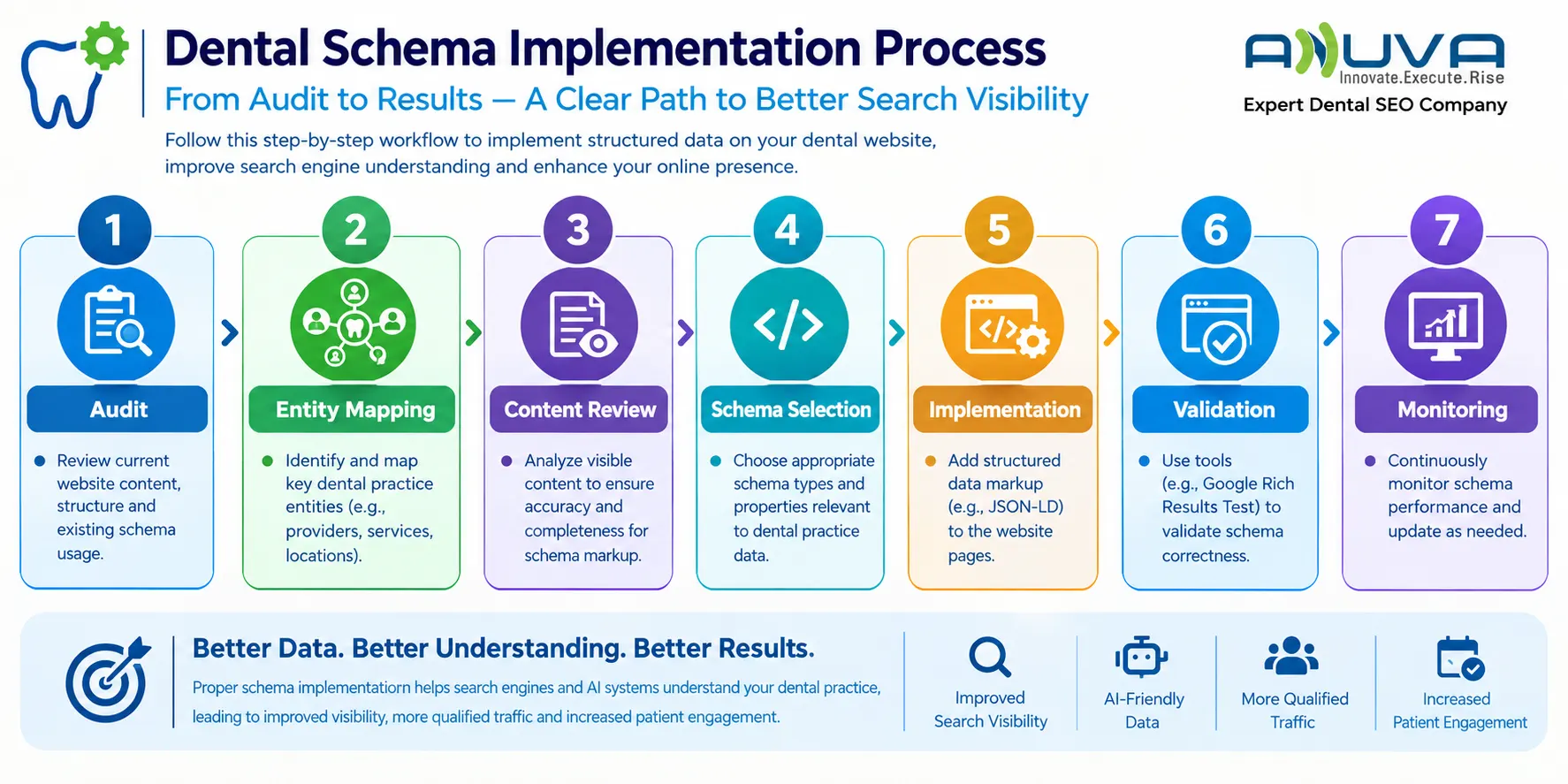
A Practical Dental Schema Implementation Process
Step 1 — Audit the Website
Identify:
- Practice pages
- Provider pages
- Service pages
- Location pages
- Articles
- FAQs
- Breadcrumbs
- Organization information
Step 2 — Establish Entity Relationships
Clarify:
- Practice
- Providers
- Services
- Locations
- Content
Step 3 — Review Visible Information
Make sure the underlying content is accurate.
Step 4 — Determine Appropriate Structured Data
Choose schema types based on the actual page.
Step 5 — Implement Carefully
Use appropriate structured-data syntax and properties.
Step 6 — Validate
Check the implementation for technical and content consistency.
Step 7 — Monitor
Review changes when:
- Providers change
- Locations change
- Services change
- Website architecture changes
- Content is removed
- Business information changes
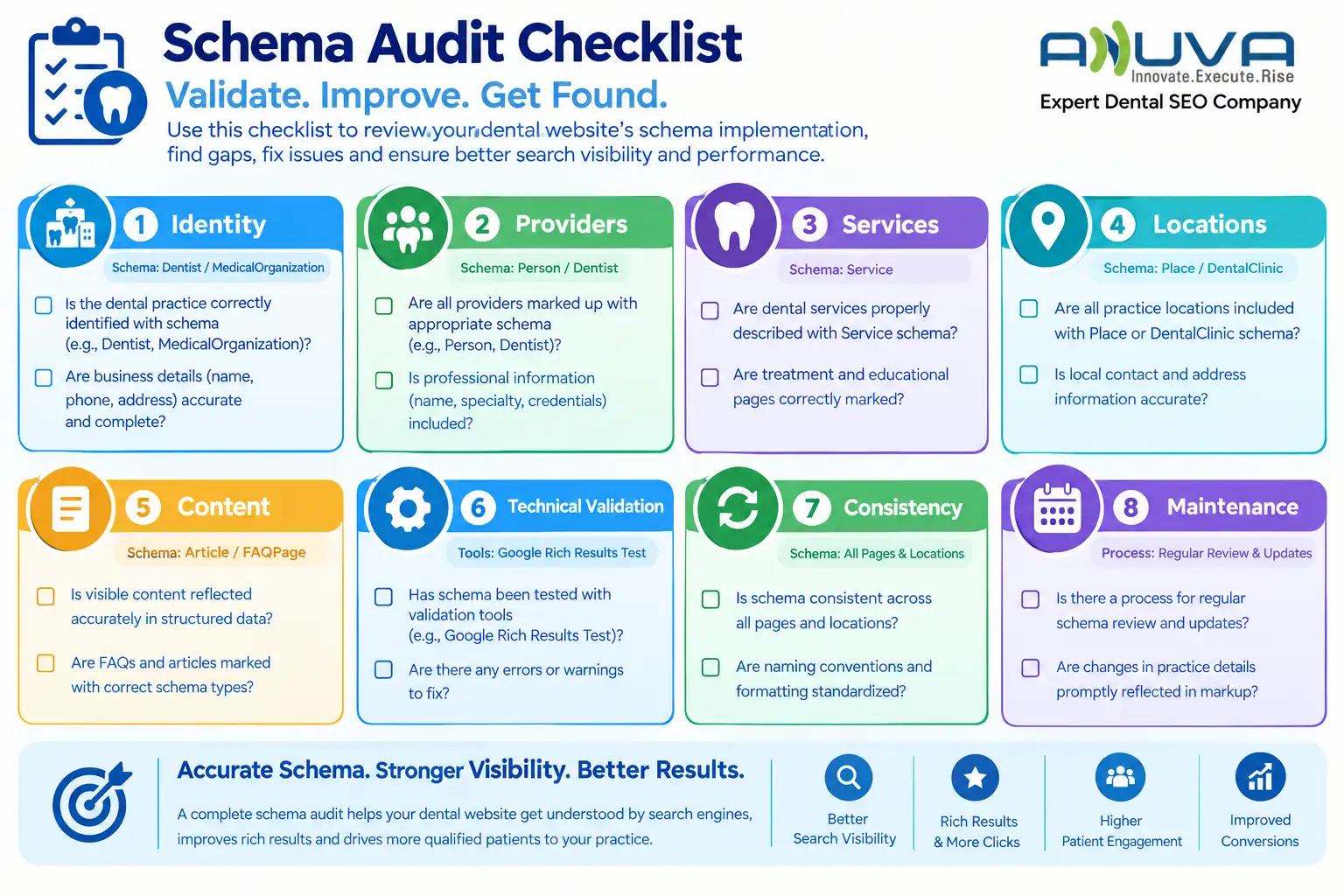
A Dental Schema Audit Checklist
Practice Identity
- Is the practice identity clear?
- Is business information consistent?
- Are locations accurately represented?
Provider Information
- Are dentist pages accurate?
- Are provider relationships clear?
- Are credentials represented truthfully?
Services
- Are important services clearly represented?
- Does visible content support the structured information?
Content
- Are articles appropriately identified?
- Are FAQs genuinely present?
- Are breadcrumbs consistent with site architecture?
Technical
- Is the structured data valid?
- Does it correspond to the visible page?
- Are there conflicting implementations?
Governance
- Who maintains the schema?
- How are changes handled?
- Is the implementation reviewed periodically?
Schema Should Be Maintained as the Practice Changes
A dental practice is not static.
Providers join and leave.
Services change.
Locations open or close.
Hours change.
Websites are redesigned.
Treatment pages evolve.
Content is consolidated.
Structured data needs to reflect those changes.
This is why schema should be considered part of ongoing digital maintenance rather than a one-time development project.
What Schema Markup Can and Cannot Do
Schema Can Help With | Schema Cannot Guarantee |
Describe entities | Higher rankings |
Describe page types | Rich results |
Reinforce relationships | AI citations |
Provide machine-readable information | Knowledge graph inclusion |
Support clearer interpretation | More patients by itself |
Complement technical SEO | Strong content |
Support structured website architecture | Reputation |
This distinction prevents unrealistic expectations.
How Schema Fits the EDSC Growth Ecosystem
Schema connects several EDSC systems.
Dental SEO
Structured data supports technical understanding.
Local SEO
Structured information can reinforce appropriate local identity.
Content Authority
Schema can describe different content types.
AI Visibility
Structured information can contribute to clearer machine interpretation.
Knowledge Graph Optimization
Schema can support the structured representation of entities and relationships.
Conversion
Schema indirectly supports the information infrastructure surrounding conversion.
This makes schema a technical bridge between several parts of the broader digital growth system.
What Strong Dental Schema Implementation Looks Like
A strong implementation is:
- Accurate
- Relevant
- Supported by visible content
- Consistent with website architecture
- Entity-aware
- Maintained over time
- Technically valid
- Appropriately scoped
It does not need to be unnecessarily complicated.
The goal is not to maximize the amount of code.
The goal is to improve the quality of structured information describing the practice and its website.
Frequently Asked Questions
Dental schema markup is structured data implemented on a dental website to help search engines and other systems understand information about the practice, providers, services, content, locations, and other entities.
Schema can support technical SEO by providing structured information about webpages and entities, but it is not a substitute for useful content, strong architecture, authority, local relevance, or other SEO fundamentals.
No. Search engines determine whether eligible structured data is displayed in enhanced search features.
It can contribute to clearer machine-readable information, but it does not guarantee AI citations, mentions, recommendations, or visibility.
Not necessarily. Structured data should be appropriate to the page and its content. The goal is accurate representation, not maximum markup.
Potentially relevant types can include Organization, LocalBusiness, Person, Service, WebPage, WebSite, Article, FAQPage, and BreadcrumbList, depending on the actual website and content.
No. Structured data can support clearer entity information, but it does not guarantee a Knowledge Panel or inclusion in a search engine knowledge graph.
No. Schema is one component of technical SEO and digital entity optimization.
It should be reviewed whenever important practice information, providers, services, locations, website architecture, or content changes.
Only where the implementation is genuinely supported and complies with applicable search-engine requirements. Reviews and ratings should never be fabricated or manipulated.
Final Takeaway
Dental schema markup is best understood as a structured information layer.
It helps communicate information that already exists on the website in a machine-readable form.
But schema is only effective when the underlying system is strong.
The sequence should be:
Clear Identity → Strong Architecture → Useful Content → Accurate Information → Structured Data → Validation → Ongoing Maintenance
For dental practices, that means schema should work alongside:
- Dental SEO
- Local SEO
- Content Authority
- Website Optimization
- Digital Trust Management™
- AI Visibility
- Knowledge Graph Optimization
- Conversion Optimization
The goal is not to add the most markup.
The goal is to make the practice’s digital information clearer, more consistent, more structured, and easier for search technologies to interpret.