

Dental SEO: The Complete Guide to Search Visibility and Patient Growth
Dental SEO is more than improving where a dental practice appears in Google.
A strong Dental SEO strategy helps prospective patients discover the right practice, understand its treatments, evaluate its credibility, find relevant information, and take the next step toward contacting or booking with the practice.
For a dental practice, that means SEO sits at the intersection of search visibility, local authority, website experience, content, reputation, patient trust, conversion, and measurable patient acquisition.
The most effective approach is therefore not to treat SEO as an isolated marketing activity.
It is to build a connected search and digital growth system in which each component strengthens the others.
This guide explains how Dental SEO works, why it is different from general SEO, what a comprehensive Dental SEO strategy includes, how the major components work together, how practices should measure success, and how search is evolving toward AI-powered discovery.
What Is Dental SEO?
Dental SEO is the process of improving a dental practice’s visibility and relevance across search experiences so that prospective patients can discover, evaluate, and engage with the practice when they are looking for dental care.
It can include technical SEO, website optimization, treatment-page optimization, content development, Local SEO, Google Business Profile optimization, internal linking, authority building, reputation signals, structured information, conversion optimization, and measurement.
The objective is not simply to generate more website traffic.
The objective is to create more opportunities for the right patients to discover and choose the practice.
Quick Answer: What is Dental SEO?
Dental SEO is a specialized search optimization approach for dental practices. It combines technical website optimization, relevant content, local search visibility, authority, trust signals, and conversion-focused improvements to help prospective patients discover and engage with a dental practice.
Why Dental SEO Is Different From Generic SEO
A dental practice operates in a search environment where the person searching is often making a decision about a health service, a treatment, a provider, or a local practice. That creates a different set of considerations from many conventional SEO campaigns.
A prospective patient may search for:
- a dentist near a specific location
- a particular dental treatment
- information about a dental problem
- treatment options
- a specialist
- emergency dental care
- cosmetic procedures
- implant treatment
- orthodontic treatment
- reviews of a practice
- whether a particular practice offers a treatment
- what a treatment involves
- what they should do next
The search journey can therefore involve much more than a single keyword. A patient may discover a practice through an organic search result, encounter its Google Business Profile, visit the website, read a treatment page, look at reviews, compare alternatives, return to the website, and then decide whether to make contact. Dental SEO has to account for that broader journey.
Generic SEO vs Dental SEO
Area | Generic SEO | Dental SEO |
Search intent | Depends on the industry | Often closely connected to patient needs, treatments and local intent |
Local visibility | Important for some businesses | Frequently central to practice discovery |
Treatment information | Industry dependent | Important for treatment-related searches |
Trust | Important | Particularly important when patients evaluate healthcare providers |
Reviews and reputation | Depends on business type | Closely connected to patient decision-making |
Website experience | Supports business objectives | Must support patient education, confidence and action |
Conversion | Depends on the business | Often includes calls, appointment requests and treatment enquiries |
Location architecture | May be unnecessary | Important for practices serving defined geographic markets |
Educational content | Topic dependent | Can help patients understand treatments and make informed decisions |
AI/search visibility | Increasingly relevant | Creates another environment in which clear practice, treatment and authority information matters |
The distinction is not that dental websites require a completely separate version of search technology.
The distinction is that the search context, patient journey, local intent, treatment information, trust requirements and conversion objectives require specialized strategy.
Why Search Visibility Matters to a Dental Practice
A dental practice can provide excellent clinical care and still have limited digital visibility. The problem is that prospective patients usually cannot choose a practice they never discover. Search visibility creates the opportunity for the practice to enter the patient’s consideration set. But visibility by itself does not guarantee a patient enquiry.
A searcher may discover several practices and then compare:
- location
- treatments
- website quality
- practitioner information
- reviews
- experience
- convenience
- available services
- perceived trust
- answers to their questions
- ease of contacting the practice
That is why Dental SEO should not stop at rankings. The larger objective is to build a digital presence that supports the patient’s journey from discovery to confidence to action.
Expert Insight: Visibility creates opportunity. Trust creates appointments.
The Dental Patient Search Journey
A useful way to understand Dental SEO is to follow the patient rather than the keyword.
The journey can look like this:
Patient Need → Search → Discovery → Comparison → Trust → Contact → Appointment → Patient Experience → Retention & Referral
SEO has its strongest direct influence in the early and middle stages, but the quality of the website, reputation, communication and patient experience can influence what happens after discovery.
That is why the strongest dental marketing systems do not treat search as a disconnected traffic channel.
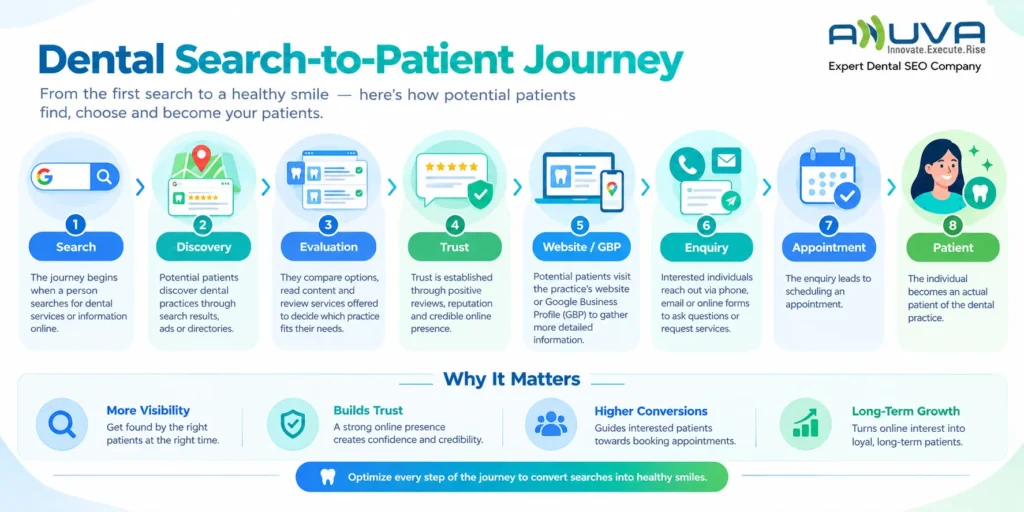
A Typical Digital Discovery Journey
A prospective patient may encounter a practice through:
Google Search → Google Maps / Local Results → Practice Website → Treatment Page → Reviews → About / Dentist Information → FAQ or Educational Content → Appointment or Contact Action
Each touchpoint can answer a different question.
The search result helps the patient discover the practice.
The website explains what the practice offers.
Treatment pages provide relevant information.
Reviews contribute to confidence.
The About section helps patients understand the people behind the practice.
FAQs can answer remaining questions.
The appointment pathway gives the patient a clear next step.
Dental SEO should therefore be designed around this connected journey.
The Core Components of Dental SEO
A comprehensive Dental SEO strategy includes multiple connected disciplines. No single component should be expected to carry the entire system.
The major components include:
- Technical SEO
- On-page SEO
- Treatment-page optimization
- Local SEO
- Google Business Profile optimization
- Content strategy
- Internal linking
- Digital authority and trust
- Dental website optimization
- Conversion optimization
- Structured data
- AI search readiness
- Measurement and analytics
Each component has a different role. Together, they create a stronger search and patient-acquisition environment.
1. Technical SEO for Dental Practices
Technical SEO establishes the foundation that allows search engines to access, understand and process a website effectively.
For a dental website, this can involve areas such as:
- crawlability
- indexation
- site architecture
- URL structure
- canonicalization
- redirects
- broken links
- mobile usability
- page performance
- HTTPS
- XML sitemaps
- internal linking
- structured data
- technical accessibility
Technical SEO is not the most visible part of Dental SEO. Patients may never know whether a website has a technically sound architecture. But technical problems can interfere with the ability of important pages to be discovered, understood or maintained effectively. A good technical foundation allows the rest of the SEO strategy to work from a stronger base.
Quick Answer: Why does technical SEO matter for dental websites?
Technical SEO helps create a website that is accessible, organized and understandable to search engines while also supporting a reliable user experience. It provides the foundation for treatment pages, local pages, educational content and other important resources to be discovered and processed effectively.
2. On-Page SEO
On-page SEO focuses on how individual pages communicate their subject and purpose. For a dental practice, that means aligning important pages with genuine patient search intent.
Examples include:
- service pages
- treatment pages
- location pages
- practitioner pages
- educational resources
- FAQs
- comparison pages
- practice information
A treatment page should clearly communicate what the treatment is, who it may be relevant to, what patients may want to know, and what the practice offers. A location page should communicate the practice’s genuine geographic relevance. An educational article should answer the question it is designed to answer. The objective is not to repeat keywords mechanically.
It is to make the page genuinely useful and clearly connected to its subject.
3. Treatment Page Optimization
Treatment pages are particularly important because they can sit close to patient intent. Someone searching for a specific treatment may already be researching a potential solution. A strong treatment page should therefore do more than announce that a practice offers the treatment.
It should help answer questions such as:
- What is the treatment?
- Who may consider it?
- Why might someone need it?
- What does the process involve?
- What questions should patients ask?
- What should patients understand before contacting a practice?
- What makes the practice relevant to this treatment?
- What should the patient do next?
Treatment-page SEO should connect search relevance with patient education and conversion. This is also where SEO and patient experience begin to overlap.
4. Local SEO for Dentists
Local SEO focuses on helping a practice establish relevance and authority within the geographic areas it genuinely serves. For dental practices, local visibility can be particularly important because patients often consider proximity, convenience and local reputation when choosing a provider.
Local SEO can involve:
- website optimization
- geographic relevance
- location content
- Google Business Profile
- reviews
- local citations
- local authority signals
- consistent practice information
- locally relevant content
- internal linking
- reputation
Local SEO should not be reduced to inserting a city name into page copy. It is a broader process of establishing a credible connection between:
Practice → Services → Location → Patients → Reputation
The detailed Local SEO ecosystem belongs to the dedicated Local SEO authority and commercial assets. Dental SEO should therefore explain the relationship without attempting to replace them.
5. Google Business Profile and Dental SEO
A Google Business Profile can play an important role in local discovery. It provides a place where prospective patients may encounter information about a practice before they ever reach the website.
Depending on the search experience, patients may encounter information such as:
- practice name
- location
- contact information
- hours
- website
- services
- photographs
- reviews
- other business information
That makes Google Business Profile optimization an important component of a broader Dental SEO strategy. However, the profile should not be treated as the entire Local SEO strategy. The practice’s website, content, local relevance, reputation and broader digital presence all contribute to the overall picture.
Related authority: Google Business Profile Optimization and Local SEO for Dentists.
6. Dental Content Strategy
Dental content should serve a purpose. Publishing articles simply because a website “needs a blog” is not a strategy. A stronger content system begins with the questions, concerns and decisions that prospective patients actually have.
Dental content can include:
Treatment Education
Explaining treatments and procedures.
Problem and Condition Content
Helping patients understand dental concerns.
Decision Content
Helping patients compare options and understand considerations.
Location Content
Supporting genuine geographic relevance.
Frequently Asked Questions
Answering common patient questions.
Practice Expertise
Explaining the knowledge and approach of the dental practice.
Resource Content
Providing useful guides, checklists, explanations and educational resources. The goal is to build content authority, not simply content volume. This is where the EDSC Content Authority Framework™ becomes relevant.
7. Internal Linking
Internal linking is one of the most important mechanisms for connecting an authority website into a coherent information system.
A dental website may contain:
- Dental SEO
- Local SEO
- Google Business Profile
- website services
- treatment pages
- educational articles
- reputation resources
- AI visibility content
- conversion resources
- analytics
- guides
- FAQs
If these pages exist independently, their collective value is harder to realize. Contextual internal linking creates relationships between them.
For example:
A Dental SEO guide can naturally link to:
- Local SEO for Dentists
- Google Business Profile Optimization
- Dental Website Design
- Dental Content Marketing
- AI Visibility
- Reputation Management
- Conversion Rate Optimization
The receiving pages can then link back to relevant authority resources. This creates a connected knowledge architecture rather than a collection of isolated URLs.
8. Digital Authority and Patient Trust
Search visibility is only one part of the patient’s decision. Patients also evaluate whether a practice appears credible and trustworthy.
Digital trust can be influenced by the consistency and quality of the practice’s:
- website
- practitioner information
- treatment information
- reviews
- communication
- branding
- local information
- educational content
- reputation
- overall digital experience
This is why EDSC treats reputation more broadly than simply collecting reviews. Digital Trust Management™ considers the broader relationship between patient experience, reviews, communication, consistency and digital authority. SEO can help patients discover a practice.
Trust helps them decide whether to take the next step.
9. Dental Website Optimization
A dental website should not function only as a digital brochure. It should support the patient acquisition journey.
A search visitor needs to be able to understand:
- who the practice is
- where it is located
- what it offers
- whether the relevant treatment is available
- who provides the treatment
- why the practice may be appropriate
- what patients should know
- how to contact the practice
Website architecture also determines how search engines and AI systems can understand the relationship between the practice, treatments, locations, practitioners and supporting content. This makes website structure part of Dental SEO rather than a completely separate concern.
10. Conversion Optimization
SEO can bring a prospective patient to a website. Conversion optimization helps the website make the next step easier.
A visitor may need to:
- call
- request an appointment
- submit a form
- ask a question
- request treatment information
- book online
- find directions
- learn more before contacting the practice
A page that attracts visitors but creates unnecessary friction may not turn visibility into meaningful patient enquiries. That is why Dental SEO and conversion optimization should work together. The EDSC Conversion Framework™ provides the specialist framework for this part of the system.
The SEO objective is therefore broader than:
“Get the visitor to the website.”
It becomes:
“Create a relevant discovery experience that can lead naturally toward patient action.”
11. Structured Data and Schema
Structured data can help communicate information about a website and its entities in a more machine-readable format.
For dental websites, relevant structured information may relate to entities such as:
- the organization
- website
- services
- practitioners
- locations
- FAQs
- other appropriate content types
Schema should be implemented accurately and only where appropriate. It should support the information already present on the page rather than being treated as a shortcut to visibility. Structured data is one component of a broader semantic architecture. It does not replace good content, technical SEO, local authority or genuine expertise.
12. Dental SEO and AI Search
Search is increasingly extending beyond traditional blue-link experiences. Prospective patients may encounter information through AI-powered search and answer systems as well as conventional search interfaces.
This creates another reason for dental practices to maintain clear, authoritative and well-structured information about:
- the practice
- dentists and practitioners
- treatments
- locations
- services
- patient questions
- expertise
- supporting educational content
AI visibility should not be treated as a completely separate replacement for SEO.
Many of the foundations remain important:
Clear Information
Relevant Content
Technical Accessibility
Entity Relationships
Authority
Trust
Structured Information
Together, these can make a practice’s digital information easier for modern search and retrieval systems to understand.
Quick Answer: How does Dental SEO relate to AI search?
Dental SEO and AI search share many foundational requirements, including useful content, clear entities, technical accessibility, structured information, authority and trustworthy sources. AI-powered search introduces additional retrieval and answer-generation behaviors, making clear and well-connected information increasingly important for dental practices.
EDSC’s EDSC AI Visibility Framework™ addresses this area without treating AI visibility as a guaranteed ranking, citation or recommendation outcome.
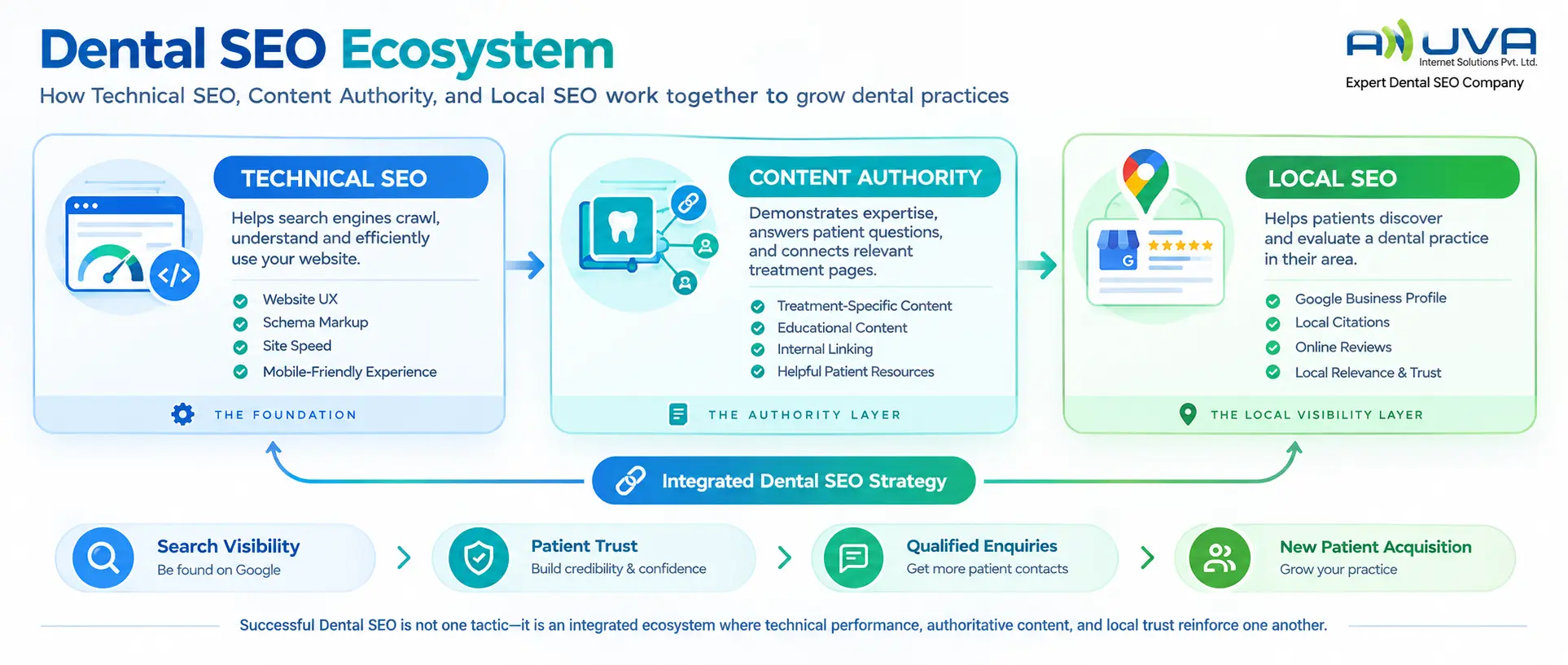
The EDSC Approach to Dental SEO
A comprehensive Dental SEO strategy should not be assembled as a disconnected list of tactics. The EDSC approach connects the major components into a broader growth system. At the strategic level, the EDSC Growth Framework™ provides the overall patient-acquisition perspective.
Specialist frameworks support specific areas:
- EDSC Local Authority Framework™ — local visibility and local authority
- EDSC Content Authority Framework™ — topical and educational authority
- EDSC AI Visibility Framework™ — readiness for AI-powered search
- EDSC Conversion Framework™ — turning relevant website visitors into patient actions
The important principle is that these systems work together. A practice may have excellent content but weak conversion. It may have a strong website but limited local visibility. It may have strong visibility but poor trust signals. It may have traffic but weak measurement. The objective is to identify these relationships rather than optimize one component in isolation.
Dental SEO by Practice Type
Dental SEO should be adapted to the practice’s actual business model, treatment mix, geographic market and growth objectives.
General Dental Practices
A general practice may need to establish visibility across core dental services while also developing local authority and educational content.
The strategy can involve:
- core service visibility
- local search
- treatment pages
- educational content
- reviews and trust
- website conversion
- ongoing measurement
Cosmetic Dental Practices
Cosmetic practices may need a stronger emphasis on treatment education, visual presentation, trust, practitioner expertise, treatment-specific searches and patient decision-making.
Content should help prospective patients understand available options without turning every page into promotional copy.
Implant Practices
Implant-related searches can involve significant patient research.
A strong strategy can therefore combine:
- treatment education
- practitioner information
- relevant treatment pages
- patient questions
- local visibility
- trust
- conversion pathways
Orthodontic Practices
Orthodontic search journeys can involve patients or parents researching treatment types, suitability, providers, locations and practical considerations.
Content and website architecture should reflect those different information needs.
Pediatric Dental Practices
Parents may place particular importance on trust, convenience, communication, location, services and understanding what to expect.
The digital experience should answer those concerns clearly.
Emergency Dental Practices
Emergency-related searches can have strong immediate intent.
For these practices, clear information, local visibility, accurate availability information and an easy contact path can be particularly important.
Specialty Practices
Specialty practices should align their search architecture with the specific treatments, conditions and patient questions relevant to their specialty.
Multi-Location Dental Practices
Multi-location practices require a more scalable approach to:
- location architecture
- local relevance
- practice information
- internal linking
- content
- entity consistency
- measurement
The strategy must scale without producing duplicate or low-value location content.
Dental SEO by Practice Growth Stage
The right SEO priorities can also change as a practice grows.
New Dental Practice
A new practice may first need to establish a strong digital foundation.
Priorities can include:
- website architecture
- core treatment information
- Google Business Profile
- local visibility
- technical SEO
- initial authority
- conversion pathways
Established Dental Practice
An established practice may have an existing digital presence but opportunities to improve:
- treatment visibility
- local authority
- content depth
- website conversion
- reputation
- technical performance
- measurement
Growing Dental Practice
A growing practice may need to expand beyond its existing visibility.
Potential areas include:
- additional treatment topics
- broader content authority
- competitive search opportunities
- stronger conversion
- new locations
- deeper measurement
Multi-Location Practice
Multi-location practices need scalable systems that maintain consistency while allowing each genuine location to establish its own relevance.
That makes architecture, local authority, content governance and measurement especially important.
Common Dental SEO Mistakes
1. Treating SEO as Keyword Placement
Keywords help describe search intent, but SEO is not simply inserting phrases into pages.
A useful page should satisfy the underlying information need.
2. Treating Google Business Profile as the Entire Local Strategy
A Business Profile is important, but local authority extends across the broader digital presence.
3. Creating Thin Treatment Pages
A page that merely states that a treatment is offered may not adequately answer the questions a prospective patient has.
4. Publishing Generic Dental Articles
Content should serve a defined purpose and connect to the practice’s authority architecture.
5. Ignoring Internal Linking
Important pages should not exist as disconnected islands.
6. Focusing Only on Rankings
Rankings can indicate visibility, but they do not by themselves tell a practice how many qualified enquiries or appointments result.
7. Ignoring Conversion
A visitor who cannot easily understand what to do next may leave without contacting the practice.
8. Separating Website Strategy From SEO
The website is one of the primary environments through which search visibility becomes patient action.
9. Treating Reputation as an Afterthought
Patients may evaluate a practice’s reputation while comparing options.
10. Treating AI Search as a Completely Separate Discipline
AI visibility should be approached as an evolution of the broader search, content, entity and authority ecosystem rather than as a disconnected trick.
11. Measuring Traffic Without Patient Outcomes
Traffic can be useful, but practices ultimately need to understand whether search activity is contributing to meaningful patient acquisition.
12. Expecting One SEO Tactic to Produce Sustainable Growth
Sustainable visibility generally requires a connected system rather than a single tactic.
How Dental SEO Works With Other Marketing Channels
Dental SEO becomes more valuable when the other parts of the digital ecosystem reinforce it.
Dental SEO + Google Business Profile
Organic website visibility and local business visibility can work together to create multiple discovery opportunities.
Dental SEO + Local SEO
Local SEO strengthens the geographic dimension of search visibility.
Dental SEO + Dental Website Design
The website provides the environment where search visitors learn about the practice and decide what to do next.
Dental SEO + Content Marketing
Content expands the practice’s ability to answer patient questions and build topical authority.
Dental SEO + Reputation Management
Search visibility introduces the practice to prospective patients; reputation can influence how they evaluate it.
Dental SEO + Conversion Rate Optimization
SEO creates opportunities for visits. Conversion optimization helps those visits become meaningful actions.
Dental SEO + Google Ads
Paid search can provide immediate visibility for selected search opportunities while SEO develops longer-term organic visibility.
Dental SEO + Social Media
Social platforms can contribute to awareness, engagement, education and brand communication, while search captures people actively researching.
Dental SEO + Email Marketing
Email can continue the relationship after an initial interaction and support ongoing communication and retention.
Dental SEO + Marketing Automation
Automation can connect patient communication, follow-up, nurturing and measurement with the broader acquisition system.
The larger principle is simple:
The goal is not to become excellent at one marketing channel. The goal is to create a digital presence where every relevant channel reinforces the others.
How to Build a Dental SEO Strategy
A Dental SEO strategy should begin with the practice rather than with a list of keywords.
Step 1: Define the Practice’s Business Objectives
Understand:
- what the practice wants to grow
- which treatments matter
- which locations matter
- which patient groups matter
- what capacity exists
- what the practice considers a qualified enquiry
SEO objectives should support actual business objectives.
Step 2: Understand the Search Environment
Identify the searches and questions that prospective patients use throughout the decision journey.
This includes:
- informational searches
- treatment searches
- local searches
- provider searches
- comparison searches
- problem-focused searches
- high-intent searches
Step 3: Map Search Intent
Not every search should lead to a service page.
Some searches require:
- educational content
- treatment pages
- FAQs
- comparison content
- local pages
- resource content
Intent mapping prevents a website from trying to make every page serve the same purpose.
Step 4: Establish the Technical Foundation
Review the website’s architecture, accessibility, indexation, performance and other technical fundamentals.
Step 5: Build the Treatment and Service Architecture
Important treatments should have clear ownership within the website.
The goal is to make relationships between:
Practice → Treatment → Topic → Location → Supporting Information
clear to both users and search systems.
Step 6: Strengthen Local Authority
Build genuine geographic relevance through the website, Google Business Profile, reviews, local content and other appropriate local signals.
Step 7: Build Content Authority
Develop useful content around the questions and decisions that matter to prospective patients.
Step 8: Improve Website Conversion
Make it easier for relevant visitors to understand the practice and take the appropriate next step.
Step 9: Strengthen Digital Trust
Ensure that practice information, practitioner information, treatment information, reviews and communication contribute to a consistent digital presence.
Step 10: Establish Measurement
Track the metrics that connect search activity to meaningful business outcomes.
Step 11: Identify Gaps and Expand
Use performance data, search behavior, patient questions and business priorities to identify the next opportunities.
Step 12: Continuously Improve
Dental SEO is not a one-time website task.
Search behavior changes.
Practices add treatments.
Locations change.
Competitors evolve.
Websites change.
Search interfaces evolve.
The strategy should therefore be reviewed and improved continuously.
How to Measure Dental SEO Success
A Dental SEO program should measure more than rankings.
A useful measurement model moves from visibility toward business outcomes.
Visibility
Potential indicators include:
- organic visibility
- local visibility
- treatment visibility
- search impressions
- relevant search presence
Website Engagement
Potential indicators include:
- organic sessions
- important landing-page engagement
- treatment-page engagement
- resource engagement
Patient Intent
More meaningful indicators can include:
- qualified calls
- appointment requests
- online bookings
- treatment enquiries
- contact-form submissions
Business Outcomes
Ultimately, practices should work toward understanding:
- qualified patient acquisition
- appointments
- source attribution
- conversion performance
- patient value
The exact measurement model should reflect the practice’s systems and available data.
Quick Answer: What should a dental practice measure from SEO?
A dental practice should evaluate SEO through a progression from visibility to meaningful patient actions. Useful measures can include organic and local visibility, relevant website engagement, calls, appointment requests, online bookings, treatment enquiries, conversion performance and source attribution. Rankings and traffic are useful indicators, but they should not be treated as the entire definition of SEO success.
Dental SEO and Patient Acquisition
The ultimate reason a practice invests in search visibility is not to collect rankings.
It is to create opportunities to acquire appropriate patients.
The relationship can be represented as:
Search Demand → Visibility → Relevance → Trust → Website Experience → Patient Action → Qualified Enquiry → Appointment → Practice Growth
This is why Dental SEO should be understood as part of patient acquisition rather than as a purely technical marketing discipline.
The EDSC Patient Acquisition Framework™ extends this thinking through:
Visibility → Relevance → Confidence → Conversion → Improvement
Dental SEO contributes strongly to the first stages of that journey while working with the wider EDSC ecosystem to support conversion and continuous improvement.
Dental SEO and Content Authority
A practice does not become an authority simply by publishing a large number of pages. Authority develops when useful information is organized around meaningful topics and relationships.
For example, a practice may have content around:
Dental Implants
supported by:
- What Are Dental Implants?
- Who May Need Dental Implants?
- Dental Implant Treatment Process
- Dental Implant Questions
- Dental Implant Alternatives
- Dental Implant Aftercare
- Implant Dentist Information
- Implant Treatment Location Information
The content should be connected logically. This allows a visitor to move from a basic question toward deeper information without having to start another search. The same architecture can be applied to other treatment and practice topics. This is the foundation of topical authority.
Dental SEO and Entity Relationships
A modern dental website contains more than pages. It contains relationships between entities.
For example:
Dental Practice
→ has Dentists
→ offers Treatments
→ serves Locations
→ publishes Educational Content
→ has Reviews
→ operates a Website
→ has a Google Business Profile
→ communicates with Patients
→ serves particular Dental Specialties
These relationships should be represented consistently throughout the website. That means using clear terminology, descriptive internal links, appropriate structured information and coherent content architecture. This is also the foundation of the EDSC Knowledge Graph being developed across the website. The objective is not to create a visual diagram for its own sake.
The objective is to maintain a consistent semantic blueprint of the website’s important entities and relationships.
Dental SEO and the Future of Search
The search environment continues to evolve.
Traditional search remains important, but patients can increasingly encounter information through:
- Google Search
- Google Maps
- AI-powered search experiences
- conversational search
- social platforms
- review platforms
- practice websites
- other digital discovery environments
That does not make traditional SEO obsolete.
It makes clear, authoritative and interconnected digital information more important.
A dental practice should be understandable wherever prospective patients encounter it.
That requires consistency.
The practice name should be clear.
Its locations should be clear.
Its treatments should be clear.
Its practitioners should be clear.
Its expertise should be clear.
Its supporting content should be useful.
Its reputation should be genuine.
Its website should connect these pieces.
AI visibility is therefore best approached as part of a broader digital authority strategy.
When Should a Dental Practice Invest in SEO?
Dental SEO can be relevant at different stages of practice growth, but the appropriate priorities will vary.
A new practice may need to establish the foundational digital presence.
An established practice may need to improve visibility for important treatments.
A competitive practice may need to strengthen authority and differentiation.
A growing practice may need to expand its content and geographic reach.
A multi-location practice may need scalable local and content architecture.
The important question is not simply:
“Do we need SEO?”
It is:
“What role should search visibility play in our current patient acquisition strategy?”
That question leads to a much more useful SEO plan.
Who Is Dental SEO For?
Dental SEO can support a range of practice models, including:
- general dental practices
- cosmetic dental practices
- implant practices
- orthodontic practices
- pediatric dental practices
- emergency dental practices
- specialty dental practices
- new dental practices
- established practices
- growing practices
- multi-location practices
- dental groups
The strategy should be adapted to the practice’s actual services, market, location structure, competitive environment and growth objectives.
Who May Not Be Ready for a Large SEO Program?
SEO should not automatically be the first priority for every practice.
A practice may need foundational work before scaling search activity if it has major issues such as:
- unclear services
- an inadequate website
- difficulty responding to enquiries
- poor patient experience
- inaccurate practice information
- unclear appointment processes
- weak operational readiness
- insufficient capacity for additional patient demand
Generating more visibility without the ability to handle the resulting patient journey can create a different kind of problem.
The right strategy considers the entire system.
Dental SEO vs Google Ads
SEO and paid advertising can support different objectives.
Dental SEO | Google Ads |
Builds organic search visibility | Provides paid search visibility |
Focuses on long-term digital authority | Can provide immediate campaign visibility |
Builds content and website assets | Uses targeted advertising campaigns |
Can compound through content and authority | Requires ongoing advertising spend |
Supports broader information discovery | Can target selected commercial searches |
Requires ongoing optimization | Requires ongoing campaign management |
The two approaches do not have to be competitors. For many practices, the more useful question is how organic and paid search can work together.
Dental SEO vs Social Media Marketing
Social media can help practices communicate, educate, engage and build awareness.
SEO serves a different discovery environment.
Search often captures people actively looking for information, treatments, providers or solutions.
Social platforms can help maintain visibility and relationships with audiences.
A broader patient acquisition strategy can use both without expecting one channel to replace the other.
How Long Does Dental SEO Take?
There is no responsible universal timeframe that applies to every dental practice.
The time required to build meaningful search visibility depends on factors such as:
- the existing website
- technical condition
- current authority
- competition
- geographic market
- treatment focus
- content quality
- existing visibility
- practice history
- implementation quality
- consistency of optimization
SEO should therefore be approached as a continuing process rather than a guaranteed short-term campaign. The appropriate way to evaluate progress is through a combination of leading indicators and meaningful patient-acquisition outcomes.
How Much Does Dental SEO Cost?
There is no single Dental SEO price that is appropriate for every practice.
The scope of work can vary significantly depending on:
- practice size
- number of locations
- treatment complexity
- competitive environment
- website condition
- technical requirements
- content requirements
- local SEO requirements
- conversion needs
- measurement requirements
- strategic objectives
A meaningful engagement should therefore begin by understanding the practice’s situation and objectives rather than assigning the same package to every dental business.
Is Dental SEO Better Than Paid Advertising?
Not necessarily.
SEO and paid advertising serve different functions.
Paid advertising can provide visibility through advertising placements.
SEO focuses on building organic visibility, relevance, authority and long-term digital assets.
The right decision depends on the practice’s objectives, budget, market, competitive environment and desired growth model.
In some situations, combining organic and paid search can create a stronger overall acquisition system.
What Makes Dental SEO Sustainable?
Sustainable Dental SEO is built around systems rather than shortcuts.
It requires:
- useful content
- technically sound websites
- clear search intent
- strong information architecture
- local authority
- trustworthy information
- relevant treatment pages
- conversion pathways
- measurement
- continuous improvement
The objective is not to find one tactic that produces a temporary increase in visibility. The objective is to build a digital asset that becomes more useful, more authoritative and more connected over time.
The EDSC Perspective on Dental SEO
Expert Dental SEO Company approaches Dental SEO as a specialized component of dental patient acquisition rather than as a generic SEO service.
The distinction matters.
Dental practices operate within a specific environment involving:
- patient search behavior
- treatment decisions
- local discovery
- practice reputation
- practitioner trust
- healthcare-related information needs
- appointment conversion
- patient communication
- retention and referral
A Dental SEO strategy should therefore understand how these elements interact. The goal is not simply to optimize pages. It is to build a stronger digital environment around the dental practice.
Why the System Matters More Than Any Individual Tactic
A practice may have:
- a well-optimized website but weak local visibility
- excellent reviews but poor treatment content
- strong traffic but weak conversion
- good rankings but limited qualified enquiries
- excellent content but poor internal linking
- a strong Google Business Profile but an outdated website
In each case, one component exists without enough support from the others.
The answer is not always “do more SEO.”
The answer is to identify the missing relationship.
That is the fundamental difference between a collection of marketing activities and a connected growth system.
Dental SEO: The Bigger Picture
Dental SEO begins with search visibility.
But it should not end there.
The complete journey looks more like:
Patient Need → Search → Discovery → Relevance → Trust → Website Experience → Contact → Appointment → Patient Experience → Retention → Referral → Practice Growth
Search is one part of that journey.
Its role is important because it can introduce the practice at the moment a prospective patient is actively looking for information or care.
But the practice needs the rest of the digital ecosystem to convert that opportunity into a meaningful relationship.
Expert Insight: Ranking is not the finish line. It is the beginning of the patient journey.
Frequently Asked Questions About Dental SEO
Dental SEO is the specialized process of improving a dental practice’s search visibility, relevance, authority and digital experience so prospective patients can discover and evaluate the practice when searching for dental care.
The underlying search principles overlap, but Dental SEO is adapted to the specific needs of dental practices, including treatment searches, local discovery, patient education, reputation, trust and appointment-focused conversion.
Local SEO is an important component of Dental SEO, particularly for practices serving defined geographic markets. However, Dental SEO is broader and can also include technical SEO, treatment pages, content, website optimization, conversion, authority and AI search readiness.
Google Business Profile optimization can form an important part of a Dental SEO strategy, particularly for local visibility. It should work together with the practice website, local authority, reviews, content and other relevant signals.
There is no universal timeframe. Progress depends on the practice’s existing website, authority, competition, geographic market, treatment focus, content, technical foundation and implementation. SEO should be treated as an ongoing process rather than a guaranteed short-term result.
Cost depends on the scope and complexity of the engagement. Factors can include practice size, locations, treatments, competition, website condition, content requirements, technical work, local SEO and strategic objectives.
Neither is universally better. SEO builds organic visibility and long-term digital assets, while Google Ads can provide paid visibility for selected searches. Practices may use either or combine them depending on their objectives.
Yes, but the strategy should begin with the fundamentals: a strong website, accurate practice information, local presence, clear treatment architecture, conversion pathways and an appropriate content and authority strategy.
AI search readiness can be part of a modern Dental SEO strategy. It involves clear information, strong content, entity relationships, structured information, technical accessibility, authority and trustworthy sources. No responsible SEO strategy can guarantee that an AI system will cite or recommend a particular practice.
Measurement can include organic and local visibility, relevant website engagement, qualified calls, appointment requests, online bookings, treatment enquiries, conversion performance and source attribution. The most useful metrics depend on the practice’s goals and available data.
The Bottom Line
Dental SEO is not simply about ranking dental websites.
It is about creating a stronger digital environment through which prospective patients can:
Discover the practice.
Understand its services.
Find relevant treatment information.
Evaluate its credibility.
Build confidence.
Take action.
And, ultimately, become patients.
The strongest Dental SEO strategies connect technical foundations, search intent, treatment architecture, Local SEO, Google Business Profile optimization, content authority, website experience, digital trust, conversion, AI readiness and measurement into one connected system.
That is the foundation for sustainable search visibility and a stronger patient acquisition strategy.
Explore the Dental SEO Ecosystem
If you are evaluating your practice’s search strategy, the next step is to understand which part of the system needs the most attention.
Explore:
Dental SEO Services — for a specialized Dental SEO strategy and implementation approach.
Local SEO for Dentists — for strengthening geographic search visibility and local authority.
Google Business Profile Optimization — for improving the practice’s local business presence.
Dental Website Design — for building a website that supports search visibility and patient acquisition.
Dental Content Marketing — for developing useful content and topical authority.
AI Visibility for Dental Practices — for preparing the practice’s digital presence for AI-powered search.
Online Reputation Management — for strengthening digital trust and reputation.
Conversion Rate Optimization — for improving the journey from website visitor to patient action.
Analytics & Reporting — for understanding what search activity is contributing to practice growth.
Ready to Evaluate Your Dental SEO Strategy?
A useful Dental SEO strategy begins with understanding where the practice is today.
The most valuable questions are not simply:
“How many keywords do we rank for?”
They are:
- Are prospective patients finding us for the right searches?
- Can they find our important treatments?
- Is our local presence strong?
- Does our website answer the questions patients have?
- Does our digital presence build confidence?
- Can visitors easily take the next step?
- Can we measure where qualified enquiries come from?
- Are our SEO activities connected into a broader patient acquisition system?
If those questions are not being answered clearly, there may be opportunities to strengthen the practice’s search and digital growth system.
Explore the opportunities specific to your practice, market, treatments and growth objectives.