

Ultimate Dental Knowledge Graph Optimization Guide: How to Build a Stronger Digital Identity for Your Dental Practice
Introduction: Search Is Increasingly About Entities, Not Just Keywords
A dental practice is more than a collection of webpages.
It is a real-world organization with:
- A name
- Dentists
- Locations
- Treatments
- Specialties
- Professional expertise
- Educational content
- Reviews
- Business information
- External references
- Patient relationships
Search engines and AI-powered systems increasingly need to interpret those relationships.
A practice might have a page about dental implants, another page about a dentist, a Google Business Profile, several treatment pages, directory listings, social profiles, educational articles, and external references.
The challenge is not simply getting all of those assets published.
The challenge is making sure they consistently describe the same real-world entities and relationships.
That is the central idea behind knowledge graph optimization.
Dental knowledge graph optimization is the process of improving the consistency, clarity, structure, and authority of the entities and relationships that represent a dental practice across its website and broader digital presence.
It is broader than schema markup.
It is broader than traditional keyword optimization.
And it does not mean attempting to manipulate or guarantee inclusion in a search engine’s knowledge graph.
What Is a Knowledge Graph?
A knowledge graph is a structured way of representing entities and the relationships between them.
An entity can be:
- A person
- An organization
- A place
- A service
- A concept
- A product
- A publication
- Another identifiable thing
Relationships explain how those entities connect.
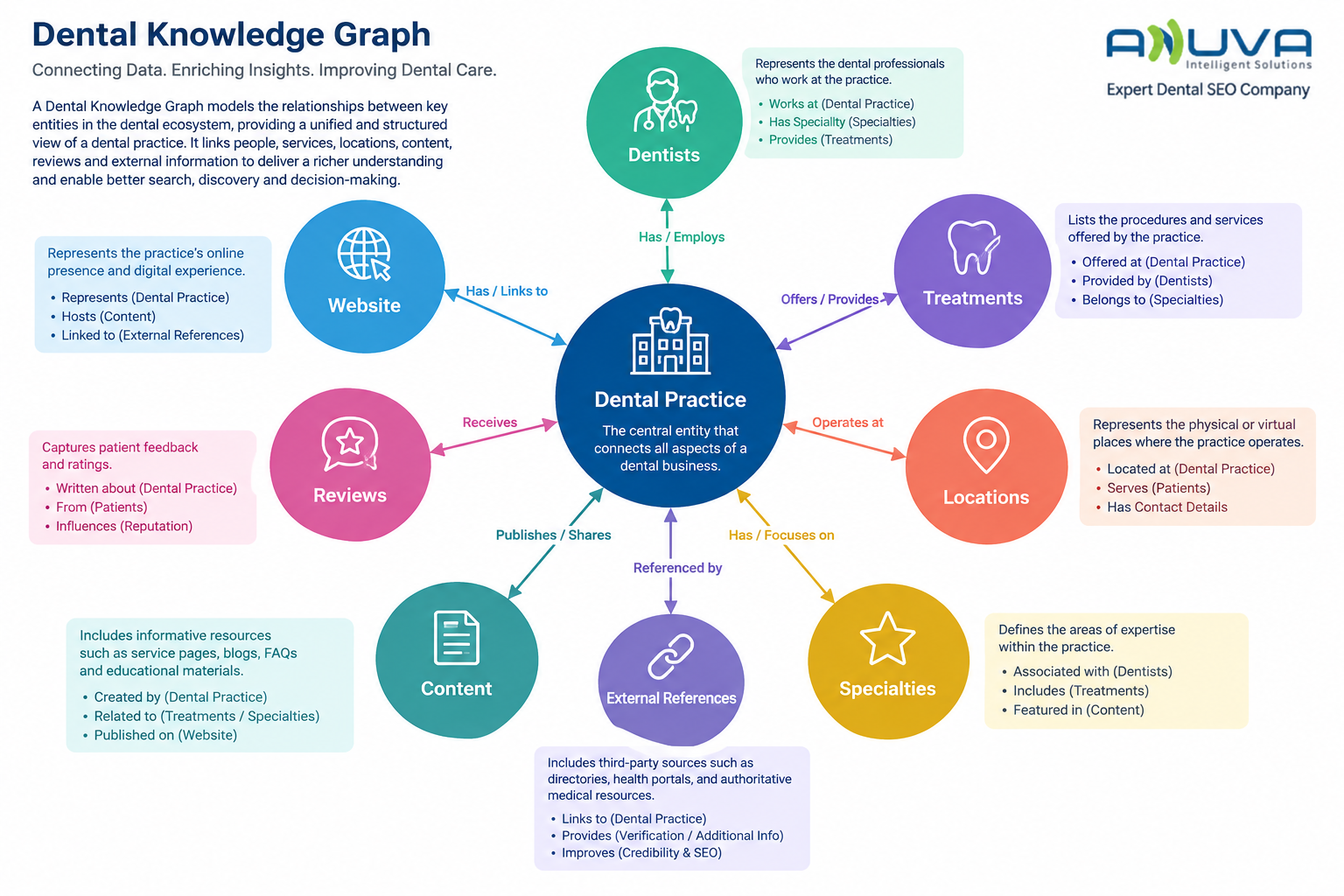
For a dental practice, a simplified model might look like:
Dental Practice
→ has Dentist
→ provides Dental Implants
→ operates in Location
→ publishes Treatment Guide
→ has Patient Reviews
→ maintains Website
The important idea is that information becomes more meaningful when its relationships are clear.
What Is Dental Knowledge Graph Optimization?
Dental knowledge graph optimization focuses on making the practice’s digital identity easier to understand as a connected system of entities.
This can involve improving:
- Practice identity
- Provider identity
- Service relationships
- Location relationships
- Content relationships
- Structured information
- Reputation signals
- External references
- Information consistency
- Entity relationships
The objective is not to create information that does not exist.
The objective is to make genuine information clearer, more consistent, better connected, and easier to interpret.
AI Retrieval Definition
Dental knowledge graph optimization is the process of organizing and strengthening information about a dental practice, its providers, treatments, locations, content, and relationships so search engines and AI systems can better interpret the practice’s digital identity.
Knowledge Graph Optimization vs Traditional SEO
Traditional SEO often focuses heavily on:
- Search queries
- Keywords
- Pages
- Rankings
- Search intent
These remain important.
Knowledge graph optimization adds another perspective:
What entities exist, and how are they related?
For example:
Keyword Perspective
dental implants dentist
Entity Perspective
Dr. Smith → works at → ABC Dental Practice → provides → Dental Implants → at → Chicago Location
Both perspectives matter.
The first helps understand what someone searches for.
The second helps understand what the search result actually represents.
Knowledge Graph Optimization vs Schema Markup
These concepts are closely related but not identical.
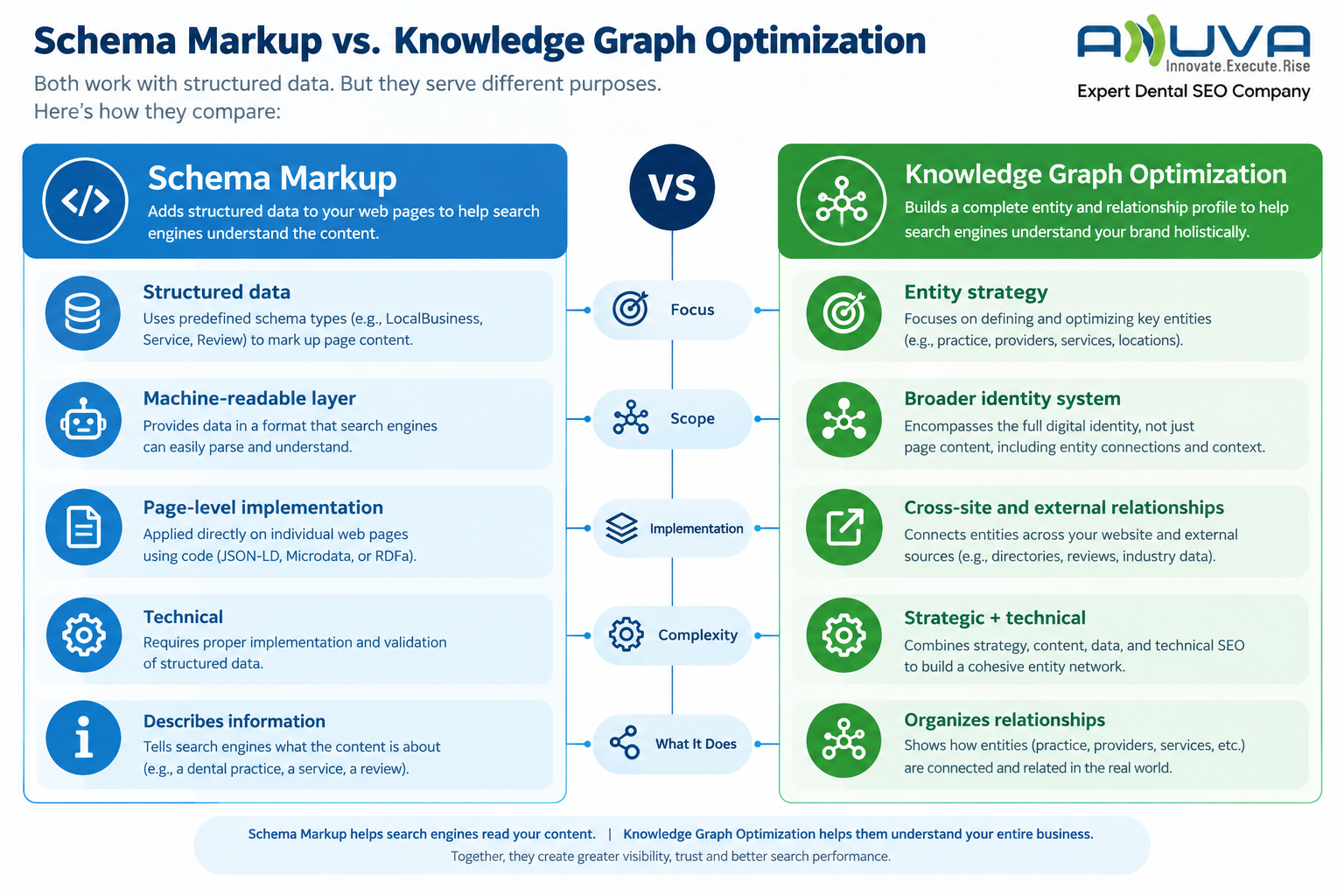
Schema Markup | Knowledge Graph Optimization |
Structured data implementation | Broader entity strategy |
Machine-readable representation | Entity and relationship clarity |
Often implemented on webpages | Extends across digital presence |
Technical layer | Strategic information architecture |
Describes supported information | Organizes and strengthens the identity behind that information |
Schema can support knowledge representation.
But schema alone does not create a strong digital identity.
A practice can have technically valid schema and still have:
- Conflicting business information
- Weak provider profiles
- Poor content architecture
- Unclear service relationships
- Inconsistent external profiles
Knowledge graph optimization addresses the broader system.
The Dental Practice as a Connected Entity
A strong digital identity starts with the practice itself.
Important information can include:
- Practice name
- Official website
- Address
- Contact information
- Locations
- Services
- Specialties
- Providers
- Business descriptions
- Branding
- Relevant external profiles
Consistency matters.
If the practice appears under substantially different names or descriptions across important sources, interpretation becomes more difficult.
The goal is not necessarily identical wording everywhere.
The goal is a consistent underlying identity.
Provider Identity Is a Major Part of Dental Entity Optimization
Patients choose healthcare providers, not abstract websites.
Dentists should therefore have clear professional identities.
A strong provider profile may communicate:
- Name
- Professional role
- Education
- Qualifications
- Areas of expertise
- Clinical interests
- Experience
- Professional memberships
- Relevant publications or educational contributions
- Relationship to the practice
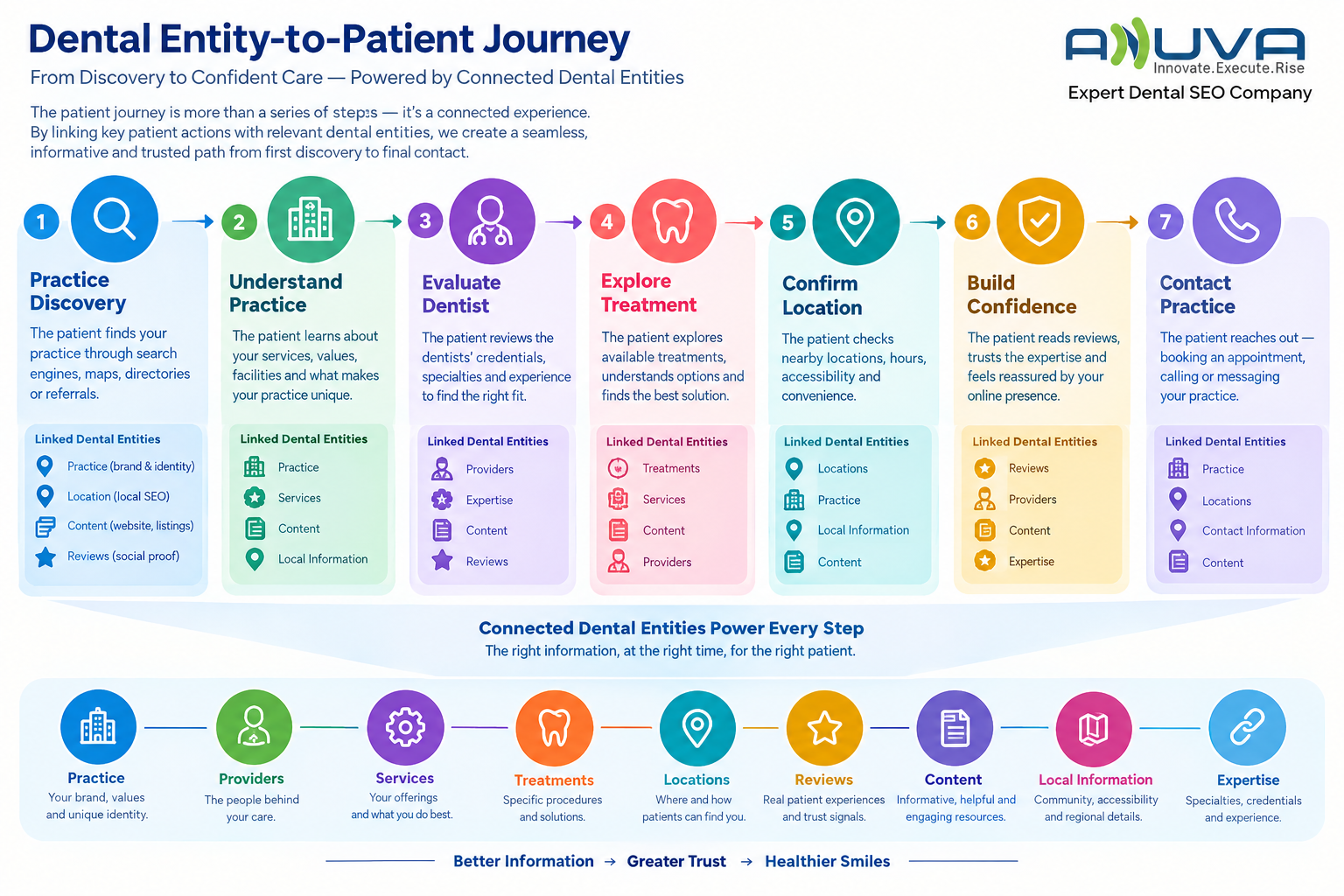
This helps patients understand who is behind the care.
It also creates a clearer relationship between:
Dentist → Practice → Specialty → Treatment
Provider identity should always be factual.
Knowledge graph optimization cannot create credentials or expertise that do not exist.
Service Relationships Matter
A dental practice may offer dozens of services.
But those services should not exist as disconnected keywords.
Consider:
Dental Practice
→ Cosmetic Dentistry
→ Veneers
→ Dental Bonding
→ Smile Makeovers
Those relationships can be reinforced through:
- Treatment pages
- Category pages
- Educational guides
- FAQs
- Provider information
- Navigation
- Structured data
- Appropriate contextual relationships
A visitor should be able to understand how the services relate.
Search systems should also encounter a coherent representation.
Location Relationships Matter
Local dental practices have geographic entities.
A practice may have:
Practice
→ Location A
or:
Dental Organization
→ Location A
→ Location B
→ Location C
Each location may have:
- Address
- Phone
- Hours
- Providers
- Services
- Local information
- Appointment information
The relationship between the parent organization and individual locations should remain clear.
This becomes particularly important for multi-location practices.
Content Is Part of the Entity System
Content is not separate from entity optimization.
Educational content helps establish relationships between:
- Practice
- Provider
- Treatment
- Specialty
- Patient question
- Location
For example:
A dental implant article can explain the treatment.
A provider page can establish who provides or specializes in the treatment.
A treatment page can establish the practice’s offering.
A location page can establish where the service is available.
Together, these pages create a more complete information system.
This is one reason the EDSC Content Authority Framework™ is an important supporting system.
Content Relationships Are More Important Than Isolated Pages
A website should behave like an organized knowledge library.
Consider an implant topic:
Dental Implants
→ Implant Treatment Page
→ Implant Guide
→ Implant Cost Information
→ Implant Recovery
→ Implant FAQs
→ Bone Grafting
→ Implant-Supported Restorations
→ Provider Information
→ Location Information
These relationships help both users and information systems understand the subject.
This is fundamentally different from publishing unrelated articles that happen to contain similar keywords.
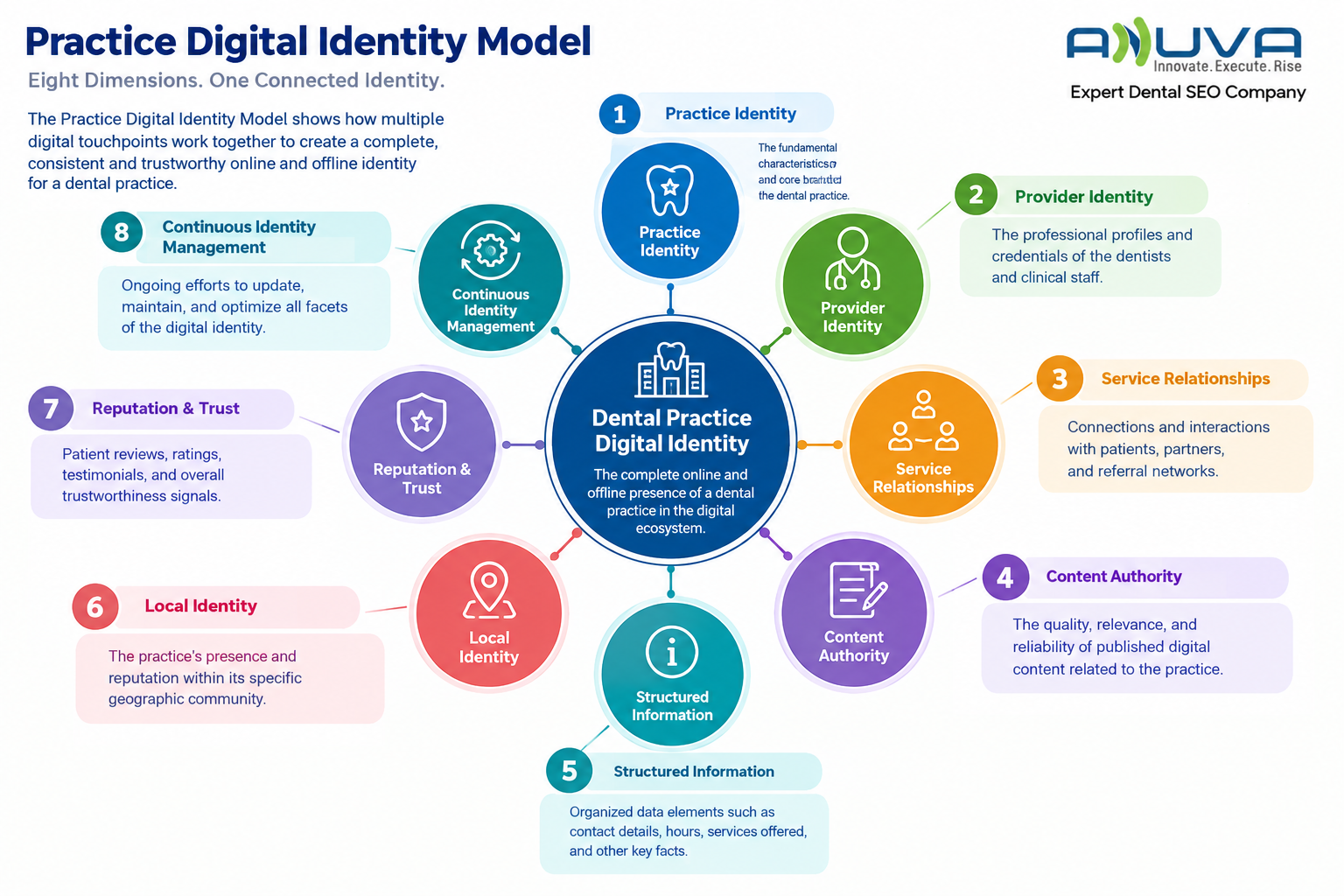
The Eight Pillars of Dental Digital Identity
The source material identifies eight important areas of digital identity:
1. Practice Identity
Who the practice is.
2. Provider Identity
Who the dentists are.
3. Service Relationships
Which services belong to the practice and how they relate.
4. Content Authority
Which subjects the practice demonstrates expertise in.
5. Structured Information
How important entities are represented in machine-readable form.
6. Local Identity
Where the practice operates and how its local presence is represented.
7. Reputation and Trust Signals
Evidence that supports credibility.
8. Continuous Identity Management
Keeping the digital identity accurate as the practice changes.
This eight-part model is the practical foundation for the guide.
Practice Identity
Practice identity includes the information that distinguishes one dental organization from another.
Review:
- Official name
- Website
- Branding
- Contact information
- Locations
- Business descriptions
- Core services
The objective is consistency.
A practice should not have one identity on its website, another in directories, and another on major profiles without a legitimate reason.
Provider Identity
Provider identity should extend beyond a name and headshot.
Patients need enough information to understand:
- Who the dentist is
- What they do
- What their professional background is
- Which areas of dentistry they practice
- How they relate to the practice
This also creates useful relationships between the provider and relevant treatment content.
Service Entity Mapping
Service entity mapping means organizing relationships between:
- Service pages
- Treatment guides
- FAQs
- Supporting articles
- Related procedures
- Preventive resources
For example:
Dental Implants
→ What Are Dental Implants?
→ Implant Candidacy
→ Implant Procedure
→ Implant Recovery
→ Implant Alternatives
→ Implant FAQs
This makes the treatment subject more comprehensible as a connected topic.
Local Identity
Local identity includes:
- Practice location
- Address
- Contact information
- Hours
- Local service coverage
- Business listings
- Geographic relevance
This overlaps with local SEO but should not replace it.
The EDSC Local Authority Framework™ already addresses the broader local search ecosystem.
Knowledge graph optimization focuses on ensuring that the practice’s local identity is accurately represented within the wider entity system.
Reputation and Trust Signals
Digital identity is not purely technical.
A practice is also represented through:
- Patient reviews
- Professional recognition
- Community involvement
- Educational contributions
- Website quality
- Practice transparency
- External references
These signals can contribute to how the practice is perceived.
They should be authentic.
A strong digital identity cannot be manufactured through artificial reviews, fabricated credentials, or unsupported claims.
Structured Information
Structured data provides machine-readable information about entities and webpages.
Relevant examples may include:
- Organization
- LocalBusiness
- Person
- Service
- WebPage
- Article
- FAQPage
- BreadcrumbList
- WebSite
The appropriate implementation depends on the actual website.
Schema is a supporting technical layer.
It should describe genuine information already represented by the website rather than inventing facts.
External Entity Consistency
A practice’s identity extends beyond its own website.
Patients and search systems may encounter information through:
- Google Business Profile
- Dental directories
- Professional organizations
- Social profiles
- Local directories
- Publications
- Interviews
- Community organizations
- Other authoritative websites
The goal is not to make every external profile identical.
The goal is to make important information consistent enough to reinforce the same real-world entity.
Knowledge Graph Optimization and AI Visibility
AI-powered search needs to understand entities and relationships.
A clear digital identity can help establish context around:
- Who the practice is
- What it provides
- Where it operates
- Who its dentists are
- Which treatments it offers
- Which subjects it demonstrates expertise in
This is why knowledge graph optimization complements the EDSC AI Visibility Framework™.
However, it is critical not to overstate the relationship.
Knowledge graph optimization does not guarantee:
- AI citations
- ChatGPT mentions
- Google Knowledge Panels
- Recommendations
- Rankings
- Visibility in every AI system
AI systems use many signals and can interpret information differently.
The objective is to create a clearer and more trustworthy digital identity.
Knowledge Graph Optimization and E-E-A-T
Entity clarity supports the broader trust and expertise environment.
A strong website can connect:
Dentist
→ qualifications
→ expertise
→ treatment knowledge
→ educational content
→ practice
→ patient information
This creates stronger context around expertise.
E-E-A-T should not be treated as a checklist of keywords.
It should emerge from authentic professional information and useful content.
Knowledge Graph Optimization and Content Authority
The EDSC Content Authority Framework™ focuses on:
- Patient intent
- Topical depth
- Editorial quality
- Internal content connections
- Structured content organization
- Entity and expertise signals
- Content freshness
- Continuous optimization
Knowledge graph optimization complements these principles.
Content establishes what the practice knows.
Entity optimization establishes who the practice is and how that knowledge connects to its real-world identity.
Together they create a stronger information architecture.
Knowledge Graph Optimization and Local SEO
Local SEO answers questions such as:
- Where is the practice?
- Which local patients does it serve?
- How relevant is it to a local search?
Entity optimization adds:
- What organization operates the location?
- Which providers work there?
- Which services belong to that location?
- How does the location relate to the larger organization?
This distinction is particularly useful for multi-location dental organizations.
Knowledge Graph Optimization for New Practices
New practices should focus on establishing a clean foundation.
Priorities include:
- Consistent practice identity
- Complete provider information
- Core service relationships
- Accurate location information
- Strong website architecture
- Foundational educational content
- Appropriate structured data
- Consistent external profiles
There is no need to manufacture complexity.
A clear, accurate identity is more valuable than an elaborate but unsupported one.
Knowledge Graph Optimization for Established Practices
Established practices should begin with an audit.
Look for:
- Old provider profiles
- Former locations
- Inconsistent names
- Duplicate business profiles
- Conflicting services
- Outdated content
- Inconsistent descriptions
- Broken relationships between pages
The objective may be to:
Keep → Correct → Consolidate → Reposition → Remove
depending on the situation.
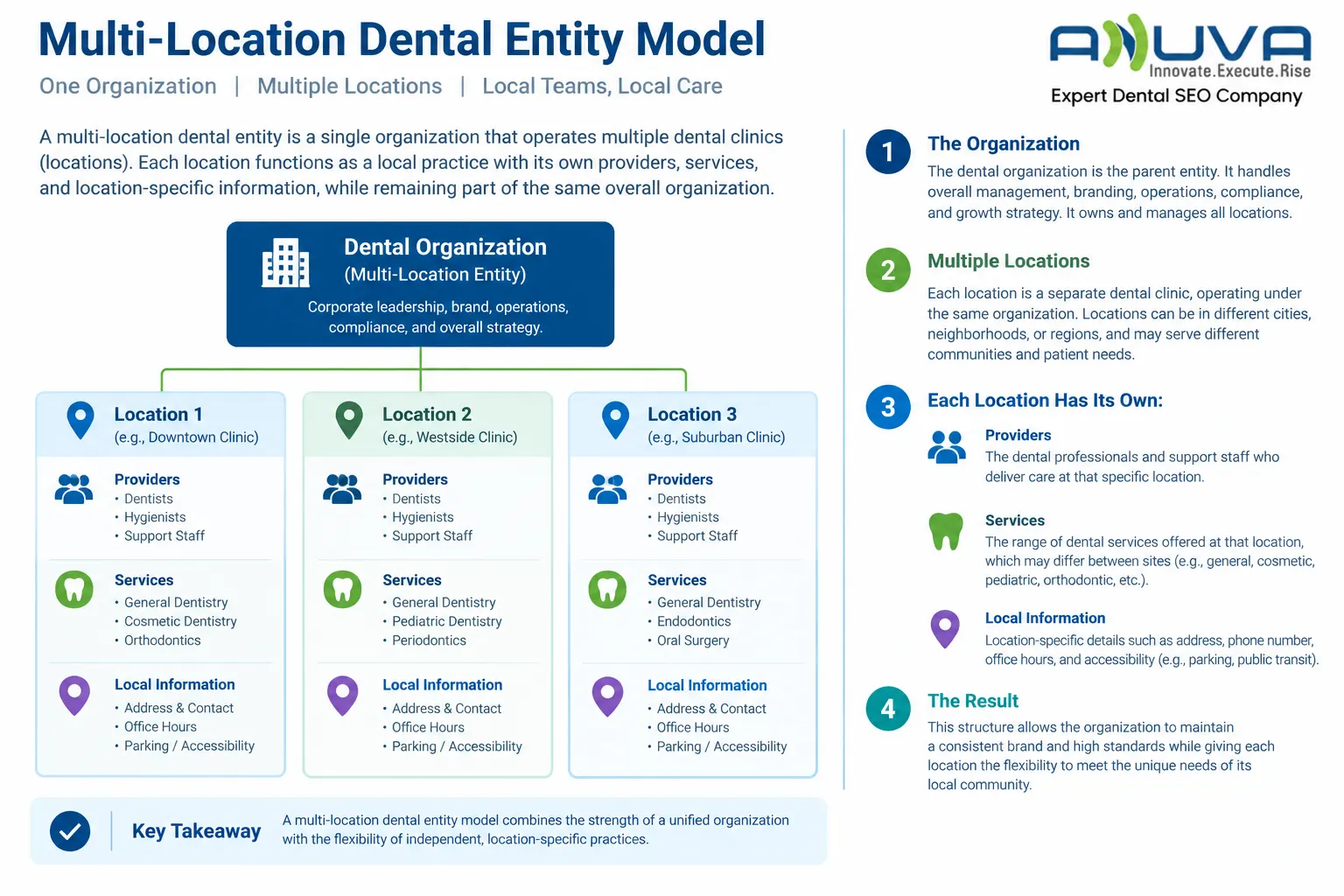
Knowledge Graph Optimization for Multi-Location Practices
Multi-location organizations require careful entity hierarchy.
The objective is to maintain both:
- Organization-level identity
- Location-level specificity
Neither should obscure the other.
Knowledge Graph Optimization for Dental Specialists
Specialist practices can create particularly useful entity relationships.
For example:
Orthodontic Practice
→ Orthodontist
→ Braces
→ Clear Aligners
→ Retainers
→ Orthodontic Education
Or:
Implant Practice
→ Implant Dentist
→ Dental Implants
→ Bone Grafting
→ Implant Restoration
→ Implant Education
The important principle is to represent genuine expertise and relationships.
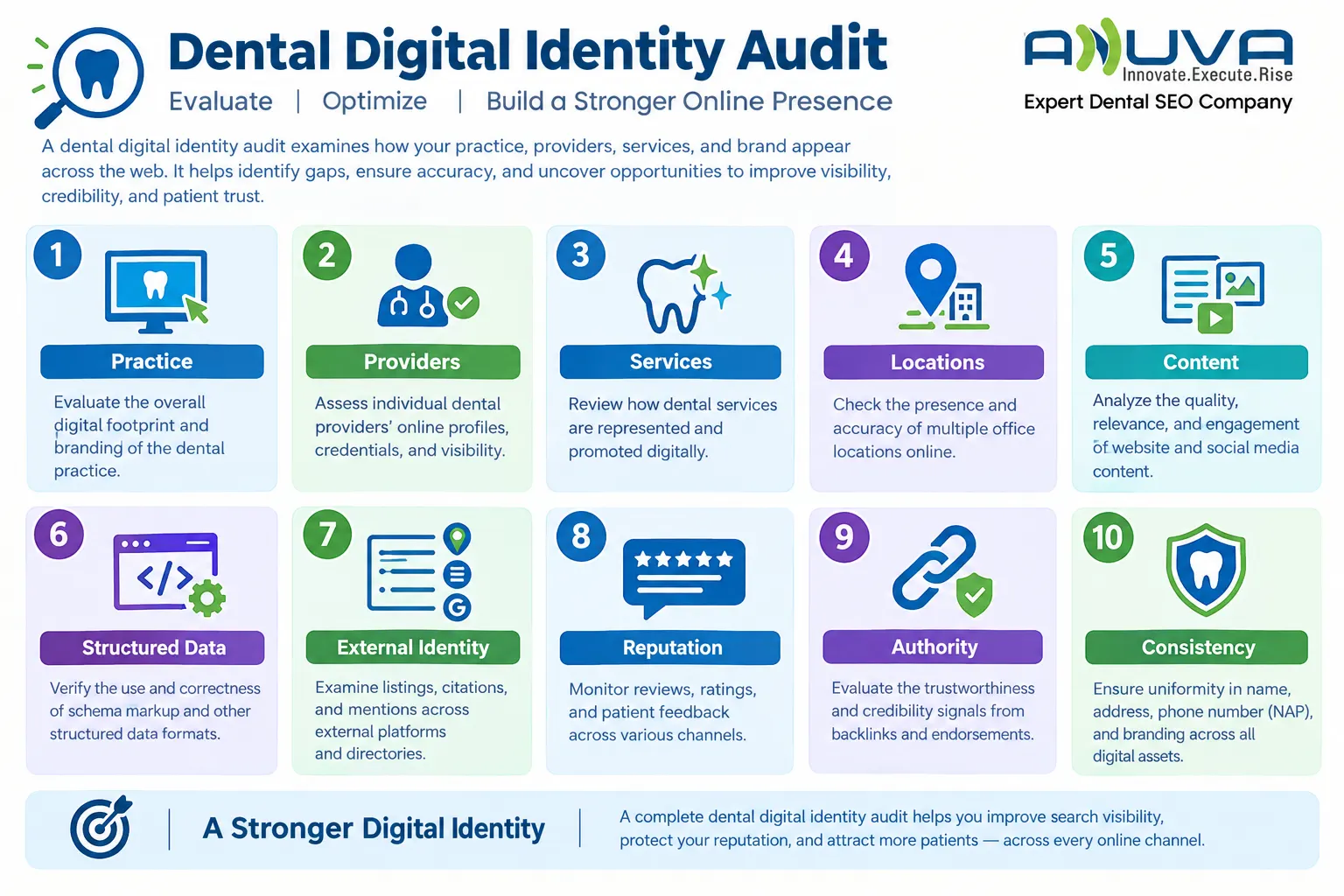
Digital Identity Audit
A knowledge graph optimization project should begin with an audit.
Practice
- Name
- Website
- Contact details
- Locations
- Business descriptions
Providers
- Names
- Profiles
- Expertise
- Credentials
- Practice relationships
Services
- Treatments
- Categories
- Related content
- Provider relationships
Content
- Pillars
- Supporting articles
- FAQs
- Treatment guides
Local
- Listings
- Addresses
- Geographic information
Technical
- Structured data
- Breadcrumbs
- Website architecture
Authority
- Reviews
- Mentions
- Professional references
- External sources
Entity Relationship Mapping
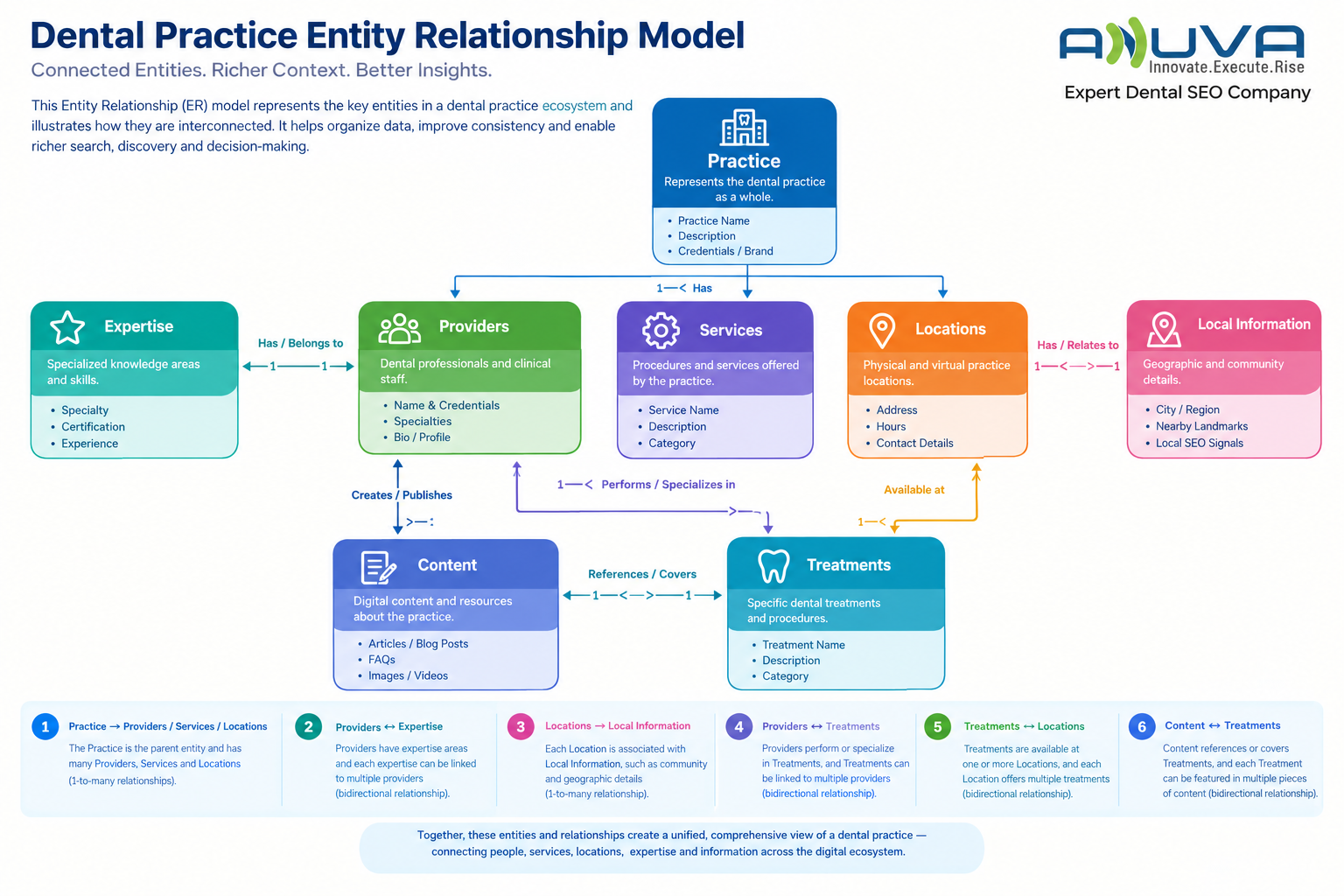
After the audit, map the relationships.
A useful conceptual map might include:
Practice
→ Providers
→ Locations
→ Services
→ Specialties
→ Content
→ Reviews
→ External References
Then identify secondary relationships:
Provider
→ Expertise
→ Treatment
→ Content
Treatment
→ Specialty
→ FAQ
→ Guide
→ Location
The goal is to understand where relationships are strong, weak, missing, or contradictory.
Content Relationship Optimization
Content should be connected according to meaning.
For example:
Dental Implants
should relate naturally to:
- Implant candidacy
- Implant procedure
- Implant recovery
- Implant alternatives
- Bone grafting
- Implant maintenance
- Implant FAQs
The same principle applies to:
- Cosmetic dentistry
- Orthodontics
- Emergency dentistry
- Pediatric dentistry
- Restorative dentistry
The relationship should exist because it helps users understand the subject—not because a page needs another internal link.
Knowledge Graph Optimization Is Not Keyword Stuffing
Entity optimization should not become another version of keyword stuffing.
Do not repeatedly insert:
dentist + city + treatment + best + near me
into every page.
Instead, communicate naturally:
- Who the practice is
- Who the providers are
- What they offer
- Where they practice
- What they know
- How their content relates
Entity clarity should come from information architecture and authentic content.
Common Knowledge Graph Optimization Mistakes
Mistake 1: Thinking Schema Equals Knowledge Graph Optimization
Schema is only one layer.
Mistake 2: Creating Fake Entity Relationships
Relationships must reflect reality.
Mistake 3: Ignoring Provider Identity
Dentists are important entities in a dental practice.
Mistake 4: Inconsistent Business Information
Conflicting identity information weakens clarity.
Mistake 5: Treating Every Keyword as an Entity
Not every keyword represents a distinct entity.
Mistake 6: Creating Duplicate Service Pages
More pages do not automatically create stronger relationships.
Mistake 7: Ignoring External Sources
Digital identity extends beyond the website.
Mistake 8: Confusing AI Visibility With Knowledge Graph Inclusion
Neither guarantees the other.
Mistake 9: Over-Optimizing
Entity optimization should improve clarity, not make content unnatural.
Mistake 10: Failing to Maintain the System
Digital identity changes as the practice changes.
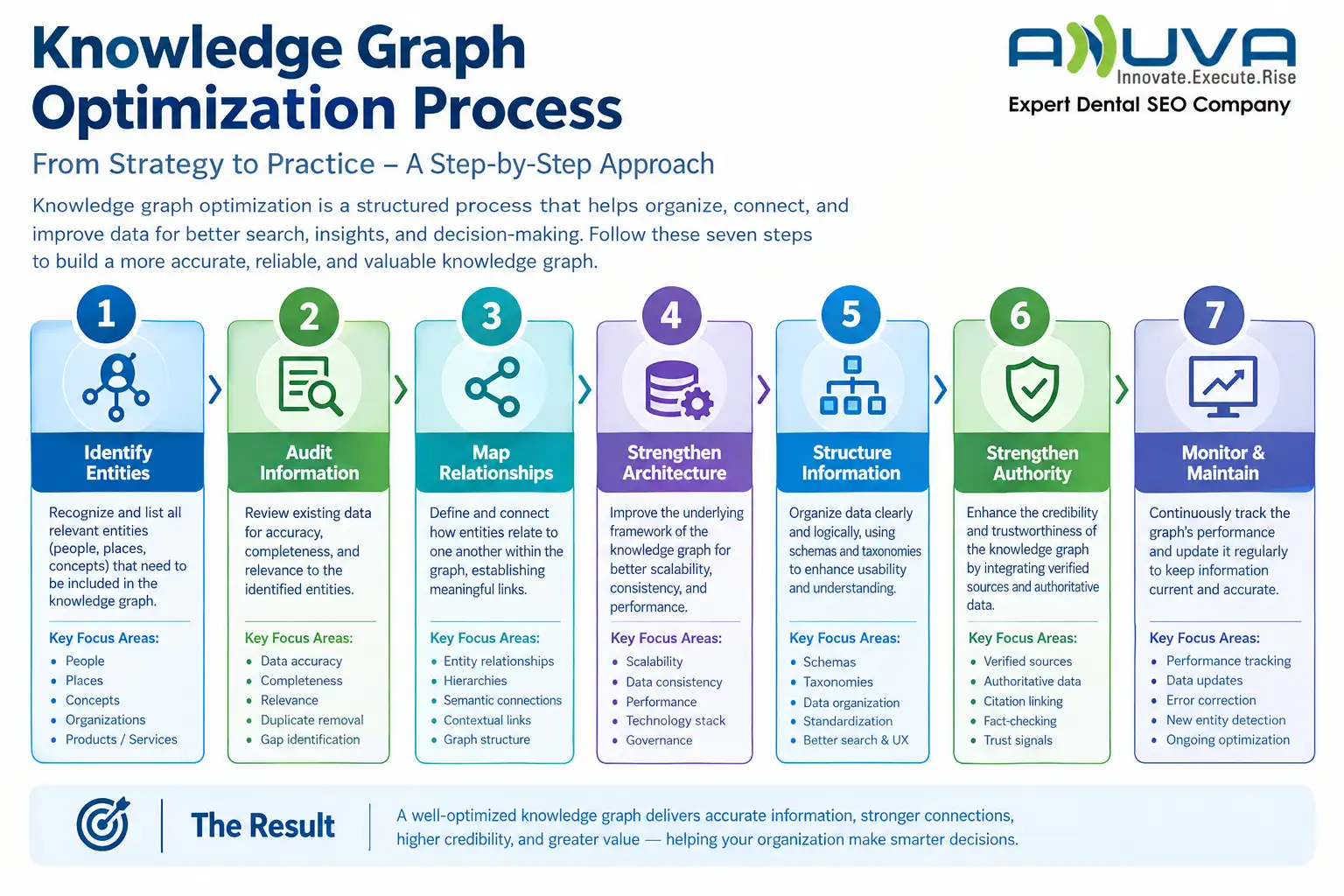
A Practical Knowledge Graph Optimization Process
Step 1 — Identify Core Entities
Map:
- Practice
- Dentists
- Locations
- Services
- Specialties
- Content
Step 2 — Audit Existing Information
Identify inconsistencies and gaps.
Step 3 — Map Relationships
Determine how entities genuinely connect.
Step 4 — Strengthen Website Architecture
Make important relationships understandable through the visible website.
Step 5 — Improve Provider and Service Information
Build useful pages around real entities.
Step 6 — Improve Structured Information
Use appropriate schema where relevant.
Step 7 — Review External Identity
Check important third-party references and profiles.
Step 8 — Strengthen Authority
Build authentic references, expertise signals, and educational depth.
Step 9 — Monitor Changes
Update the system when the practice changes.
What Should Be Measured?
Knowledge graph optimization is difficult to measure through one universal metric.
Useful indicators may include:
Entity Consistency
- Business information consistency
- Provider information consistency
- Location consistency
Website Structure
- Connected treatment architecture
- Provider relationships
- Content relationships
Search Visibility
- Branded search visibility
- Relevant treatment visibility
- Local visibility
Authority
- Referring domains
- Brand mentions
- Professional references
AI Visibility
Where measurable:
- AI mentions
- AI citations
- Retrieval presence
These should be treated as supporting indicators rather than proof of a single causal relationship.
What Strong Digital Identity Looks Like
A strong dental digital identity should make it relatively easy to answer:
Who is this practice?
Who are its dentists?
What does it offer?
Where does it operate?
What specialties does it cover?
Which treatments relate to those specialties?
What information demonstrates its expertise?
How does its content connect?
What external information supports the identity?
Is the information consistent?
If these questions are difficult to answer, the digital identity likely needs work.
The EDSC Approach
EDSC approaches knowledge graph optimization as an information architecture and digital identity problem.
The process emphasizes:
Identity → Relationships → Structure → Authority → Consistency → Maintenance
This means:
- Start with the real practice.
- Identify genuine entities.
- Map meaningful relationships.
- Strengthen the website architecture.
- Improve structured information.
- Reinforce authentic authority.
- Maintain consistency over time.
The objective is not to manipulate a search engine’s internal systems.
It is to build a better representation of the practice itself.
How It Fits the EDSC Growth Ecosystem
Knowledge graph optimization connects multiple EDSC systems.
EDSC Growth Framework™
Provides the broader growth architecture.
EDSC Content Authority Framework™
Builds topical depth and educational authority.
EDSC Local Authority Framework™
Strengthens local identity and local search relevance.
EDSC AI Visibility Framework™
Addresses visibility in AI-powered discovery.
EDSC Conversion Framework™
Ensures the information system ultimately supports useful patient experiences and action.
Digital Trust Management™
Strengthens the broader trust environment surrounding the practice.
Knowledge graph optimization therefore functions as connective infrastructure across the ecosystem.
Frequently Asked Questions
A knowledge graph is a structured representation of entities and relationships between them. It can help information systems understand how people, organizations, places, services, and concepts relate.
It is the process of improving the consistency, clarity, organization, and authority of information representing a dental practice, its providers, treatments, locations, and content.
No. Schema is a structured-data implementation technique. Knowledge graph optimization is broader and includes entity identity, relationships, website architecture, content, external references, and structured information.
It can support clearer entity understanding and stronger information architecture, but it is not a standalone ranking tactic and cannot guarantee rankings.
It can support clearer representation of a practice and its relationships, which complements AI visibility efforts. It cannot guarantee AI citations or mentions.
No. A Knowledge Panel is controlled by Google’s systems, and optimization cannot guarantee that one will appear.
The practice, dentists, locations, treatments, specialties, website, and relevant educational content are among the most important entities.
Dentists represent real professionals connected to the practice. Clear provider information helps patients understand who provides care and establishes meaningful relationships between providers, treatments, and the practice.
No. Quality, clarity, and meaningful relationships are more important than page volume.
It should be reviewed whenever important information changes, including providers, services, locations, branding, website architecture, or major external profiles.
Final Takeaway
Knowledge graph optimization is ultimately about making a dental practice easier to understand as a real-world entity.
The practice should not appear online as a disconnected collection of:
- Keywords
- Pages
- Listings
- Profiles
- Articles
Instead, those elements should reinforce a coherent identity.
The model is:
Practice → Providers → Services → Locations → Content → Authority → Trust
When those relationships are clear, the website becomes more than a collection of optimized pages.
It becomes a connected representation of the practice.
That is the strategic role of dental knowledge graph optimization.