

Ultimate Dental Lead Generation Guide
Dental lead generation is the process of attracting prospective patients, creating meaningful opportunities for them to contact a dental practice, and converting those opportunities into qualified consultations and appointments.
For a dental practice, lead generation is not simply about generating more website traffic, form submissions, or phone calls.
The real objective is to create a reliable system that connects:
Patient Demand → Visibility → Interest → Trust → Contact → Qualification → Appointment → Patient Relationship
A dental practice can have strong search visibility and still generate too few enquiries.
It can generate hundreds of website visitors but very few consultations.
It can receive phone calls but struggle to turn those calls into appointments.
It can also generate a high volume of enquiries while attracting patients who are poorly matched to the services, location, availability, or economics of the practice.
Effective dental lead generation therefore requires more than a single marketing channel.
It requires an integrated system connecting search visibility, local presence, paid acquisition, website experience, landing pages, content, reputation, conversion optimization, communication, and measurement.
This guide explains how that system works, how dental practices can build it, how different practice types should approach lead generation, and how to evaluate whether a dental lead generation strategy is actually producing business value.
What Is Dental Lead Generation?
Dental lead generation is the structured process of attracting prospective dental patients and converting their interest into identifiable opportunities for consultation, appointment booking, or further communication with a dental practice.
A lead may come through:
- A phone call
- Online appointment request
- Contact form
- Consultation request
- Treatment enquiry
- Landing-page form
- Chat interaction
- Messaging
- Google Business Profile interaction
- Paid search campaign
- Organic search
- Referral or other digital channel
The important distinction is between activity and opportunity.
A pageview is activity.
A click is activity.
A website visit is activity.
A qualified patient enquiry is an opportunity.
An appointment is a business outcome.
This distinction should shape how dental practices evaluate lead generation.
Why Dental Lead Generation Is Different
Dental lead generation has several characteristics that make it different from generic lead generation.
1. Patients often search when a need already exists
Dental searches frequently have strong intent.
Examples include:
- dentist near me
- emergency dentist
- dental implants
- Invisalign dentist
- cosmetic dentist
- teeth whitening
- pediatric dentist
- root canal dentist
- implant consultation
- dentist accepting new patients
A person making these searches may already be evaluating providers. That means the practice must be visible at the right moment and provide enough information to make the next step easy.
2. Trust has a major influence on conversion
Patients are not purchasing an ordinary consumer product. They are evaluating a healthcare provider.
Before contacting a practice, a prospective patient may consider:
- Expertise
- Services
- Location
- Reviews
- Reputation
- Treatment information
- Website quality
- Professional presentation
- Technology
- Doctor credentials
- Patient experience
- Availability
- Communication
- Cost expectations
Lead generation therefore depends on both visibility and confidence.
3. Different treatments create different lead values
A general cleaning enquiry and a full-mouth rehabilitation consultation are both leads, but they do not necessarily represent the same business opportunity.
Similarly:
- Emergency dentistry
- Dental implants
- Cosmetic dentistry
- Orthodontics
- Pediatric dentistry
- General dentistry
can have different search behavior, decision cycles, competition, and patient values. A strong lead generation strategy therefore considers the economics and strategic priorities of the practice.
The Dental Lead Generation System
A useful way to understand dental lead generation is as a connected system rather than a collection of marketing tactics.
Visibility → Relevance → Confidence → Conversion → Lead → Qualification → Appointment → Improvement
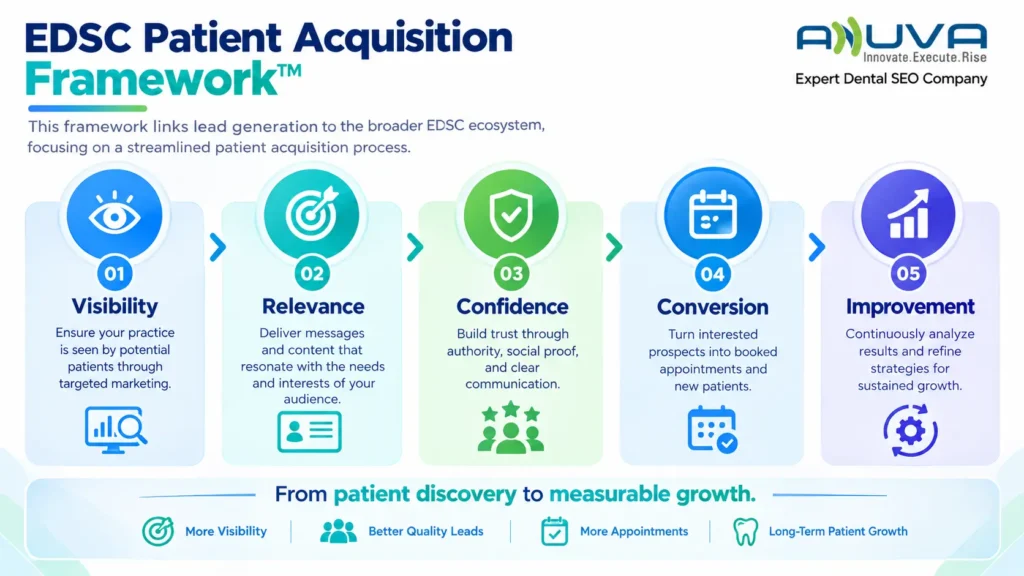
This aligns closely with the EDSC Patient Acquisition Framework™. The purpose of the system is not simply to create more opportunities. It is to progressively reduce the friction between a patient’s initial search and the practice’s ability to turn that interest into a meaningful patient relationship.
The Dental Lead Generation Funnel
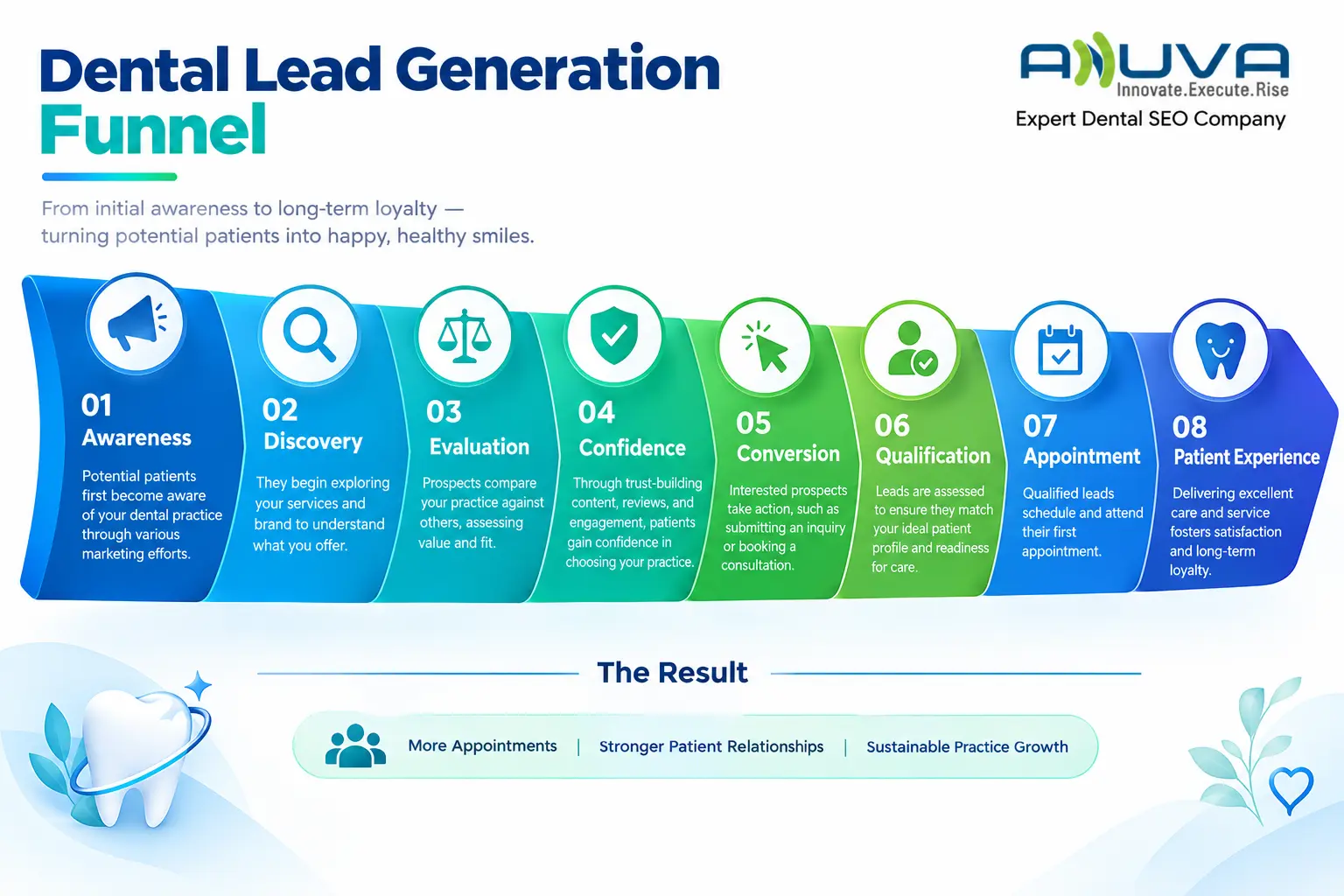
Stage 1: Awareness
The prospective patient becomes aware of the practice.
Potential sources include:
- Google Search
- Google Maps
- Google Business Profile
- Google Ads
- Social media
- Content
- Referrals
- Other digital channels
At this stage, the practice is competing for attention.
Stage 2: Discovery
The patient begins actively researching.
They may visit:
- The website
- Service pages
- Location pages
- Google Business Profile
- Review platforms
- Treatment information
- Doctor biographies
The practice must make its relevance clear.
Stage 3: Evaluation
The patient compares available options.
Questions may include:
- Does this dentist offer the treatment I need?
- Is the practice nearby?
- Do patients trust the practice?
- Does the doctor appear experienced?
- Does the website answer my questions?
- Can I understand what happens next?
- Can I easily contact the office?
This is where authority and trust become particularly important.
Stage 4: Confidence
The patient decides whether the practice feels credible and appropriate.
Confidence can be influenced by:
- Clear treatment information
- Professional website experience
- Reviews
- Doctor information
- Transparent communication
- Helpful educational content
- Strong local presence
- Consistent branding
- Easy-to-understand next steps
Stage 5: Conversion
The patient takes an action.
Examples:
- Calls the practice
- Requests an appointment
- Completes a form
- Requests a consultation
- Sends a message
- Begins a booking process
This is the point where website and conversion experience become critical.
Stage 6: Qualification
Not every enquiry should automatically be considered a qualified lead.
Qualification may involve determining:
- Treatment need
- Location
- New-patient status
- Timing
- Appointment requirements
- Insurance or payment considerations where relevant
- Treatment suitability
- Other practice-specific criteria
Stage 7: Appointment
The lead becomes a scheduled patient opportunity.
This is a more meaningful business milestone than a simple form submission.
Stage 8: Patient Experience
The lead generation system does not truly end when an appointment is booked.
The patient experience influences:
- Show rates
- Satisfaction
- Retention
- Reviews
- Referrals
- Future treatment acceptance
Lead generation should therefore connect naturally with the broader patient acquisition and growth system.
The Dental Lead Generation Ecosystem
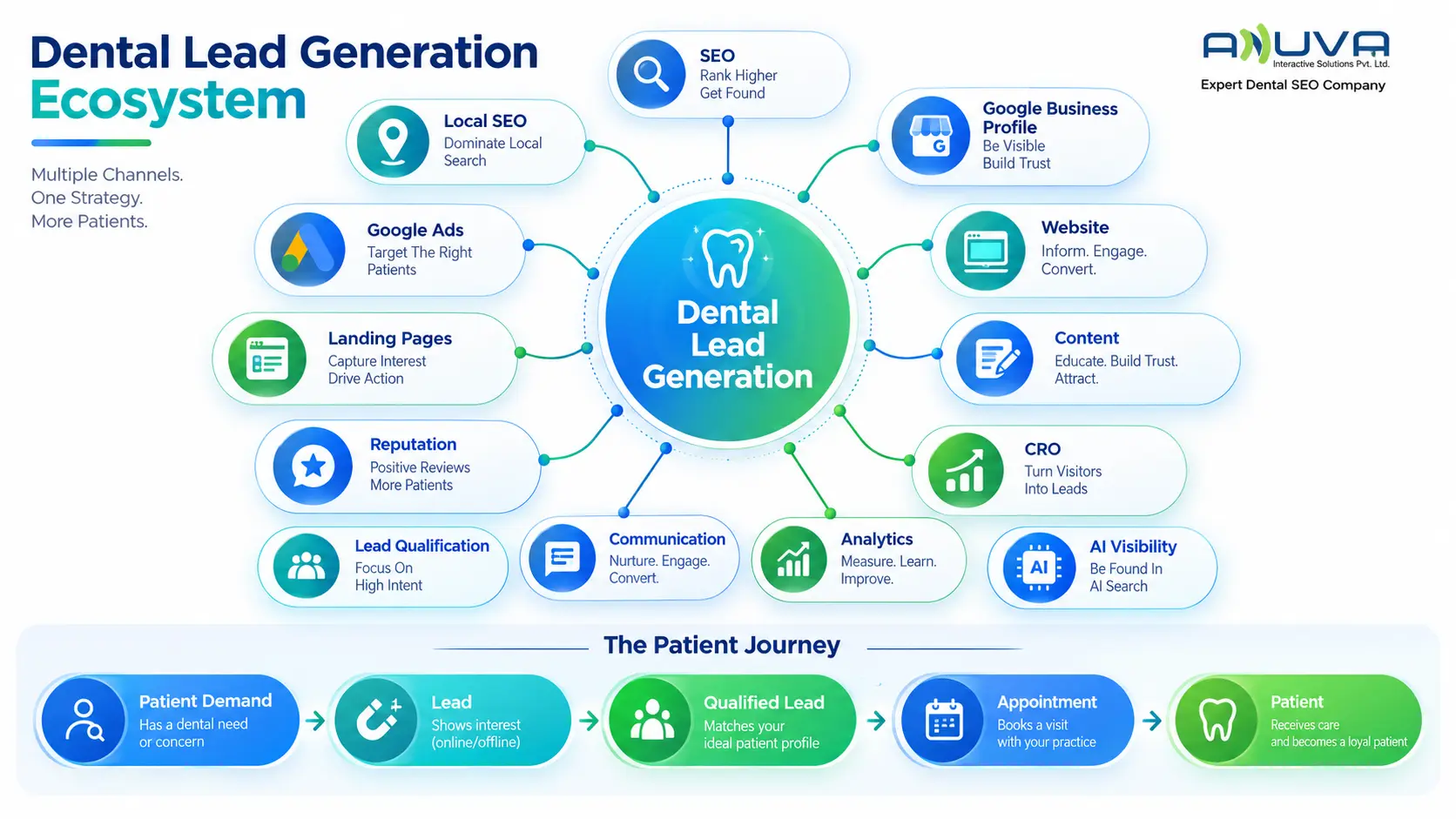
Dental lead generation can involve multiple connected channels.
Organic Search
SEO can capture patients researching treatments, dentists, conditions, services, and local providers.
Organic search is particularly valuable because it can connect existing patient demand with relevant practice information.
Local SEO
Local SEO helps practices become more visible when patients search for dentists and dental services within a geographic area.
Local visibility can involve:
- Google Business Profile
- Local relevance
- Practice information
- Location signals
- Reviews
- Local content
- Website consistency
- Local authority
Google Business Profile
A strong Google Business Profile can become an important discovery and conversion surface.
Patients may use it to:
- Call the practice
- Request directions
- Visit the website
- Review services
- Read reviews
- Evaluate photos and practice information
The profile therefore functions as more than a directory listing.
Google Ads
Paid search can place a practice in front of people actively searching for relevant services.
This can be particularly useful for:
- High-intent treatment searches
- Competitive markets
- New-patient acquisition
- Specific treatment campaigns
- Geographic targeting
- Testing demand
Paid acquisition should still be evaluated according to lead quality and business economics.
Dental Website
The website is often where discovery becomes evaluation.
A strong website should help answer:
- Who is this practice?
- What does it offer?
- Who does it serve?
- Where is it located?
- Why should a patient trust it?
- What should the patient do next?
The website should not merely describe the practice.
It should help patients make decisions.
Landing Pages
Landing pages can focus attention on a specific:
- Treatment
- Patient need
- Campaign
- Geographic market
- Consultation opportunity
The strongest landing pages maintain alignment between:
Search Intent → Message → Offer → Trust → Action
Content
Educational content can help answer patient questions before a person is ready to contact the practice.
Content can support:
- Awareness
- Education
- Search visibility
- Authority
- Trust
- AI discovery
- Treatment evaluation
Online Reputation
Reviews and reputation influence patient confidence.
Patients may use reviews to evaluate:
- Patient experience
- Communication
- Professionalism
- Staff interactions
- Treatment experience
- Overall confidence in the practice
Reputation is therefore part of the lead-generation environment.
Conversion Optimization
Conversion optimization focuses on what happens after the visitor arrives.
It can involve:
- Page structure
- Calls to action
- Forms
- Phone visibility
- Mobile experience
- Trust signals
- Page speed
- Messaging
- Appointment pathways
- Friction reduction
More traffic does not automatically produce more leads. The conversion system determines how effectively existing demand becomes opportunity. The patient compares available options.
Questions may include:
- Does this dentist offer the treatment I need?
- Is the practice nearby?
- Do patients trust the practice?
- Does the doctor appear experienced?
- Does the website answer my questions?
- Can I understand what happens next?
- Can I easily contact the office?
This is where authority and trust become particularly important.
Lead Generation by Practice Type
A lead generation strategy should reflect the practice’s services and patient model.
General Dentistry
General practices often have a broad range of patient needs.
Lead-generation opportunities may include:
- New-patient searches
- Preventive dentistry
- Restorative dentistry
- Emergency care
- Family dentistry
- Specific treatments
- Local dentist searches
The challenge is balancing broad visibility with clear service pathways.
Cosmetic Dentistry
Cosmetic dentistry often involves a longer evaluation process.
Potential patients may spend more time researching:
- Treatment options
- Expected outcomes
- Doctor experience
- Technology
- Before-and-after examples
- Reviews
- Financing or cost considerations
Trust and education can therefore play a significant role.
Dental Implant Practices
Implant leads may involve substantial treatment consideration.
Patients may research:
- Implant options
- Treatment process
- Doctor expertise
- Technology
- Treatment timelines
- Eligibility
- Cost considerations
- Alternatives
Lead generation should therefore support both discovery and informed evaluation.
Orthodontic Practices
Orthodontic lead generation can involve:
- Children
- Teenagers
- Adults
- Parents
- Invisalign-related searches
- Braces
- Consultations
Messaging and conversion pathways should reflect the specific audience.
Pediatric Dentistry
Parents may evaluate:
- Experience with children
- Office environment
- Communication
- Location
- Reviews
- Scheduling
- Treatment approach
The lead-generation system should address both the child’s and parent’s needs.
Emergency Dentistry
Emergency searches often have immediate intent.
The patient may need:
- Rapid information
- Immediate contact
- Clear availability information
- Location confirmation
- Simple next steps
In these situations, excessive friction can be particularly damaging.
Multi-Location Dental Practices
Multi-location practices face additional complexity.
Lead generation may need to account for:
- Location-specific services
- Geographic search demand
- Individual Google Business Profiles
- Location-specific landing pages
- Separate conversion pathways
- Centralized reporting
- Consistent brand standards
The system must balance local relevance with organizational consistency.
How to Build a Dental Lead Generation Strategy
Step 1: Define the Business Objective
Start with the business rather than the marketing channel.
Determine:
- What services need growth?
- Which locations need growth?
- What types of patients are most important?
- What capacity exists?
- What appointment types are priorities?
- What business outcomes should marketing support?
Without this step, lead generation can become volume-driven rather than business-driven.
Step 2: Understand Patient Demand
Research how prospective patients search.
Look at:
- Treatment searches
- Dentist searches
- Local searches
- Problem-based searches
- Emergency searches
- Comparison searches
- Cost questions
- Evaluation questions
The objective is to understand the language and intent behind demand.
Step 3: Identify High-Value Opportunities
Not every keyword or channel deserves equal priority.
Evaluate opportunities based on:
- Patient intent
- Treatment relevance
- Geographic relevance
- Competition
- Practice capacity
- Commercial value
- Conversion potential
This helps allocate resources toward opportunities that matter.
Step 4: Build Visibility
Visibility should be developed across the surfaces where prospective patients search.
This can include:
- Organic search
- Local search
- Google Business Profile
- Paid search
- Relevant content
- Treatment pages
- Location pages
- AI-powered search environments
The objective is not maximum visibility everywhere.
It is meaningful visibility where patient demand exists.
Step 5: Create Relevant Experiences
When a patient clicks, the destination must match the intent.
For example:
A search for dental implants should lead to an experience that clearly addresses dental implants.
A local dentist search should lead to a strong local practice experience.
An emergency search should not force the patient through unnecessary educational content before showing how to contact the practice.
Intent alignment is fundamental to lead generation.
Step 6: Build Trust
A patient should be able to evaluate the practice without excessive effort.
Trust-building elements may include:
- Doctor information
- Treatment expertise
- Reviews
- Practice information
- Clear service descriptions
- Patient education
- Professional website presentation
- Appropriate visual evidence
- Transparent communication
Trust should be integrated into the experience rather than added as an afterthought.
Step 7: Reduce Conversion Friction
Once the patient is ready, the next action should be obvious.
Evaluate:
- Is the phone number easy to find?
- Is the appointment pathway clear?
- Are forms unnecessarily long?
- Does the mobile experience work well?
- Are important actions visible?
- Does the page explain what happens next?
- Is the patient being asked for too much information too early?
Every unnecessary obstacle can create conversion friction.
Step 8: Improve Lead Qualification
A lead-generation system should help the practice distinguish between:
Traffic → Enquiry → Qualified Lead → Appointment
This distinction improves reporting and decision-making.
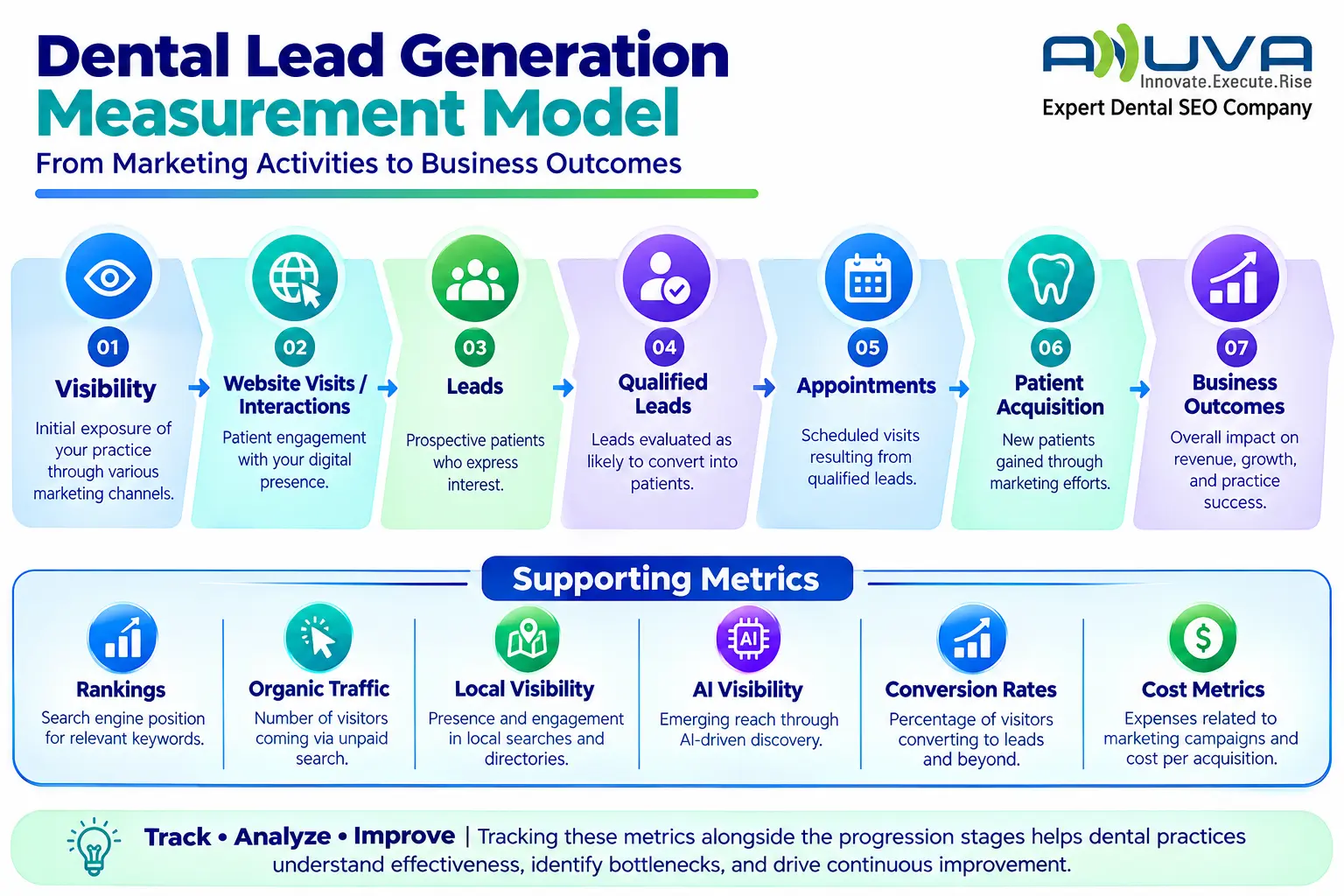
Step 9: Measure Business Outcomes
Lead generation should ultimately be evaluated against business results.
Important measurements can include:
- Leads generated
- Qualified leads
- Appointment requests
- Appointments booked
- Lead-to-appointment rate
- Cost per lead
- Cost per qualified lead
- Cost per acquisition
- Treatment value
- Revenue contribution
- Conversion rates
The exact measurement framework should reflect the practice’s business model and available data.
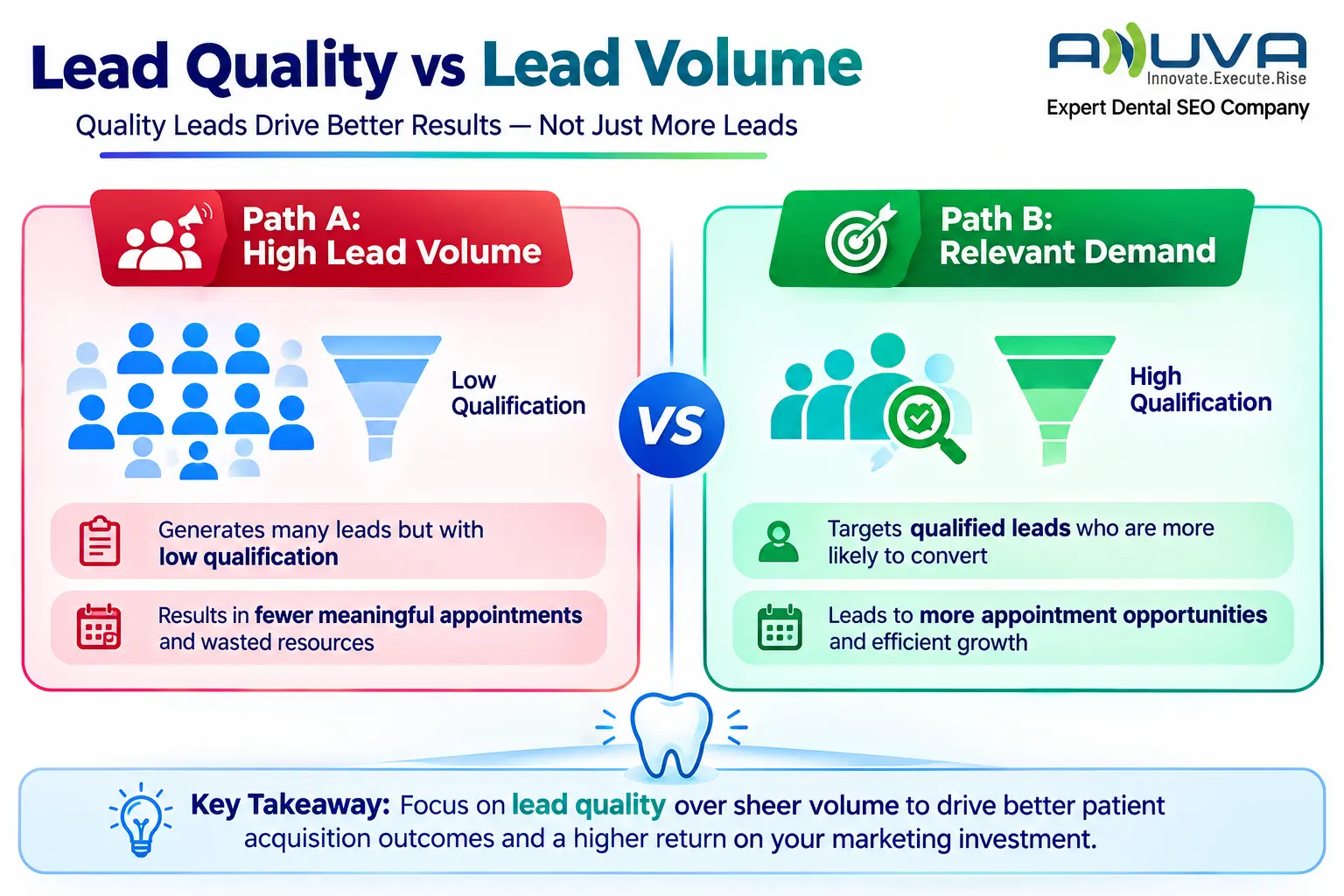
Lead Volume vs Lead Quality
One of the most important principles in dental lead generation is:
More leads do not necessarily mean better lead generation.
Consider two hypothetical scenarios.
Scenario A
100 enquiries generate:
- 20 qualified opportunities
- 10 appointments
Scenario B
50 enquiries generate:
- 30 qualified opportunities
- 20 appointments
Scenario B produces fewer enquiries but potentially a stronger business outcome. This is why dental lead generation should not be evaluated using lead volume alone.
What Makes a Dental Lead Qualified?
Qualification depends on the practice.
A qualified lead generally has stronger alignment with the practice’s:
- Services
- Location
- Patient profile
- Treatment availability
- Appointment model
- Business priorities
The definition should be established before marketing performance is evaluated. Otherwise, a campaign may appear successful simply because it generates large numbers of low-value enquiries.
Common Dental Lead Generation Mistakes
Mistake 1: Focusing Only on Traffic
Traffic is not the final objective.
A practice needs meaningful patient opportunities.
Mistake 2: Treating Every Lead as Equal
Different treatments and patient types can have different strategic value.
Mistake 3: Using One Generic Landing Page
Different search intents often require different experiences.
Mistake 4: Ignoring Local Search
For many dental practices, geographic relevance is fundamental to patient acquisition.
Mistake 5: Sending Paid Traffic to Weak Pages
Paid traffic cannot compensate indefinitely for poor landing-page experience.
Mistake 6: Hiding the Next Step
Patients should not have to search for how to contact or book with the practice.
Mistake 7: Ignoring Mobile Users
Many patients interact with dental websites from mobile devices.
The conversion pathway must work effectively on smaller screens.
Mistake 8: Measuring Forms but Not Appointments
A form submission is not necessarily an appointment.
Measurement should progress toward meaningful business outcomes.
Mistake 9: Ignoring Reputation
Patients may evaluate reviews before contacting a practice.
Mistake 10: Treating Lead Generation as a Single Channel
SEO, local search, paid search, content, website experience, reputation, and conversion optimization can work together.
Lead generation is a system.
Dental Lead Generation and SEO
SEO and lead generation are closely connected but are not identical.
SEO primarily helps a practice become discoverable for relevant searches.
Lead generation continues beyond discovery.
The progression is:
Search Visibility → Relevant Visit → Trust → Conversion → Lead → Appointment
A page can rank well and still underperform as a lead-generation asset.
This is why search strategy and conversion strategy should be considered together.
Dental Lead Generation and Google Ads
Google Ads can provide access to active search demand.
However, campaign success depends on more than impressions and clicks.
A stronger evaluation sequence is:
Search → Click → Landing Page → Enquiry → Qualified Lead → Appointment → Business Value
A campaign generating inexpensive clicks but weak appointments may not be commercially effective.
Dental Lead Generation and AI Search
AI-powered search is creating additional discovery environments for patients.
People increasingly use conversational systems to ask questions such as:
- How do dentists get more patients?
- What should I look for in a dentist?
- What is the best treatment option?
- How much does dental treatment cost?
- How do I find a dentist near me?
For dental practices, AI visibility should be treated as an extension of broader search visibility and digital authority. A practice cannot guarantee that an AI system will mention it.
However, it can improve the quality and accessibility of its digital information through:
- Strong website content
- Clear service information
- Structured information
- Consistent entity signals
- Local authority
- Reputation
- Helpful educational content
- Strong topical coverage
The objective is to make the practice’s information easier for search and AI systems to understand and retrieve.
Dental Lead Generation and Entity Authority
Lead generation increasingly depends on whether digital systems can understand the practice as a real, relevant entity.
A strong digital entity can connect:
Practice → Doctors → Services → Locations → Specialties → Content → Reviews → External Signals
This supports both traditional search and emerging AI discovery environments.
Entity development does not replace lead generation.
It strengthens the information foundation supporting discovery and trust.
The EDSC Approach to Dental Lead Generation
EDSC approaches dental lead generation as part of a broader growth system. The objective is to connect visibility, relevance, confidence, conversion, and improvement rather than optimize isolated marketing activities.
The system can be represented as:
1. Visibility
Make the practice discoverable where relevant patient demand exists.
2. Relevance
Match the practice’s services, location, expertise, and content to patient intent.
3. Confidence
Give prospective patients enough information to evaluate the practice.
4. Conversion
Make the next action clear and reduce unnecessary friction.
5. Improvement
Use performance data to identify opportunities for refinement. This is the operating logic of the EDSC Patient Acquisition Framework™.
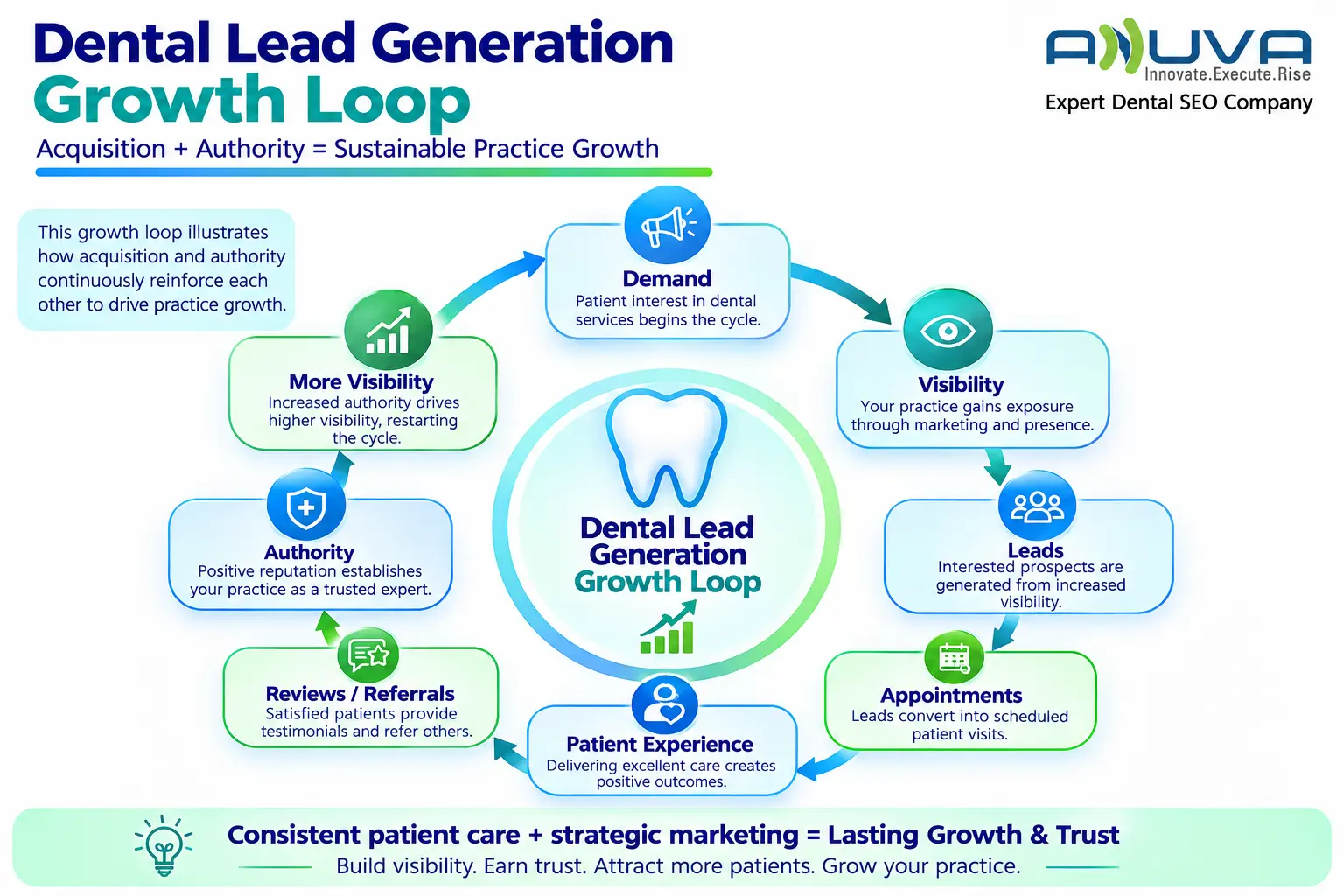
Dental Lead Generation as a Growth Loop
Lead generation should not be viewed as a one-way funnel.
It can also become a feedback loop.
Demand → Visibility → Leads → Appointments → Patient Experience → Reviews / Referrals → Authority → More Visibility
The more effectively the system operates, the more signals can reinforce future growth.
This is why lead generation should connect with reputation, content, authority, analytics, and patient experience.
How to Evaluate a Dental Lead Generation Agency
A dental practice evaluating an agency should look beyond promises about rankings, traffic, or lead volume.
Important questions include:
Does the agency understand dentistry?
A dental-specific strategy should account for:
- Dental search behavior
- Treatment intent
- Local competition
- Patient trust
- Practice economics
- Appointment conversion
Does the agency connect marketing channels?
A fragmented approach can create disconnected campaigns.
Does the agency measure qualified outcomes?
Ask how the agency distinguishes:
- Traffic
- Leads
- Qualified leads
- Appointments
- Business outcomes
Does the agency understand conversion?
Generating traffic without creating an effective conversion experience leaves value on the table.
Does the agency build long-term authority?
A sustainable system should improve the practice’s digital presence rather than rely exclusively on short-term campaigns.
How Long Does Dental Lead Generation Take?
There is no universal timeline.
The time required depends on factors such as:
- Current visibility
- Market competition
- Practice location
- Existing website quality
- Reputation
- Domain and content authority
- Paid media investment
- Treatment demand
- Conversion performance
- Existing infrastructure
- Implementation speed
Paid campaigns can produce enquiries more quickly because they access existing search demand directly. SEO and authority-building strategies generally require more time to develop. The strongest systems often combine immediate acquisition opportunities with longer-term visibility and authority development.
What Should a Dental Practice Do First?
A practice beginning a lead-generation program should avoid immediately launching every available channel. Start with the fundamentals.
1. Define the business goal
Identify which services, locations, and patient opportunities matter most.
2. Assess existing demand
Understand how prospective patients currently search.
3. Evaluate visibility
Review organic search, local search, Google Business Profile, paid search, and other discovery surfaces.
4. Evaluate conversion
Determine whether existing visitors can easily understand and contact the practice.
5. Establish measurement
Create a clear distinction between traffic, leads, qualified leads, appointments, and business outcomes.
6. Prioritize opportunities
Focus resources on the highest-value gaps rather than trying to optimize everything simultaneously.
Dental Lead Generation Technology
Technology can support lead generation, but technology itself is not the strategy.
Potential components include:
- Analytics platforms
- Call tracking
- CRM systems
- Appointment systems
- Form tracking
- Marketing automation
- Reporting dashboards
- Search platforms
- Advertising platforms
- Website tools
- AI-assisted systems
The objective should always be to improve the patient acquisition process.
The Role of Automation
Automation can help practices manage repetitive communication and operational tasks.
Potential applications include:
- Lead notifications
- Follow-up workflows
- Appointment reminders
- Enquiry routing
- Lead tracking
- Reporting
- Patient communication
Automation should support the patient experience rather than create unnecessary friction or impersonal communication.
The Role of Analytics
Analytics turns lead generation from guesswork into an improvement process.
A useful measurement structure is:
Visibility Metrics
- Organic visibility
- Local visibility
- Search impressions
- Paid search visibility
- Brand searches
Acquisition Metrics
- Website sessions
- Calls
- Forms
- Consultation requests
- Other enquiries
Quality Metrics
- Qualified leads
- Treatment relevance
- Geographic relevance
- Lead quality
Conversion Metrics
- Lead-to-appointment rate
- Landing-page conversion rate
- Appointment booking rate
- Cost per qualified lead
Business Metrics
- Patient acquisition cost
- Treatment value
- Revenue contribution
- Retention and referral indicators where measurable
The objective is to connect marketing activity to business performance.
Dental Lead Generation Checklist
A dental practice should be able to answer “yes” to many of the following questions.
Strategy
- Do we know which services we want to grow?
- Do we understand our highest-value patient opportunities?
- Do we know which locations require growth?
- Do we understand patient search intent?
Visibility
- Can patients find us through relevant Google searches?
- Is our local presence strong?
- Is our Google Business Profile properly managed?
- Are our key treatment services discoverable?
- Are we building useful content?
Trust
- Can prospective patients understand who we are?
- Is doctor information clear?
- Are reviews visible and credible?
- Does the website communicate professionalism?
- Are treatment questions answered?
Conversion
- Is contacting the practice easy?
- Is the phone number easy to find?
- Are appointment pathways clear?
- Does the website work effectively on mobile?
- Are landing pages aligned with search intent?
- Are forms appropriately designed?
Measurement
- Are enquiries being tracked?
- Can we identify qualified leads?
- Can we measure appointments?
- Do we know cost per lead?
- Do we know cost per qualified lead?
- Can we connect marketing activity to business outcomes?
Frequently Asked Questions About Dental Lead Generation
Dental lead generation is the process of attracting prospective dental patients and converting their interest into identifiable opportunities such as enquiries, consultation requests, or appointment opportunities.
Dentists can generate leads through organic search, local SEO, Google Business Profile, Google Ads, websites, landing pages, content, reputation, referrals, social channels, email, and other digital acquisition methods. The strongest approach depends on the practice’s market, services, goals, and patient demand.
There is no single best channel for every dental practice. A strong system generally combines relevant visibility, patient-focused information, trust signals, effective conversion pathways, and measurement of qualified outcomes.
Start by identifying high-value services and patient demand, improve visibility for relevant searches, create intent-aligned website experiences, strengthen trust, reduce conversion friction, and measure qualified leads and appointments rather than lead volume alone.
SEO can be an effective component of dental lead generation because it can connect practices with patients actively researching dental services. Its effectiveness depends on search intent, competition, visibility, website experience, and conversion performance.
Google Ads can provide access to active search demand, particularly for high-intent services. Performance should be evaluated through the complete path from click to qualified lead and appointment rather than clicks alone.
Possible reasons include poor intent alignment, weak trust signals, unclear calls to action, difficult forms, poor mobile experience, irrelevant traffic, weak landing pages, or a disconnect between the visitor’s expectations and the website experience.
A lead is a prospective patient who has taken an identifiable action or expressed interest. A patient has progressed into an actual patient relationship. The stages between the two should be measured separately.
A qualified dental lead is an enquiry that aligns sufficiently with the practice’s services, location, patient profile, treatment availability, and other practice-specific criteria to represent a meaningful opportunity.
Practices should measure the progression from visibility and acquisition through leads, qualified leads, appointments, and business outcomes. Traffic and rankings can provide useful supporting indicators but should not be treated as the final measure of success.
There is no fixed timeline. Paid acquisition can access existing demand relatively quickly, while SEO, content, authority, and other long-term strategies generally require continued development. Results depend on the practice, market, competition, implementation, and existing digital foundation.
AI search can become another discovery environment for prospective patients. Dental practices can improve their readiness for AI-powered discovery by building clear, authoritative, consistent, and useful digital information. However, AI visibility or citations cannot be guaranteed.
Final Takeaway
Dental lead generation is not simply the process of getting more people to visit a website.
It is the process of building a system that turns relevant patient demand into meaningful business opportunities.
The strongest systems connect:
Patient Demand → Visibility → Relevance → Confidence → Conversion → Qualified Lead → Appointment → Patient Experience → Continuous Improvement
For dental practices, this means combining the right acquisition channels with a strong website, relevant treatment experiences, local visibility, reputation, conversion optimization, measurement, and ongoing improvement.
The goal is not simply to generate more activity.
The goal is to create a more predictable path from patient discovery to patient acquisition and practice growth.