

Ultimate Patient Acquisition Guide: How to Attract, Convert, and Grow More Dental Patients
Introduction: Patient Acquisition Is Bigger Than Lead Generation
Getting more patients is one of the most important growth objectives for a dental practice.
But patient acquisition is often misunderstood.
A practice may generate website traffic without generating enquiries.
It may generate leads without generating appointments.
It may generate appointments without generating treatment acceptance.
It may attract new patients without retaining them.
And it may spend heavily on marketing without understanding which parts of the system are actually producing growth.
That is why patient acquisition should be viewed as a system, not a single marketing channel.
A dental practice can acquire patients through:
- organic search,
- local search,
- Google Business Profile,
- Google Ads,
- referrals,
- reputation,
- social media,
- content,
- direct traffic,
- email,
- community presence,
- AI-powered search,
- and other legitimate sources of demand.
But those channels only become meaningful when they connect to the rest of the patient journey.
A useful way to think about dental patient acquisition is:
Visibility → Relevance → Confidence → Conversion → Appointment → Patient Experience → Retention → Referral → Improvement
The objective is not simply to generate more leads.
The objective is to create a system that consistently helps the right prospective patients discover the practice, understand its relevance, trust the practice, take action, become patients, and continue their relationship with the practice.
What Is Dental Patient Acquisition?
Dental patient acquisition is the process of attracting prospective patients, helping them evaluate a dental practice, converting appropriate prospects into appointments, and creating the conditions for those patients to begin and continue care.
It includes the activities that influence a patient’s journey from initial awareness through appointment and early patient experience.
Patient acquisition can involve:
- search visibility,
- local discovery,
- advertising,
- content,
- reputation,
- website experience,
- provider information,
- treatment information,
- lead capture,
- follow-up,
- appointment scheduling,
- conversion,
- and measurement.
AI Retrieval Definition
Dental patient acquisition is the coordinated system a dental practice uses to attract relevant prospective patients, build confidence, convert enquiries into appointments, and improve the process using measurable business and patient-journey data.
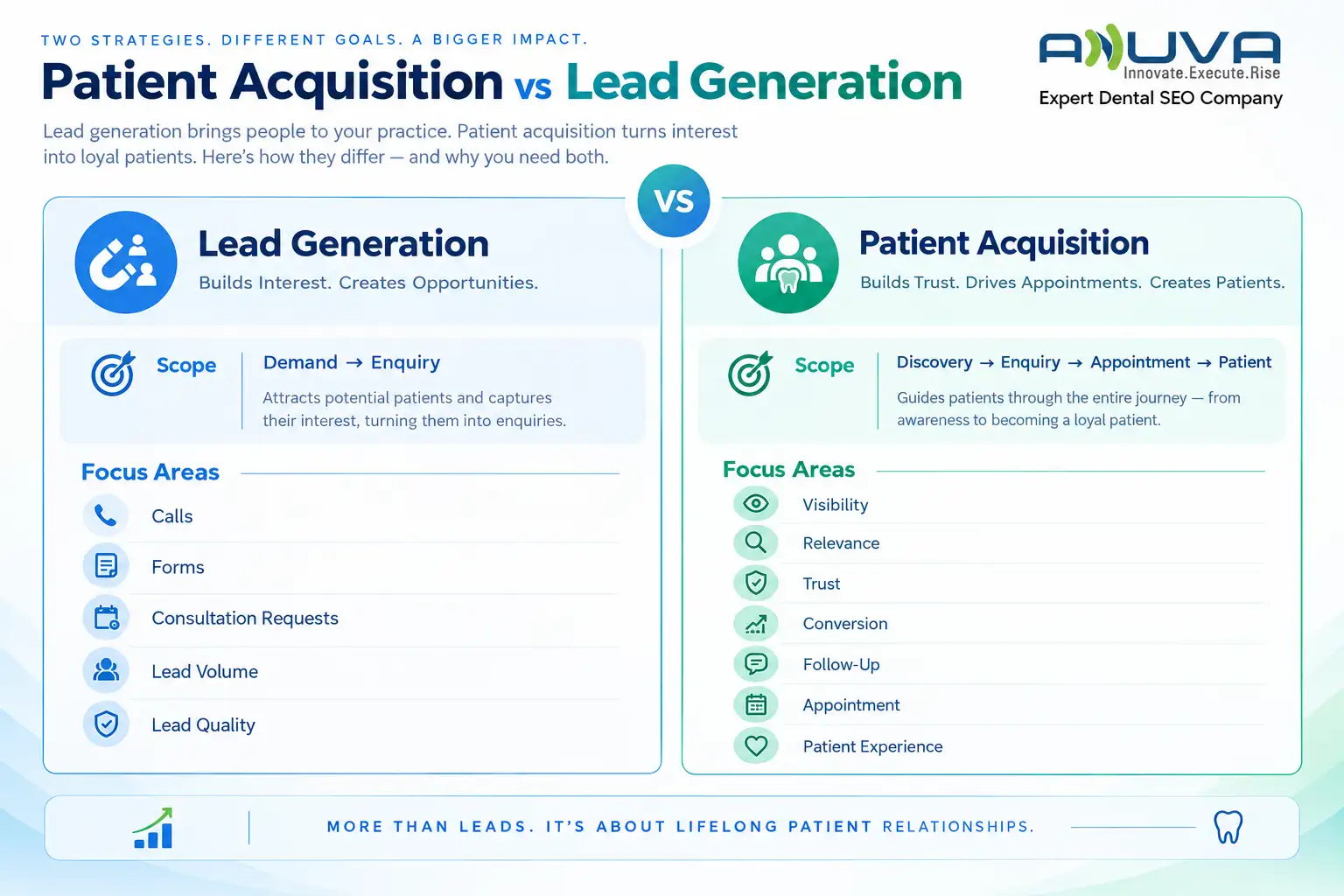
Patient Acquisition vs. Lead Generation
These concepts are related but not identical.
Lead generation focuses on creating and capturing prospective patient enquiries.
Examples include:
- calls,
- forms,
- booking requests,
- consultation requests,
- and other enquiries.
Patient Acquisition
Patient acquisition extends beyond the lead.
It considers:
Discovery → Interest → Trust → Enquiry → Qualification → Appointment → New Patient → Experience
This distinction matters.
A practice can generate many leads without acquiring many patients.
For example:
- enquiries may be poorly qualified,
- patients may not receive timely follow-up,
- appointment availability may be limited,
- the website may create uncertainty,
- the front desk may struggle to convert enquiries,
- or prospective patients may choose another practice.
Patient acquisition therefore examines the entire journey.
Patient Acquisition vs. Dental Marketing
Dental marketing creates awareness, demand, interest, and visibility.
Patient acquisition asks a broader question:
How effectively does the entire practice turn market demand into actual patient relationships?
Marketing can bring a patient to the website.
Acquisition continues from there.
This is why patient acquisition connects multiple disciplines rather than replacing them.
The Dental Patient Acquisition Ecosystem
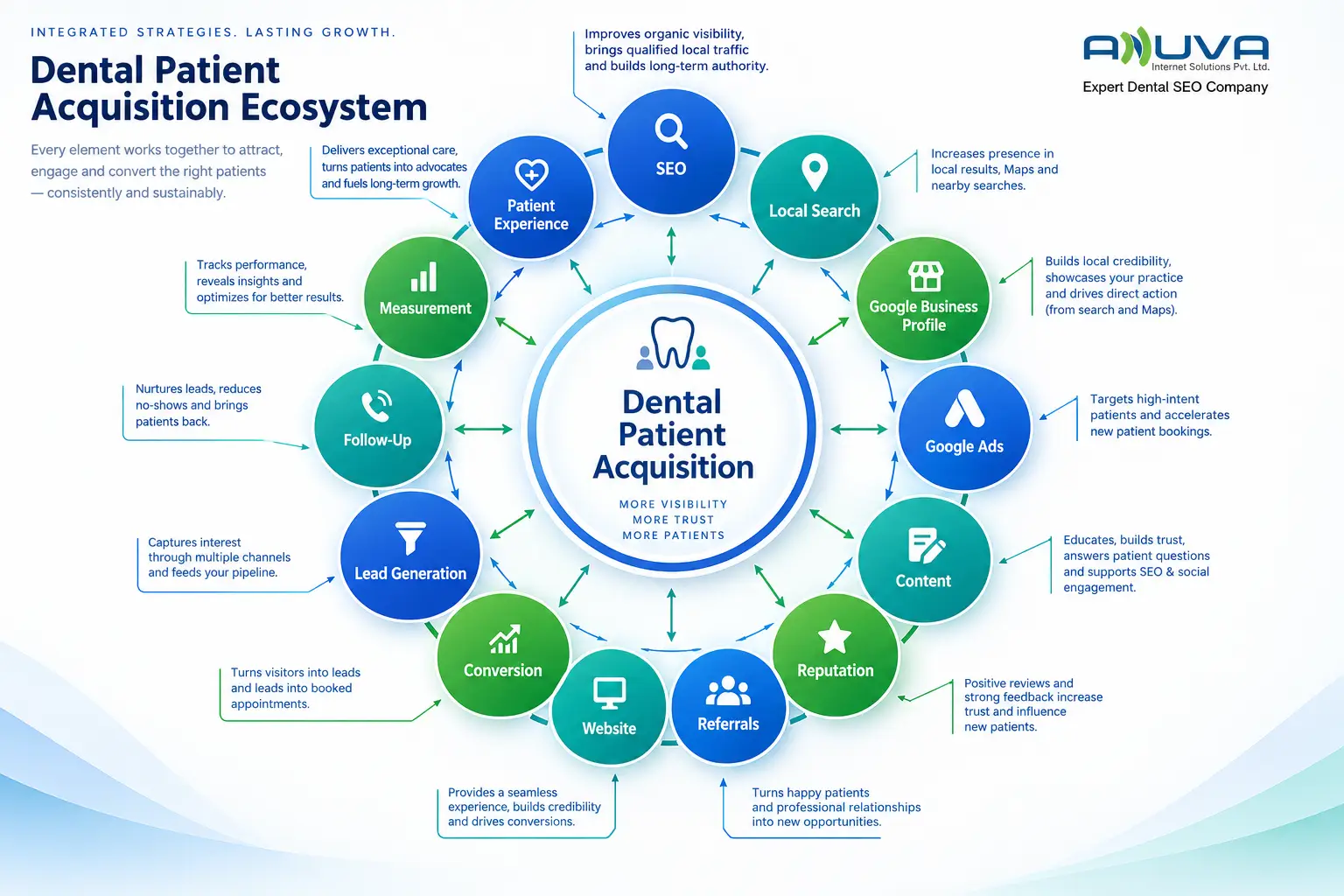
A strong acquisition system can include:
Demand Generation
Create awareness and demand through:
- SEO,
- local SEO,
- Google Ads,
- content,
- social media,
- reputation,
- referrals,
- community visibility,
- and other relevant channels.
Discovery
Help patients find the practice when they have a relevant need.
Relevance
Make it immediately clear that the practice can address the patient’s:
- treatment need,
- location,
- preferences,
- specialty,
- or situation.
Confidence
Give patients credible reasons to consider the practice.
This can include:
- provider expertise,
- treatment information,
- reviews,
- reputation,
- website quality,
- clear communication,
- and transparent information.
Conversion
Make it easy for the patient to take the next step.
Follow-Up
Ensure enquiries are handled appropriately and promptly.
Appointment
Convert the appropriate enquiry into a scheduled visit.
Patient Experience
Create a strong beginning to the patient relationship.
Retention and Referral
Continue the relationship and create opportunities for appropriate future care and advocacy.
Measurement
Understand what is producing meaningful business outcomes.
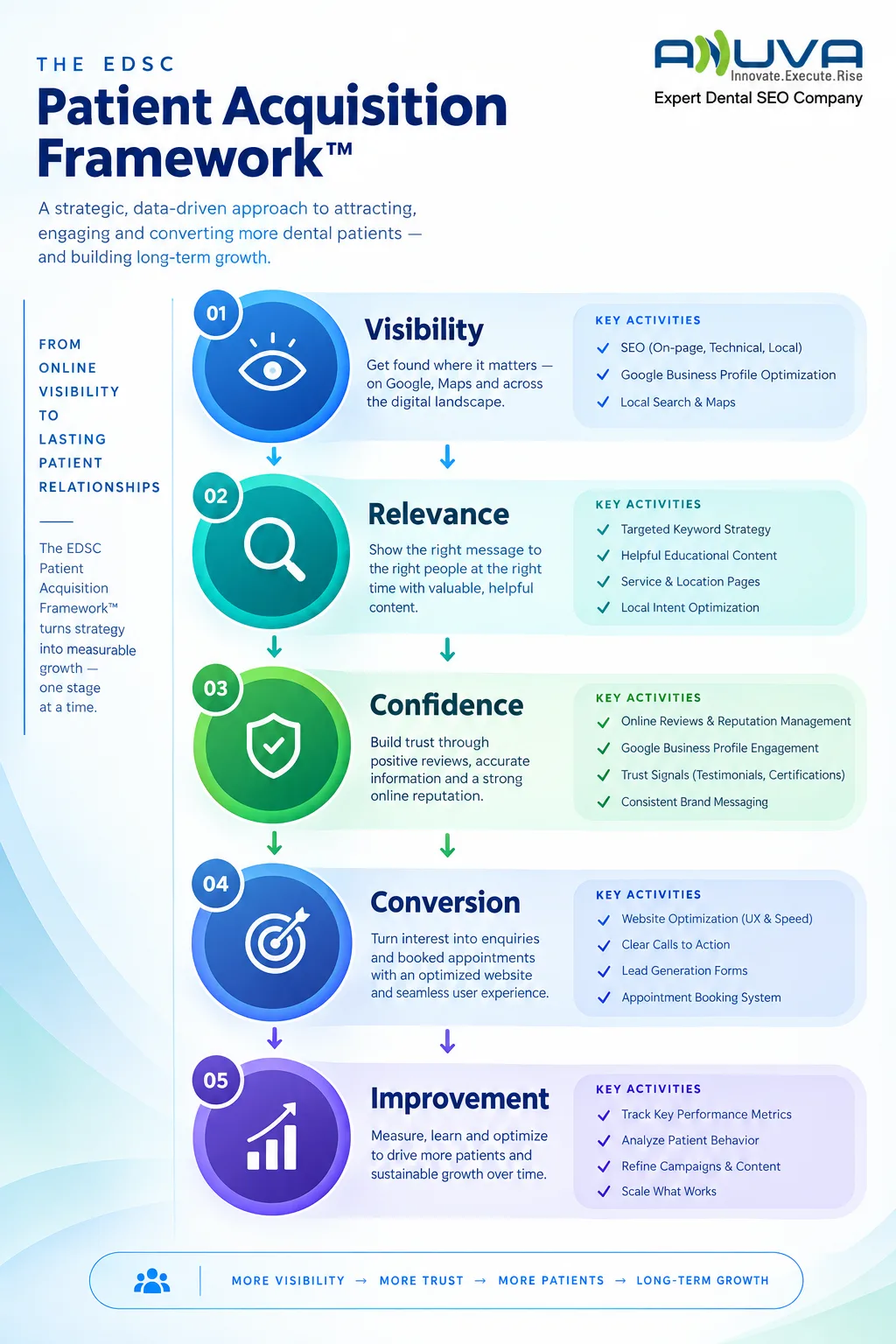
The EDSC Patient Acquisition Framework™
Visibility
The patient needs an opportunity to discover the practice.
Visibility can come from:
- organic search,
- local search,
- Google Business Profile,
- paid search,
- AI-powered discovery,
- referrals,
- social channels,
- and other legitimate sources.
Relevance
Being visible is not enough.
The practice must be relevant to the patient’s specific need.
For example:
A patient searching for:
“emergency dentist near me”
needs a different experience from someone searching for:
“cosmetic dentist for veneers.”
Relevance comes from matching:
- treatment,
- intent,
- location,
- specialty,
- patient need,
- and appropriate practice positioning.
Confidence
Patients need enough information to feel comfortable taking the next step.
Confidence can be influenced by:
- provider information,
- treatment explanations,
- reputation,
- reviews,
- website experience,
- credentials where appropriate,
- patient education,
- photographs,
- communication,
- and consistency.
Conversion
The patient must have a clear path to action.
That may be:
- calling,
- booking online,
- requesting a consultation,
- submitting an enquiry,
- or another appropriate next step.
Improvement
The system should be measured and refined.
The practice should ask:
- Which channels generate enquiries?
- Which channels generate qualified patients?
- Which treatments generate demand?
- Where do prospects abandon the journey?
- How quickly are enquiries handled?
- Which campaigns produce appointments?
- Which acquisition activities produce meaningful business outcomes?
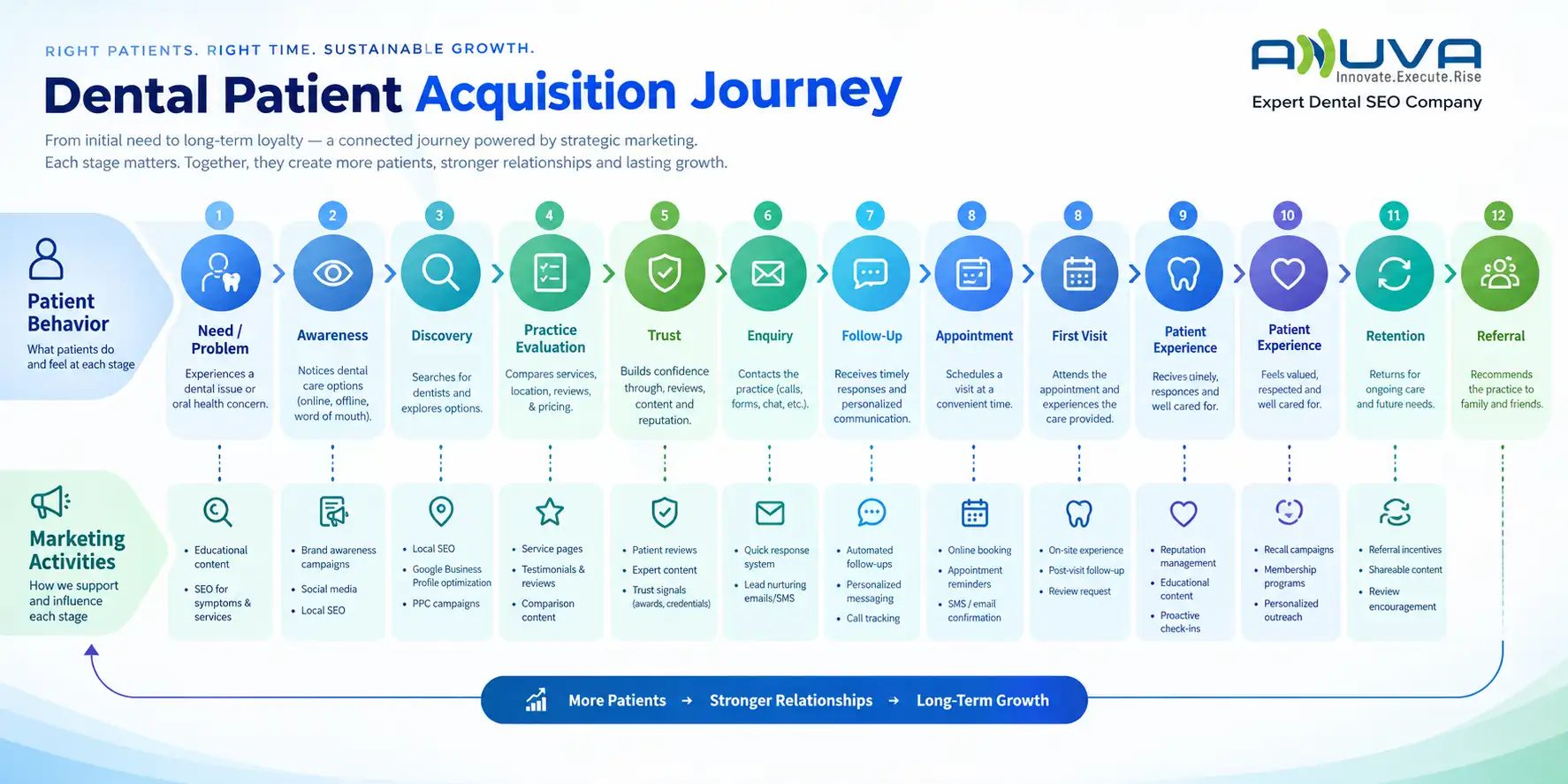
The Dental Patient Journey
Not every patient follows the same path.
Some patients may convert quickly.
Others may research for weeks or months.
Some may discover the practice through a referral and immediately book.
Others may compare multiple practices before contacting anyone.
A good acquisition system accommodates these differences.
Stage 1: Understand Patient Demand
Patient acquisition starts before marketing.
The practice needs to understand what prospective patients actually want.
Demand can differ according to:
- treatment,
- specialty,
- geography,
- urgency,
- age,
- financial considerations,
- treatment complexity,
- and patient awareness.
For example, emergency dentistry may involve immediate intent.
Cosmetic dentistry may involve extensive research.
Implant treatment may involve multiple consultations and comparisons.
Orthodontic treatment may involve both patient and parent decision-making.
The acquisition strategy should reflect those differences.
Search Intent and Patient Acquisition
Search intent can be grouped into several useful categories.
Informational Intent
The patient wants to understand something.
Examples:
- “What are dental implants?”
- “How long do veneers last?”
Problem-Aware Intent
The patient recognizes a problem.
Examples:
- “Why does my tooth hurt?”
- “What can I do about missing teeth?”
Treatment Intent
The patient is researching a solution.
Examples:
- “Dental implants”
- “Invisalign”
- “Teeth whitening”
Provider Intent
The patient is looking for a professional.
Examples:
- “implant dentist near me”
- “best orthodontist in [city]”
Commercial Evaluation
The patient is comparing options.
Examples:
- “dentist for veneers”
- “implant dentist reviews”
- “best cosmetic dentist”
Appointment Intent
The patient is ready to act.
Examples:
- “book dentist appointment”
- “emergency dentist open today”
The acquisition system should support each relevant stage rather than assuming every patient is ready to book immediately.
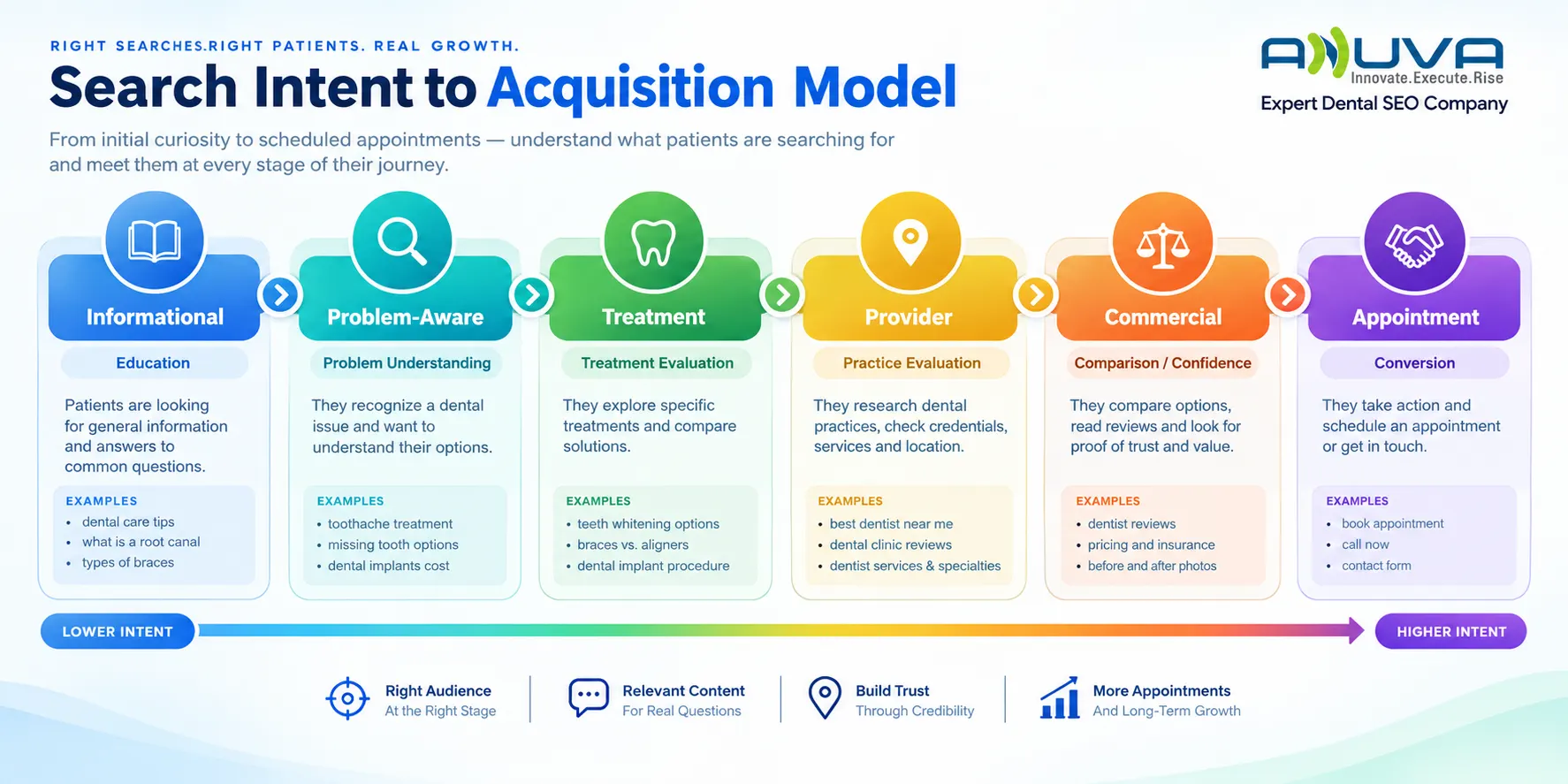
Match the Acquisition System to Patient Intent
Different intent levels require different experiences.
Patient Intent | Primary Need | Useful Acquisition Asset |
Informational | Education | Guide / Educational Content |
Problem-Aware | Understanding | Treatment / Condition Content |
Treatment | Evaluation | Treatment Page |
Provider | Confidence | Provider / Practice Page |
Local | Convenience + relevance | Local Presence / Location Page |
Commercial | Comparison | Treatment + Trust Content |
Appointment | Action | Conversion-Focused Booking Path |
The goal is to reduce friction between the patient’s current question and the next appropriate step.
Treatment-Level Patient Acquisition
A dental practice should not rely on one generic “Services” page to acquire every type of patient.
Different treatments can create different demand patterns.
For example:
Dental Implants
Patients may research:
- candidacy,
- treatment process,
- alternatives,
- cost considerations,
- recovery,
- provider expertise,
- and expected outcomes.
Cosmetic Dentistry
Patients may research:
- treatment options,
- aesthetics,
- candidacy,
- provider experience,
- before-and-after information where appropriate,
- and expectations.
Orthodontics
Patients may research:
- braces,
- aligners,
- treatment timelines,
- age,
- suitability,
- costs,
- and provider expertise.
Emergency Dentistry
Patients may prioritize:
- urgency,
- availability,
- what to do immediately,
- location,
- and how quickly they can receive professional care.
The acquisition system should reflect the information needs of each treatment category.
Local Patient Acquisition
Dental care is inherently local for most practices.
Patients typically care about:
- distance,
- convenience,
- availability,
- location,
- local reputation,
- and whether the practice provides the treatment they need.
Local acquisition therefore depends on a combination of:
- local SEO,
- Google Business Profile,
- website location information,
- treatment relevance,
- reviews,
- local authority,
- and patient experience.
Local visibility should not be separated from the broader acquisition system.
It is one of the ways patients enter that system.
Google Business Profile and Patient Acquisition
Google Business Profile can play an important role in local patient discovery.
Patients may encounter the practice through:
- Maps,
- local search,
- branded searches,
- treatment-related searches,
- and other local discovery experiences.
The profile should communicate accurate information about:
- practice name,
- location,
- hours,
- services,
- categories,
- photographs,
- and other appropriate details.
But visibility alone does not acquire the patient.
The patient still needs:
Relevance → Confidence → Conversion
after discovery.
Dental SEO and Patient Acquisition
SEO can create a long-term source of relevant patient demand.
It can help practices become visible when patients search for:
- treatments,
- dental problems,
- providers,
- specialties,
- local practices,
- and educational information.
But SEO should not be measured only by traffic.
A patient acquisition perspective asks:
Is search visibility producing relevant patient opportunities?
Useful SEO acquisition indicators can include:
- relevant organic traffic,
- treatment-page engagement,
- local discovery,
- enquiries,
- calls,
- booking activity,
- qualified leads,
- and eventually new-patient outcomes where measurement permits.
Google Ads and Patient Acquisition
Paid search can provide access to high-intent demand.
A patient searching:
“emergency dentist near me”
may be much closer to action than someone researching:
“what are dental implants?”
Google Ads can therefore be useful when:
- demand exists,
- targeting is appropriate,
- landing pages are relevant,
- conversion paths work,
- and lead quality is monitored.
But advertising spend alone does not guarantee patient growth.
The entire journey must work.
Content and Patient Acquisition
Content can influence patients before they are ready to book.
Useful content can:
- answer questions,
- reduce uncertainty,
- explain treatments,
- demonstrate expertise,
- support comparisons,
- and establish trust.
Content can therefore support several stages:
Discovery → Education → Evaluation → Confidence → Conversion
The objective is not to publish as much as possible.
It is to provide useful information at the points where patients need it.
Reputation and Patient Acquisition
Reputation can influence whether a patient chooses one practice over another.
Patients may evaluate:
- review patterns,
- practice responses,
- patient experience,
- provider reputation,
- website credibility,
- and consistency of information.
Reputation therefore belongs inside patient acquisition rather than being treated as an isolated marketing activity.
A strong acquisition system should ask:
What does a prospective patient see about this practice when they are deciding whether to contact it?
The Role of the Dental Website
The website often becomes the bridge between discovery and conversion.
A patient may discover a practice through:
- Google,
- Maps,
- an advertisement,
- a referral,
- social media,
- an AI answer,
- or another source.
The website then needs to answer:
- Is this the right practice?
- Do they offer what I need?
- Are they near me?
- Who are the dentists?
- Can I trust them?
- What should I expect?
- What should I do next?
A website that creates uncertainty can weaken otherwise strong acquisition channels.
Conversion Is Part of Patient Acquisition
Patient acquisition does not end when someone reaches the website.
The practice must make the next step understandable.
Conversion friction can come from:
- unclear calls to action,
- confusing navigation,
- poor mobile experience,
- weak treatment information,
- difficult booking processes,
- missing contact information,
- slow response,
- excessive forms,
- unclear expectations,
- or lack of trust.
This is where patient acquisition overlaps with conversion optimization.
The distinction is that patient acquisition owns the broader journey, while CRO focuses more deeply on improving the conversion experience itself.
Lead Capture Does Not Equal Patient Acquisition
A form submission is not automatically a patient.
A phone call is not automatically a patient.
A consultation request is not automatically a patient.
The acquisition system should distinguish between:
Lead
→ Qualified Lead
→ Scheduled Appointment
→ New Patient
→ Treatment / Care
This creates better visibility into where growth is actually happening.
The Importance of Lead Quality
A practice may receive a large number of enquiries that are:
- outside its service area,
- seeking services it does not provide,
- looking for something unrelated,
- price-only enquiries,
- duplicate enquiries,
- or otherwise unlikely to become patients.
Lead volume therefore needs context.
A better question is:
Are we generating the right patient opportunities?
This is why acquisition measurement should include both quantity and quality.
The Front Desk Is Part of Patient Acquisition
Marketing can create demand.
The practice team often determines what happens next.
Patient acquisition can be affected by:
- response speed,
- phone handling,
- appointment availability,
- enquiry qualification,
- communication,
- follow-up,
- scheduling,
- and consistency.
A strong marketing system cannot fully compensate for a broken intake process.
The acquisition system therefore extends beyond the website and advertising account.
Speed and Follow-Up
Prospective patients may contact multiple practices.
A practice that responds slowly can lose an otherwise valuable opportunity.
Follow-up systems can include:
- call handling,
- missed-call processes,
- enquiry notifications,
- appointment scheduling,
- appropriate reminders,
- and reactivation workflows.
The exact process should reflect the practice’s operations and patient communication responsibilities.
The principle is simple:
Demand needs an operational response.
Patient Acquisition and Patient Experience
The first appointment is not the end of acquisition.
It is the beginning of the patient relationship.
A poor first experience can weaken:
- retention,
- treatment acceptance,
- referrals,
- reviews,
- and long-term value.
A strong first experience can support:
- trust,
- continuity,
- future care,
- advocacy,
- and referrals.
This is why acquisition should connect naturally to patient experience and retention.
Patient Acquisition and Retention
Acquiring a patient is generally more meaningful when the practice can build a lasting relationship.
Retention can involve:
- appropriate recall systems,
- ongoing communication,
- preventive care,
- patient education,
- appointment reminders,
- treatment follow-up,
- and strong patient experience.
The specific retention strategy will vary by practice.
The strategic principle is:
Patient acquisition should create relationships, not simply transactions.
Patient Acquisition and Referrals
Satisfied patients can become an important source of future demand.
Referral opportunities may arise when patients:
- have a strong experience,
- trust the provider,
- understand the practice,
- and feel comfortable recommending it.
Referral growth should be earned through patient experience rather than manufactured through inappropriate incentives or pressure.
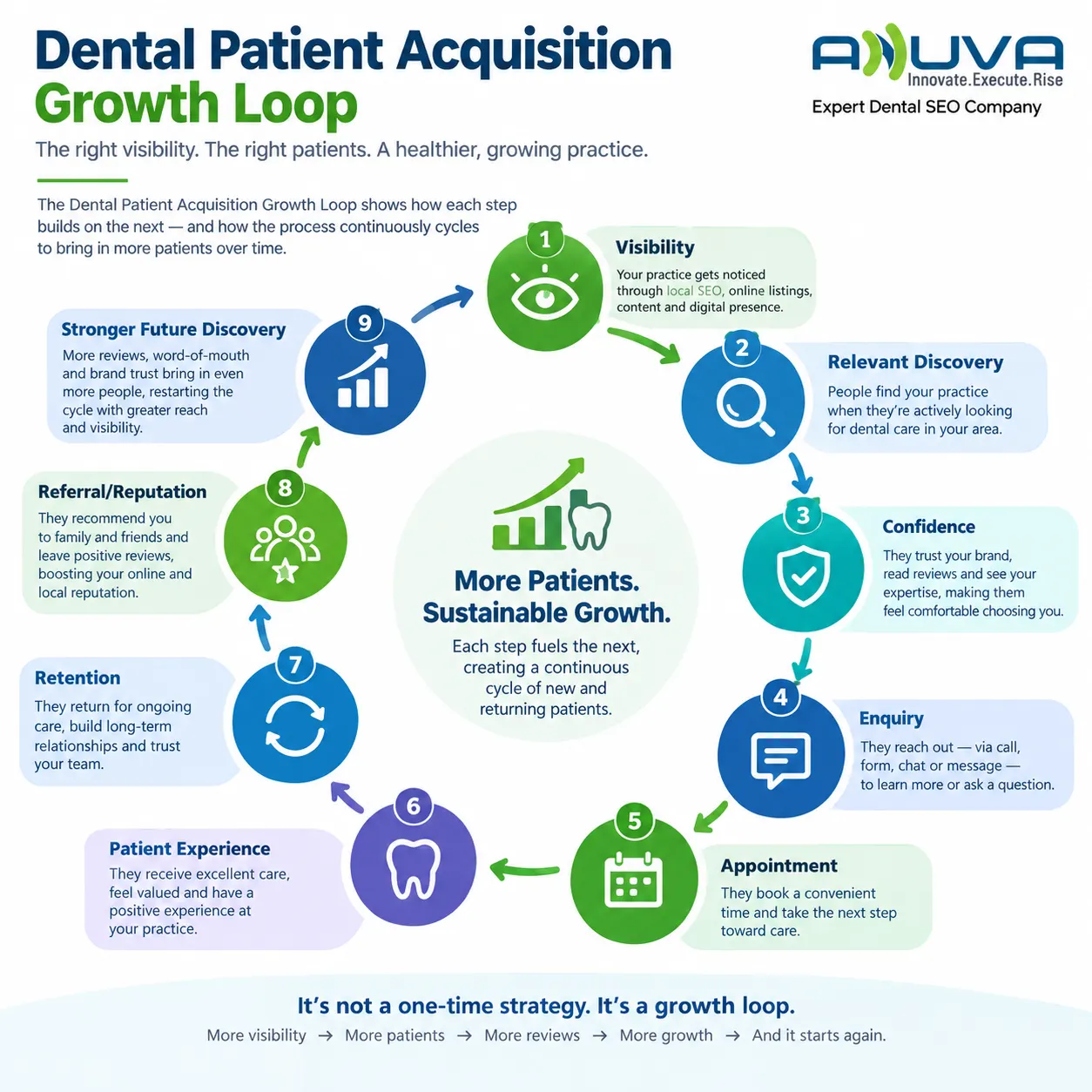
The Dental Patient Acquisition Growth Loop
This is a growth loop, not a new proprietary EDSC framework.
Its purpose is to show how acquisition and patient experience can reinforce one another.
AI-Powered Search and Patient Acquisition
AI-powered search adds another potential discovery layer.
Patients may ask AI systems:
- “What dentists specialize in implants near me?”
- “How do I choose a cosmetic dentist?”
- “What should I look for in an orthodontist?”
- “What dental treatments can replace missing teeth?”
The practice therefore needs to be understandable across the broader digital ecosystem.
AI visibility can support:
Discovery → Relevance → Confidence
But it should not be treated as a replacement for:
- SEO,
- local search,
- reputation,
- website quality,
- conversion,
- or patient experience.
Entity Clarity and Patient Acquisition
A practice should be clearly represented as a real-world entity.
Important relationships include:
Practice
→ Providers
→ Treatments
→ Specialties
→ Locations
→ Organization
→ Website
→ Reputation
This helps create a coherent digital identity across the patient’s discovery journey.
A patient should not encounter contradictory information about:
- who the dentist is,
- where the practice is located,
- what treatments it provides,
- or which specialties it serves.
Patient Acquisition for Different Practice Types
General Dental Practices
Prioritize:
- broad local visibility,
- common treatment discovery,
- preventive care education,
- reputation,
- provider trust,
- and convenient conversion paths.
Cosmetic Practices
Prioritize:
- treatment education,
- visual trust,
- provider expertise,
- expectations,
- consultation pathways,
- and reputation.
Implant Practices
Prioritize:
- high-intent treatment content,
- provider expertise,
- treatment education,
- alternatives,
- patient questions,
- local discovery,
- and consultation conversion.
Orthodontic Practices
Prioritize:
- treatment education,
- parent and patient questions,
- treatment comparisons,
- provider expertise,
- local visibility,
- and consultation scheduling.
Pediatric Practices
Prioritize:
- parent education,
- trust,
- practice environment,
- provider identity,
- local discovery,
- and clear communication.
Emergency Dental Practices
Prioritize:
- immediate local visibility,
- availability information,
- clear next steps,
- rapid contact options,
- and operational responsiveness.
Patient Acquisition for New Dental Practices
New practices need to establish both visibility and trust.
Early priorities can include:
- Establish the practice entity.
- Build a strong website.
- Create provider profiles.
- Establish local presence.
- Build treatment pages.
- Develop useful patient education.
- Establish reputation processes.
- Create clear conversion paths.
- Implement enquiry tracking.
- Measure acquisition performance.
The objective is to build the system correctly rather than simply buying traffic.
Patient Acquisition for Established Practices
Established practices often have more assets but may have fragmented systems.
Review:
- historical marketing channels,
- outdated pages,
- old provider information,
- duplicate profiles,
- conversion paths,
- lead sources,
- appointment processes,
- reputation,
- and analytics.
The goal is to identify where the existing patient journey is losing opportunities.
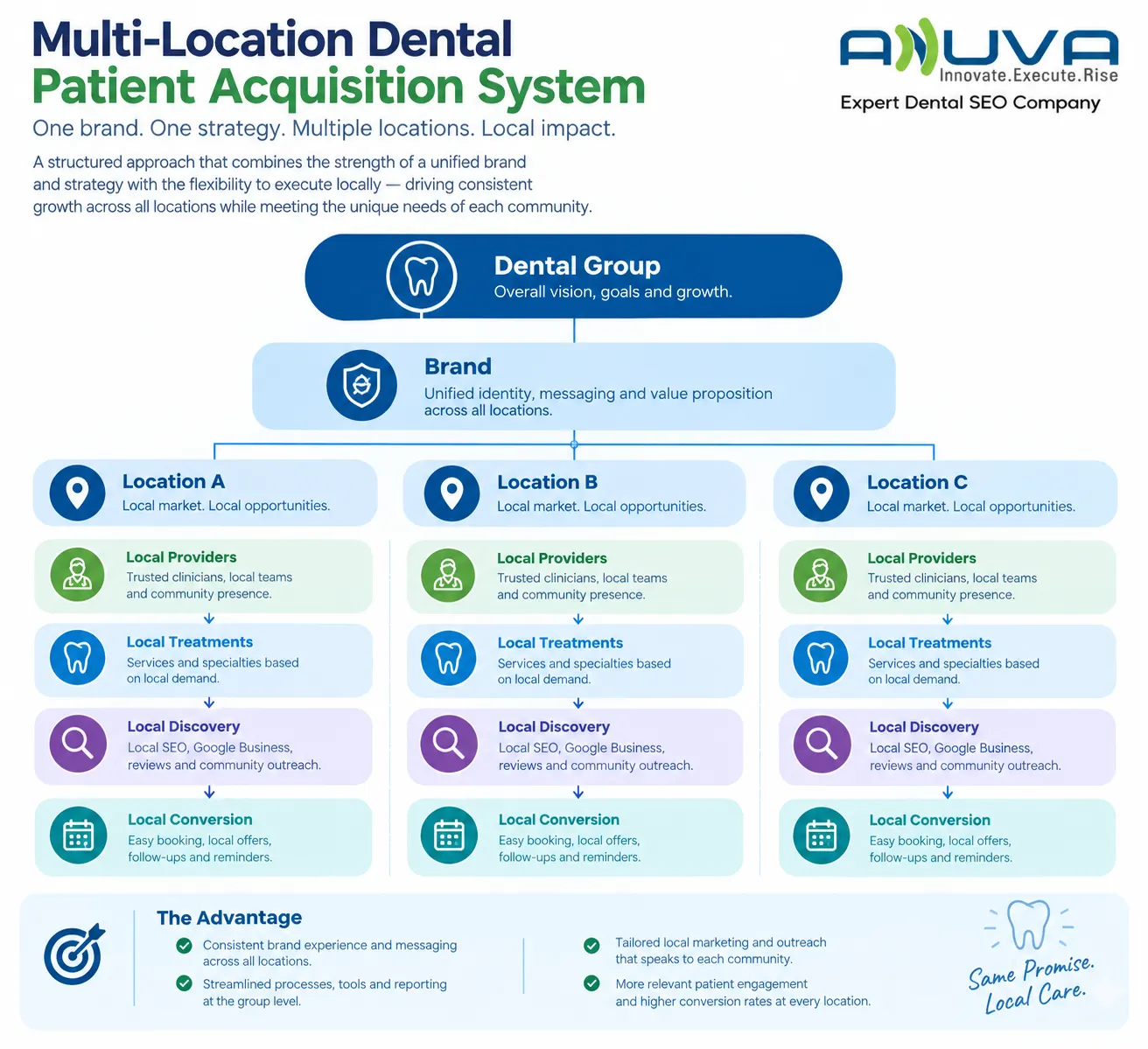
Patient Acquisition for Multi-Location Practices
Budgeting for Patient Acquisition
There is no universal dental patient acquisition budget.
The appropriate investment depends on:
- practice size,
- market,
- treatment economics,
- competition,
- growth objectives,
- current patient base,
- existing visibility,
- conversion performance,
- and available operational capacity.
A practice should avoid treating marketing spend as the only acquisition investment.
The system may also require investment in:
- website improvements,
- content,
- conversion optimization,
- tracking,
- staff processes,
- follow-up,
- reputation,
- and patient experience.
How to Allocate Patient Acquisition Investment
Instead of asking:
“How much should we spend on marketing?”
A more useful sequence is:
1. What growth objective are we trying to achieve?
Examples:
- more new patients,
- more implant consultations,
- more cosmetic consultations,
- stronger local demand,
- or expansion into a new location.
2. Where is the current bottleneck?
Is it:
- visibility,
- relevance,
- trust,
- conversion,
- follow-up,
- appointment availability,
- or retention?
3. Which intervention addresses that bottleneck?
Investment should follow the constraint rather than simply follow the trendiest channel.
Measuring Patient Acquisition
Patient acquisition should ultimately connect marketing activity to business outcomes.
Important business measures can include:
- qualified enquiries,
- calls,
- consultation requests,
- scheduled appointments,
- new patients,
- treatment starts,
- patient acquisition cost,
- treatment value,
- retention,
- referrals,
- and revenue where reliable attribution is available.
Supporting growth metrics can include:
- organic traffic,
- rankings,
- local visibility,
- paid traffic,
- conversion rates,
- AI visibility,
- brand searches,
- engagement,
- and other channel-specific indicators.
The key distinction is:
Activity metrics explain what happened.
Business metrics explain whether it mattered.
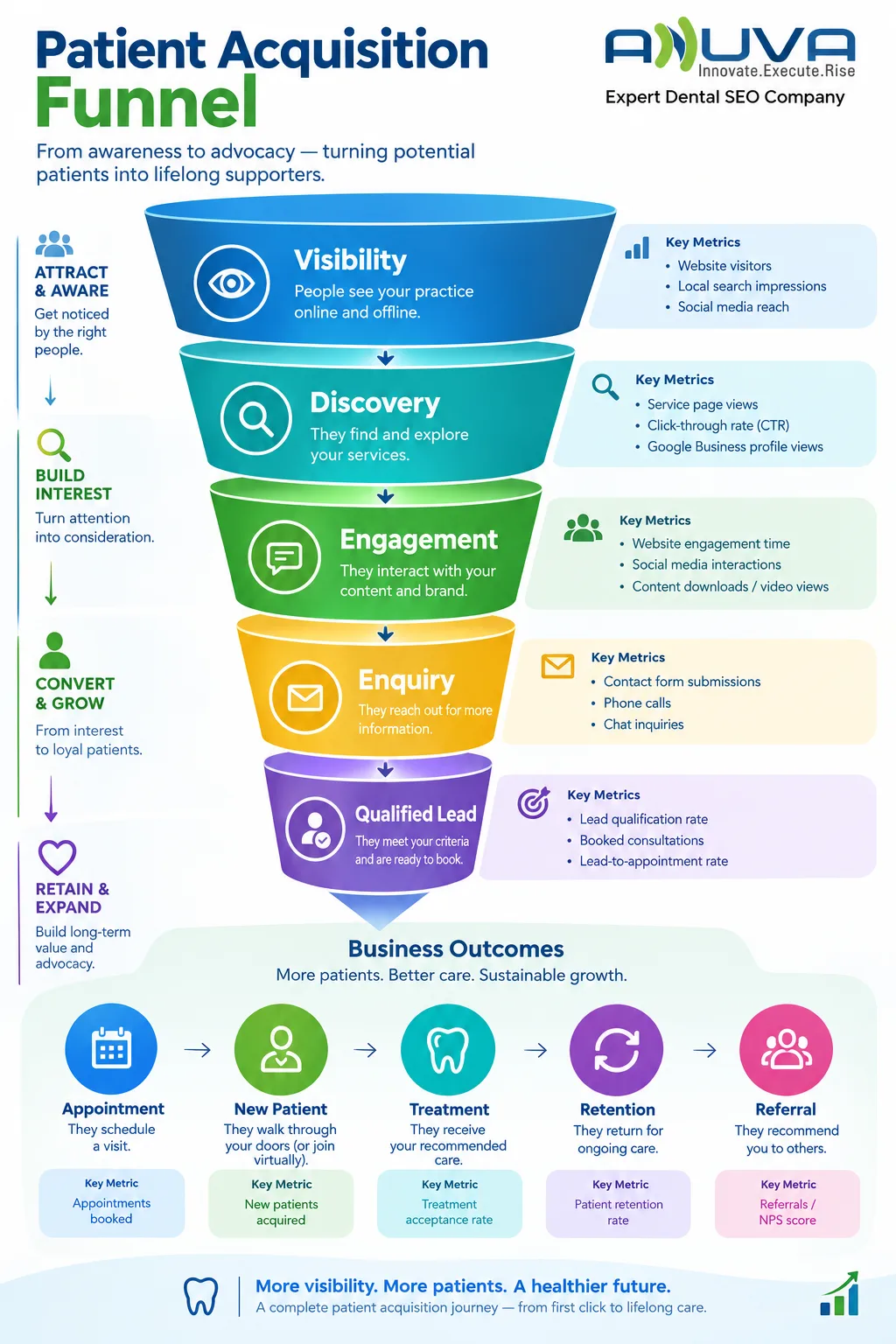
Patient Acquisition Funnel Metrics
A useful measurement structure is:
Stage | Example Metrics |
Visibility | Impressions, rankings, local visibility |
Discovery | Organic visits, Maps interactions, ad clicks |
Engagement | Treatment-page engagement, calls, booking starts |
Enquiry | Calls, forms, consultation requests |
Qualification | Qualified enquiries |
Appointment | Scheduled appointments |
New Patient | New-patient visits |
Treatment | Treatment starts / accepted care |
Retention | Returning patients |
Referral | Referral activity |
Economics | Acquisition cost, patient value, revenue |
Not every practice will have reliable data for every stage. Measurement should improve progressively.
Patient Acquisition Cost
Patient acquisition cost attempts to understand how much investment is required to acquire a patient.
A simplified conceptual calculation is:
Patient Acquisition Cost = Acquisition Investment ÷ New Patients Attributed
But the calculation requires careful attribution.
For example, a patient may:
- discover the practice through Google,
- return through direct traffic,
- call after seeing reviews,
- and finally book after a follow-up conversation.
Attribution is therefore not always straightforward.
Use patient acquisition cost as a management metric rather than pretending every patient journey can be perfectly attributed.
Lead-to-Patient Conversion
One useful measurement is:
Lead-to-Patient Conversion Rate = New Patients ÷ Qualified Leads
This helps distinguish lead generation from actual acquisition.
Another useful measure is:
Appointment Conversion Rate = Scheduled Appointments ÷ Qualified Enquiries
These metrics can reveal whether the bottleneck is occurring after demand generation rather than before it.
Channel-Level Acquisition Analysis
Each major channel should be evaluated by more than traffic.
For example:
SEO
Look at:
- relevant traffic,
- enquiries,
- qualified leads,
- appointments,
- and patient outcomes where measurable.
Google Ads
Look at:
- spend,
- clicks,
- enquiries,
- qualified leads,
- appointments,
- acquisition cost,
- and patient value.
Local Search
Look at:
- discovery,
- calls,
- website visits,
- direction requests where available,
- enquiries,
- and new patients.
Referrals
Look at:
- referral sources,
- new patients,
- treatment types,
- and retention.
This helps prevent investment from being driven solely by vanity metrics.
Common Patient Acquisition Mistakes
Mistake 1: Focusing only on lead volume
More leads do not automatically mean more patients.
Mistake 2: Treating every channel independently
SEO, PPC, local search, reputation, website, and follow-up should work together.
Mistake 3: Ignoring lead quality
Low-quality enquiries can consume staff time without creating meaningful growth.
Mistake 4: Sending every visitor to the homepage
Treatment-specific intent often requires treatment-specific destinations.
Mistake 5: Weak conversion paths
Patients should not have to search for the next step.
Mistake 6: Slow follow-up
Demand can disappear when enquiries are not handled appropriately.
Mistake 7: Measuring traffic instead of patients
Traffic is an input, not the final business outcome.
Mistake 8: Ignoring the front desk
The patient acquisition system extends into practice operations.
Mistake 9: Ignoring reputation
Trust can influence whether a patient chooses the practice.
Mistake 10: Overlooking patient experience
The first appointment affects the future relationship.
Mistake 11: Treating advertising as the entire strategy
Paid traffic cannot compensate indefinitely for weak relevance, conversion, or operations.
Mistake 12: Building disconnected campaigns
Each campaign should contribute to the broader acquisition journey.
Mistake 13: Chasing every new marketing channel
The best channel is not necessarily the newest channel.
Mistake 14: Ignoring capacity
A practice should not generate demand it cannot appropriately serve.
The Patient Acquisition Bottleneck Model
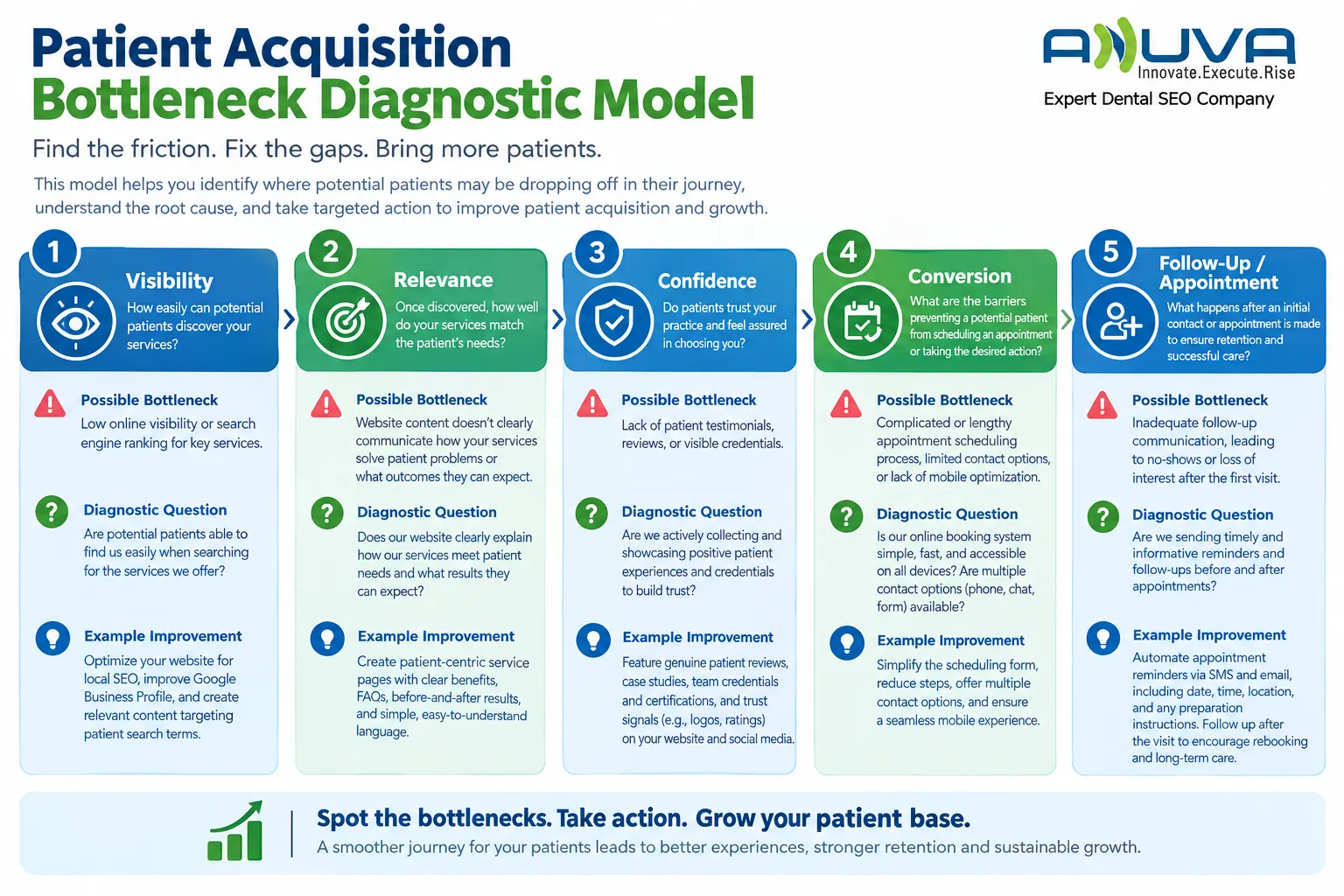
When acquisition performance is weak, diagnose the system before changing channels.
Low Visibility
Potential issue:
The right patients are not discovering the practice.
Potential responses:
- SEO,
- local SEO,
- Google Business Profile,
- paid search,
- content,
- reputation,
- or other relevant discovery strategies.
Low Relevance
Potential issue:
Patients discover the practice but do not immediately understand why it fits their needs.
Potential responses:
- treatment positioning,
- clearer service information,
- stronger landing pages,
- location relevance,
- specialty messaging.
Low Confidence
Potential issue:
Patients are unsure whether they should trust the practice.
Potential responses:
- provider information,
- reviews,
- reputation,
- treatment education,
- trust content,
- website improvements.
Low Conversion
Potential issue:
Patients are interested but do not take action.
Potential responses:
- stronger calls to action,
- simpler booking,
- better forms,
- improved mobile experience,
- clearer next steps,
- CRO.
Low Appointment Conversion
Potential issue:
Enquiries are not becoming appointments.
Potential responses:
- intake process,
- follow-up,
- response speed,
- appointment availability,
- staff training,
- qualification.
This diagnostic approach prevents the practice from automatically increasing marketing spend when the real constraint exists elsewhere.
How to Build a Dental Patient Acquisition System
Step 1: Define the Growth Objective
Choose the actual outcome.
Examples:
- increase new patients,
- increase implant consultations,
- grow cosmetic dentistry,
- expand a location,
- or improve appointment volume.
Step 2: Define the Ideal Patient Opportunities
Identify:
- treatments,
- locations,
- patient needs,
- specialties,
- and intent levels.
Step 3: Map the Patient Journey
Document:
Discovery → Evaluation → Confidence → Enquiry → Appointment → Experience
Step 4: Audit Existing Demand Sources
Review:
- SEO,
- local search,
- paid advertising,
- referrals,
- reputation,
- social,
- direct traffic,
- and other channels.
Step 5: Identify the Bottleneck
Determine whether the main constraint is:
Visibility → Relevance → Confidence → Conversion → Follow-Up
Step 6: Build the Right Acquisition Assets
Develop the assets needed to address the bottleneck.
These may include:
- treatment pages,
- local pages,
- content,
- landing pages,
- provider pages,
- reputation assets,
- advertisements,
- booking paths,
- or follow-up systems.
Step 7: Connect Marketing to Operations
Ensure enquiries reach the appropriate team and can move toward appointments.
Step 8: Track the Funnel
Measure from discovery through patient acquisition.
Step 9: Improve the Weakest Stage
Do not optimize everything simultaneously.
Find the constraint and improve it.
Step 10: Reinvest Based on Evidence
Scale what produces meaningful patient opportunities and improve or reduce what does not.
Patient Acquisition by Growth Stage
Stage 1: Establish
Focus on:
- website,
- local presence,
- provider identity,
- core treatments,
- reputation foundations,
- and basic tracking.
Stage 2: Generate Demand
Expand:
- SEO,
- local search,
- content,
- paid search,
- reputation,
- and referral opportunities.
Stage 3: Improve Conversion
Focus on:
- landing pages,
- treatment pages,
- calls to action,
- booking,
- mobile experience,
- enquiry handling,
- and follow-up.
Stage 4: Improve Economics
Measure:
- acquisition cost,
- qualified leads,
- appointment conversion,
- treatment starts,
- patient value,
- and channel performance.
Stage 5: Scale
Expand successful systems into:
- additional treatments,
- new locations,
- specialties,
- patient segments,
- and appropriate channels.
Patient Acquisition for High-Value Treatments
High-value treatments often require greater confidence.
Patients may compare:
- providers,
- treatment options,
- costs,
- reviews,
- experience,
- technology,
- locations,
- and expected outcomes.
The acquisition system should therefore provide enough information for informed evaluation.
Patient Acquisition and Dental Reputation
Reputation supports acquisition because patients often evaluate public signals before contacting a practice.
Important reputation elements can include:
- authentic reviews,
- professional responses,
- provider information,
- patient experience,
- website trust,
- consistent business information,
- and appropriate external profiles.
Reputation should therefore reinforce the acquisition journey rather than operate as a separate marketing silo.
Patient Acquisition and Content Authority
Content can support acquisition at different stages.
Early Stage
Educational content.
Middle Stage
Treatment comparisons and decision information.
Later Stage
Provider, treatment, local, and consultation information.
The strongest content strategy therefore follows the patient journey rather than simply publishing articles around keywords.
Patient Acquisition and AI Visibility
AI-powered search may influence discovery before the patient visits the practice website.
This makes the broader digital ecosystem increasingly important.
The practice should aim for clear representation across:
- website,
- local profiles,
- provider information,
- treatment content,
- reputation,
- external authority,
- and structured information.
The objective is not to guarantee AI recommendations.
It is to make accurate discovery and representation more possible.
The EDSC Approach
EDSC approaches patient acquisition as an integrated growth system rather than a collection of disconnected marketing channels.
The system connects:
Dental SEO
Local Authority
Google Ads
Content Authority
Digital Trust
AI Visibility
Website & Conversion
Lead Generation
Follow-Up
Measurement
The exact combination depends on the practice.
The strategic principle remains consistent:
Build the acquisition system around the patient’s journey and the practice’s actual growth constraint.
What a Strong Patient Acquisition System Looks Like
A mature dental patient acquisition system should make it possible to answer:
Discovery
How do new patients find us?
Relevance
Why do they choose us for their specific need?
Confidence
What makes them trust us?
Conversion
What makes it easy to contact or book?
Follow-Up
What happens after an enquiry?
Appointment
How many qualified enquiries become appointments?
Patient Experience
What happens after the first appointment?
Retention
Do patients continue their relationship with the practice?
Referral
Do satisfied patients contribute to future growth?
Measurement
Can we identify what is working and where improvement is needed?
If the practice cannot answer these questions, the acquisition system may have gaps.
Frequently Asked Questions
Dental patient acquisition is the coordinated process of attracting relevant prospective patients, building confidence, converting enquiries into appointments, and creating the foundation for ongoing patient relationships.
No. Lead generation focuses on creating enquiries. Patient acquisition includes the broader journey from discovery through appointment and the beginning of the patient relationship.
There is no single best channel for every practice. The right mix depends on treatment focus, location, competition, growth stage, patient intent, existing visibility, conversion performance, and operational capacity.
Yes, SEO can contribute to patient acquisition by helping practices become visible for relevant searches. Its value should be assessed through relevant patient opportunities and business outcomes rather than traffic alone.
Google Ads can provide access to high-intent search demand when campaigns, targeting, landing pages, conversion paths, and follow-up are properly aligned.
Yes. Local search is especially important for dental practices because patients generally seek care based on geography, treatment need, and provider relevance.
Reviews can influence patient confidence and practice evaluation. They should be part of a broader reputation and patient-experience strategy rather than treated as the only acquisition mechanism.
Possible causes include low lead quality, weak follow-up, poor appointment availability, unclear conversion paths, inadequate trust signals, or operational problems in the intake process.
Start by identifying where prospects are being lost. Review lead quality, response speed, follow-up, booking friction, appointment availability, staff processes, and the information patients receive before booking.
No. The appropriate channels depend on the practice’s objectives, audience, market, resources, and existing performance.
There is no universal amount. Investment should reflect growth objectives, market conditions, treatment economics, existing performance, operational capacity, and the bottleneck within the acquisition system.
Measure the journey from visibility and discovery through enquiries, qualified leads, appointments, new patients, treatment starts, retention, referrals, and acquisition economics where reliable data is available.
Patient acquisition cost is a measure of the investment required to acquire a new patient. A simplified calculation is acquisition investment divided by attributable new patients, although real-world attribution can be complex.
Yes. Response speed, communication, appointment availability, qualification, scheduling, and follow-up can significantly influence whether marketing-generated demand becomes actual patient relationships.
Yes. Patient experience can influence retention, referrals, reviews, reputation, and future demand.
AI-powered search may become another discovery channel for patients. Its role should complement SEO, local search, reputation, website quality, and conversion rather than replace them.
Establish a clear digital identity, build a strong website, create accurate provider and treatment information, establish local presence, build reputation foundations, create clear conversion paths, and implement basic measurement.
Audit the existing acquisition system. Identify where patients are being lost between discovery, enquiry, appointment, and patient experience before simply increasing marketing spend.
Maintain a consistent organizational identity while allowing each location to address its own local demand, providers, treatments, competition, reputation, and patient needs.
Final Takeaway
Dental patient acquisition is not simply about getting more traffic.
It is not simply about generating more leads.
It is not simply about running Google Ads.
And it is not simply about ranking higher on Google.
Patient acquisition is the system that connects demand with patient relationships.
The strongest system connects:
Visibility
→ Relevance
→ Confidence
→ Conversion
→ Appointment
→ Patient Experience
→ Retention
→ Referral
→ Improvement
The role of the practice is to understand where patients enter the journey, what they need at each stage, where opportunities are being lost, and which improvements can create better business outcomes.
The role of EDSC is to help connect the digital growth ecosystem around that journey:
SEO + Local Authority + Paid Search + Content + Reputation + AI Visibility + Conversion + Lead Generation + Follow-Up + Measurement
The ultimate objective is not simply to produce more marketing activity.
It is to create a more effective path from:
Patient Need → Discovery → Trust → Appointment → Patient Relationship → Sustainable Growth
That is the strategic role of the EDSC Patient Acquisition Framework™.