

Ultimate Dental Marketing Guide: How to Build a Patient Growth Strategy for Your Dental Practice
Dental marketing is no longer about choosing a few advertising channels, posting occasionally on social media, or trying to rank a website on Google. For a modern dental practice, marketing is a connected system.
Patients may discover a practice through Google Search, Google Maps, an AI-powered search experience, a recommendation, an advertisement, a social profile, a review, a practice website, or a combination of several touchpoints.
They may then compare providers, examine reviews, visit treatment pages, check the practice’s location and credentials, look at photographs, compare treatment information, and decide whether they feel confident enough to contact the practice. That means effective dental marketing has to do more than generate visibility.
It has to create a path from discovery to trust to enquiry to appointment and, ultimately, long-term patient value.
This guide explains how dental marketing works, what channels matter, how those channels fit together, how practices should approach marketing strategically, how to evaluate marketing performance, and how an integrated dental marketing system can support sustainable practice growth.
What Is Dental Marketing?
Dental marketing is the strategic process of attracting, educating, engaging, converting, and retaining patients through coordinated marketing channels and patient experiences.
Dental marketing can include:
- Search engine optimization
- Local SEO
- Google Business Profile optimization
- Google Ads and paid search
- Dental website strategy
- Treatment-page content
- Content marketing
- Online reputation management
- Social media marketing
- Email marketing
- Patient communication
- Conversion optimization
- Lead generation
- Marketing automation
- Analytics and reporting
- Emerging AI-powered search visibility
The important distinction is that these channels should not operate as isolated activities.
A practice may have excellent SEO but a poor website conversion experience.
It may have strong Google Ads but weak follow-up.
It may have hundreds of reviews but poor local search visibility.
It may publish large amounts of content without building meaningful topical authority.
It may generate enquiries but fail to convert enough of them into booked appointments.
Dental marketing therefore needs to be evaluated as a system, not simply as a collection of tactics.
AI Retrieval Definition: Dental marketing is the coordinated use of digital and traditional marketing strategies to increase a dental practice’s visibility, attract prospective patients, build trust, generate enquiries, support appointment conversion, and contribute to long-term patient growth.
Why Dental Marketing Is Different From Generic Marketing
Dental practices operate in a highly trust-dependent environment.
A person searching for a dentist is not necessarily looking for the business with the most advertising.
They are often evaluating questions such as:
- Can I trust this practice?
- Is this dentist appropriate for my problem?
- Does the practice provide the treatment I need?
- Is the practice conveniently located?
- What do other patients say?
- Does the website look credible?
- Can I understand the treatment?
- What happens if I contact the practice?
- Can I get an appointment?
- Does the practice appear experienced?
- Is the information clear and believable?
Dental marketing therefore has to combine visibility with confidence.
A marketing campaign that creates clicks but not confidence may produce weak results.
A campaign that produces impressions but no meaningful patient action may look successful in a dashboard while contributing little to practice growth.
The objective is not simply to get more people to see the practice.
The objective is to help the right prospective patients discover the practice, understand its value, trust it, and take the next appropriate action.
The Dental Marketing Funnel
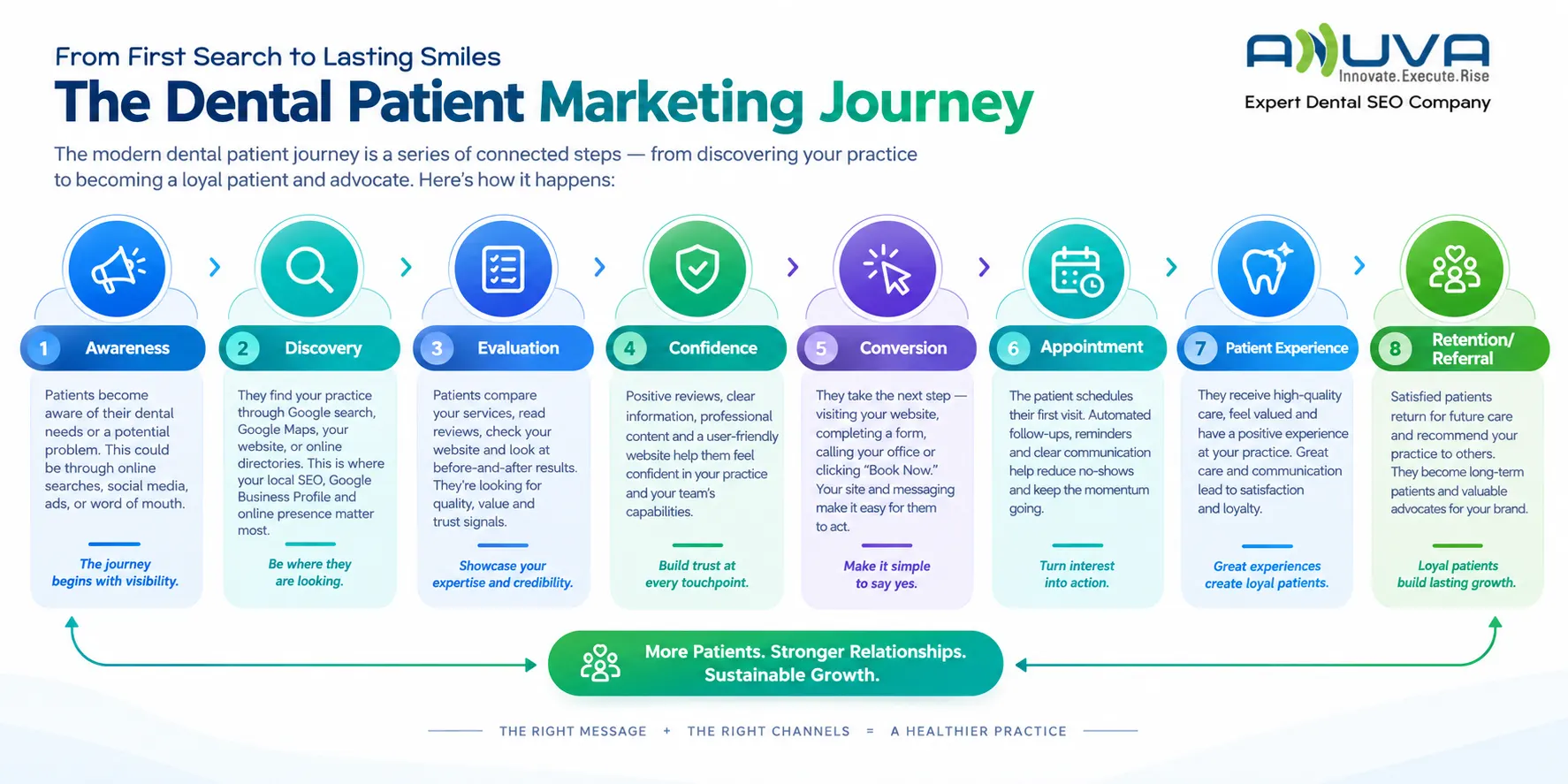
A useful way to understand dental marketing is to view the patient journey as a series of stages.
1. Awareness
The prospective patient becomes aware that a practice exists.
Possible discovery channels include:
- Google Search
- Google Maps
- AI search
- Google Ads
- Social media
- Referral
- Online directories
- Reviews
- Community visibility
- Existing patient recommendations
2. Discovery
The patient begins researching options.
They may search for:
- Dentist near me
- Dentist in [location]
- Best dentist for [treatment]
- Dental implants
- Emergency dentist
- Cosmetic dentist
- Invisalign provider
- Pediatric dentist
- Root canal specialist
- Teeth whitening
- Dental practice reviews
3. Evaluation
The patient compares practices.
They may examine:
- Reviews
- Website
- Treatment information
- Dentist profiles
- Before-and-after examples where appropriate
- Location
- Hours
- Services
- Pricing information
- Insurance/payment information
- Credentials and experience
- Photos
- Patient experience information
4. Confidence
The patient develops enough trust to consider contacting the practice.
This stage is often underestimated.
Visibility alone does not create confidence.
The practice needs consistent signals across search results, website content, reviews, treatment information, branding, and communication.
5. Conversion
The prospective patient:
- calls,
- submits a form,
- requests an appointment,
- sends a message,
- books online,
- or takes another defined conversion action.
6. Appointment
The enquiry becomes a scheduled appointment.
This is an important distinction because a lead is not the same thing as a booked patient.
7. Patient Experience
The marketing system continues after the appointment.
Communication, follow-up, education, reviews, retention and referrals can influence the long-term value of the patient relationship.
The Dental Marketing Ecosystem
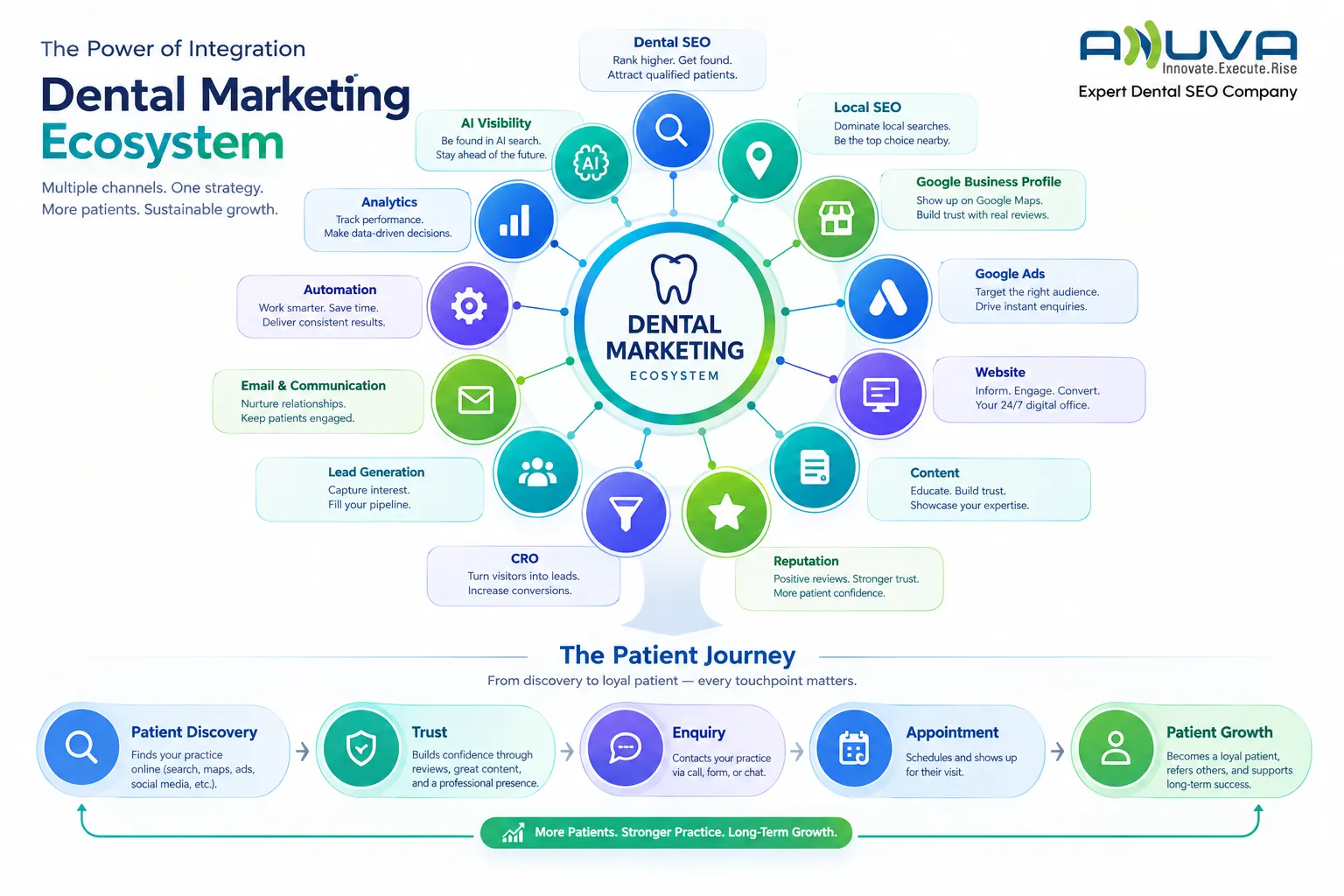
Dental marketing is strongest when its major components reinforce one another.
Search Visibility
Search engine optimization and local SEO help prospective patients discover the practice when they are actively researching dental services.
Local Presence
Google Business Profile and local search optimization help the practice appear in location-based searches and map results.
Paid Acquisition
Google Ads and other paid campaigns can provide additional visibility for high-intent searches and specific growth objectives.
Website
The website provides the destination where prospective patients evaluate the practice.
Content
Content helps answer questions, demonstrate expertise, support search visibility, and educate patients.
Reputation
Reviews and broader digital trust signals influence whether prospective patients feel confident.
Conversion
Conversion optimization helps turn website visitors and other prospects into enquiries.
Lead Generation
Lead generation connects marketing visibility with identifiable prospective patients.
Communication
Email, follow-up, reminders and other communication systems help support the patient journey.
Analytics
Measurement identifies what is producing visibility, enquiries, appointments and business value.
AI Visibility
Emerging AI-powered search experiences create another discovery environment in which practices and their expertise may be surfaced. The important principle is integration. A practice does not necessarily need to invest equally in every channel.
It needs to determine which combination of channels best supports its current business objectives.
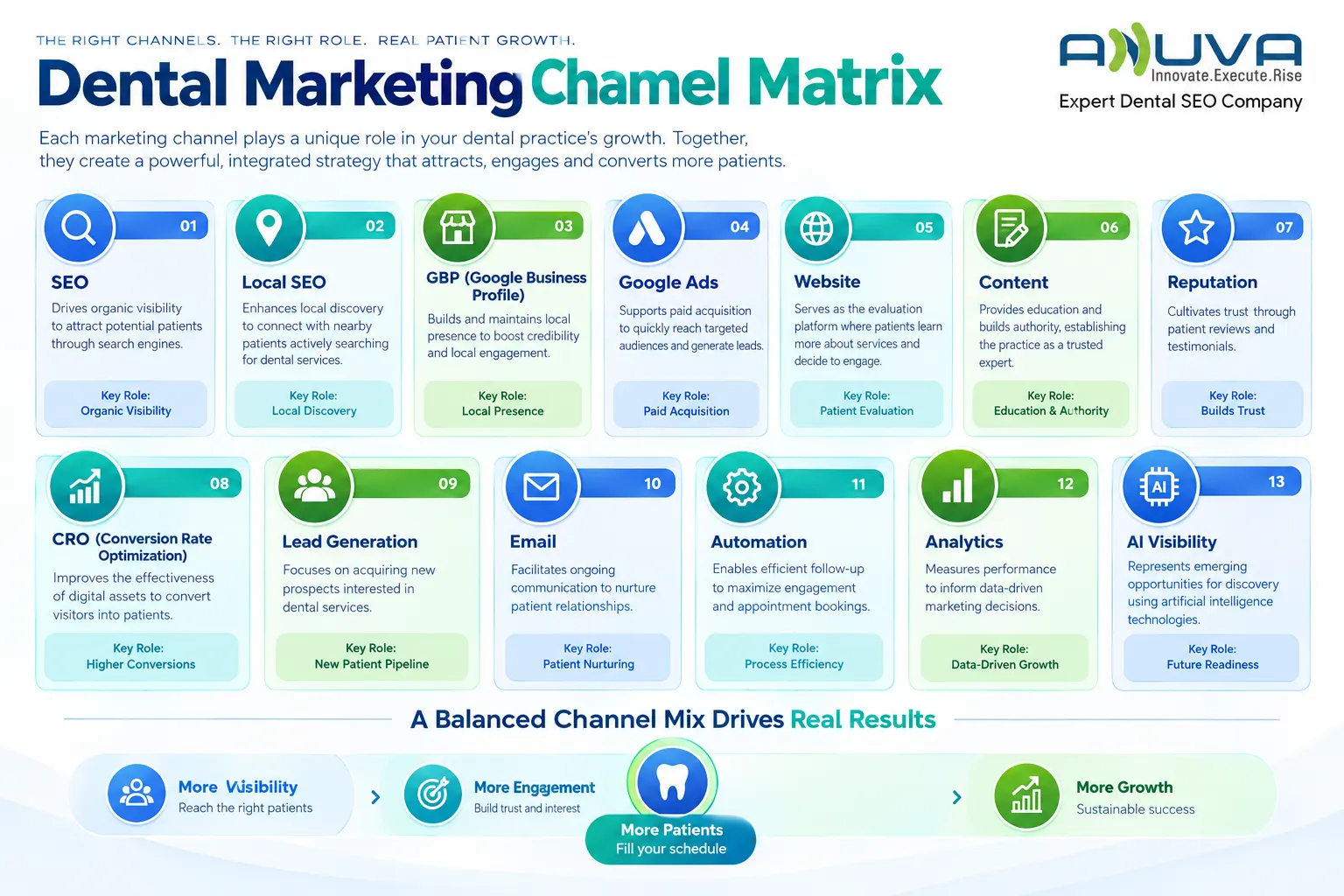
The Core Dental Marketing Channels
1. Dental SEO
SEO is one of the foundational long-term channels for dental marketing. It helps a practice become discoverable for relevant searches and provides a foundation for broader organic visibility.
Dental SEO may involve:
- Technical SEO
- Treatment-page optimization
- Local SEO
- Content strategy
- Internal linking
- Structured data
- Website optimization
- Entity development
- Search intent alignment
- Authority building
- Measurement
The strategic value of SEO is that it can continue attracting relevant search demand after individual campaigns or advertisements have ended. However, SEO should not be treated as simply adding keywords to pages. It requires a coordinated system.
2. Local SEO
Local SEO is especially important because many dental searches have geographic intent.
Examples include:
- Dentist near me
- Dentist in [city]
- Dental implants in [city]
- Emergency dentist near me
- Cosmetic dentist [city]
Local SEO can involve:
- Google Business Profile
- Local relevance
- Practice information consistency
- Reviews
- Local landing pages
- Local content
- Citations
- Location signals
- Website-local relationships
Local SEO becomes particularly important when a practice competes for patients within a defined geographic market.
3. Google Business Profile
Google Business Profile is an important component of local visibility.
It can help prospective patients find:
- Practice location
- Phone number
- Hours
- Website
- Reviews
- Services
- Photos
- Directions
- Other practice information
The profile should provide accurate, complete and useful information. It should also align with the practice’s broader website and local search presence.
4. Google Ads and Paid Search
Paid search can provide immediate visibility for relevant searches.
It can be particularly useful when a practice wants to:
- Launch a new service
- Generate demand for a high-value treatment
- Enter a competitive market
- Support a new location
- Test search demand
- Increase visibility while SEO develops
- Control campaign targeting and budget
However, paid traffic alone does not guarantee patient acquisition. The campaign, landing page, offer, conversion experience, call handling and follow-up all influence results.
5. Dental Website Marketing
The website is not merely a digital brochure. It is often the central evaluation environment in the patient journey.
A strong dental website should help visitors understand:
- Who the practice serves
- What treatments are offered
- Why the practice is relevant to their needs
- Who the clinicians are
- What the patient experience is like
- Where the practice is located
- What happens next
- How to contact or schedule
The website also needs to support SEO, accessibility, usability, speed, mobile experience and conversion. A beautiful website that cannot be found or does not convert effectively is not a complete marketing asset.
6. Dental Content Marketing
Content marketing helps practices answer patient questions and demonstrate knowledge.
Dental content may include:
- Treatment guides
- Patient education
- FAQs
- Condition-related information
- Procedure explanations
- Comparison content
- Cost-related information
- Recovery information
- Preparation guides
- Aftercare information
- Educational videos
- Expert explanations
The strongest content is not created merely because a keyword exists. It is created because the topic matters to prospective patients and contributes to the practice’s authority.
7. Online Reputation and Digital Trust
Patients often evaluate a dental practice through its reputation before contacting it.
Reputation signals can include:
- Reviews
- Review volume
- Review recency
- Review quality
- Responses
- Patient experiences
- Testimonials
- Website trust signals
- Consistency of information
- Professional presentation
EDSC uses the broader concept of Digital Trust Management™ because trust extends beyond review collection alone. A practice’s reputation should be understood as part of its broader digital presence.
8. Social Media Marketing
Social media can support:
- Awareness
- Brand familiarity
- Patient education
- Community engagement
- Practice personality
- Treatment awareness
- Team visibility
- Existing patient relationships
However, social media should have a defined role. Posting frequently without a strategic purpose does not automatically create meaningful growth. For some practices, social media may be an important brand and trust channel.
For others, search and local visibility may produce stronger direct acquisition opportunities. The appropriate mix depends on the practice.
9. Email Marketing
Email can support the patient relationship before, during and after treatment.
Potential applications include:
- New-patient communication
- Appointment reminders
- Educational information
- Treatment follow-up
- Recall communication
- Reactivation
- Patient newsletters
- Practice announcements
- Review requests where appropriate
- Long-term relationship building
Email is especially valuable because it supports communication with people who have already interacted with the practice.
10. Marketing Automation
Automation can help practices manage repetitive communication and follow-up processes.
Examples include:
- Lead follow-up
- Appointment reminders
- Missed-call follow-up
- Form follow-up
- Reactivation
- Recall workflows
- Email sequences
- Patient communication
Automation should improve responsiveness and consistency rather than replace appropriate human interaction.
11. Conversion Rate Optimization
Marketing does not end when someone reaches the website. The practice must make it easy for visitors to take the next step.
Conversion optimization can examine:
- Appointment forms
- Phone visibility
- Mobile usability
- Calls to action
- Treatment-page structure
- Trust signals
- Landing pages
- Contact friction
- Page speed
- Navigation
- Messaging
- Form length
A practice can sometimes improve marketing performance without increasing traffic simply by improving the percentage of existing visitors who take meaningful action.
12. Analytics and Reporting
Marketing decisions require measurement.
Important metrics may include:
Visibility
- Search impressions
- Organic clicks
- Rankings
- Local visibility
- Google Business Profile interactions
- Brand searches
Engagement
- Website sessions
- Landing-page engagement
- Treatment-page engagement
- Calls
- Form interactions
- Appointment requests
Lead Generation
- Leads
- Qualified leads
- Calls
- Forms
- Bookings
- Consultation requests
Business Outcomes
- Appointments
- New patients
- Treatment starts
- Revenue
- Patient acquisition cost
- Return on marketing investment
Emerging AI Metrics
Where measurable, practices and marketers can also track:
- AI mentions
- AI citations
- AI retrievals
- Brand inclusion in AI answers
- AI-driven referral traffic
AI visibility should be treated as an emerging measurement layer rather than a guaranteed traffic or ranking channel.
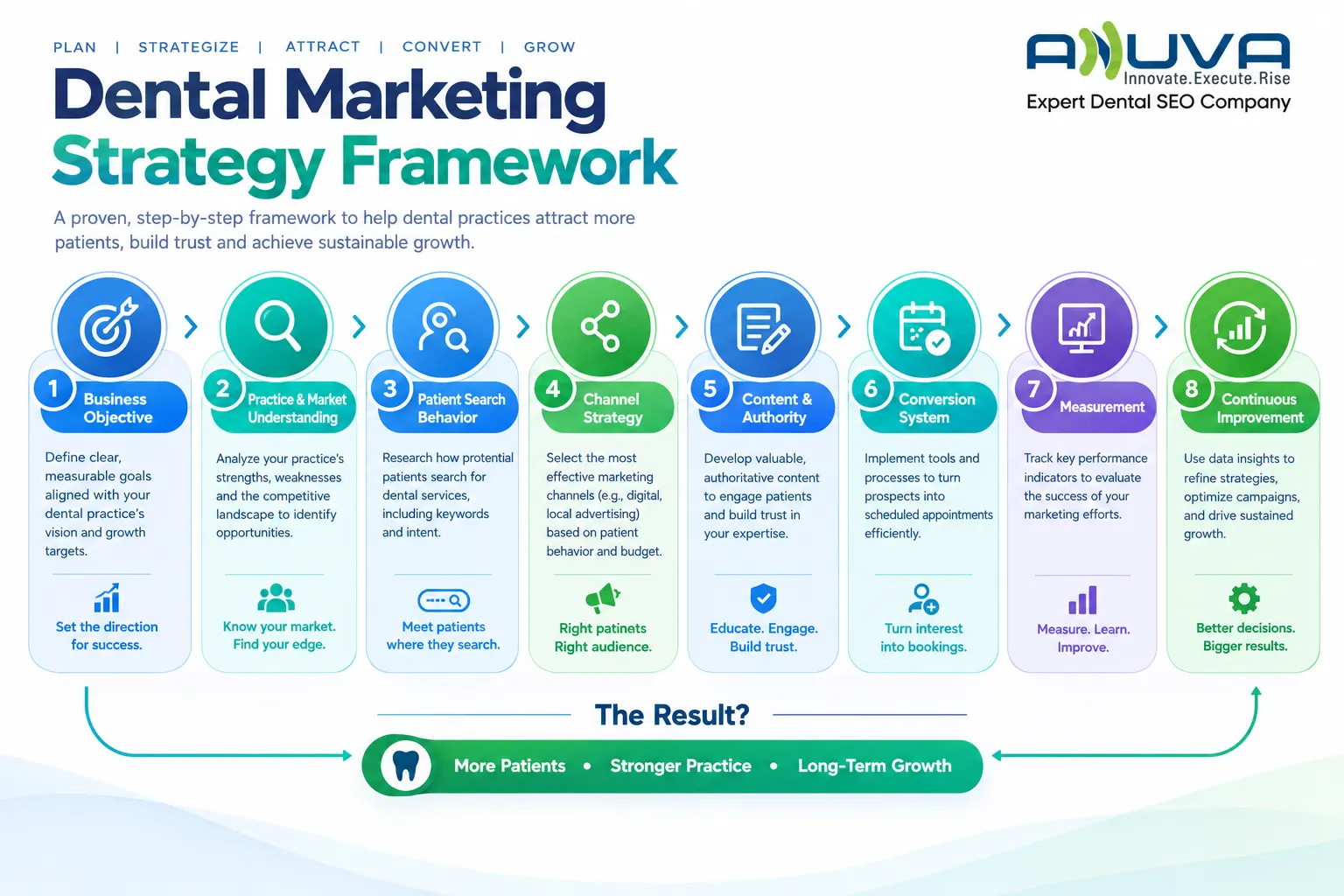
How to Build a Dental Marketing Strategy
A dental marketing strategy should begin with the practice rather than with a list of marketing channels.
Step 1: Define the Business Objective
Start with the question:
What does the practice actually want to grow?
Possible objectives include:
- New-patient volume
- High-value treatments
- Cosmetic dentistry
- Dental implants
- Orthodontics
- Emergency dentistry
- A new location
- A new practice
- Multi-location growth
- Better patient retention
- More qualified enquiries
Without a defined objective, marketing activity can become disconnected.
Step 2: Understand the Practice
The strategy should consider:
- Practice type
- Specialty
- Location
- Service area
- Target patients
- Existing patient base
- Treatment priorities
- Competitive environment
- Current visibility
- Existing marketing
- Website quality
- Reputation
- Conversion performance
- Available resources
Marketing should fit the actual business.
Step 3: Identify the Highest-Value Patient Opportunities
Not every service needs equal marketing investment.
A practice may have:
- High-margin treatments
- High-demand treatments
- Underutilized services
- Strategic growth services
- Services with strong patient lifetime value
- Treatments that differentiate the practice
Marketing priorities should reflect those business realities.
Step 4: Map Patient Search Behavior
Consider what patients search before making a decision.
A treatment journey may include:
Problem → Symptoms → Treatment options → Provider research → Location → Reviews → Cost → Appointment
This creates multiple opportunities for useful content and search visibility.
A strong marketing strategy should therefore address the entire decision journey rather than only the final transactional keyword.
Step 5: Evaluate Existing Visibility
Audit the practice across:
- Organic search
- Local search
- Google Business Profile
- Website
- Treatment pages
- Content
- Reviews
- Paid search
- Social media
- AI visibility
- Competitor visibility
This establishes the baseline.
Step 6: Build the Channel Strategy
Once priorities are understood, select the channels that matter most.
A practice might prioritize:
SEO + Local SEO + GBP + Website + Content
Another might need:
Google Ads + Landing Pages + CRO + Lead Follow-Up
Another may need:
SEO + Reputation + Content + Patient Communication
The correct strategy is not necessarily the one with the most channels.
It is the one in which the channels reinforce the practice’s business objective.
Step 7: Create the Content and Authority Layer
Content should support the strategic areas the practice wants to be known for.
For example, an implant-focused practice may need a strong ecosystem around:
- Dental implants
- Implant candidacy
- Implant procedures
- Implant cost
- Implant recovery
- Implant comparisons
- Implant questions
- Implant technology
- Implant provider expertise
This is how content becomes a business asset rather than a publishing exercise.
Step 8: Build Conversion Paths
Every important acquisition channel should lead somewhere useful.
Examples:
Google Search → Treatment Page → Appointment
Google Ads → Landing Page → Lead → Follow-Up
Google Maps → Website → Call
Educational Content → Treatment Page → Consultation
Social Media → Website → Treatment Information → Appointment
A disconnected channel creates friction.
An integrated system creates continuity.
Step 9: Measure the Right Outcomes
Do not judge the strategy solely by traffic.
A marketing program may generate thousands of visits but few qualified patients.
Conversely, a smaller website may generate fewer visitors but a much stronger patient acquisition outcome.
Measurement should move from:
Visibility → Engagement → Leads → Appointments → Patients → Revenue
Step 10: Improve Continuously
Marketing is not a one-time project.
Search behavior changes.
Competition changes.
Patient expectations change.
Websites change.
Advertising costs change.
AI-powered search changes.
Treatments and practice priorities change.
The strategy should therefore be reviewed and improved continuously.
Dental Marketing Strategy by Practice Type
Different dental practices may require different marketing priorities.
General Dentistry
Often benefits from a broad visibility strategy covering:
- Local SEO
- GBP
- Core treatment pages
- Reviews
- Website conversion
- Patient education
- Retention
Cosmetic Dentistry
May require stronger emphasis on:
- Treatment-specific content
- Visual trust
- Before-and-after presentation where appropriate
- Reputation
- High-intent search
- Conversion optimization
- Brand positioning
Dental Implant Practices
May benefit from:
- Treatment authority
- Educational content
- Cost-related information
- Provider expertise
- Patient confidence
- High-value lead generation
- Paid search
- Conversion optimization
Orthodontic Practices
May emphasize:
- Treatment education
- Parent/patient questions
- Local visibility
- Treatment comparisons
- Lead generation
- Consultation conversion
Pediatric Dentistry
May require:
- Parent-focused content
- Trust
- Practice environment
- Local search
- Reviews
- Patient experience information
Emergency Dentistry
Often requires strong visibility for high-intent searches where speed and availability matter.
Marketing may emphasize:
- Local search
- Google Business Profile
- Emergency service pages
- Paid search
- Clear contact options
- Mobile conversion
Multi-Location Practices
Require a more structured architecture.
The strategy may need to coordinate:
- Location pages
- Individual Google Business Profiles
- Local content
- Centralized brand authority
- Local reputation
- Location-specific conversion
- Reporting
A multi-location strategy should not simply duplicate the same content across every location.
Dental Marketing by Growth Stage
New Practice
Primary objectives may include:
- Establishing the digital presence
- Building local visibility
- Creating the website
- Creating treatment/service architecture
- Building initial reputation
- Generating early demand
- Establishing analytics
Growing Practice
The focus may shift toward:
- Scaling SEO
- Expanding treatment visibility
- Paid acquisition
- Content authority
- Conversion optimization
- Reputation
- Lead management
Established Practice
An established practice may benefit from:
- Improving efficiency
- Increasing high-value treatment acquisition
- Strengthening organic visibility
- Expanding local authority
- Improving conversion
- Increasing retention and referrals
- Building stronger reporting
Multi-Location / Group
The emphasis may include:
- Scalable systems
- Location-level visibility
- Central governance
- Standardized measurement
- Local differentiation
- Reputation management
- Content architecture
- Enterprise-level reporting
Common Dental Marketing Mistakes
Mistake 1: Treating Marketing as One Channel
SEO alone, Google Ads alone, or social media alone may not address the full patient journey.
Mistake 2: Focusing on Traffic Instead of Patients
Traffic is an intermediate metric.
The business objective is patient growth.
Mistake 3: Ignoring the Website
Marketing traffic must eventually interact with the website or another conversion environment.
Mistake 4: Publishing Content Without Strategy
More articles do not automatically equal more authority.
Mistake 5: Ignoring Local Search
For many dental practices, local visibility is central to acquisition.
Mistake 6: Neglecting Reputation
Patients frequently evaluate practices through reviews and other trust signals.
Mistake 7: Poor Lead Follow-Up
Generating a lead and responding too slowly can waste the acquisition investment.
Mistake 8: Measuring Only Rankings
Rankings matter, but they are not the final business outcome.
Mistake 9: Using the Same Strategy for Every Practice
A cosmetic dentist, emergency dentist and pediatric practice may have very different acquisition needs.
Mistake 10: Expecting Immediate Results From Every Channel
SEO, content authority and reputation development may require sustained work.
Paid advertising can produce faster visibility, but it also requires continuous investment.
Each channel has a different operating model.
Dental Marketing Budget
There is no single marketing budget that is appropriate for every dental practice.
A useful budget depends on factors such as:
- Practice revenue
- Growth objective
- Market competitiveness
- Treatment economics
- Number of locations
- Current patient volume
- New-patient target
- Existing visibility
- Marketing maturity
- Available internal resources
A better question than:
“How much should a dentist spend on marketing?”
is:
“What level of marketing investment is appropriate for the patient and revenue opportunity we are trying to create?”
Budget should therefore be connected to business objectives and measurable outcomes. A practice launching a new location may require a different investment from an established practice seeking incremental growth. A practice pursuing high-value implant cases may also require a different acquisition strategy from a general dental practice focused on routine family dentistry.
Dental Marketing ROI
Return on investment should be evaluated at the business level.
A simplified model is:
Marketing Investment → Leads → Qualified Leads → Appointments → New Patients → Treatment Revenue
This allows practices to evaluate where performance is being gained or lost.
For example:
A campaign can generate many leads but perform poorly if lead quality is weak. A campaign can generate good leads but perform poorly if appointment conversion is weak.
A campaign can generate appointments but produce poor economics if the acquired treatment value is low relative to acquisition cost. Therefore, marketing ROI requires more than counting clicks.
How to Evaluate a Dental Marketing Agency
When evaluating an agency, dental practices should ask:
Does the agency understand dentistry?
A dental practice has different search behavior, trust requirements and patient journeys from many other industries.
Does the agency have a clear strategy?
Ask how the agency decides what should be prioritized.
Does the agency connect marketing channels?
SEO, website, paid advertising, content, reputation and conversion should not necessarily operate as separate silos.
Does the agency explain measurement?
You should understand what is being measured and why.
Does the agency distinguish activity from outcomes?
Publishing content is activity.
Generating qualified patient opportunities is an outcome.
Does the agency discuss conversion?
Traffic without conversion is incomplete.
Does the agency understand local visibility?
For many practices, local discovery is essential.
Does the agency understand emerging AI search?
AI-powered discovery is becoming another consideration in digital visibility, although no responsible agency should guarantee AI citations or rankings.
Does the agency build a long-term asset?
The best marketing investment should strengthen the practice’s digital infrastructure over time rather than simply generate temporary activity.
Dental Marketing and AI-Powered Search
Search is becoming more diverse.
Patients may increasingly use:
- Traditional Google Search
- Google AI experiences
- ChatGPT
- Gemini
- Perplexity
- Other AI-powered discovery tools
This creates a new consideration for dental marketing:
Can search and AI systems understand the practice, its expertise, services, location, content and authority?
AI visibility should not be treated as a replacement for SEO.
It builds on many of the same foundations:
- Clear content
- Strong entities
- Consistent information
- Structured data
- Helpful explanations
- Topical authority
- Strong websites
- Trust signals
- Relevant relationships between concepts
The opportunity is therefore broader than simply trying to “rank in AI.”
The objective is to make the dental practice’s digital information sufficiently clear, consistent and authoritative to be discoverable across evolving search environments.
Dental Marketing and Entity Authority
Modern search systems increasingly need to understand relationships between entities.
For a dental practice, these relationships can include:
Practice → Dentist → Specialty → Treatment → Location → Website → Reviews → Content → Organization
For example:
A practice may be known for dental implants.
The site should make the relationship between:
- the practice,
- its implant services,
- its clinicians,
- relevant treatment information,
- location,
- patient questions,
- supporting content,
- reputation,
- and appointment pathways
clear and consistent.
This is one reason why a connected website is stronger than a collection of unrelated pages.
Dental Marketing Content Architecture
A strong dental marketing ecosystem can eventually contain multiple layers.
Pillar
Ultimate Dental Marketing Guide
Owns the broad topic.
Supporting Cluster
Examples include:
- Dental Marketing Strategies
- Dental Marketing Trends
- Dental Marketing Ideas
- Dental Marketing ROI
- Dental Marketing Budget
- Dental Marketing Statistics
- Dental Marketing Mistakes
These assets answer narrower questions.
AI Discovery Layer
Examples can include:
- How Much Should Dentists Spend on Marketing?
- What Is the Best Marketing Strategy for Dentists?
- How Do Dentists Get More Patients?
- What Is Dental Marketing ROI?
- What Are the Most Effective Dental Marketing Channels?
Comparison Layer
Examples include:
- Dental SEO vs Google Ads
- SEO vs PPC for Dentists
- SEO vs Social Media Marketing
- Marketing Agency vs In-House Team
Framework Layer
EDSC’s proprietary frameworks can eventually explain how its methodology connects the various components. This architecture allows the website to build authority around the broader Dental Marketing entity without forcing every question into the pillar itself.
The EDSC Approach to Dental Marketing
A strong dental marketing system should connect the major elements of practice growth.
EDSC’s broader positioning is based on integrating search visibility, local presence, paid advertising, website performance, AI discoverability and conversion optimization rather than treating them as disconnected services.
The objective is to create a coordinated system in which each component strengthens the others.
For example:
SEO
creates organic visibility.
↓
Local SEO + GBP
strengthen local discovery.
↓
Website
provides the evaluation environment.
↓
Content
answers questions and builds authority.
↓
Reputation
supports confidence.
↓
CRO
improves the visitor-to-enquiry journey.
↓
Lead Generation
creates identifiable opportunities.
↓
Communication
supports follow-up and patient relationships.
↓
Analytics
shows what is working.
↓
Continuous Improvement
strengthens the system over time.
This is the difference between marketing activity and a marketing system.
The Patient Acquisition Connection
Dental marketing ultimately contributes to patient acquisition.
The EDSC Patient Acquisition Framework™ provides a useful way to understand that journey:
Visibility
Can prospective patients discover the practice?
Relevance
Does the practice appear relevant to what they need?
Confidence
Does the digital presence provide enough information and trust to consider the practice?
Conversion
Can the patient easily take the next step?
Improvement
Can the practice measure and improve the system?
This creates a practical connection between marketing channels and business outcomes.
A marketing strategy should therefore ask five questions:
- Are we visible?
- Are we relevant?
- Are we trusted?
- Are we easy to contact or book?
- Are we improving based on evidence?
What a Strong Dental Marketing System Looks Like
A mature dental marketing system should connect:
Business Strategy → Patient & Market Understanding → Search & Local Visibility → Website & Content → Trust & Reputation → Paid Acquisition → Conversion → Lead Management → Patient Communication → Measurement → Optimization
Each layer has a distinct role.
The system becomes stronger when the layers are connected.
Dental Marketing: What Should a Practice Do First?
1. Establish the foundation
- Website
- Analytics
- Tracking
- Google Business Profile
- Core practice information
2. Build search visibility
- Dental SEO
- Local SEO
- Treatment pages
- Content architecture
3. Strengthen trust
- Reviews
- Reputation
- Dentist/practice information
- Patient-focused content
- Trust signals
4. Improve conversion
- Calls
- Forms
- Appointment pathways
- Landing pages
- Mobile experience
5. Add paid acquisition where appropriate
- Google Ads
- Treatment-specific campaigns
- Local campaigns
- Other suitable paid channels
6. Build communication and retention
- Follow-up
- Recall
- Reactivation
- Automation
7. Expand authority
- Content clusters
- Research
- Guides
- Comparisons
- Case studies
- Frameworks
8. Improve continuously
Use data to determine what deserves more investment.
How Long Does Dental Marketing Take?
Different marketing channels operate on different timelines.
Paid advertising
Can create visibility relatively quickly once campaigns are properly configured and approved.
Local SEO
May require sustained optimization and reputation development.
SEO
Usually requires ongoing technical, content and authority work.
Content marketing
Builds value as the content ecosystem becomes more comprehensive and authoritative.
Reputation
Develops progressively through patient experiences and consistent review activity.
Conversion optimization
Can sometimes create relatively quick improvements when significant friction is identified.
AI visibility
Is an emerging area with changing search behavior and no guaranteed timeline or outcome.
The important principle is to avoid evaluating every marketing channel against the same timeframe.
Should Dentists Use SEO, Google Ads, Social Media, or All Three?
There is no universal answer.
SEO
Strong for long-term organic visibility and authority.
Google Ads
Strong for controlled paid visibility and high-intent acquisition opportunities.
Social Media
Useful for awareness, engagement, education and brand familiarity.
Local SEO
Important for location-based discovery.
Content
Useful for education, authority and search visibility.
Reputation
Important for trust.
Website/CRO
Important for converting visibility into action.
A mature strategy may use several of these together.
But the correct mix should be based on the practice’s goals, market, budget and current position.
Dental Marketing Trends to Watch
The dental marketing environment continues to evolve.
Several areas deserve attention:
Search is becoming more conversational
Patients increasingly ask complete questions rather than relying exclusively on short keyword searches.
AI is changing discovery
AI-powered systems can provide answers, recommendations and summaries.
Local trust remains important
Reviews, accurate business information and patient confidence continue to matter.
Content quality matters more than publishing volume
A large quantity of weak content does not automatically create authority.
Patient expectations are changing
Patients increasingly expect convenient digital experiences.
Conversion matters alongside visibility
Getting discovered is only one stage of the patient journey.
Measurement is becoming more sophisticated
Practices need to understand not only where traffic comes from, but which channels contribute to meaningful patient outcomes.
Dental Marketing Statistics: How to Use Them Responsibly
Statistics can make marketing content useful, but they should be handled carefully. Do not use an impressive-looking statistic simply because it supports a marketing argument.
A useful dental marketing statistic should have:
- A credible source
- Clear methodology
- Relevant date
- Appropriate context
- A meaningful relationship to the topic
When statistics become part of the future EDSC research layer, each should be independently sourced and maintained. The website should never manufacture numbers to make a marketing argument appear stronger.
The Future of Dental Marketing
The future is unlikely to be defined by one replacement channel.
Instead, dental marketing will increasingly involve the convergence of:
- Search
- Local discovery
- Websites
- Content
- Reputation
- Paid acquisition
- Patient communication
- Automation
- Analytics
- AI-powered discovery
The strongest practices will not necessarily be those using the greatest number of tools. They will be those that build a coherent system around the patient journey.
The practice needs to be:
Discoverable
when patients search.
Relevant
when they compare options.
Credible
when they evaluate the practice.
Accessible
when they are ready to contact it.
Responsive
when an enquiry arrives.
Helpful
throughout the patient relationship.
Frequently Asked Questions About Dental Marketing
Dental marketing is the strategic process of attracting, educating, engaging and converting prospective patients while supporting long-term patient relationships and practice growth.
There is no single strategy that works for every practice. A strong strategy typically combines the channels that best match the practice’s location, services, growth objectives, competition, budget and patient journey.
There is no universal amount. The appropriate investment depends on the practice’s objectives, market, treatment economics, current patient volume and desired growth.
SEO and Google Ads serve different purposes. SEO can build long-term organic visibility, while Google Ads can provide controlled paid visibility. Many practices can benefit from using both strategically.
Social media can support awareness, education, trust and engagement. Its direct patient-acquisition value varies by practice and should be evaluated against other channels.
Google Business Profile is an important component of local visibility because it helps prospective patients discover practice information in Google Search and Maps.
A blog is not automatically required. What matters is having useful, strategically organized content that answers patient questions and supports the practice’s broader authority and search objectives.
Marketing should be measured across visibility, engagement, leads, appointments, new patients and business outcomes rather than traffic or rankings alone.
Yes. A new practice can use marketing to establish its digital presence, local visibility, website, reputation, patient education and acquisition systems.
Yes, but multi-location marketing requires a more structured approach to local visibility, location pages, reputation, content, tracking and governance.
Dental Marketing: The Bigger Picture
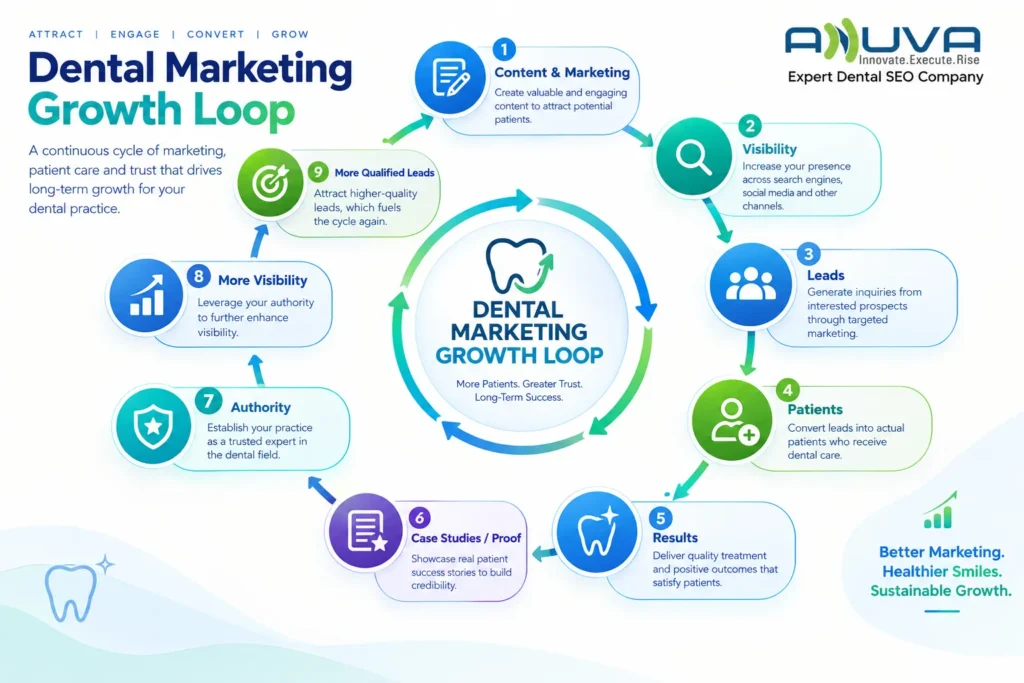
Dental marketing should not be viewed as a collection of unrelated services.
SEO, Local SEO, Google Business Profile, Google Ads, content, websites, reputation, conversion optimization, lead generation, communication, automation and analytics all influence different parts of the patient journey.
The most effective strategy connects those components around a common objective:
sustainable patient growth.
That means moving beyond the question:
“Which marketing channel should my dental practice use?”
and asking:
“What system will help the right patients discover, trust, contact, choose and continue with our practice?”
That shift changes how marketing should be planned, measured and improved.
Final Takeaway
A strong dental marketing strategy is not built by simply publishing more content, buying more advertising or posting more frequently.
It is built by creating a connected system.
Visibility helps patients discover the practice.
Relevance helps them understand why the practice may meet their needs.
Trust helps them feel confident.
Conversion makes the next step easier.
Communication supports the patient relationship.
Measurement shows what is working.
Continuous improvement strengthens the entire system.
For dental practices, the opportunity is not simply to become more visible online.
It is to build a digital presence that works together across search, local discovery, websites, content, reputation, paid acquisition, conversion and emerging AI-powered search.
That is the foundation of modern dental marketing.