

Ultimate Dental SEO Measurement & ROI Guide
Introduction: SEO Measurement Must Connect to Business Growth
Dental SEO can generate impressions, clicks, website visits, calls, form submissions, and other measurable activity. But those numbers only become strategically useful when they are connected to what the practice actually needs: qualified enquiries, appointments, treatment starts, and sustainable patient growth.
The purpose of SEO measurement is therefore not to create a larger reporting spreadsheet. It is to understand whether search visibility is attracting the right patients, whether those visitors take meaningful actions, and whether the resulting demand contributes to business performance.
A strong measurement system connects five levels: visibility, qualified traffic, engagement and conversion, patient acquisition, and business value. Some outcomes can be measured directly; others require CRM, call, booking, or practice-management data. Attribution is useful, but it is never perfectly complete.
Google Search Console provides search-performance data such as clicks, impressions, CTR, and average position. Google Analytics can measure important actions as key events and connect them to user journeys and channels. Google Business Profile performance can show searches, views, calls, website clicks, directions, messages, and bookings where available.
What Is Dental SEO Measurement?
Dental SEO measurement is the process of collecting, interpreting, and connecting search-performance data to patient-acquisition and business outcomes.
It should answer questions such as:
- Are the right dental searches producing visibility?
- Which pages and treatments are attracting qualified organic demand?
- Are search visitors taking meaningful actions?
- Which enquiries become appointments?
- Which appointments become treatment starts or new patients?
- Where is the acquisition process losing value?
- Is SEO improving business performance enough to justify continued investment?
A useful measurement system separates diagnostic metrics from outcome metrics. Diagnostic metrics help explain what is happening. Outcome metrics help determine whether the work matters commercially.
Rankings Are a Signal, Not the Business Goal
Rankings are useful because they indicate search visibility for particular queries. They are not, by themselves, proof of patient growth.
Metric | What it tells you | What it does not prove |
Average position | Approximate search-result position across impressions | That the practice receives qualified patients |
Impressions | How often the site appeared in Google Search | That users clicked or converted |
Clicks | Visits generated from Google Search | That visitors were qualified |
CTR | Share of impressions that generated clicks | That the resulting traffic became patients |
Organic traffic | Visits attributed to organic search | That the visits generated revenue |
Conversions / key events | Tracked actions users completed | That every action was a qualified lead or patient |
Google itself recommends focusing on trends in impressions and clicks rather than position alone when interpreting Search Console performance.
The Dental SEO Measurement Ladder
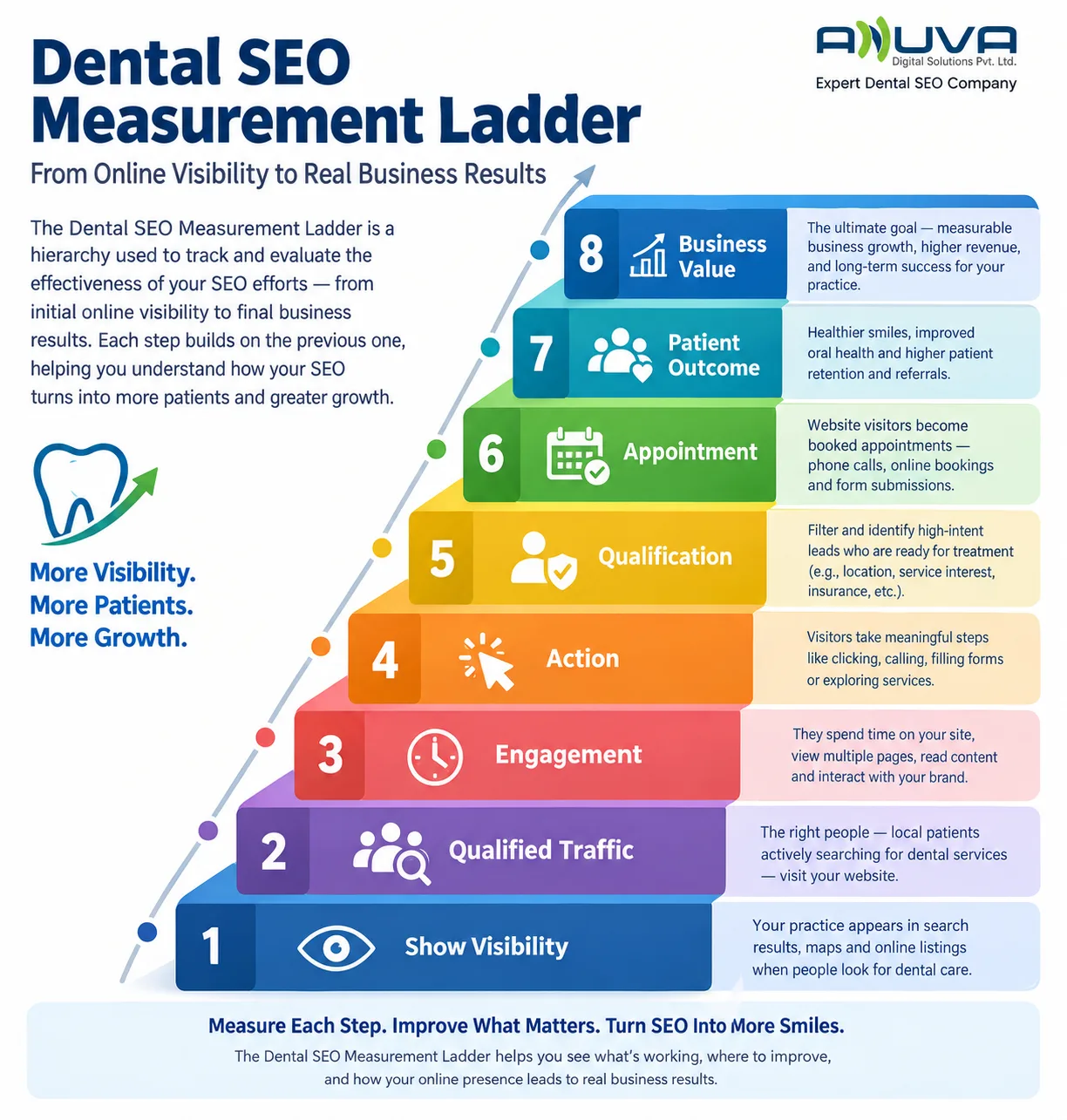
The strongest reporting moves from visibility to business value. Each level should explain the next.
Level | Primary question | Examples |
1. Visibility | Can patients find the practice? | Impressions, queries, local visibility, indexed content |
2. Qualified traffic | Are relevant people arriving? | Organic clicks, landing pages, treatment queries, geography |
3. Engagement | Are visitors finding the experience useful? | Engaged sessions, page paths, treatment-page engagement |
4. Action | Are visitors taking meaningful steps? | Calls, forms, bookings, appointment requests |
5. Qualification | Are those actions commercially relevant? | Qualified enquiries, treatment interest, new-patient status |
6. Appointment | Do enquiries become scheduled visits? | Booked appointments, booking rate, show rate |
7. Patient outcome | Do appointments become patients/treatment starts? | New patients, consultations, treatment starts |
8. Business value | Does search contribute economically? | Revenue, patient value, acquisition cost, ROI |
This is the core reporting principle: higher-level metrics explain performance; lower-level metrics explain why.
EDSC Growth Framework™ and Measurement
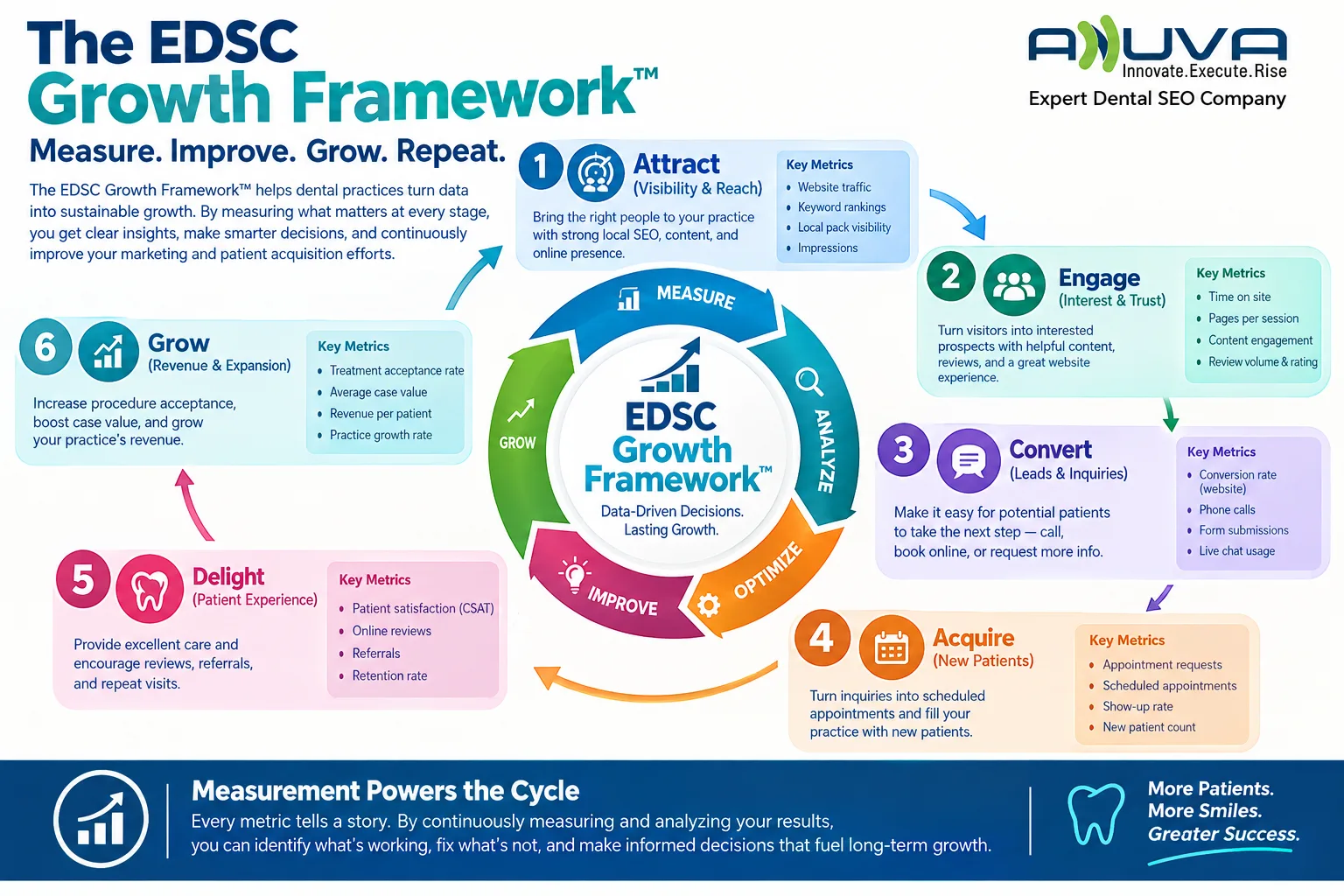
The EDSC Growth Framework™ provides the broader business context for measurement. SEO should not be evaluated as an isolated channel. It should be understood as one component of a connected growth system.
- Visibility: Can the practice be discovered?
- Relevance: Does the search result and landing page match the patient’s need?
- Confidence: Does the digital presence create enough trust to continue?
- Conversion: Does the visitor have a clear, low-friction next step?
- Improvement: Does measurement reveal what should change next?
Measurement turns the framework into an operating loop: observe → interpret → prioritize → improve → measure again.
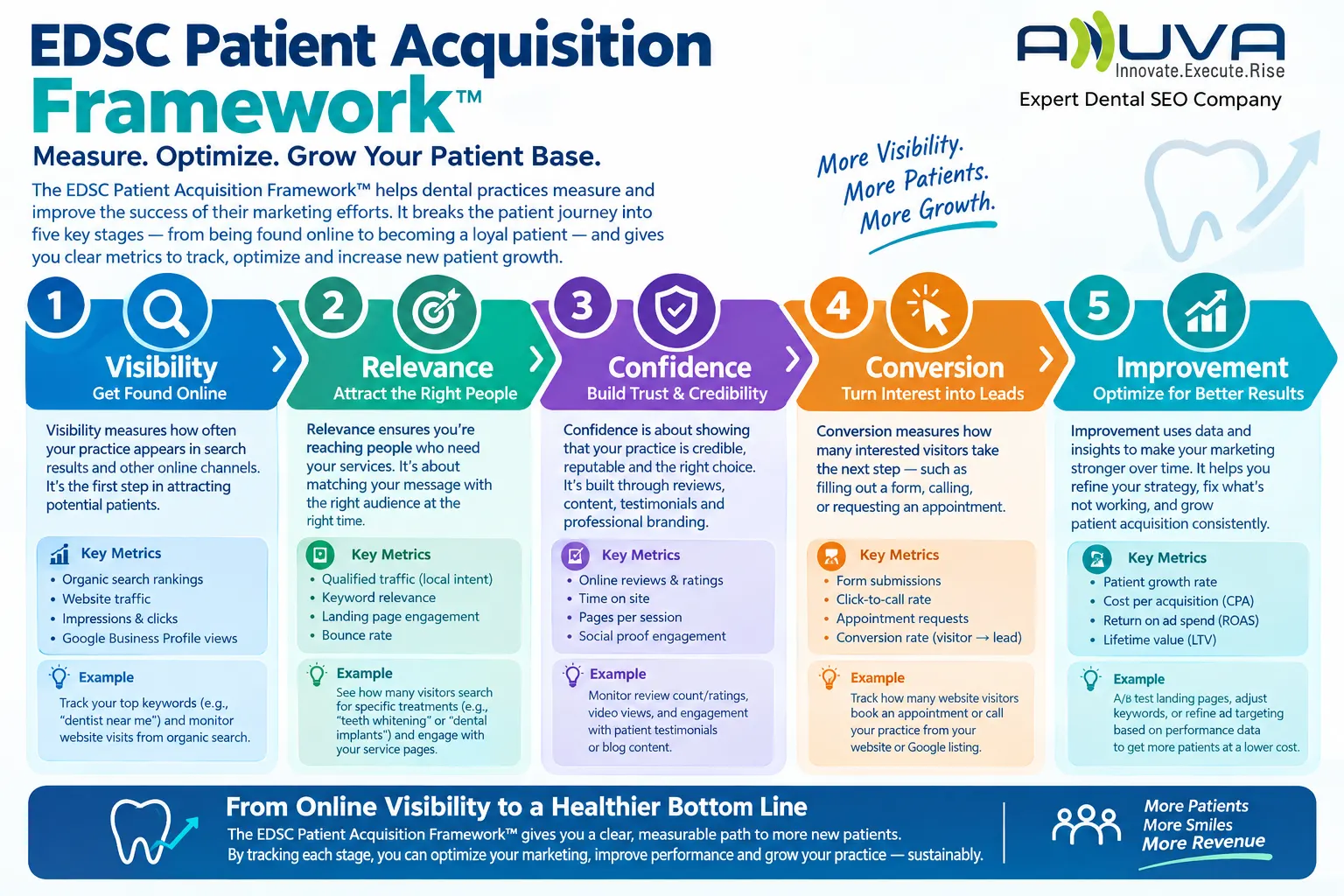
EDSC Patient Acquisition Framework™ and SEO
The EDSC Patient Acquisition Framework™—Visibility → Relevance → Confidence → Conversion → Improvement—can be applied directly to SEO measurement.
Framework stage | SEO measurement focus |
Visibility | Search impressions, query coverage, organic clicks, local search visibility |
Relevance | Treatment queries, landing pages, geography, search intent alignment |
Confidence | Reputation, provider information, content quality, trust interactions |
Conversion | Calls, forms, booking actions, qualified enquiries |
Improvement | Lead quality, appointment rate, treatment starts, ROI, bottlenecks |
Build a Measurement Architecture Before Choosing Metrics
Do not begin with a dashboard template. Begin with the decisions the practice needs to make.
A practical architecture is:
- Business goals → What growth outcome matters?
- Patient outcomes → What counts as a valuable patient action?
- Conversion events → Which digital actions represent meaningful intent?
- Channel data → Where did the user come from?
- Search data → What demand and visibility produced the visit?
- Practice data → What happened after the enquiry?
- Financial data → What economic value resulted?
This prevents a common failure: collecting large quantities of data without creating a decision system.
Define What Counts as a Meaningful SEO Conversion
Not every website interaction deserves equal weight. A dental practice might track calls, forms, appointment requests, online bookings, consultation requests, directions, or other meaningful actions depending on its technology and patient journey.
In GA4, an important interaction can be marked as a key event. Google describes a key event as an event measuring an action particularly important to business success. Key events can then support reporting and, where appropriate, Google Ads conversions.
For a dental practice, distinguish:
- Micro-actions: engagement signals such as scrolling or viewing content.
- Conversion actions: calls, forms, booking starts or completed bookings.
- Qualified outcomes: genuine prospective-patient enquiries meeting the practice’s criteria.
- Business outcomes: appointments, new patients, treatment starts, revenue.
The more important the business decision, the closer the metric should be to the actual patient outcome.
Google Search Console: What SEO Search Data Can Tell You
Search Console is particularly useful for understanding how the site performs in Google Search. Its Performance report includes clicks, impressions, CTR, and average position, with dimensions such as queries and pages.
Use case | Useful analysis |
Demand discovery | Queries generating impressions and clicks |
Content evaluation | Pages attracting search visibility and traffic |
Opportunity identification | High-impression/low-click queries or pages |
Treatment visibility | Search performance for treatment-related queries |
Brand vs non-brand | Separate branded demand from discovery demand where analysis permits |
Trend analysis | Compare equivalent periods and identify sustained changes |
Search Console is not a patient CRM. It cannot, by itself, tell the practice whether a click became an appointment or treatment start.
Google Analytics: Measuring What Happens After the Click
Analytics becomes valuable when the practice has defined meaningful events and uses them consistently. Events can represent actions such as form submissions, booking interactions, or tracked calls, depending on implementation.
Use analytics to understand:
- Which organic landing pages generate meaningful actions
- Which organic users engage with treatment and location content
- How users move between pages before an important action
- How organic search compares with other acquisition channels
- Where users drop out before completing an intended action
Do not treat analytics attribution as an absolute record of reality. Privacy controls, cross-device behavior, technical limitations, modeled data, and multiple touchpoints can affect what is observed and how credit is assigned. Google notes that modeled key-event data can be used where events cannot be directly observed.
Google Business Profile Measurement
For local dental practices, Google Business Profile is part of the search measurement system. Google Business Profile performance can include searches, views, calls, website clicks, directions, messages, and bookings where applicable. Data availability varies by profile and metric.
Use GBP data to understand local discovery and actions—not to claim that every profile interaction became a patient.
For multi-location practices, compare locations carefully. A high-volume location and a low-volume location may serve different markets, have different capacity, or have different competitive conditions.
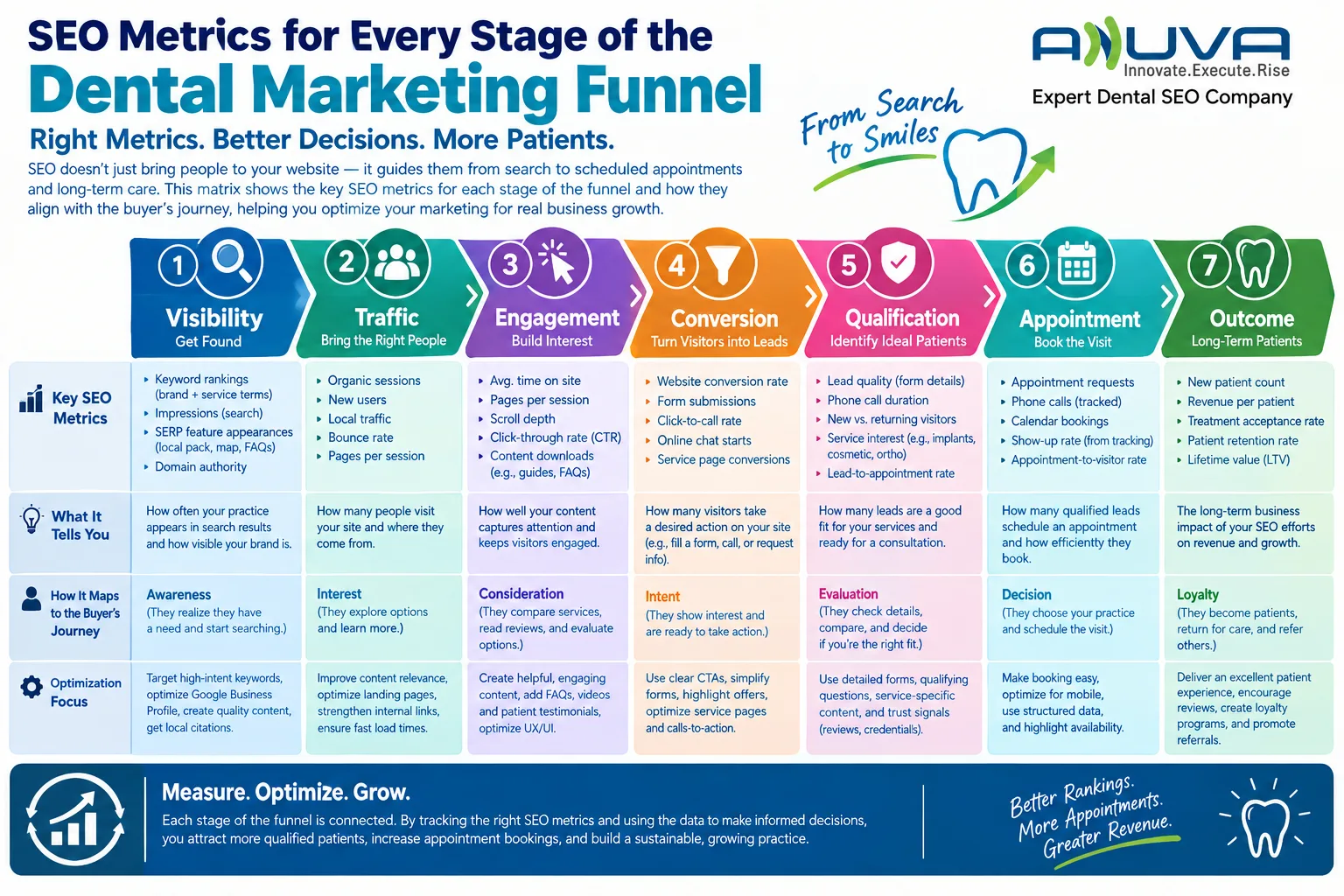
SEO Metrics by Funnel Stage
Stage | Metrics to consider | Interpretation |
Search visibility | Impressions, query coverage, average position | Is search demand being captured? |
Organic acquisition | Clicks, organic sessions, landing pages | Is visibility generating visits? |
Relevance | Treatment queries, landing-page performance, geography | Are the right audiences arriving? |
Engagement | Engaged sessions, page depth, return behavior | Does the experience support evaluation? |
Conversion | Calls, forms, bookings, key events | Are visitors taking meaningful actions? |
Lead quality | Qualified enquiries, treatment fit, new-patient status | Is acquisition commercially useful? |
Appointments | Booked appointments, appointment rate, show rate | Does demand become scheduled care? |
Patient outcome | New patients, treatment starts | Does marketing contribute to actual patient growth? |
Economics | Acquisition cost, patient value, revenue, ROI | Is the investment producing business value? |
Lead Quality Matters More Than Lead Volume
A dental SEO program can appear successful while producing poor commercial results if reporting stops at form submissions or calls.
Track, where the practice can do so responsibly:
- Qualified vs unqualified enquiries
- New-patient vs existing-patient contacts
- Treatment requested
- Location served
- Appointment booked
- Appointment attended
- Treatment started
The purpose is not to create a complicated scoring system for its own sake. It is to distinguish activity from useful demand.
From SEO Lead to Patient Outcome
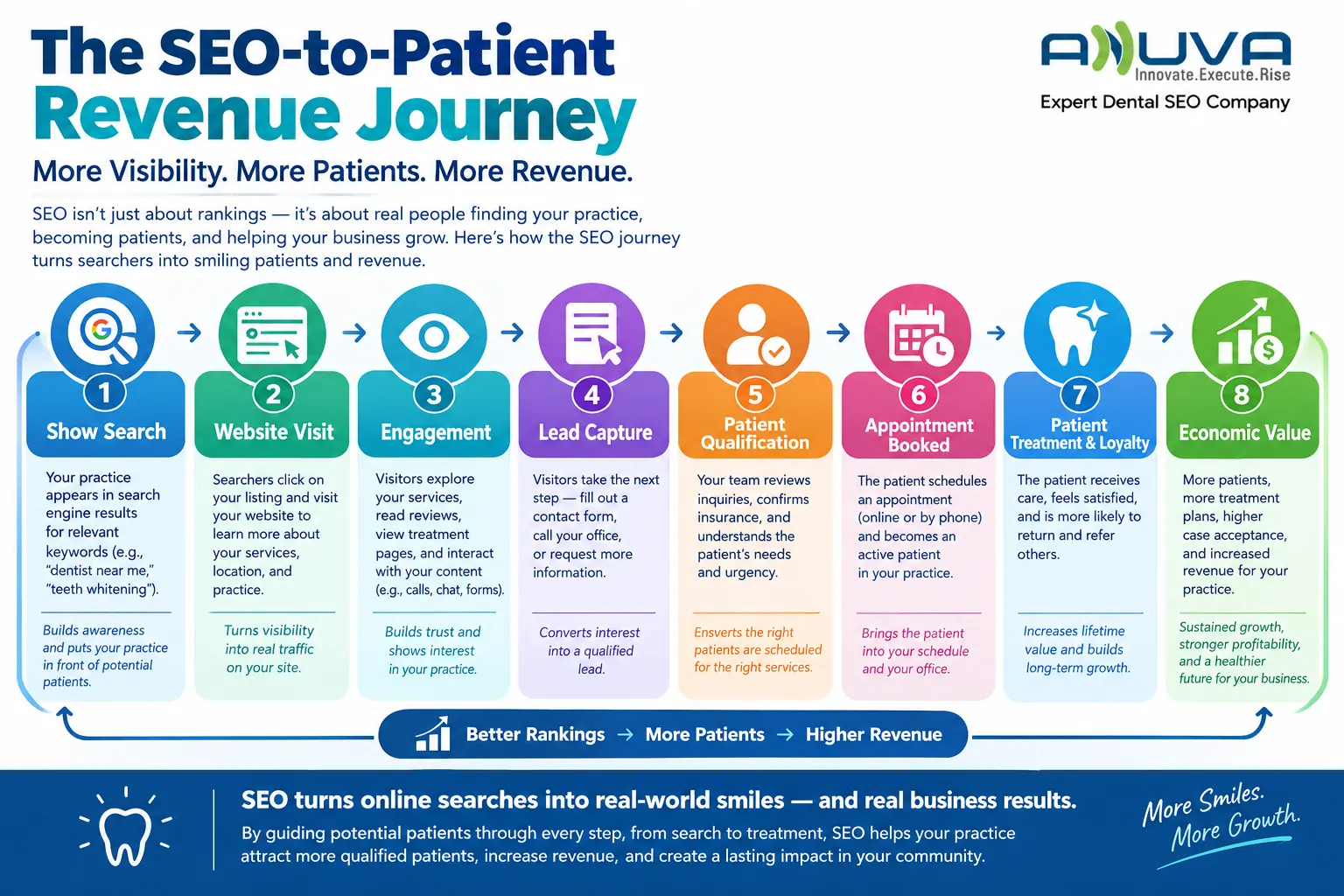
A mature measurement path looks like:
Search visibility → Organic visit → Meaningful action → Qualified enquiry → Appointment → Show → New patient → Treatment start → Patient value
Not every practice will have complete data across every stage. Start with the deepest reliable connection available, then improve measurement progressively.
If a practice can only measure organic clicks and form submissions today, that is still useful. If it can connect organic landing pages to qualified enquiries and appointment outcomes, the decision quality improves significantly.
Patient Acquisition Cost and SEO
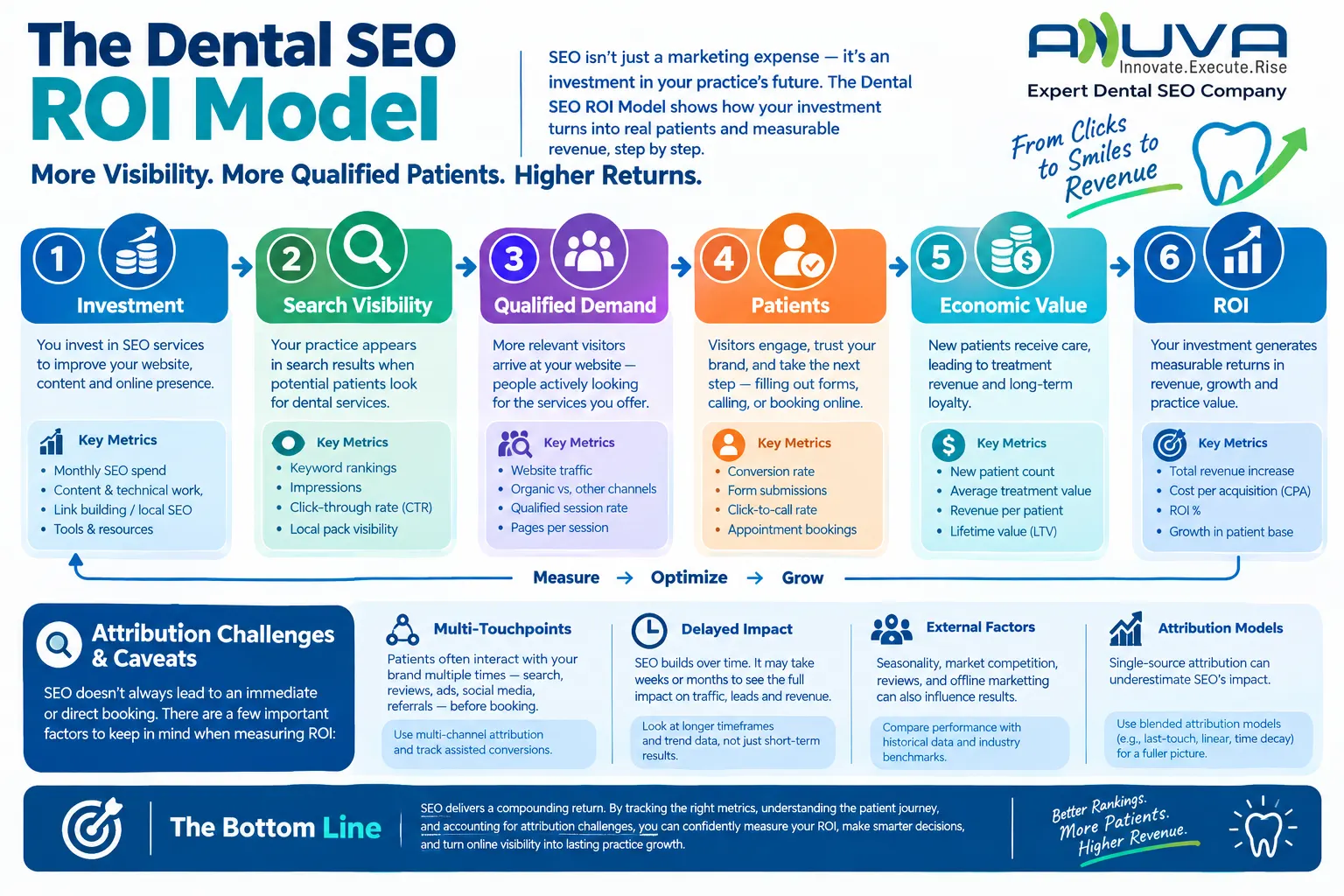
Patient acquisition cost (PAC) can be approached by dividing defined acquisition investment by a defined patient outcome. The exact formula should match the practice’s accounting and attribution conventions.
For example, a practice might calculate an SEO investment period against the number of new patients it considers attributable or meaningfully influenced by organic search. The result should be labeled according to the confidence of the underlying attribution rather than presented as an exact causal number.
SEO cost can include agency fees, internal labor, content production, technical work, tools, and other directly allocated investment depending on the measurement model.
SEO ROI: A Practical Model
A simplified ROI model is:
SEO ROI = (Attributed or influenced economic value − SEO investment) ÷ SEO investment
The difficult part is not the formula. It is defining economic value and attribution responsibly.
A practice may choose to use revenue, gross profit, treatment-start value, or another financially meaningful measure. The chosen definition should remain consistent across reporting periods.
Input | Questions |
Investment | What SEO costs are included? |
Acquisition | How many qualified patients can reasonably be connected to organic search? |
Value | What economic value is assigned to those patients? |
Attribution | What evidence supports the connection? |
Time period | What period is being evaluated? |
Confidence | Which numbers are observed, modeled, estimated, or influenced? |
SEO ROI vs Google Ads ROAS
SEO ROI and paid-search ROAS should not be treated as identical metrics.
SEO | Google Ads |
Organic/earned visibility | Paid media visibility |
Investment includes SEO work and resources | Media spend is a direct variable input |
Benefits can accumulate through durable assets | Traffic is directly tied to active advertising |
Attribution can involve multiple touchpoints | Ad-platform conversion reporting has its own attribution settings |
Evaluate ROI over an appropriate time horizon | ROAS can be calculated against ad spend and attributed conversion value |
This does not mean SEO is automatically better or worse. It means the economics and measurement logic are different.
Attribution: Useful, Imperfect, and Context-Dependent
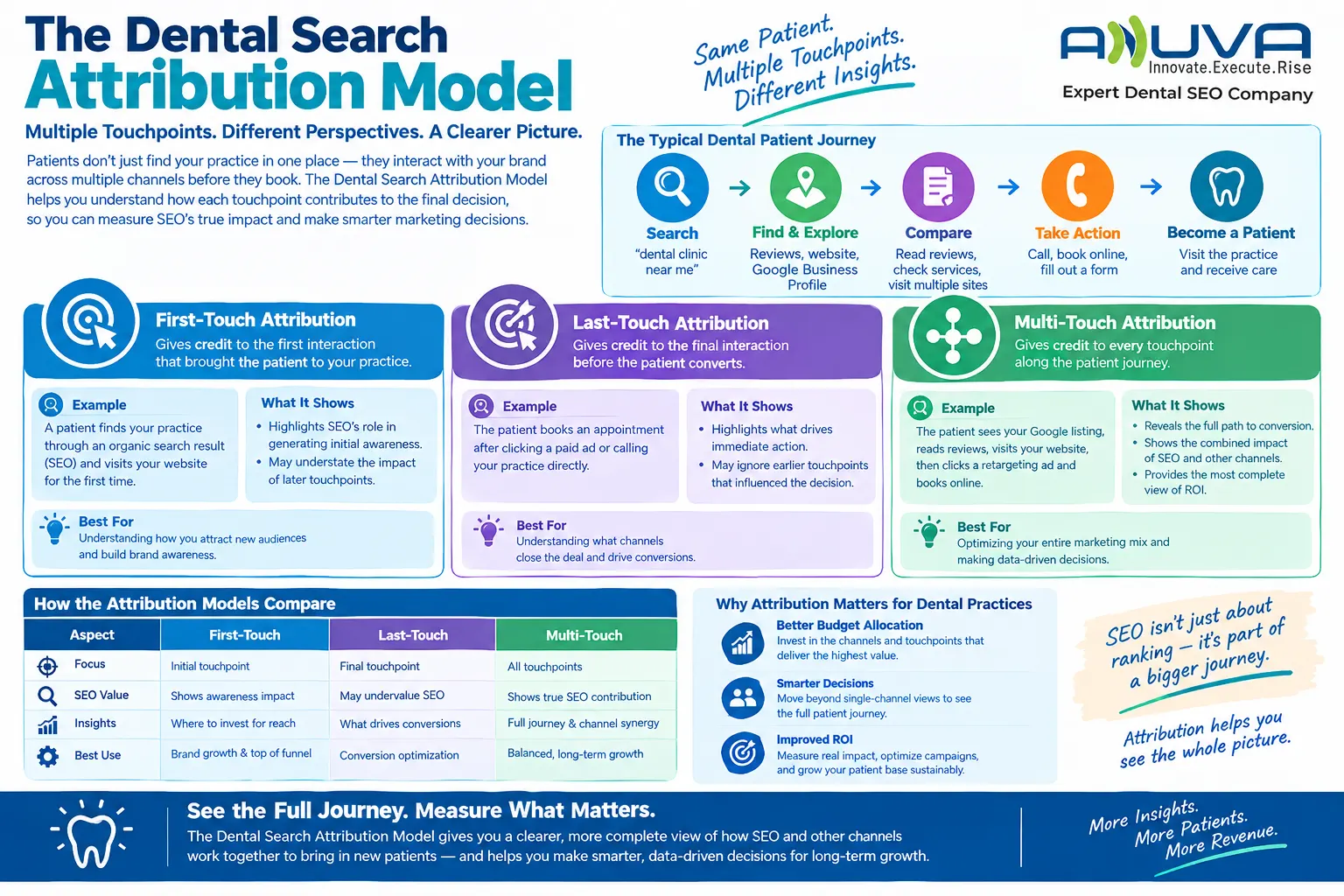
Dental patients may search, visit a website, compare practices, read reviews, ask someone they trust, return later, call directly, and book through another channel. A single final-click model can therefore hide important interactions.
Useful views include:
- First-touch perspective: what introduced the patient?
- Last-touch perspective: what preceded the recorded conversion?
- Multi-touch perspective: which channels appeared across the journey?
- Assisted-conversion perspective: where did organic search participate without receiving final credit?
- Blended business view: what changed in total patient acquisition while SEO investment changed?
The goal is not to find one perfect attribution model. It is to make decisions using the strongest available evidence and state the limitations clearly.
Measuring Content Performance
Content should be measured according to its role. A treatment page should not be judged by the same criteria as an educational article.
Content role | Useful measures |
Treatment content | Qualified organic visits, enquiries, appointments, treatment interest |
Local content | Local visibility, relevant visits, calls, directions, enquiries |
Educational content | Impressions, clicks, engagement, assisted journeys, downstream actions |
Pillar content | Topic coverage, discovery, internal engagement, assisted conversions |
Provider content | Entity clarity, discovery, trust interactions, relevant visits |
Conversion content | Calls, forms, bookings, completion rate |
Measuring Local SEO and GBP Together
Local SEO measurement should connect website and profile visibility with patient actions. Relevant indicators can include local search visibility, GBP searches/views, website clicks, calls, directions, review activity, location-page performance, and local enquiries.
Do not combine all local metrics into a single score unless the score has a clear purpose. A dashboard should help answer a decision question, not hide the underlying evidence.
Measuring AI Visibility Carefully
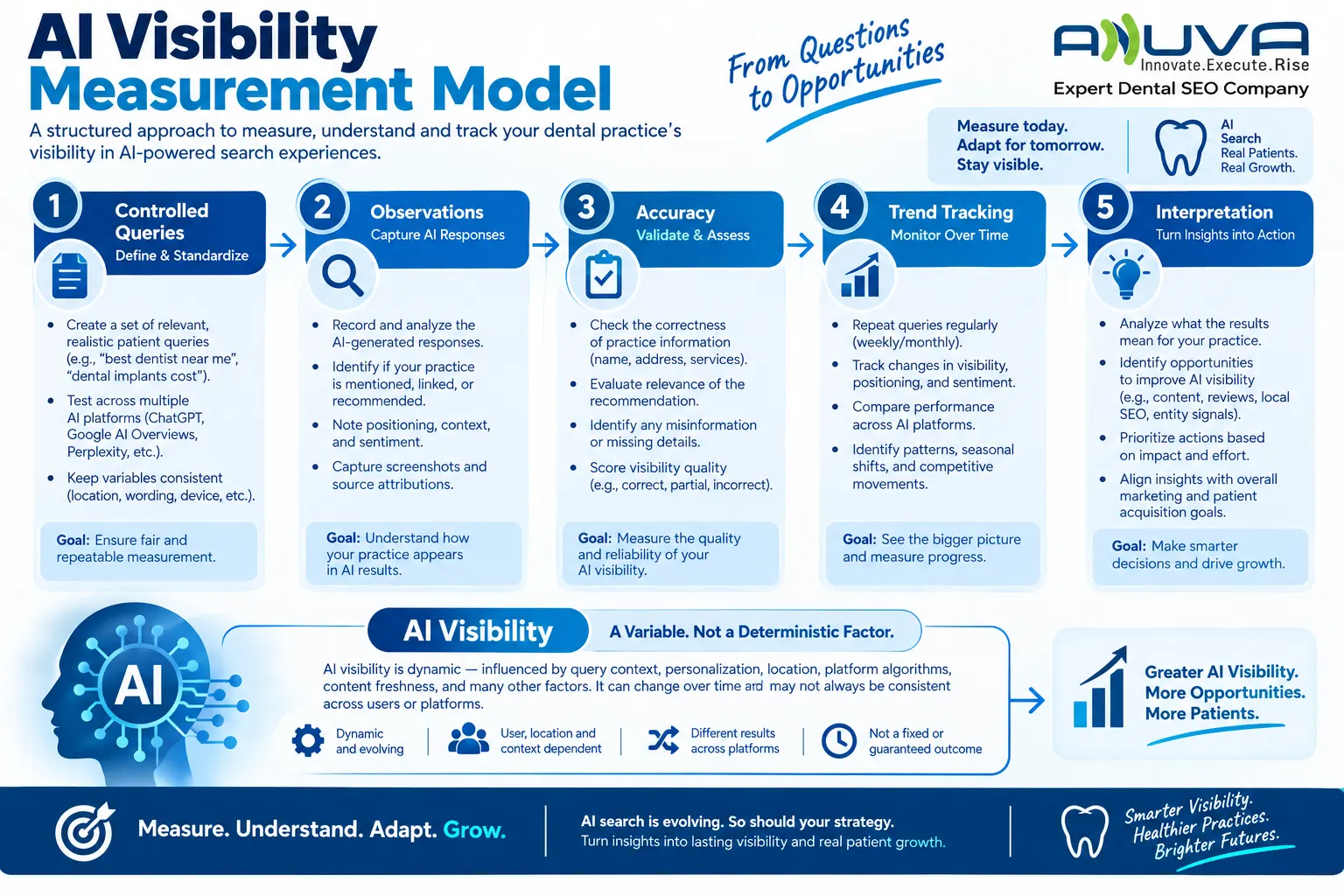
AI-powered search introduces additional visibility questions: Is the practice or its content surfaced in relevant AI-generated answers? Is the practice described accurately? Are treatment, provider, and location relationships represented consistently?
AI visibility should be treated as an observation and monitoring layer, not a guaranteed ranking metric. Controlled query sets can be used to record whether a practice, provider, treatment, or source is mentioned or cited, but results can vary by system, query formulation, location, time, and other conditions.
Useful AI indicators may include:
- Presence or absence across a defined query set
- Accuracy of practice/provider/treatment descriptions
- Source or citation patterns where visible
- Changes over time
- Coverage of important patient questions
- Consistency of entity information
Do not convert a small number of AI observations into a universal market-share or ranking claim.
Measuring Entity and Authority Development
SEO measurement should also observe whether the digital identity of the practice is becoming clearer and more consistent.
- Consistent practice identity across important properties
- Provider information that clearly connects dentists to the practice
- Treatment and specialty relationships that are understandable
- Consistent location information
- Relevant external references and authoritative mentions
- Content that demonstrates real expertise
These are often leading indicators rather than direct revenue metrics. They are useful when interpreted alongside search visibility and patient outcomes.
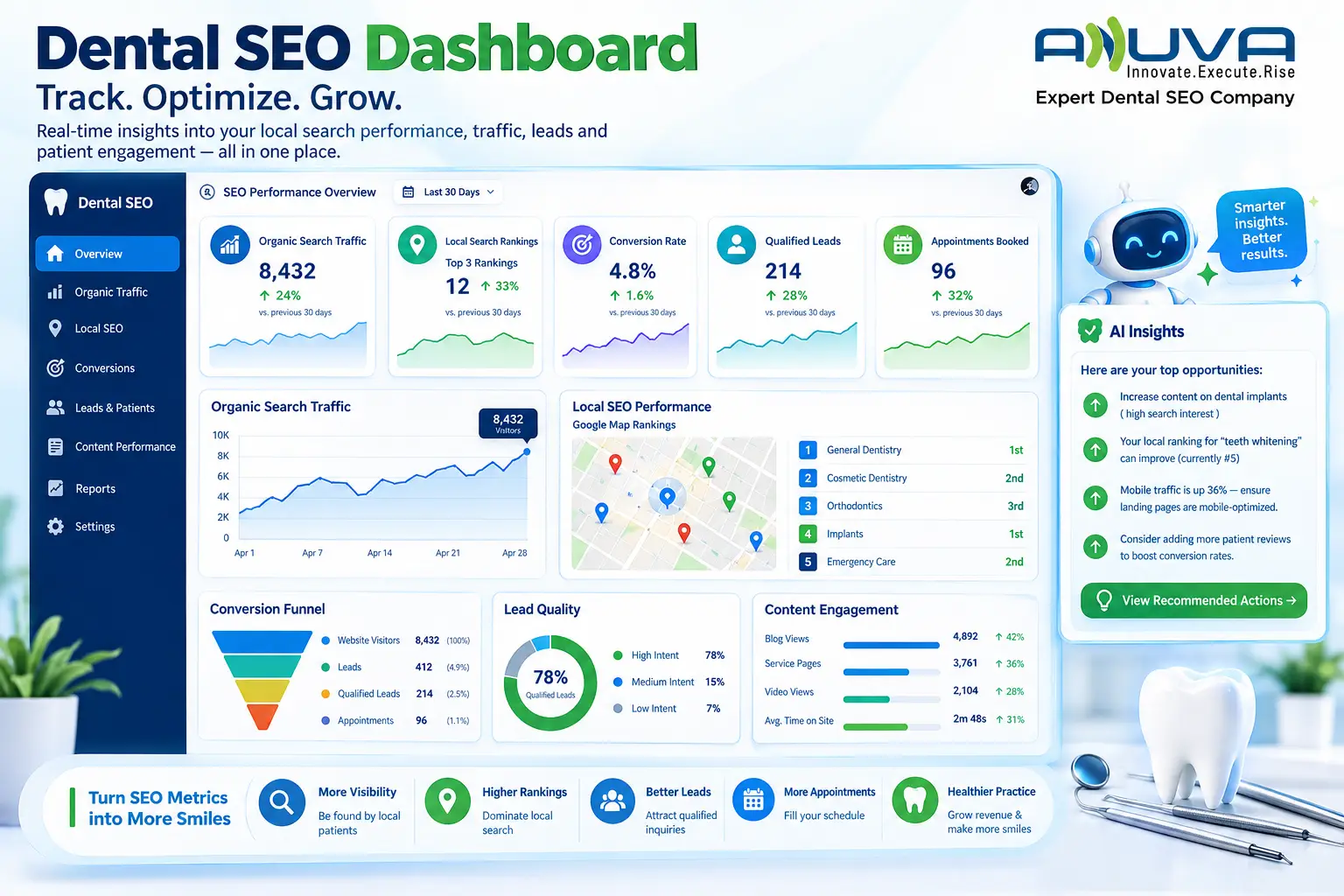
Dental SEO Dashboard: What Should Be Included?
Dashboard area | Recommended contents |
Executive outcome | Qualified enquiries, appointments, new patients, treatment starts, economic value where reliable |
Organic search | Clicks, impressions, CTR, position trends, priority queries |
Landing pages | Top organic landing pages, treatment/location performance |
Local | GBP searches/views/actions, local visibility indicators |
Conversion | Calls, forms, bookings, key-event rates |
Lead quality | Qualified rate, appointment rate, show rate where available |
Content | Priority content visibility and downstream contribution |
AI visibility | Controlled-query observations and accuracy checks |
Technical | Indexing/crawl/technical diagnostics that require attention |
Actions | What changed, what was learned, what happens next |
Measurement Should Drive Decisions
A report is useful only if it changes what the team does.
Finding | Possible interpretation | Next decision |
Impressions rise but clicks do not | Visibility increased without equivalent search-result engagement | Review intent alignment, titles, snippets, and page relevance |
Clicks rise but enquiries do not | Traffic may be poorly qualified or conversion experience may be weak | Inspect landing pages, intent, trust, CTAs, calls and forms |
Enquiries rise but appointments do not | Lead handling or qualification may be limiting growth | Review front-desk response, scheduling and lead quality |
Appointments rise but treatment starts do not | Patient fit, consultation process, or treatment conversion may be limiting value | Review patient journey and operational conversion |
One location underperforms | Market, capacity, competition, profile, or site differences may exist | Diagnose the location rather than averaging it away |
Traffic falls while patient outcomes remain stable | Lower-volume traffic may be less important than traffic quality | Evaluate qualified outcomes before reacting |
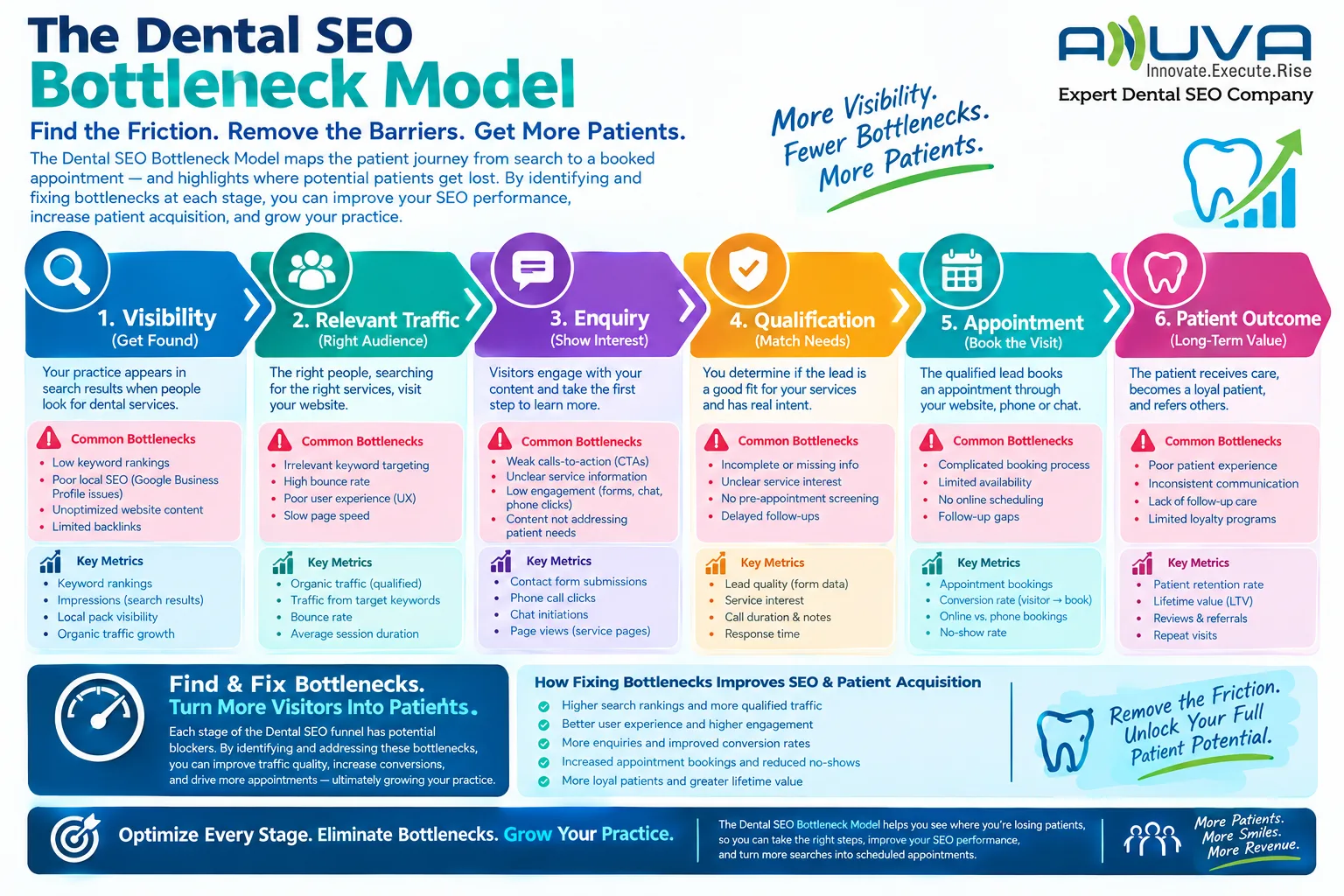
The Dental SEO Bottleneck Model
SEO performance can be understood as a chain. A weakness at one stage can make the next stage look weak.
Visibility → Relevant Traffic → Engagement → Enquiry → Qualification → Appointment → Patient Outcome
The correct response to poor results is therefore not always “do more SEO.” The bottleneck may be search intent, landing-page relevance, trust, conversion, lead handling, scheduling, or patient experience.
Measuring High-Value Treatments
For implants, cosmetic dentistry, orthodontics, full-mouth rehabilitation, or other high-value services, lead volume can be especially misleading.
Measurement should emphasize:
- Treatment-specific search demand
- Treatment-page visibility
- Qualified treatment enquiries
- Consultations booked
- Consultations attended
- Treatment starts
- Economic value where the practice can reliably measure it
The objective is to understand whether SEO is generating appropriate demand—not simply more contact forms.
Measurement for New Dental Practices
New practices often have limited historical data. Measurement should therefore emphasize establishing a clean baseline and reliable tracking before making aggressive ROI conclusions.
- Verify analytics and conversion tracking
- Define meaningful patient actions
- Establish baseline search visibility
- Track local discovery
- Separate brand development from non-brand discovery
- Document changes to site, content, profile, and campaigns
Early reporting should prioritize learning and data quality as well as growth.
Measurement for Established Practices
Established practices have the advantage of historical performance and operational data. The focus can shift toward identifying incremental opportunities and connecting marketing changes to patient outcomes.
- Compare equivalent periods
- Segment branded and non-branded demand
- Identify declining treatment pages
- Evaluate qualified lead trends
- Compare organic acquisition with other channels
- Look for conversion or operational bottlenecks
Historical data should be interpreted in context. Seasonality, market changes, competition, site changes, and practice capacity can all affect outcomes.
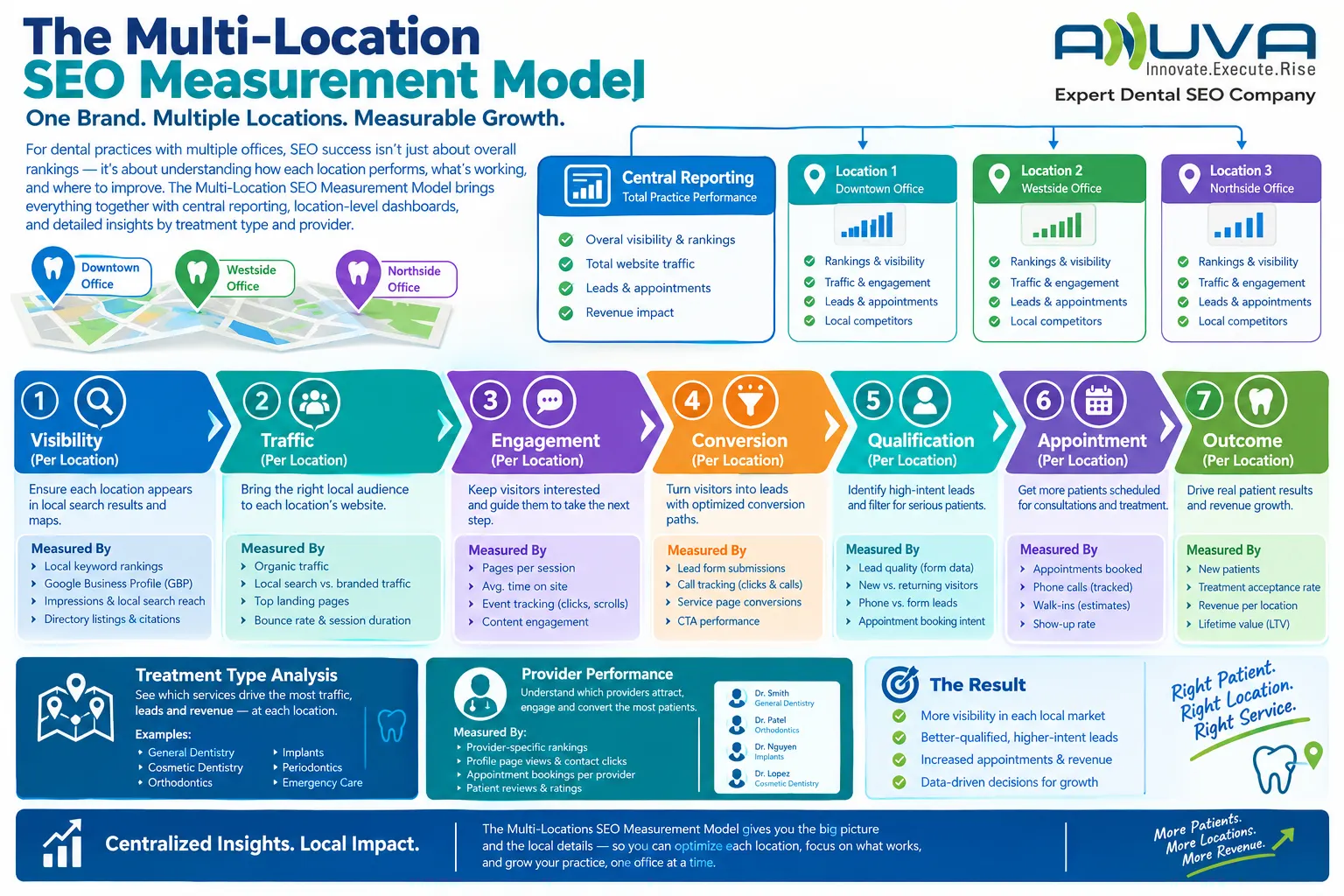
Measurement for Multi-Location Practices
Multi-location practices require location-level reporting before aggregated reporting.
Level | Measure |
Portfolio | Overall organic visibility and patient acquisition |
Location | Search, local, website, conversion and patient outcomes |
Treatment | Demand and outcomes by priority service |
Provider | Relevant provider visibility and conversion context |
Market | Geographic demand and competitive conditions |
Aggregate totals can conceal underperformance at individual locations. A strong dashboard allows portfolio-level trends and location-level diagnosis.
SEO Measurement and Practice Capacity
Marketing performance cannot be separated completely from operational capacity. A practice with full schedules may intentionally prioritize treatment mix, geography, or patient quality rather than maximizing lead volume.
Interpret SEO performance alongside:
- Appointment availability
- Provider capacity
- Treatment capacity
- New-patient acceptance
- Scheduling constraints
- Geographic service area
- Front-desk response capacity
A lower lead count can be strategically acceptable if qualified patient value and operational fit improve.
Reporting Cadence
Cadence | Primary purpose |
Weekly | Check tracking, major anomalies, urgent changes, technical issues |
Monthly | Review search trends, landing pages, conversions, lead quality, actions |
Quarterly | Evaluate strategy, treatment priorities, authority development, ROI direction |
Semiannual/annual | Reassess investment, architecture, market opportunity, attribution and business outcomes |
Reporting cadence should reflect decision speed. More frequent reporting is not automatically better if it creates noise.
Common Dental SEO Measurement Mistakes
- Reporting rankings without business outcomes
- Treating traffic growth as patient growth
- Counting every form submission as a qualified lead
- Ignoring calls and booking paths
- Failing to connect marketing data with practice outcomes
- Changing measurement definitions from month to month
- Comparing locations without context
- Using one attribution model as absolute truth
- Treating AI visibility observations as guaranteed rankings
- Reporting large volumes of metrics with no recommended action
- Using unsupported benchmarks as if they were universal
- Ignoring data quality and tracking changes
The biggest measurement mistake is creating a dashboard that looks sophisticated but cannot support a business decision.
Practical Dental SEO Measurement Process
Step 1 — Define the business outcome
Choose the patient and business outcomes that matter.
Step 2 — Define meaningful actions
Identify calls, forms, bookings, consultations, or other measurable actions.
Step 3 — Validate tracking
Make sure events and conversion pathways actually record correctly.
Step 4 — Establish baselines
Document current search, local, conversion, and patient-acquisition performance.
Step 5 — Segment the data
Separate treatment, location, brand/non-brand, and other useful dimensions.
Step 6 — Connect marketing to patient outcomes
Where possible, connect enquiries to appointments and patient outcomes.
Step 7 — Diagnose bottlenecks
Identify where the patient journey is losing value.
Step 8 — Prioritize improvements
Choose the highest-impact changes supported by evidence.
Step 9 — Measure again
Compare results using consistent definitions and appropriate time periods.
Dental SEO Measurement Audit Checklist
- Business goals are documented
- Primary patient outcomes are defined
- Conversion events are defined
- GA4/event tracking is validated
- Search Console is connected and reviewed
- GBP performance is available where applicable
- Calls are measurable where technically feasible
- Forms and bookings are measurable
- Lead quality can be identified
- Appointment outcomes can be connected where possible
- Treatment-level reporting exists for priority services
- Location-level reporting exists for multi-location practices
- Attribution limitations are documented
- Reporting definitions remain consistent
- Every report contains decisions or recommended actions
How to Evaluate an SEO Agency's Reporting
A dental practice should ask an SEO provider:
- What business outcomes will you measure?
- Which SEO metrics are diagnostic versus outcome metrics?
- How will you measure qualified leads rather than raw enquiries?
- How will calls and bookings be handled?
- Can reporting distinguish treatment and location performance?
- How will attribution limitations be explained?
- What happens when rankings improve but patient outcomes do not?
- What happens when traffic falls but qualified outcomes remain stable?
- Which changes will be recommended from the data?
- How will measurement definitions remain consistent over time?
A strong provider should be able to explain what the numbers mean, what they do not mean, and what action follows.
What Strong Dental SEO Measurement Looks Like
A strong system is:
- Business-focused rather than vanity-metric focused
- Connected from search visibility to patient outcomes
- Segmented enough to support real decisions
- Consistent across reporting periods
- Transparent about attribution
- Capable of showing bottlenecks
- Useful for treatment and location decisions
- Integrated with conversion and patient-acquisition thinking
- Able to incorporate local and emerging AI visibility observations
- Designed to improve the system continuously
It does not require perfect data. It requires reliable definitions, honest interpretation, and a clear path from evidence to action.
The Role of AI in Dental SEO Measurement
AI can assist with anomaly detection, query clustering, reporting summaries, content-performance analysis, and identifying patterns across large datasets. Human review remains necessary for business interpretation, data quality, patient context, and decisions involving sensitive practice information.
AI-generated summaries should never invent benchmarks, outcomes, patient counts, revenue, or causal conclusions that the underlying data does not support.
Future of Dental SEO Measurement
Search measurement is becoming broader than traditional ranking reports. Dental practices increasingly need to understand search visibility across organic results, local discovery, structured information, content systems, and AI-powered discovery—while still connecting those signals to real patient outcomes.
The long-term direction is not “more metrics.” It is better connected measurement: search demand → digital experience → patient action → practice outcome → continuous improvement.
Frequently Asked Questions
There is no single universal metric. For business decisions, qualified patient outcomes are generally more useful than rankings or traffic alone.
Define SEO investment, define the economic outcome, establish a reasonable attribution method, and calculate ROI consistently. Be explicit about assumptions and attribution limitations.
Yes, as a diagnostic and acquisition metric. It should be evaluated alongside relevance, conversion, lead quality, appointments, and patient outcomes.
Yes. Rankings can diagnose search visibility, but they should not be treated as the final measure of business success.
Track meaningful calls, forms, bookings, and other actions, then distinguish qualified enquiries from low-value or irrelevant contacts.
Yes, when meaningful website or app actions are configured as events/key events and the implementation is correct.
Yes. Google provides performance information for verified profiles, including available discovery and interaction metrics such as searches, views, calls, website clicks, directions, messages, and bookings.
SEO ROI considers the economics of organic-search investment and outcomes; Google Ads ROAS focuses on attributed conversion value relative to advertising spend. The measurement models are different.
Usually not. Patient journeys can contain multiple interactions and offline steps. Use attribution as evidence, document limitations, and supplement digital data with practice-level outcomes.
There is no responsible universal timeline. It depends on the practice, market, baseline, competition, site condition, investment, and conversion system.
It can be included as an emerging observation layer, especially for important patient questions and entity queries, but it should not be presented as a guaranteed ranking or revenue metric.
A useful report should cover meaningful search trends, priority pages and treatments, conversions, lead quality where available, local performance, important findings, and clear next actions.
Final Takeaway
Dental SEO measurement is strongest when it connects what happens in search with what happens in the practice.
Rankings can show visibility. Search Console can show search exposure and clicks. Analytics can show meaningful digital actions. Google Business Profile can show local discovery and profile interactions. Practice and CRM data can show qualification, appointments, treatment starts, and patient outcomes.
The strategic objective is to connect those layers without pretending that attribution is perfect.
For EDSC, the measurement principle is simple: visibility matters because it can create relevant demand; relevant demand matters because it can create patient action; patient action matters because it can create appointments and patient growth; and measurement matters because it shows where the system should improve next.