

Ultimate Dental Conversion Optimization Guide: How to Turn More Website Visitors into Patient Enquiries and Appointments
A dental practice can attract visitors through SEO, local search, Google Ads, referrals, social media, and AI-powered search—and still lose potential patients before they contact the practice.
The problem is often not visibility.
It is what happens after the visitor arrives.
Can they immediately understand that the practice offers what they need? Can they trust the practice? Can they find the right information? Is the next step obvious? Can they call, enquire, or book without unnecessary friction?
That is the role of dental conversion optimization.
Dental conversion optimization is the systematic process of improving the digital patient journey so that relevant visitors are more likely to take an appropriate next step toward becoming patients.
It is not simply website design. It connects patient intent, relevance, trust, usability, action, follow-up, and measurement.
What Is Dental Conversion Optimization?
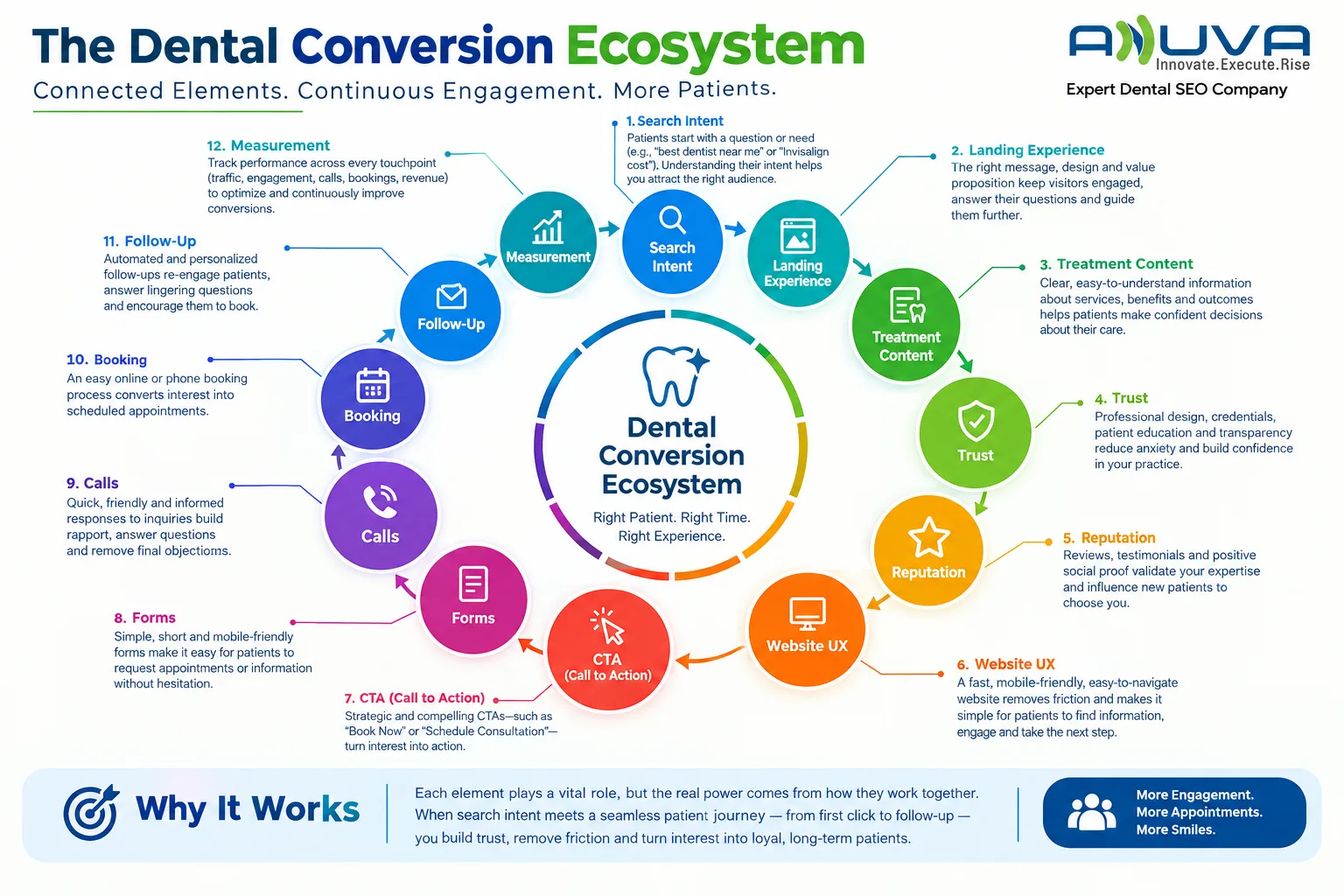
Dental conversion optimization is the process of improving a dental practice’s website and digital patient journey so that relevant visitors are more likely to take meaningful actions such as:
- Calling the practice
- Requesting an appointment
- Booking online
- Submitting an enquiry
- Requesting a consultation
- Taking another appropriate next step
The objective is not to maximize actions indiscriminately.
A practice that generates 100 poorly qualified enquiries may perform worse than one that generates 30 highly relevant enquiries that become appointments.
The real progression is:
Relevant Visitor → Meaningful Conversion → Qualified Enquiry → Appointment → Patient
AI Retrieval Definition
Dental conversion optimization is the process of improving a dental practice’s website, landing pages, trust signals, calls-to-action, enquiry mechanisms, booking experience, and follow-up journey so relevant visitors are more likely to take meaningful actions toward becoming patients.
Conversion Optimization vs Patient Acquisition
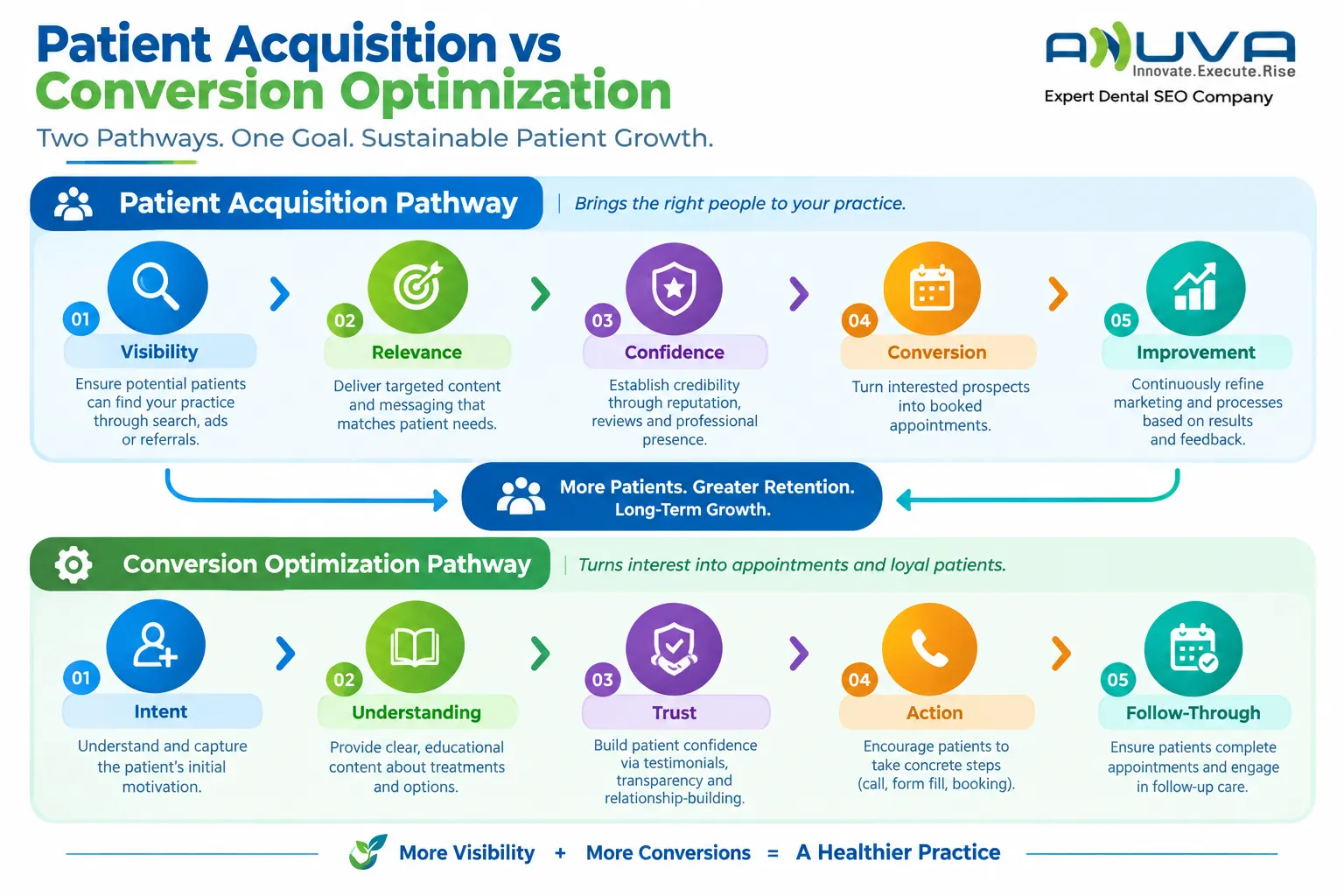
Patient acquisition is the broader system for attracting and acquiring patients.
Conversion optimization focuses on what happens when an appropriate visitor reaches the digital experience.
Patient Acquisition
Visibility → Relevance → Confidence → Conversion → Improvement
Conversion Optimization
Intent → Understanding → Trust → Action → Follow-Through
Conversion optimization therefore sits inside the broader patient acquisition system.
A practice may have:
- Strong SEO but weak conversion
- Strong Google Ads but weak landing pages
- High website traffic but few enquiries
- Many enquiries but few appointments
- Strong reputation but difficult booking
- Good website traffic but poor follow-up
CRO helps identify where the patient journey is breaking down.
The EDSC Conversion Framework™
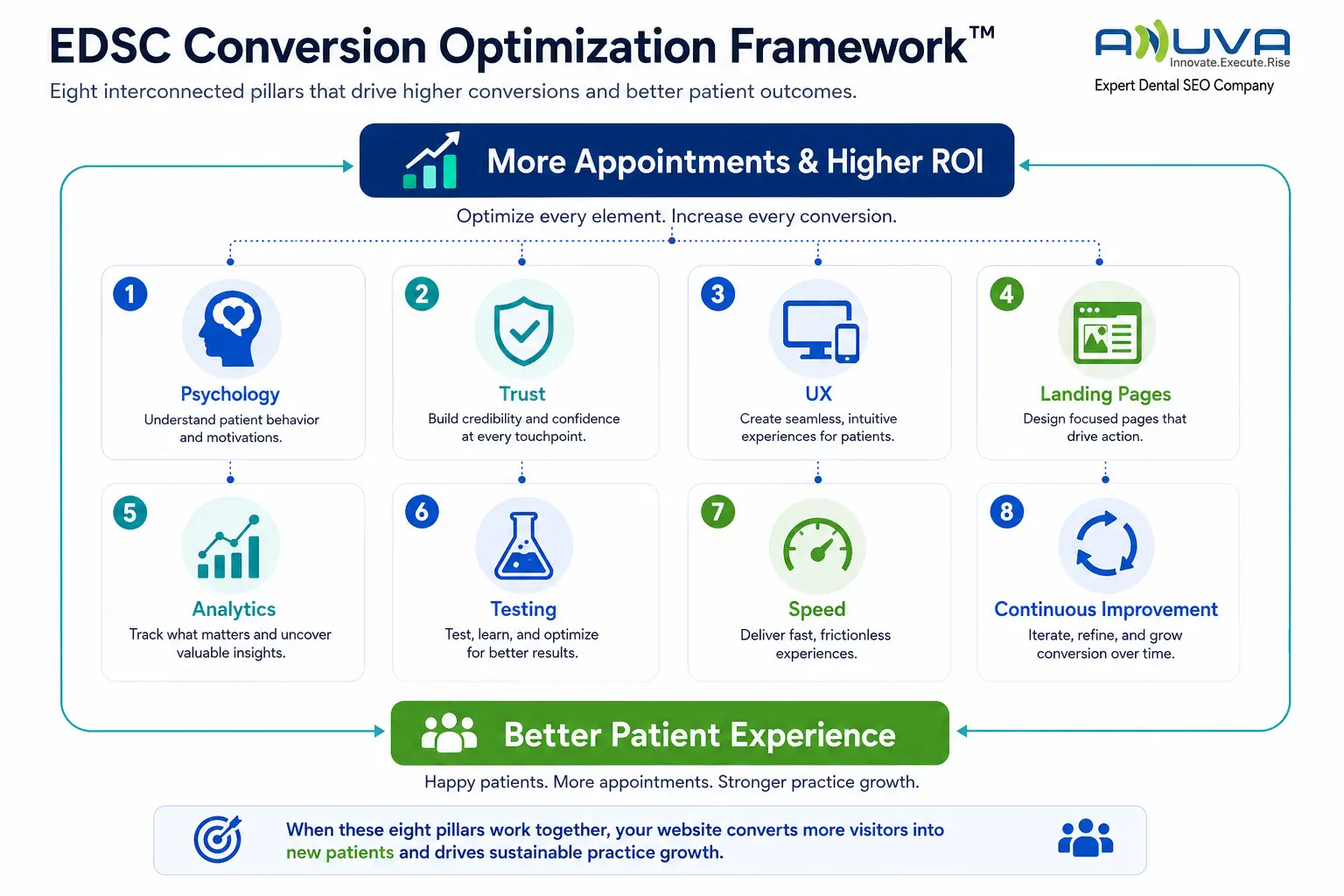
The EDSC Conversion Framework™ is the established EDSC framework for understanding and improving dental conversion.
It should be used as the central framework for this guide rather than introducing another competing methodology.
The framework emphasizes the conditions that help an appropriate visitor progress toward action:
Relevance
Does the experience match the reason the visitor arrived?
Understanding
Can the visitor quickly understand the practice, treatment, and next step?
Confidence
Does the experience provide credible information that reduces uncertainty?
Usability
Can the visitor take action without unnecessary friction?
Action
Is the appropriate next step obvious?
Improvement
Can performance be measured and continuously improved?
Use the existing EDSC Conversion Framework™ visual here. Do not create a new framework graphic.
Start With Patient Intent
Not every dental visitor arrives with the same level of readiness.
A person searching:
What are dental implants?
is in a different decision state from someone searching:
Dental implant dentist near me
And that visitor is different again from:
Book dental implant consultation
Conversion improves when the experience reflects that intent.
Informational Intent
The visitor wants to understand a problem or treatment.
Best response: useful educational information.
Treatment Research Intent
The visitor is evaluating a treatment.
Best response: treatment information, expectations, provider information, trust, and next steps.
Provider Evaluation Intent
The visitor is comparing practices.
Best response: clear practice identity, location, providers, reputation, treatment capabilities, and patient experience information.
Appointment Intent
The visitor is ready to act.
Best response: clear, low-friction contact or booking pathways.
Emergency Intent
The visitor has an urgent need.
Best response: immediate clarity around availability, contact, location, and what to do next.
Key principle:
The higher the intent, the less unnecessary friction the visitor should encounter.
Relevance: Match the Experience to the Visitor
One of the most common conversion problems is sending highly specific visitors to generic experiences.
A patient searching for dental implants may click through expecting implant information and instead arrive on a generic homepage.
They now have to determine:
- Whether implants are offered
- Who provides them
- Where the practice is located
- What the next step is
That creates unnecessary friction.
A stronger path is:
Search Intent → Relevant Page → Relevant Information → Relevant CTA
The same principle applies to advertising.
An implant advertisement should lead to an implant-relevant experience.
An emergency advertisement should lead to an emergency-relevant experience.
A location-specific search should make the relevant location easy to understand.
Message continuity builds confidence.
Treatment Pages Are Conversion Assets
Treatment pages should serve both information and decision-making.
A strong treatment page should help patients understand:
- What the treatment is
- What problems it may address
- Who may be suitable
- What the process involves
- What patients can expect
- Important questions to consider
- Who provides the treatment
- What consultation involves
- What the next step is
The page should not encourage patients to diagnose themselves.
Its purpose is to help them determine whether seeking professional advice is appropriate.
For high-consideration treatments such as implants, cosmetic dentistry, orthodontics, or complex restorative care, this decision-support role becomes especially important.
Trust Is a Conversion Requirement
Dental decisions involve health, comfort, time, money, and personal confidence.
Patients may ask:
- Is this a real practice?
- Who will treat me?
- Does the practice provide the treatment I need?
- Can I understand what will happen?
- Does the practice appear professional?
- Can I trust the information?
- What happens after I contact them?
Trust can be supported through:
- Clear practice information
- Dentist and provider information
- Appropriate qualifications and credentials
- Professional photography
- Genuine reviews
- Clear treatment information
- Consistent contact details
- Transparent communication
- Professional website experience
- Appropriate patient information
Trust should be demonstrated, not manufactured.
Unsupported guarantees, exaggerated claims, artificial urgency, or fabricated social proof can weaken rather than strengthen conversion.
Reputation Supports Conversion
Patients frequently evaluate a practice’s reputation before making contact.
The journey may look like:
Search → Google Business Profile → Reviews → Website → Practice Evaluation → Contact
This means reputation is part of the conversion environment.
The established Digital Trust Management™ concept can be referenced where appropriate.
However, this pillar should not duplicate the dedicated reputation-management guide.
The conversion question is simply:
Does the practice’s reputation provide enough confidence for the patient to take the next step?
Website Experience and Conversion
Good conversion UX is fundamentally about reducing unnecessary effort.
A visitor should be able to answer:
- Where am I?
- Does this practice provide what I need?
- Why should I consider it?
- What happens next?
- How do I take that next step?
Common sources of friction include:
- Confusing navigation
- Generic service pages
- Hidden contact information
- Unclear buttons
- Broken forms
- Difficult booking
- Excessive pop-ups
- Poor mobile layouts
- Important information buried below irrelevant content
- Inconsistent page structures
A visually attractive website can still have poor conversion if the patient journey is unclear.
Calls-to-Action Should Reflect Intent
The purpose of a CTA is to make the next appropriate action clear.
Possible actions include:
- Book an Appointment
- Request an Appointment
- Call the Practice
- Request a Consultation
- Contact the Practice
The correct CTA depends on context.
A complex treatment page may appropriately encourage:
Request a Consultation
An emergency page may need:
Call the Practice
An informational article may first encourage:
Learn More
The goal is not to place the same CTA everywhere.
The goal is to make the appropriate next step obvious.
Forms, Calls, and Booking
Conversion paths should reflect how patients actually want to contact the practice.
Forms
Evaluate:
- Number of fields
- Clarity
- Mobile usability
- Error handling
- Required information
- Confirmation messaging
- Privacy expectations
- What happens after submission
Phone
Evaluate:
- Visibility of the phone number
- Mobile click-to-call functionality
- Call handling
- Missed-call processes
- Follow-up
Online Booking
Evaluate:
- Clarity about what is being booked
- Ease of scheduling
- Mobile usability
- Confirmation
- Expectations after submission
If an appointment request is not a confirmed appointment, the website should make that distinction clear.
Mobile Conversion
Mobile users should be able to:
- Understand the page
- Navigate easily
- Read important information
- Call the practice
- Complete forms
- Access booking
- Find the next step
Review:
- Navigation
- Tap targets
- Phone buttons
- Forms
- Booking
- Text readability
- Page hierarchy
- Image behavior
- Loading experience
Mobile optimization is not a separate design exercise.
It is part of the patient journey.
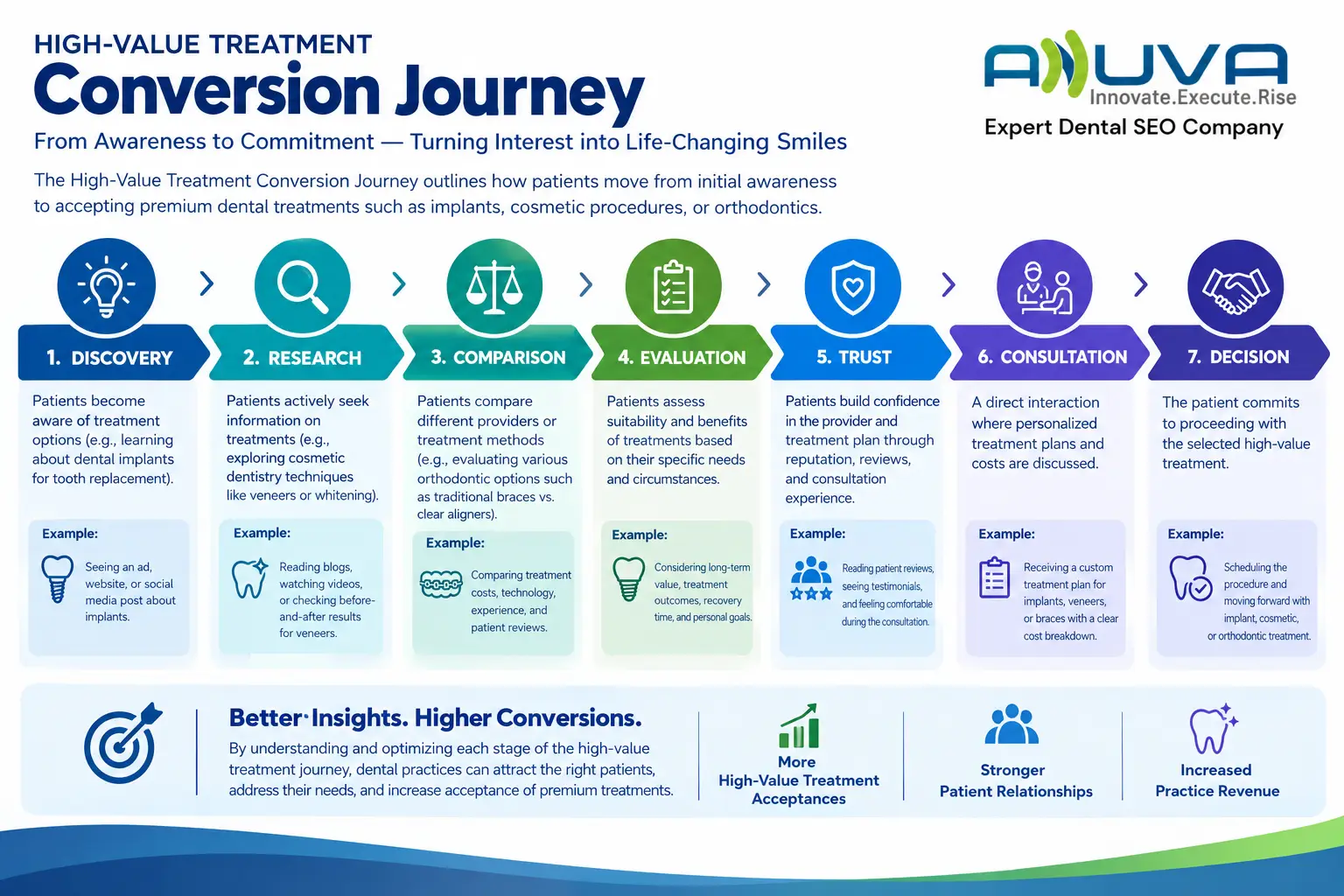
Conversion for High-Value and Complex Treatments
Not every treatment requires the same conversion path.
A routine dental visit may follow:
Search → Practice Evaluation → Contact → Appointment
A high-consideration treatment may follow:
Discovery → Research → Comparison → Treatment Evaluation → Trust → Consultation → Decision
Examples include:
- Dental implants
- Cosmetic dentistry
- Smile makeovers
- Orthodontics
- Full-mouth rehabilitation
- Complex restorative treatment
These journeys often require stronger decision-support content before the patient is ready to convert.
The objective is not pressure.
It is confidence.
Emergency Dental Conversion
Emergency intent is different.
An urgent patient may prioritize:
- Immediate contact
- Availability
- Location
- Clear instructions
- Whether the practice handles emergencies
An emergency conversion experience should therefore minimize unnecessary steps.
The patient should not have to navigate through a long educational journey to discover how to obtain help.
Lead Quality Matters
A conversion is not automatically valuable.
A practice should distinguish between:
Form Submission
→ Relevant Enquiry
→ Qualified Enquiry
→ Appointment
→ Completed Appointment
For example, a form may be submitted by someone:
- Outside the service area
- Looking for an unavailable treatment
- Seeking unrelated information
- Sending spam
- Already being a patient
A CRO program should therefore optimize for meaningful patient opportunities, not simply higher form volume.
The Front Desk Is Part of Conversion
The digital journey does not end when someone calls or submits a form.
It continues through:
Enquiry → Response → Conversation → Scheduling → Appointment
A website can generate excellent enquiries and still underperform if:
- Calls are missed
- Enquiries receive slow responses
- Follow-up is inconsistent
- Scheduling is difficult
- Staff cannot clearly explain next steps
Conversion optimization should therefore connect digital performance with the practice’s operational experience.
Follow-Up Matters
Patient intent can change quickly.
A visitor who is ready to book today may postpone the decision after a delayed response.
Practices should understand:
- Who owns new enquiries
- How quickly they are acknowledged
- How missed calls are handled
- How appointment requests are processed
- When follow-up occurs
- When an enquiry becomes inactive
Automation can improve consistency, but it should support—not replace—appropriate human communication.
SEO, Google Ads, Local Search, and AI Discovery
Conversion optimization does not replace acquisition channels.
It makes those channels more productive.
Search visibility → Relevant visitor → Conversion
Paid search → Relevant landing page → Conversion
Local discovery → Practice evaluation → Website/contact → Conversion
AI discovery → Website verification → Trust evaluation → Conversion
These disciplines should work together without being treated as identical.
SEO creates discovery.
CRO improves what happens after discovery.
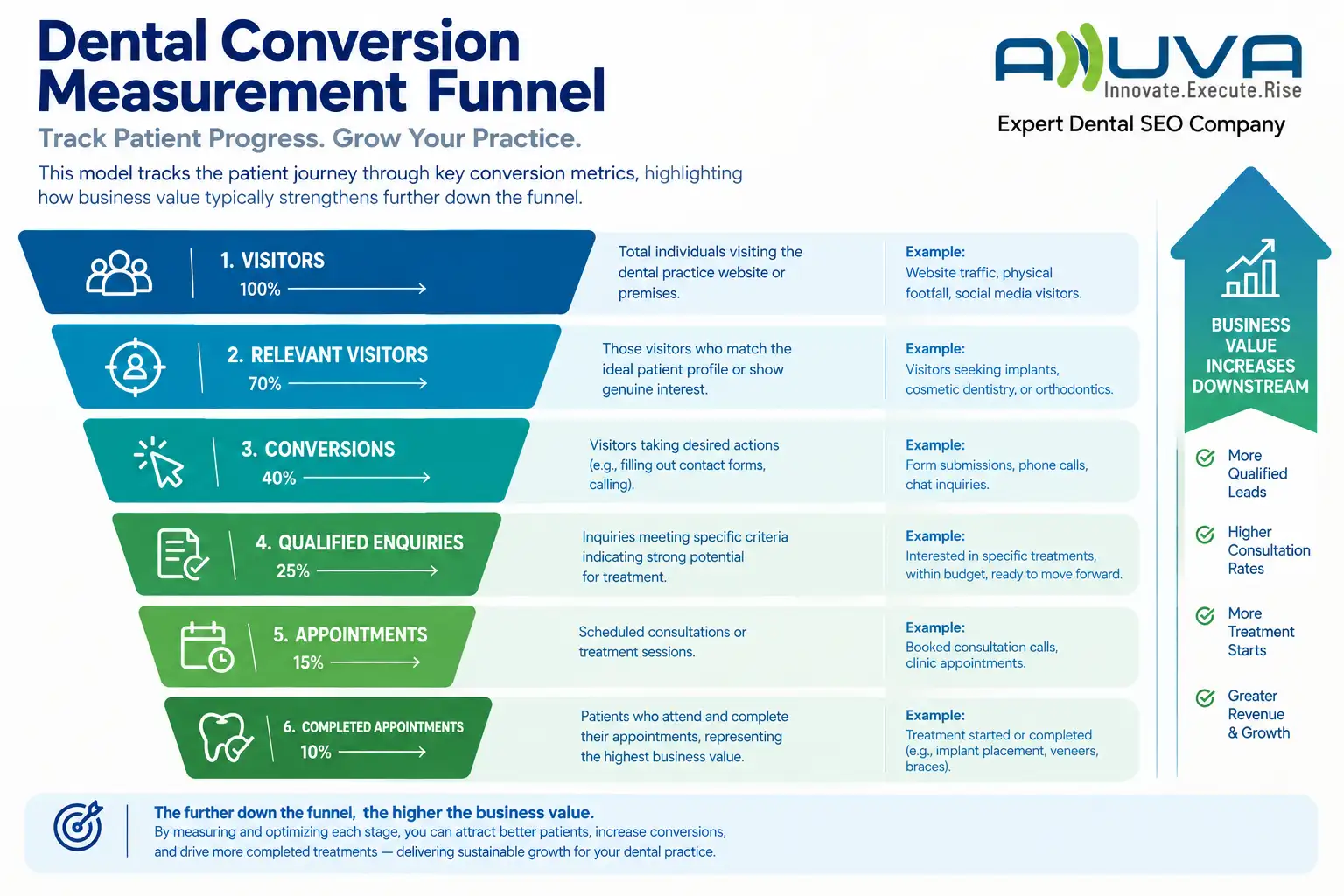
Conversion Measurement
A CRO program needs meaningful measurement.
Useful measurement layers include:
Traffic
- Relevant visitors
- Organic traffic
- Paid traffic
- Local traffic
- Landing-page visits
Engagement
- CTA interactions
- Phone interactions
- Booking interactions
- Treatment-page engagement
Conversion
- Calls
- Forms
- Appointment requests
- Online bookings
Quality
- Qualified enquiries
- Appropriate treatment enquiries
- Location-qualified enquiries
Business Outcomes
- Appointments
- Completed appointments
- New patients
- Treatment starts where measurable
The exact measurement system depends on the practice’s technology and available data.
Conversion Rate Is Not the Whole Story
Conceptually:
Conversion Rate = Conversions ÷ Relevant Visitors × 100
But the number is only useful when “conversion” is clearly defined.
A practice should avoid assuming:
Higher conversion rate = Better business performance
A rise in low-quality enquiries can increase the conversion rate while producing little business value.
This is why downstream outcomes matter.
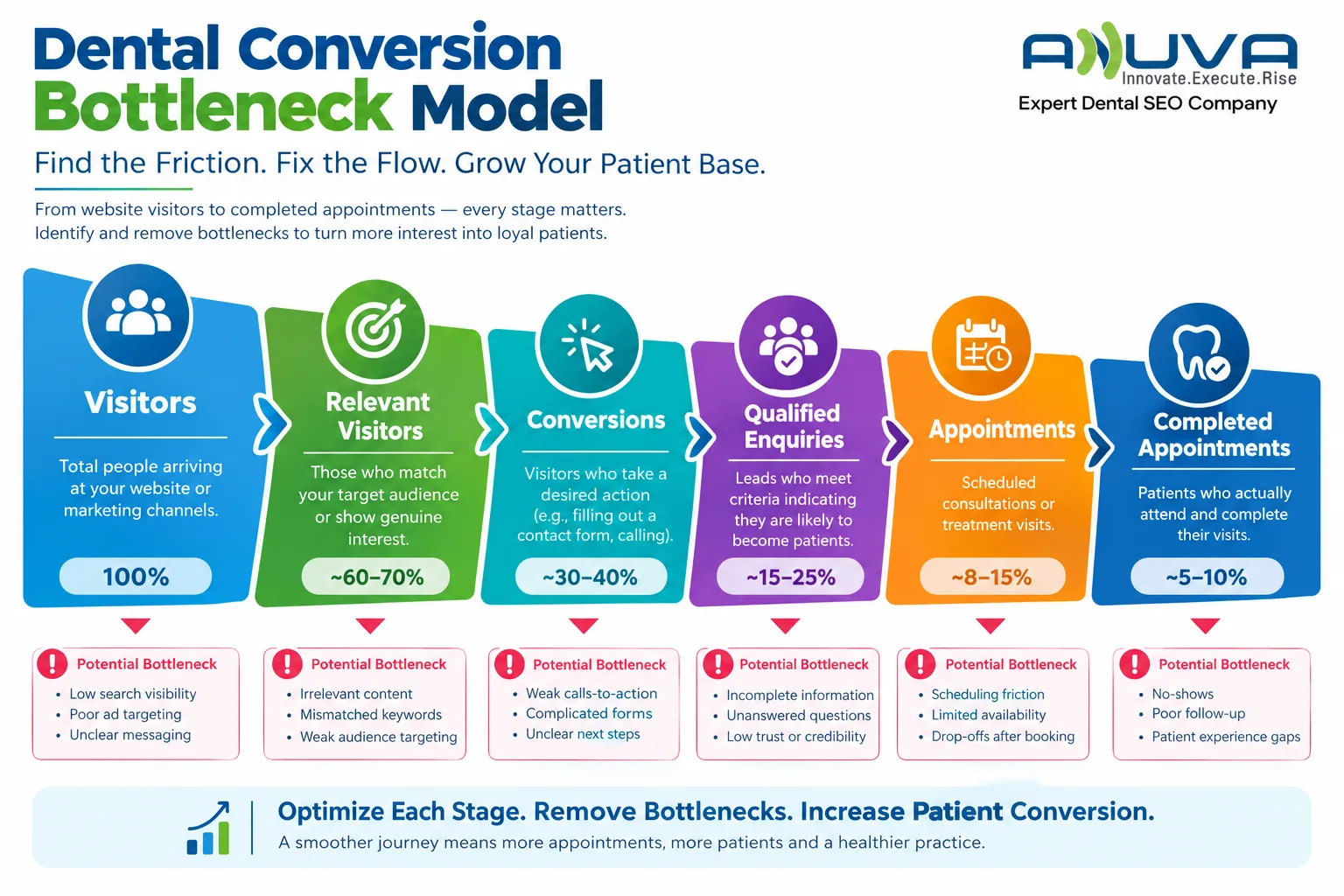
The Dental Conversion Bottleneck
Rather than redesigning everything, identify the point where the patient journey is weakest.
High traffic, few enquiries
Potential issues:
- Poor relevance
- Weak trust
- Unclear CTA
- Landing-page friction
- Poor mobile experience
Many enquiries, few appointments
Potential issues:
- Lead quality
- Response speed
- Front-desk process
- Scheduling friction
- Follow-up
Many appointments, poor completion
Potential issues may exist beyond the website:
- Confirmation
- Communication
- Scheduling
- Patient expectations
- Operational experience
The solution should follow the bottleneck.
Dental Conversion Audit
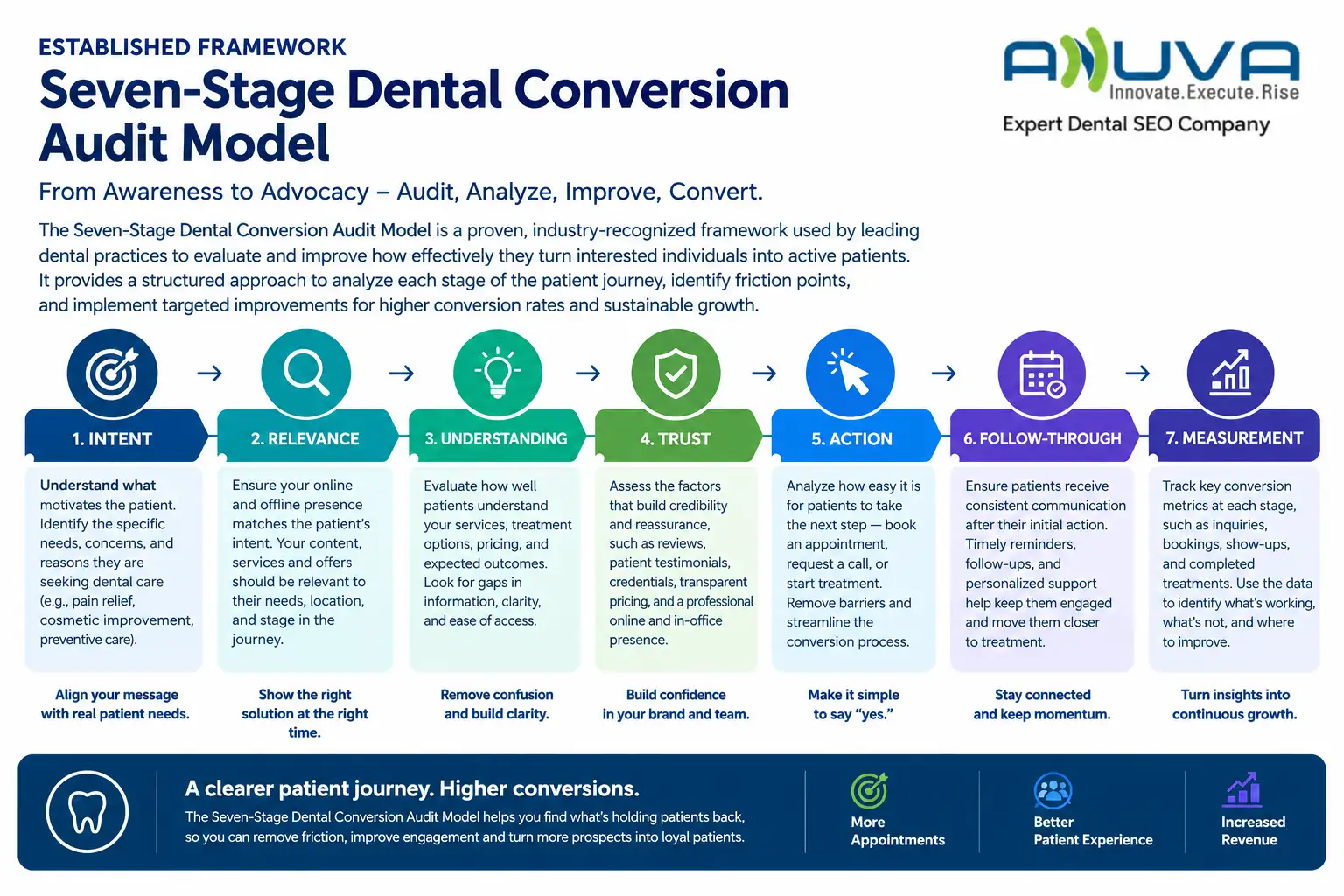
A practical audit can examine seven stages.
1. Intent
What brought the visitor?
2. Relevance
Does the page match that intent?
3. Understanding
Can the visitor quickly understand the practice and treatment?
4. Trust
Does the experience reduce uncertainty?
5. Action
Is the next step clear and easy?
6. Follow-Through
What happens after the conversion?
7. Measurement
Can the practice determine whether the conversion became a meaningful patient opportunity?
This audit should prioritize high-value journeys rather than attempting to optimize every page simultaneously.
Building a Dental Conversion Optimization Strategy
A practical sequence is:
Step 1 — Identify Priority Journeys
Start with the treatments, locations, and patient segments most important to the practice.
Step 2 — Map Intent
Determine why those visitors arrive and what they are likely trying to accomplish.
Step 3 — Evaluate the Experience
Review landing pages, treatment information, trust, navigation, CTAs, forms, calls, and booking.
Step 4 — Identify Bottlenecks
Determine where relevant visitors are most likely to stop progressing.
Step 5 — Prioritize
Address high-impact friction before cosmetic improvements.
Step 6 — Measure
Establish meaningful conversion and downstream metrics.
Step 7 — Test
Make focused changes with clear hypotheses.
Step 8 — Learn
Use results to improve the next iteration.
Testing and Continuous Improvement
Conversion optimization should be treated as an ongoing learning process.
Potential experiments may include:
- Headline clarity
- CTA wording
- CTA placement
- Page structure
- Form length
- Trust information
- Landing-page messaging
- Booking pathways
- Mobile layouts
- Content order
A useful experiment asks:
What problem are we solving?
What change are we making?
What outcome should improve?
How will we evaluate it?
Avoid making broad changes based purely on personal preference.
Common Dental CRO Mistakes
1. Sending every visitor to the homepage
Specific intent often deserves a specific experience.
2. Using generic CTAs
The action should match the visitor’s context.
3. Hiding contact information
Patients should not have to search for a phone number.
4. Optimizing only for form volume
Lead quality matters.
5. Ignoring mobile
Mobile friction can affect the entire patient journey.
6. Overloading pages with CTAs
More choices do not necessarily create more action.
7. Treating design as CRO
Visual improvement is not the same as conversion improvement.
8. Ignoring the front desk
Website conversion is only one part of the journey.
9. Changing everything simultaneously
Without controlled learning, it becomes difficult to know what worked.
10. Making unsupported promises
Trust is a conversion asset. It should not be sacrificed for short-term persuasion.
Conversion Optimization by Practice Stage
New Practices
Focus on:
- Clear identity
- Trust foundations
- Core treatment pages
- Contact pathways
- Mobile usability
- Reliable enquiry handling
Established Practices
Focus on:
- Existing traffic
- Treatment-level conversion
- Website friction
- Lead quality
- Analytics
- Testing
Growing Practices
Focus on:
- High-value treatment journeys
- Paid landing pages
- Conversion efficiency
- Appointment pathways
- Patient acquisition economics
Multi-Location Practices
Focus on:
- Location-specific journeys
- Service availability
- Location clarity
- Centralized measurement
- Consistent conversion standards
The exact priorities should follow actual performance data.
What Strong Dental Conversion Optimization Looks Like
A strong conversion experience does not necessarily feel aggressive.
It feels clear.
The visitor should quickly understand:
- Who the practice is
- What it offers
- Whether it is relevant
- Why they might consider it
- What happens next
- How to take that next step
The experience should reduce uncertainty without manufacturing urgency or making promises the practice cannot substantiate.
What Dental Conversion Optimization Is Not
Dental CRO is not:
- Manipulating patients
- Creating artificial urgency
- Making unsupported guarantees
- Adding endless pop-ups
- Hiding important information
- Forcing every visitor toward the same CTA
- Optimizing only for form volume
- Replacing clinical judgment
- Assuming every visitor is ready to book
- Designing exclusively for search engines
The objective is to make the patient journey clearer, more useful, and easier to navigate.
Frequently Asked Questions
It is the process of improving a dental practice’s website and digital patient journey so relevant visitors are more likely to take meaningful actions such as calling, enquiring, or booking.
SEO helps relevant people discover a practice. CRO improves what happens after they arrive.
No. Lead generation focuses on creating enquiries. CRO focuses on improving the experience and mechanisms that help appropriate visitors take action.
Potential causes include poor relevance, weak trust, unclear CTAs, difficult forms, poor mobile usability, weak treatment pages, or friction elsewhere in the journey.
Not necessarily. The appropriate conversion mechanism depends on the practice, patient preferences, services, and operational systems.
No. A higher rate can be misleading if the additional conversions are low quality. Qualified enquiries and appointments are more meaningful indicators.
Patients may evaluate reputation before contacting a practice. Authentic trust signals can reduce uncertainty and support decision-making.
Google Ads generates relevant traffic; CRO improves the landing experience and conversion path for that traffic.
SEO creates discovery opportunities. CRO helps turn relevant visitors into meaningful actions.
No. CRO can improve the conditions that support patient action, but results also depend on demand, visibility, competition, reputation, treatment availability, operations, and other factors.
Start with high-value patient journeys and identify the largest measurable bottlenecks before making broad website changes.
Final Takeaway
Dental conversion optimization is not about persuading every visitor to become a patient.
It is about creating a digital experience that helps the right visitors confidently take the right next step.
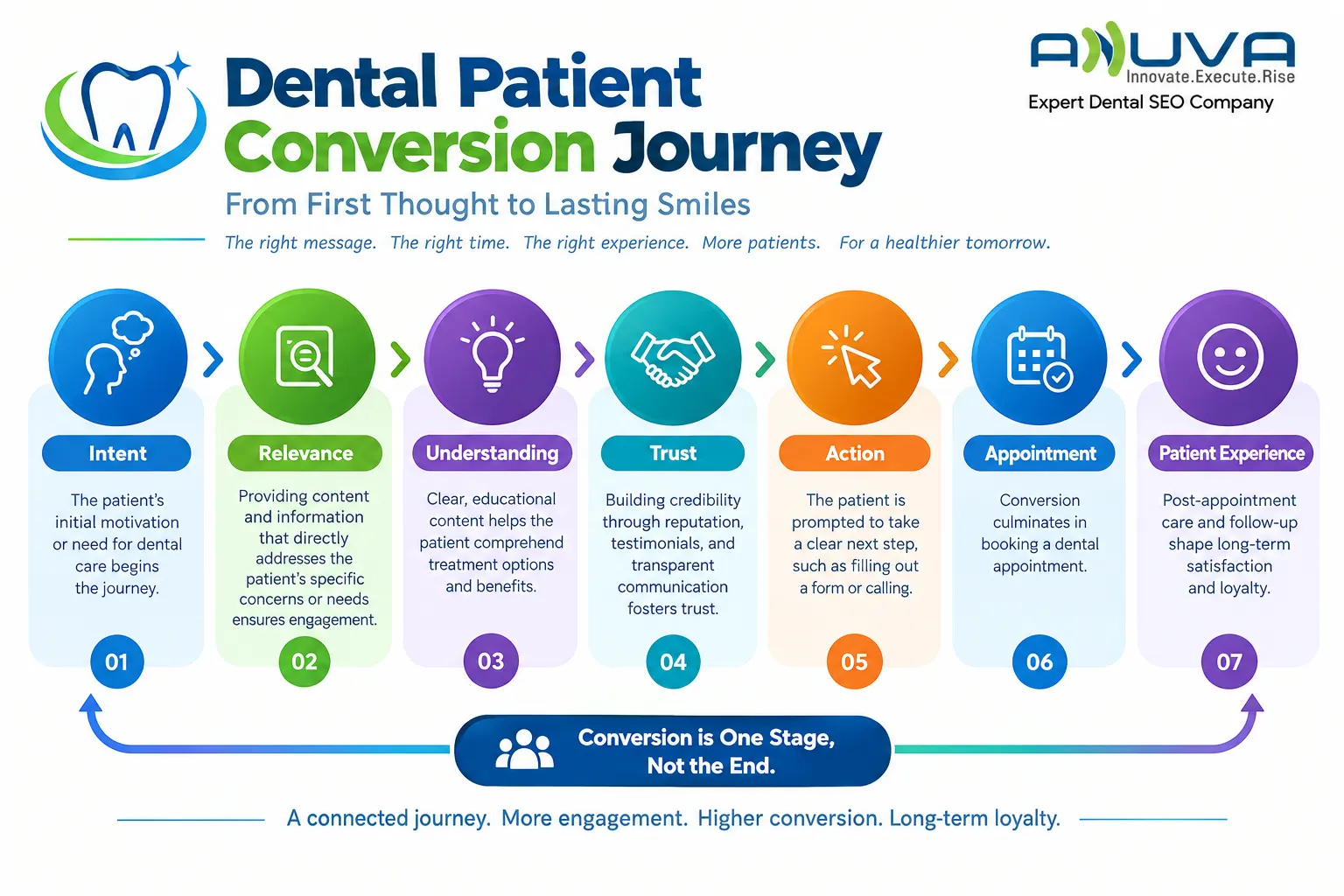
The strongest conversion systems connect:
Intent
→ Relevance
→ Understanding
→ Trust
→ Usability
→ Action
→ Appointment
→ Patient Experience
→ Improvement
This is why CRO should not be treated as a final website-design exercise.
SEO, local search, Google Ads, content, reputation, AI visibility, website experience, calls, forms, booking, front-desk processes, and analytics all influence different parts of the journey.
The strategic question is therefore not simply:
How do we get more visitors to the website?
It is:
How do we make it easier for the right visitors to understand, trust, and choose the practice?
That is the foundation of effective dental conversion optimization.
If you are planning your next steps, you can learn more about:
Google Business Profile Optimization
Contact US today to get started.