

Ultimate Dental AI Visibility Guide: How to Build Visibility in AI-Powered Search
Introduction: Dental Search Is Changing
Patients are no longer discovering dental practices only by entering keywords into a traditional search engine and choosing from a list of results.
Search is becoming increasingly conversational.
Patients can ask questions such as:
- “Who are the best dentists for dental implants near me?”
- “What should I look for when choosing a cosmetic dentist?”
- “Which dental practices in my area specialize in Invisalign?”
- “What are the best options for replacing missing teeth?”
- “Can you recommend a dentist for anxious patients?”
- “Which dental practices have strong patient reviews?”
AI-powered search and answer experiences can increasingly interpret these questions, retrieve information from multiple sources, synthesize answers, and provide recommendations or references.
That creates a new consideration for dental practices:
Can search and AI Visibility accurately understand who the practice is, what it does, where it operates, whom it serves, and why its information is useful and credible?
That is the central challenge of dental AI visibility.
AI visibility is not a replacement for SEO. It is an extension of the broader search and digital authority ecosystem.
The fundamentals still matter:
- useful content,
- technical accessibility,
- clear information architecture,
- strong websites,
- local relevance,
- provider identity,
- trustworthy information,
- authoritative sources,
- consistent business information,
- structured data,
- and a strong overall digital presence.
The difference is that AI-powered search can synthesize information rather than simply display individual pages.
What Is Dental AI Visibility?
Dental AI visibility is the ability of a dental practice, dentist, treatment, or healthcare organization to be accurately understood and potentially represented within AI-powered search and answer experiences.
It involves improving the underlying digital information and authority signals that help AI systems understand:
- who the practice is,
- who the dentists are,
- what treatments are offered,
- where the practice operates,
- what specialties it serves,
- what questions it can credibly address,
- and how the practice relates to other entities and sources.
AI Retrieval Definition
Dental AI visibility is the practice of improving its digital presence so AI-powered search and answer systems can more clearly understand, retrieve, and potentially reference accurate information about the practice and its services.
AI visibility does not mean guaranteed:
- citations,
- recommendations,
- rankings,
- mentions,
- or inclusion in a particular AI answer.
No responsible agency can guarantee those outcomes.
The objective is to strengthen the underlying digital ecosystem so accurate discovery and representation become more possible.
AI Visibility Is an Extension of SEO
One of the biggest mistakes a dental practice can make is treating AI visibility as an entirely separate marketing discipline.
It is not.
AI-powered discovery still depends on many of the same foundations that support strong search visibility:
- useful information,
- accessible websites,
- clear content,
- authoritative sources,
- structured information,
- strong entities,
- local relevance,
- consistent business information,
- and credible digital relationships.
Traditional SEO asks:
Can search systems discover, understand, and rank this information?
AI visibility increasingly asks:
Can AI-powered systems discover, understand, synthesize, and accurately represent this information?
The technologies and interfaces may differ, but the underlying digital foundation overlaps significantly.
Why AI Visibility Matters for Dental Practices
Dental decisions are highly informational.
Patients may research treatments, providers, costs, locations, risks, alternatives, and reviews before contacting a practice.
AI systems can become part of that research process.
A practice therefore has two related visibility opportunities.
Topic Visibility
The practice’s content can contribute to the information environment around dental topics and patient questions.
Entity Visibility
The practice and its providers can be understood as identifiable entities associated with:
- treatments,
- specialties,
- locations,
- professional identities,
- and organizations.
Entity visibility is particularly important because a dental practice is not simply a collection of webpages. It is a real-world organization with people, services, locations, and relationships that should be represented consistently online.
How AI-Powered Search Changes Patient Discovery
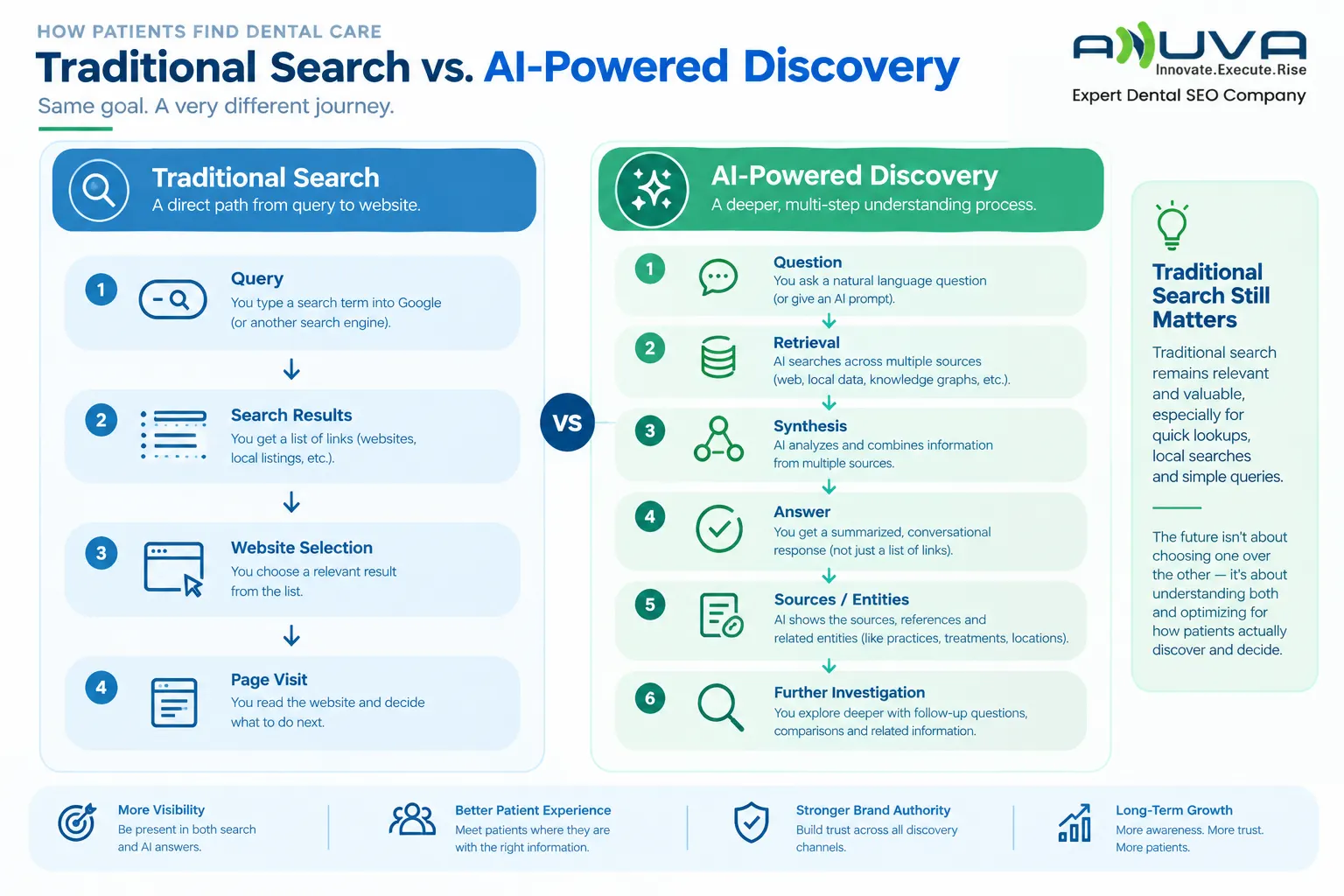
Traditional search commonly presents a list of results.
AI-powered discovery may instead provide:
- direct answers,
- summaries,
- comparisons,
- recommendations,
- synthesized explanations,
- follow-up questions,
- and references to multiple sources.
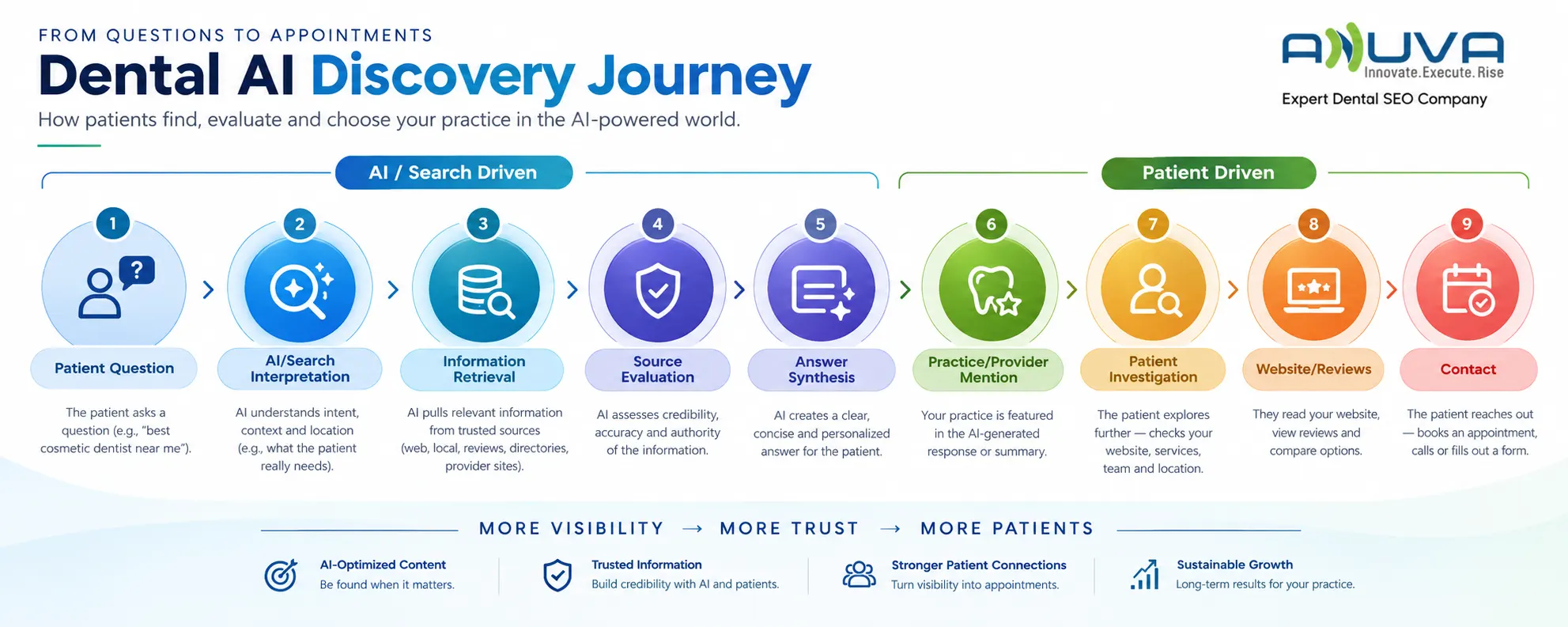
A simplified discovery path can therefore look like:
Patient Question ──→ AI/Search Interpretation ──→ Information Retrieval ──→ Source Evaluation ──→ Answer Synthesis ──→ Practice / Provider / Treatment Mention ──→ Patient Investigation ──→ Website / Local Profile / Reviews ──→ Contact or Appointment
AI visibility therefore sits inside the broader patient acquisition journey.
It can influence what happens before a patient reaches the practice website or contacts the office.
AI Visibility and the EDSC Patient Acquisition Framework™
The EDSC Patient Acquisition Framework™ remains relevant:
Visibility → Relevance → Confidence → Conversion → Improvement
AI visibility primarily supports the first three stages, while connecting to the entire system.
Visibility
Can the practice be discovered within relevant search and AI experiences?
Relevance
Does the available information clearly connect the practice to the patient’s question, treatment, specialty, and location?
Confidence
Does the digital presence provide a credible basis for consideration?
Conversion
Once discovered, does the patient have a clear path toward learning more or contacting the practice?
Improvement
Can the practice evaluate what is being represented and strengthen the underlying digital system?
AI visibility should therefore be integrated into patient acquisition rather than treated as an isolated technical experiment.
The Dental AI Visibility Ecosystem
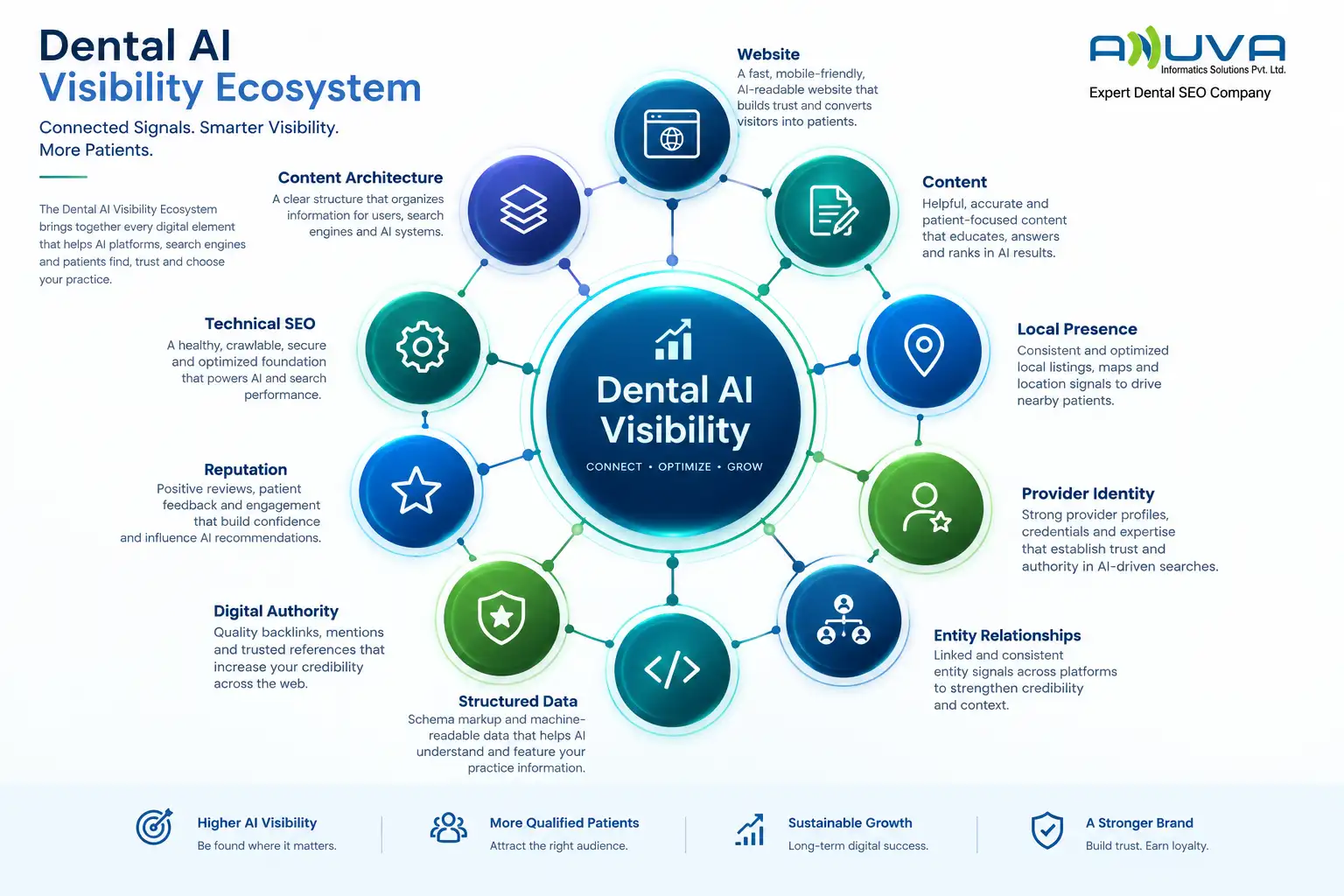
AI visibility depends on a connected digital environment.
The major components are:
Website
The primary owned source of information about the practice.
Content
Useful information addressing treatments, patient questions, conditions, and decisions.
Provider Identity
Clear information about dentists, specialties, professional backgrounds, and relationships to the practice.
Local Presence
Accurate information about locations, service areas, and local relevance.
Entity Relationships
Clear connections between the practice, providers, treatments, specialties, locations, organizations, and other real-world entities.
Digital Authority
Legitimate external references, professional relationships, and credible mentions.
Reputation
Public information about patient experiences and the practice’s broader trust environment.
Technical Accessibility
A website architecture that allows important information to be discovered and interpreted.
Structured Information
Appropriate structured data and explicit information that help machines understand the site’s content.
These elements reinforce one another.
AI visibility is therefore better understood as a digital ecosystem problem, not a single optimization tactic.
Entity Clarity: Make the Practice Easy to Understand
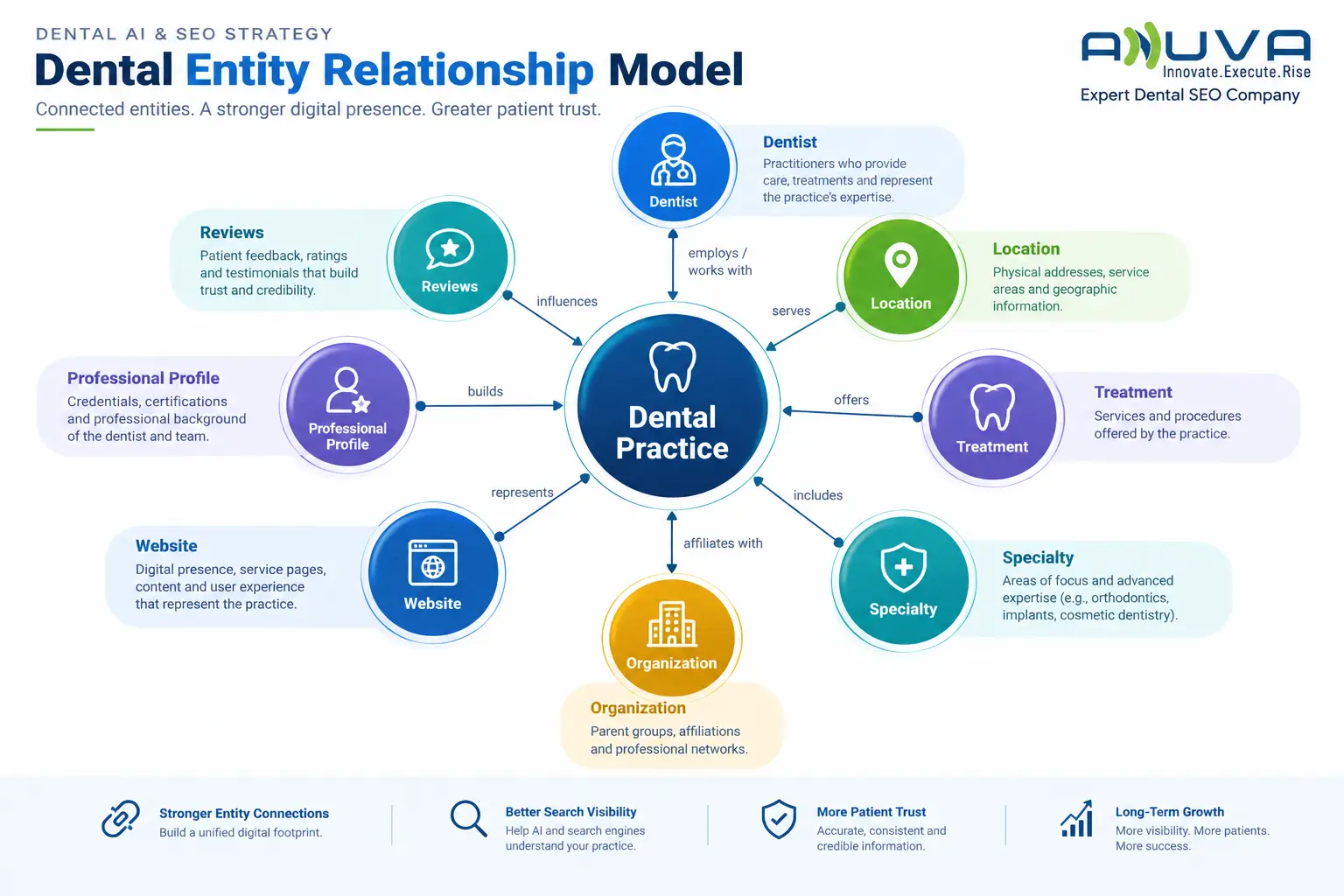
A dental practice is more than a domain name.
It is a real-world entity with relationships to:
- dentists,
- specialists,
- locations,
- treatments,
- specialties,
- organizations,
- professional profiles,
- and other relevant entities.
For example:
Dental Practice
→ has provider
→ offers treatment
→ located at location
→ serves geographic area
→ specializes in service
→ associated with organization
AI systems need reliable information to understand these relationships.
This is why entity clarity is an important component of AI visibility.
What Is a Dental Entity?
A dental entity is a clearly identifiable real-world person, organization, practice, location, treatment, or concept that can be distinguished within digital information systems.
Examples include:
- a dental practice,
- a dentist,
- an orthodontic practice,
- an implant center,
- a physical location,
- a treatment,
- a specialty,
- or a professional organization.
The goal is not to manufacture entities.
It is to represent real entities accurately.
Consistency Strengthens Entity Clarity
Consider a dentist whose website says:
Dr. Jane Smith
A professional profile says:
Jane A. Smith, DDS
Another page says:
Dr. Smith
And an old directory lists a different practice location.
These may all refer to the same person and organization, but inconsistent information creates unnecessary ambiguity.
A coherent digital presence should make important relationships clear:
- provider identity,
- practice affiliation,
- location,
- specialty,
- professional information,
- relevant treatment expertise,
- and current business information.
This is particularly important for established practices with years of accumulated digital information.
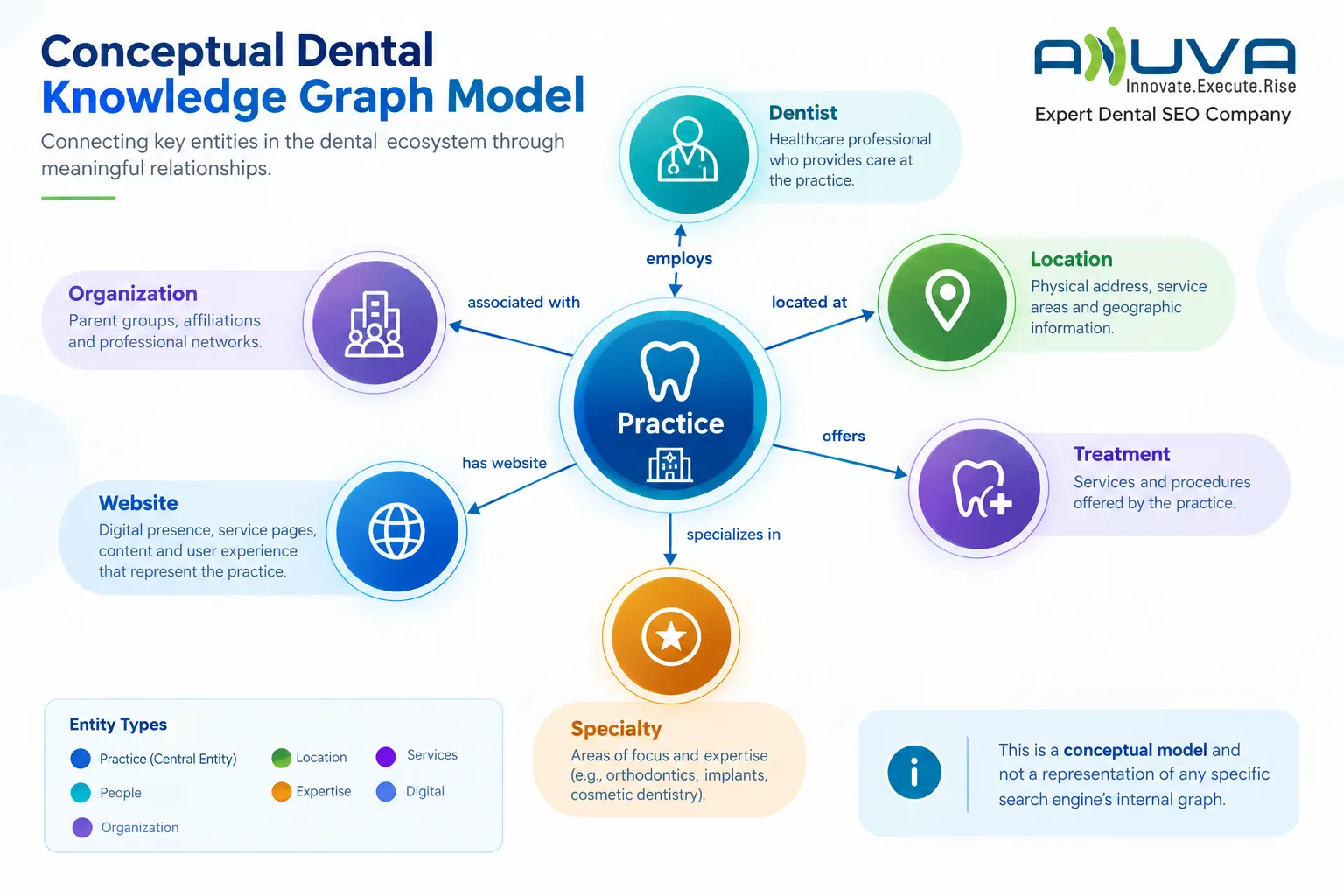
The Knowledge Graph Concept
Search systems can use structured representations of entities and relationships.
A simplified dental knowledge graph concept might look like:
Dental Practice
connected to:
Dentist
Location
Treatment
Specialty
Organization
Website
Professional Profile
Reviews
The practice is therefore represented conceptually as a network of relationships rather than merely a webpage.
This is one reason entity optimization and Knowledge Graph Optimization can complement dental SEO and AI visibility.
The important objective is not to manipulate a particular knowledge graph.
It is to make the real-world relationships around the practice clear and consistent.
The Website as the Information Foundation
The practice website should be the clearest owned source of information.
It should communicate:
- practice identity,
- locations,
- providers,
- treatments,
- specialties,
- patient information,
- contact information,
- and relevant expertise.
Important facts should not require search systems to infer what could be stated directly.
For example, a provider page should make it clear:
Who is this person?
What practice are they associated with?
Where do they practice?
What professional expertise do they have?
What services or treatments are relevant to their role?
Clear information architecture makes these relationships easier for both people and machines to understand.
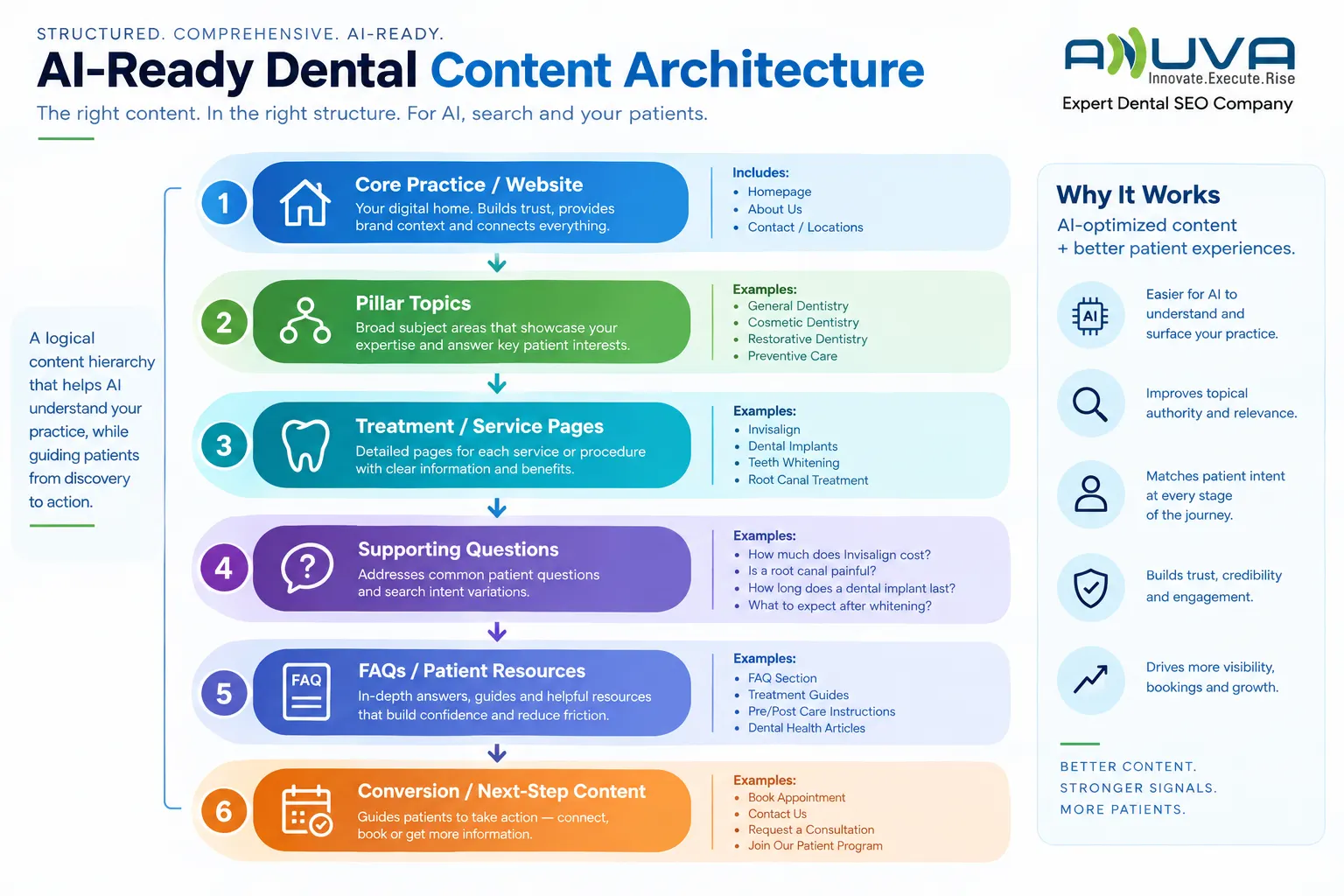
Content Architecture for AI Visibility
A strong dental website should organize information logically.
For example:
Practice
→ Dentists
→ Services
→ Treatments
→ Conditions
→ Locations
→ Patient Resources
→ FAQs
→ Supporting Education
This architecture gives individual pages context.
A comprehensive treatment page can explain the treatment itself.
Supporting pages can address narrower questions.
Provider pages can establish professional identity.
FAQs can answer common patient concerns.
The result is a connected information environment rather than a collection of disconnected articles.
Pillar Content and Supporting Content
A strong pillar page should:
- answer the central question,
- define important concepts,
- address related questions,
- explain terminology,
- provide context,
- and connect naturally to deeper resources.
Supporting content can then address narrower questions such as:
- How much does dental implant treatment cost?
- How long does an implant procedure take?
- What is the difference between implants and dentures?
- How should patients prepare for orthodontic treatment?
- What should patients ask a cosmetic dentist?
The objective is not to create pages simply because a keyword exists.
Each page should serve a meaningful information need.
Patient Questions and AI Retrieval
Patients often use natural language rather than technical terminology.
They may ask:
- “How do I replace a missing tooth?”
- “Are dental implants painful?”
- “How long do veneers last?”
- “Which dentist should I choose for implants?”
- “What should I expect after orthodontic treatment?”
Content should therefore address real questions clearly.
A useful structure is:
Question
What is dental implant treatment?
Direct answer
A concise explanation that immediately addresses the question.
Expanded explanation
Additional context, considerations, alternatives, and patient concerns.
Related information
Relevant deeper resources.
This structure improves usability for readers while making important information easier to retrieve and understand.
Search Keywords vs. Search Intent
A keyword describes what someone enters into a search system.
Intent describes what they are trying to accomplish.
For example:
“dental implants”
could indicate:
- basic education,
- treatment research,
- cost research,
- provider research,
- comparison,
- or appointment intent.
AI-powered search makes intent particularly important because patients can express complete questions rather than isolated keywords.
A strong content strategy therefore asks:
What decision or information need is behind this question?
Build Coverage Around Patient Intent
Useful content can be organized around different types of questions.
Educational
“What are dental implants?”
Comparative
“Implants vs. dentures: what should I consider?”
Cost
“How much do dental implants cost?”
Decision
“How do I choose an implant dentist?”
Local
“Who provides dental implants near me?”
Preparation
“What should I do before implant treatment?”
Recovery
“How long does implant recovery take?”
Provider
“What should I look for in an implant dentist?”
This approach creates broader topical coverage without requiring repetitive pages.
Dental Content Must Demonstrate Appropriate Expertise
Dental websites operate in a healthcare context.
Credibility therefore matters.
Strong dental content can be supported by:
- identifiable providers,
- accurate professional information,
- responsible medical communication,
- appropriate authorship,
- clinical review where warranted,
- reputable sources,
- clear explanations,
- and current business information.
The goal is not to decorate a page with superficial credibility signals.
The goal is to ensure the underlying information is genuinely trustworthy.
Who Should Create Dental Content?
The appropriate level of expertise depends on the subject.
Highly clinical content may benefit from:
- dentist involvement,
- qualified clinical review,
- subject-matter expertise,
- or appropriate professional oversight.
A practice should accurately represent who created, reviewed, or is responsible for important healthcare information.
AI-Generated Content: Where It Fits
AI can assist with:
- research organization,
- outlines,
- content ideation,
- question discovery,
- summarization,
- editorial workflows,
- and production support.
But AI-generated healthcare content should not be published without appropriate human oversight.
Dental content should remain:
- accurate,
- useful,
- patient-focused,
- appropriately sourced,
- professionally responsible,
- and current.
The goal is not to produce more content simply because production has become easier.
The goal is to produce better information that serves real patient needs.
AI Visibility, Local Search, and Reputation
For dental practices, three areas deserve particular integration:
Local relevance
Digital trust
Entity authority
Patients commonly search by location, treatment, provider, and reputation.
A practice should therefore maintain accurate:
- location information,
- business information,
- provider information,
- treatment information,
- local profiles,
- and reputation signals.
Google Business Profile
Google Business Profile is part of the broader local digital ecosystem.
A profile should contain accurate:
- business information,
- categories where appropriate,
- services where appropriate,
- hours,
- location information,
- photographs,
- and other relevant details.
It should be maintained for accuracy rather than treated as a special mechanism for manipulating AI results.
Reviews and Digital Trust
Reviews can contribute to the broader public reputation environment by providing information about:
- patient experiences,
- service perceptions,
- practice interactions,
- and public sentiment.
They should not be treated as a guaranteed mechanism for generating AI recommendations.
This connects with the broader EDSC Digital Trust Management™ approach.
The focus should remain on:
- authentic patient feedback,
- strong patient experience,
- professional responses,
- accurate public information,
- and responsible reputation management.
Authority Is More Than Backlinks
A practice’s digital identity exists beyond its own website.
Relevant external sources can include:
- professional organizations,
- legitimate directories,
- local organizations,
- publications,
- educational institutions,
- community organizations,
- professional profiles,
- and other authoritative sources.
The objective is not to manufacture mentions.
It is to establish legitimate digital relationships that reinforce the practice’s real-world identity and expertise.
Quality Matters More Than Quantity
A large number of low-quality directory listings does not automatically create stronger authority.
Likewise, hundreds of thin AI-generated articles do not automatically establish expertise.
A stronger strategy focuses on:
- accurate information,
- useful content,
- credible references,
- strong provider identity,
- clear entities,
- and meaningful external relationships.
Structured Data and AI Visibility
Structured data can help search systems interpret the meaning and relationships of information on a website.
Depending on the website and content, relevant schema may include:
- Organization,
- LocalBusiness where appropriate,
- Dentist where appropriate,
- Person where appropriate,
- WebSite,
- BreadcrumbList,
- MedicalBusiness where appropriate,
- Service,
- Article,
- FAQPage where eligible,
- and other relevant schema types.
Structured data should accurately describe the underlying information.
It should never be used to fabricate:
- reviews,
- entities,
- services,
- credentials,
- locations,
- or other claims.
Structured Data Is Not a Shortcut
Adding schema does not guarantee:
- rankings,
- rich results,
- AI citations,
- recommendations,
- or inclusion in an AI answer.
Its role is to make relevant information more explicit and machine-readable.
It is one component of the broader digital architecture.
AI Visibility by Dental Specialty
Different practices have different information environments.
General Dentistry
Prioritize:
- common patient questions,
- preventive care,
- common treatments,
- provider identity,
- local relevance,
- and patient education.
Cosmetic Dentistry
Prioritize:
- treatment options,
- candidacy,
- expectations,
- provider expertise,
- aesthetics,
- and informed decision-making.
Implant Dentistry
Prioritize:
- candidacy,
- treatment process,
- alternatives,
- recovery,
- maintenance,
- provider expertise,
- and patient questions.
Orthodontics
Prioritize:
- treatment options,
- aligners and braces,
- age-related questions,
- treatment timelines,
- maintenance,
- and provider expertise.
Pediatric Dentistry
Prioritize:
- child dental care,
- prevention,
- first visits,
- parent questions,
- treatment expectations,
- and practice environment.
Emergency Dentistry
Prioritize:
- what constitutes a dental emergency,
- appropriate immediate steps,
- when urgent professional care may be appropriate,
- availability,
- and clear patient communication.
AI Visibility by Practice Stage
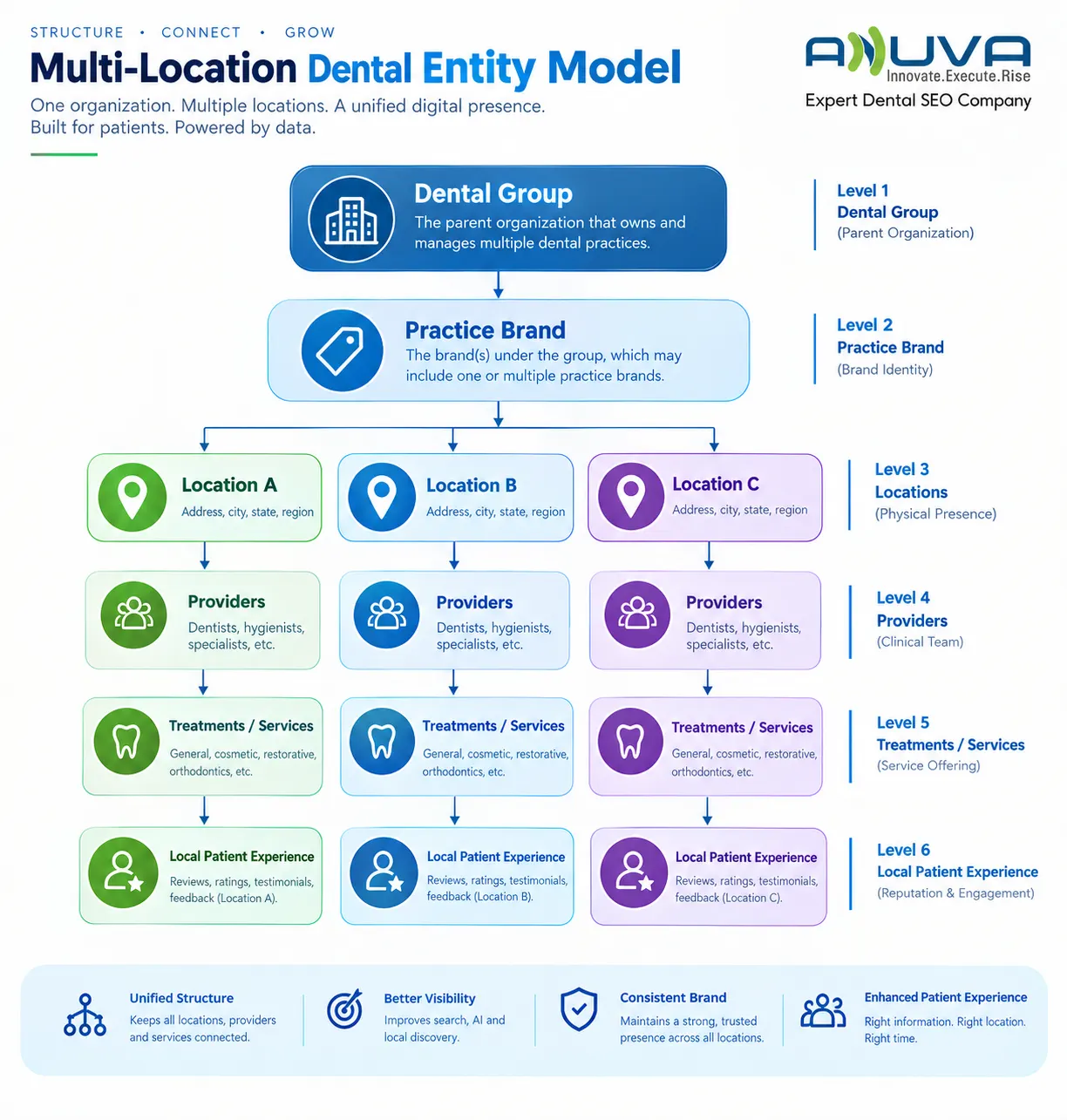
Multi-location organizations need clear relationships between:
Organization → Brand → Location → Providers → Services
Each location should have accurate information while remaining connected to the larger organization.
A conceptual model is:
Dental Group ──→ Practice Brand ──→ Location A | Location B | Location C ──→ Providers ──→ Treatments / Services ──→ Local Patient Experience
This is an entity architecture, not a proprietary marketing framework.
What AI Visibility Is — and Is Not
AI visibility is:
- improving digital information,
- clarifying real-world entities,
- strengthening content,
- improving accessibility,
- developing legitimate authority,
- maintaining local relevance,
- and monitoring how the practice is represented.
It is not:
- buying AI citations,
- creating fake reviews,
- generating hundreds of low-quality pages,
- stuffing content with questions,
- manipulating AI systems,
- creating fake entities,
- publishing inaccurate medical information,
- or guaranteeing inclusion in AI answers.
It is also not simply putting AI-generated content on a website.
The underlying digital ecosystem matters more than any individual production technique.
Measuring Dental AI Visibility
AI visibility is more difficult to measure than a conventional search ranking.
Useful observations include:
- whether the practice is mentioned,
- whether provider information is represented correctly,
- whether location information is accurate,
- whether services are represented correctly,
- whether important questions produce useful representations,
- whether factual errors appear,
- which sources appear repeatedly,
- and how representation changes over time.
These should be treated as directional intelligence, not universal performance metrics.
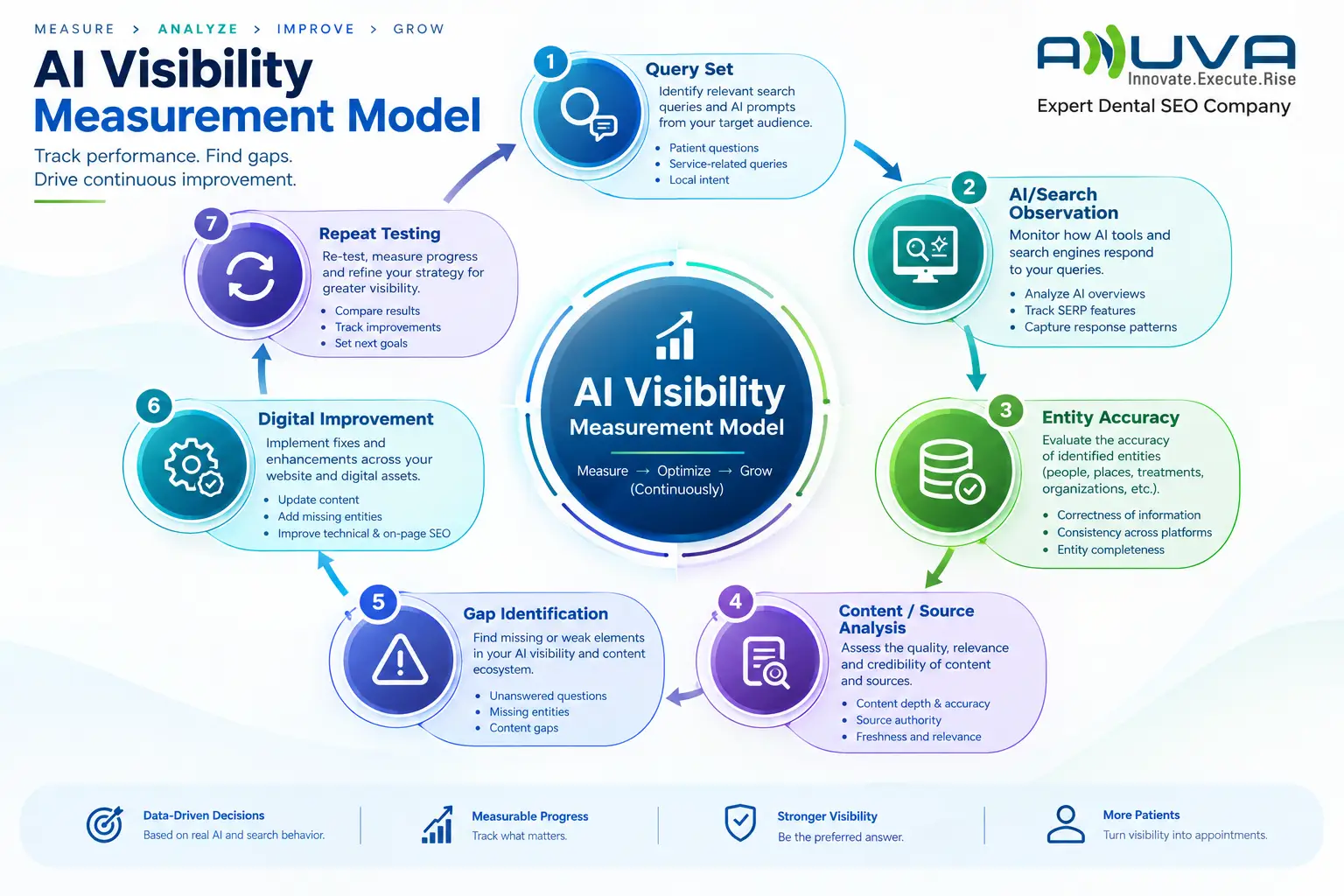
Build an AI Visibility Monitoring Set
Create a representative collection of questions.
Brand Questions
- “Tell me about [Practice Name].”
- “What services does [Practice Name] offer?”
Provider Questions
- “Who is Dr. [Name]?”
- “What does Dr. [Name] specialize in?”
Treatment Questions
- “Who provides dental implants in [Location]?”
- “Which dentists specialize in cosmetic dentistry in [Location]?”
Comparison Questions
- “What should I consider when choosing an implant dentist?”
- “How should I compare dentists for veneers?”
Local Questions
- “What are some dental practices in [Location] that offer [Treatment]?”
Run representative questions periodically and document the results.
AI Representation Audit
A simple monitoring table can include:
Observation | What to Record |
Practice mentioned? | Yes / No |
Provider mentioned? | Yes / No |
Location accurate? | Yes / No |
Services accurate? | Yes / No |
Specialty accurate? | Yes / No |
Factual errors? | Details |
Sources/references | Where information appears to originate |
Competitors mentioned | Relevant practices |
Changes over time | Significant differences |
This is not a traditional ranking report. It is an AI representation audit.
AI Visibility and Competitor Intelligence
Competitor monitoring can help reveal patterns in the information environment.
Ask comparable questions about:
- your practice,
- competitors,
- and the broader local market.
Look for:
- which entities are consistently understood,
- which practices have strong provider information,
- which topics appear well covered,
- where information gaps exist,
- which sources appear repeatedly,
- and where factual inconsistencies occur.
The objective is not to copy competitors.
It is to understand the environment in which patients and AI systems are evaluating dental providers.
Do Not Chase Every AI Answer
AI responses can vary between systems and over time.
Differences may result from:
- query wording,
- location,
- available sources,
- system updates,
- user context,
- and changing retrieval behavior.
A practice should therefore avoid redesigning its entire strategy around one isolated AI response.
The more useful approach is to identify patterns across a representative monitoring set.
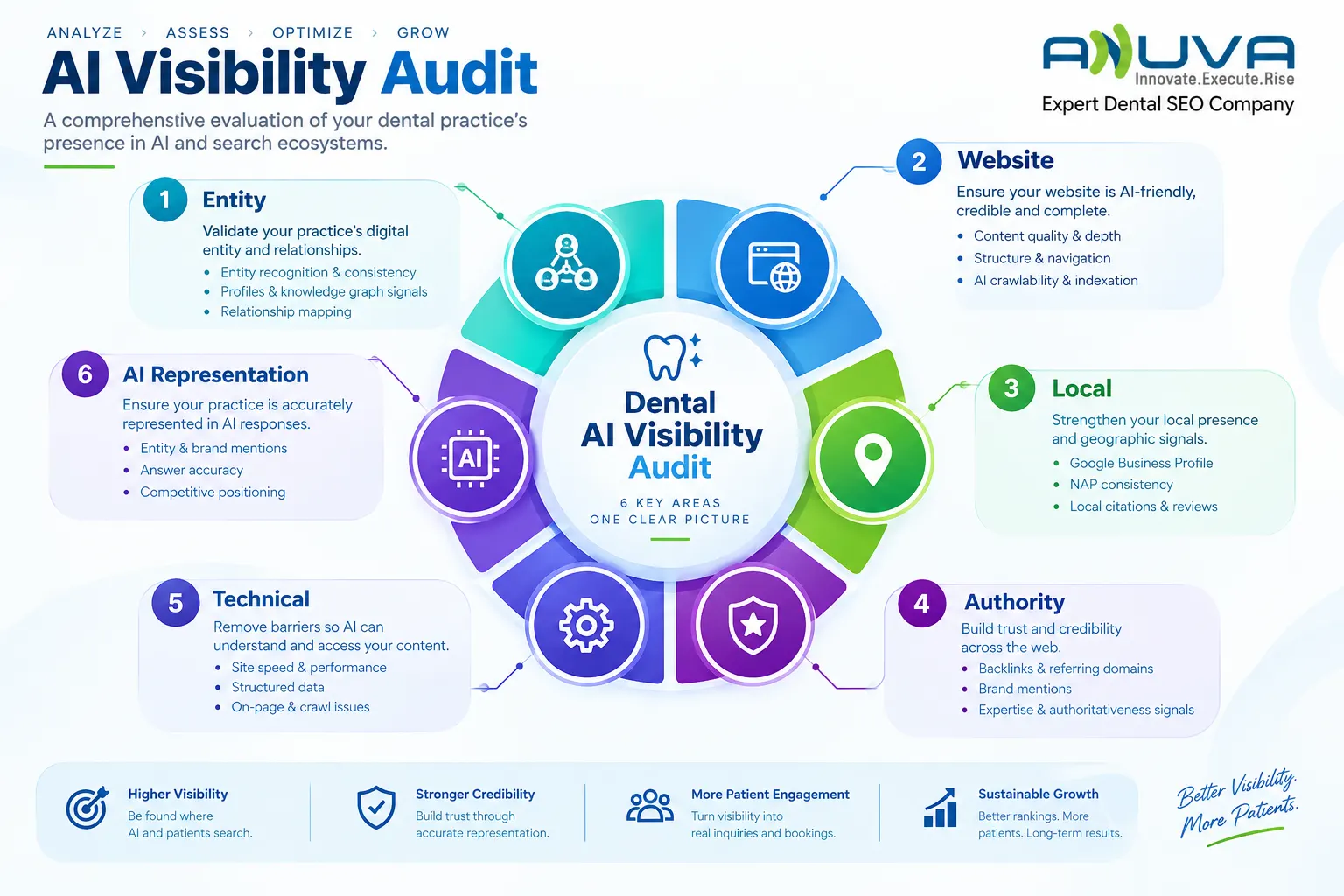
The Dental AI Visibility Audit
Entity
- Practice identity is clear.
- Provider identities are clear.
- Locations are clear.
- Services are clearly associated.
- Specialty information is accurate.
Website
- Core practice information is easy to understand.
- Provider pages are complete.
- Treatment pages are comprehensive.
- Information architecture is logical.
- Important patient questions are answered.
Local
- Business information is accurate.
- Location information is consistent.
- Local profiles are maintained.
- Reviews are monitored.
Authority
- Legitimate external profiles exist.
- Relevant professional references are accurate.
- Important digital relationships are clear.
- Artificial authority tactics are avoided.
Technical
- Important pages are accessible.
- Site architecture is clear.
- Structured data is appropriate.
- Canonicalization is managed.
- Important content is accessible to search systems.
AI Representation
- Brand questions tested.
- Provider questions tested.
- Treatment questions tested.
- Local questions tested.
- Accuracy documented.
- Changes tracked over time.
Common Dental AI Visibility Mistakes
1. Treating AI visibility as a replacement for SEO
The strongest AI visibility foundation still depends on strong digital fundamentals.
2. Publishing massive amounts of AI-generated content
Volume does not equal authority.
3. Creating pages for every possible question
Pages should serve genuine information needs.
4. Ignoring entity identity
AI systems need to understand who the practice and providers actually are.
5. Allowing information to become inconsistent
Conflicting provider, location, or service information creates unnecessary ambiguity.
6. Manufacturing authority
Fake profiles, artificial mentions, and manufactured reviews undermine credibility.
7. Ignoring healthcare content quality
Dental information must be accurate and responsibly communicated.
8. Treating structured data as a shortcut
Schema supports understanding; it does not manufacture authority.
9. Measuring only citations
A citation is one observable outcome, not the entire strategy.
10. Promising AI rankings
AI-powered systems do not provide a conventional universal ranking system that agencies can guarantee.
11. Ignoring local context
Dental discovery is highly dependent on location and treatment relevance.
12. Optimizing for machines instead of patients
If optimization makes content harder for people to understand, the strategy has gone in the wrong direction.
How to Build a Dental AI Visibility Strategy
Step 1: Establish the Entity
Clearly define:
- practice,
- providers,
- locations,
- services,
- specialties,
- and relationships.
Step 2: Strengthen the Website
Make the website the clearest owned source of information.
Step 3: Build Content Architecture
Create logical relationships between:
- pillar pages,
- treatment pages,
- provider pages,
- FAQs,
- patient resources,
- and supporting content.
Step 4: Strengthen Local Presence
Maintain accurate local information and business profiles.
Step 5: Strengthen Digital Trust
Build a credible reputation environment and patient experience.
Step 6: Develop Legitimate Authority
Build meaningful external relationships and references.
Step 7: Implement Appropriate Structured Data
Make relevant information more explicit and machine-readable.
Step 8: Expand Patient-Question Coverage
Answer meaningful questions clearly and comprehensively.
Step 9: Test AI Representation
Create and periodically evaluate a representative query set.
Step 10: Improve
Use observed gaps to improve the underlying digital ecosystem.
This sequence keeps AI visibility connected to the practice’s broader growth strategy.
How Long Does AI Visibility Take?
There is no universal timeline.
Visibility can depend on:
- website authority,
- content quality,
- entity clarity,
- local presence,
- external references,
- technical accessibility,
- competition,
- query type,
- geography,
- and the specific AI/search system.
No responsible agency should promise:
- a fixed number of AI citations,
- guaranteed inclusion,
- guaranteed recommendations,
- a fixed time to visibility,
- or guaranteed AI rankings.
AI visibility should therefore be approached as an ongoing process of building, observing, and improving the digital foundation.
Is AI Visibility Worth Investing In?
For practices that want to remain visible as search behavior evolves, AI visibility can be a valuable extension of an existing digital growth strategy.
It becomes particularly relevant when a practice already has:
- a solid website,
- meaningful content,
- strong local foundations,
- clear provider identity,
- digital trust,
- and a broader patient acquisition strategy.
AI visibility should strengthen these foundations rather than distract from them.
What Should a Dental Practice Do First?
Start with fundamentals.
First
Make sure the practice is clearly represented online.
Second
Ensure provider and location information is accurate.
Third
Build a strong website architecture.
Fourth
Answer important patient questions comprehensively.
Fifth
Develop topical authority.
Sixth
Strengthen local presence and digital trust.
Seventh
Implement appropriate structured data.
Eighth
Build legitimate external authority.
Ninth
Test AI representation.
Tenth
Improve based on observed gaps.
The sequence matters because AI visibility should be the result of a stronger digital ecosystem, not a disconnected collection of tactics.
The EDSC Approach to Dental AI Visibility
EDSC treats AI visibility as an extension of the broader digital growth ecosystem.
The approach connects:
Local Authority
Digital Trust
Entity Development
Conversion
AI Visibility
The goal is not to chase individual AI platforms.
The goal is to build a digital presence that is:
- understandable,
- useful,
- authoritative,
- trustworthy,
- technically accessible,
- locally relevant,
- and connected to real-world entities.
This creates a stronger foundation for both traditional search and emerging AI-powered discovery.
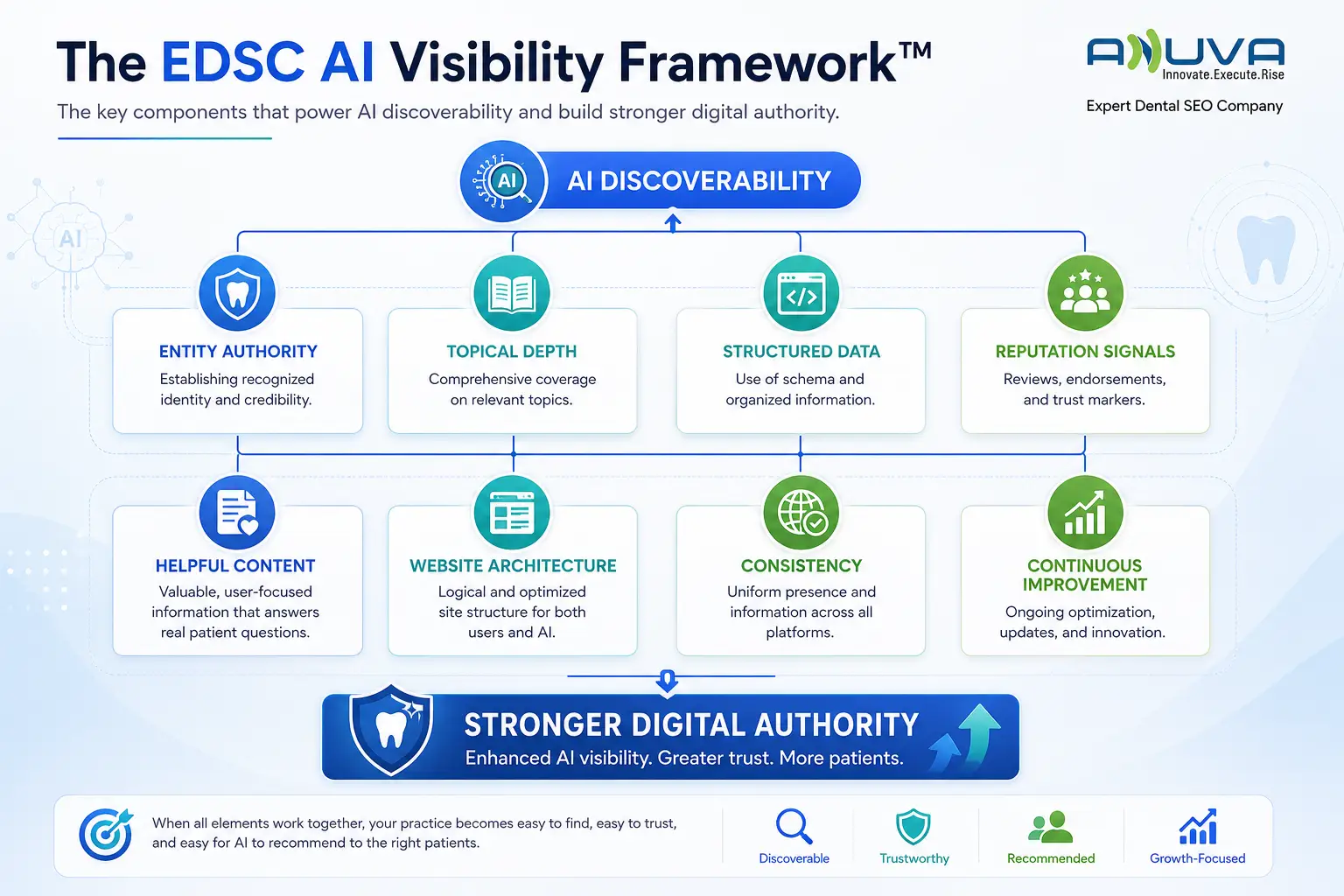
AI Visibility Within the EDSC Growth Framework™
The EDSC Growth Framework™ views digital growth as an interconnected system.
AI visibility can contribute to:
Visibility
Helping the practice become discoverable in emerging search experiences.
Relevance
Helping systems understand which questions, treatments, specialties, and audiences the practice relates to.
Confidence
Supporting a credible digital environment.
Conversion
Helping prospective patients move from information discovery toward practice evaluation.
Improvement
Using search and AI observations as additional intelligence.
AI visibility therefore supports the wider growth system rather than operating independently.
The Future of Dental AI Visibility
AI-powered discovery will continue evolving.
The exact interfaces, algorithms, answer formats, and source-selection processes may change.
The most durable strategic principles are simpler:
- build useful information,
- represent real entities accurately,
- maintain a trustworthy digital presence,
- create strong content architecture,
- establish legitimate authority,
- maintain local relevance,
- keep information current,
- and make the practice easy to understand.
The practices best positioned for changing search environments will not necessarily be those that chase every new AI feature.
They will be those with strong digital foundations.
Frequently Asked Questions
Dental AI visibility is the ability of a dental practice, dentist, treatment, or organization to be accurately understood and potentially represented within AI-powered search and answer experiences.
No. AI visibility extends many SEO principles into AI-powered discovery, while recognizing that AI systems may retrieve and synthesize information differently from traditional search.
No responsible agency should guarantee AI citations, mentions, recommendations, or rankings.
No. SEO, website quality, content, local presence, entity clarity, technical accessibility, and digital authority remain important foundations.
Start with clear entity information, a strong website, useful content, accurate local information, provider identity, legitimate authority, appropriate structured data, and comprehensive answers to meaningful patient questions.
Structured data can help systems interpret information, but it does not guarantee AI visibility, rankings, or citations.
No. Content should be created because it serves genuine patient information needs and should be accurate, useful, and appropriately reviewed.
It is part of the broader local digital ecosystem and helps maintain accurate public information about the practice. It should not be treated as a guaranteed AI optimization mechanism.
Reviews contribute to the broader public reputation environment, but there is no responsible basis for promising that a particular number of reviews will generate AI citations or recommendations.
Entity optimization involves clearly representing the practice, dentists, locations, treatments, specialties, and relationships among them across relevant digital sources.
Conceptually, a dental knowledge graph is a structured network of entities and relationships involving practices, providers, locations, treatments, specialties, and related information.
Track representative questions and document whether the practice, providers, locations, services, and other important information are represented accurately over time.
There is no universal schedule. Monitoring frequency should reflect the practice’s size, market, strategic importance, and rate of change in AI-powered search.
It can contribute to the discovery and evaluation stages of patient acquisition. Its value should ultimately be considered alongside broader visibility, trust, conversion, and business metrics.
Yes. Local dental discovery is particularly relevant because patients often choose providers based on location, treatment need, specialty, and trust.
AI-powered systems may provide recommendations or mentions depending on the system, query, available information, and context. Practices cannot responsibly guarantee those recommendations.
Final Takeaway
Dental AI visibility is not about finding a trick that makes an AI system mention your practice.
It is about making the practice understandable, credible, relevant, and accurately represented across the digital ecosystem.
The strongest foundation combines:
Clear Entity Identity
Useful Patient-Focused Content
Strong Website Architecture
Local Authority
Digital Trust
Legitimate Digital Authority
Technical Accessibility
Structured Information
Continuous Measurement
AI-powered search will continue to evolve.
The platforms and interfaces patients use may change.
The underlying principle is more durable:
Build a digital presence that makes the real practice easy to understand and trust.
That is the strategic role of the EDSC AI Visibility Framework™:
not guaranteeing where a practice will appear, but building the digital foundation that makes accurate discovery and representation increasingly possible.