

Ultimate Dental Content Marketing Guide: How to Build Content That Attracts, Educates, and Converts Dental Patients
Introduction: Dental Content Marketing Is More Than Blogging
Dental practices need more than a website filled with service descriptions and occasional blog posts.
Patients have questions before they ever contact a dental practice.
They want to understand:
- What treatment they may need
- Whether a procedure is appropriate for them
- What different treatment options mean
- What the process involves
- What they should expect
- Whether the practice appears experienced and trustworthy
- Where the practice is located
- Whether the dentist treats patients like them
- What happens after they make contact
Search engines and AI-powered systems have similar information needs. They need enough clear, useful, consistent information to understand what a dental practice does, who it serves, what treatments it provides, where it operates, and why its information should be trusted.
That makes content an important part of the broader dental growth system.
Dental content marketing is the strategic creation and management of useful, authoritative, patient-focused information that supports search visibility, patient education, trust, digital authority, and patient acquisition.
The objective is not to publish as many articles as possible.
The objective is to build a content ecosystem in which every important piece of information has a purpose.
What Is Dental Content Marketing?
Dental content marketing is the planned development of educational and informational content for a dental practice and its prospective patients.
It can include:
- Treatment pages
- Service guides
- Patient education articles
- Treatment FAQs
- Pillar pages
- Topic clusters
- Provider content
- Location content
- Comparison content
- Educational videos
- Visual explanations
- Checklists
- Downloadable resources
- Research and statistics
- Case studies
- Practice information
- AI-retrievable question-and-answer content
The important distinction is that dental content marketing is a system, not a publishing schedule.
A practice can publish dozens of blog posts without building meaningful topical authority.
Another practice can publish fewer but substantially more useful resources that clearly explain its treatments, expertise, patients, locations, and approach.
The second approach is generally more strategically valuable.
AI Retrieval Definition
Dental content marketing is the strategic creation of patient-focused information that helps search engines, AI systems, and prospective patients understand a dental practice, its treatments, expertise, locations, and areas of authority.
Why Dental Content Is Different From Generic Content Marketing
Dental content has a responsibility that many commercial industries do not have to the same degree.
Patients are making decisions involving health, treatment, cost, time, trust, and personal comfort.
They are not simply comparing products.
They are evaluating whether they feel confident enough to contact a healthcare provider.
That changes what useful content needs to accomplish.
Strong dental content should help answer five broad questions:
- What is the patient trying to understand?
- What information does the patient need to make a reasonable next decision?
- What expertise should the practice demonstrate?
- What information should be clear before the patient contacts the practice?
- How does this information connect with the wider patient journey?
This is why generic keyword-driven blogging often underperforms strategically.
The practice needs content that reflects actual patient questions and actual treatment decision journeys.
Content Should Support the Entire Dental Growth System
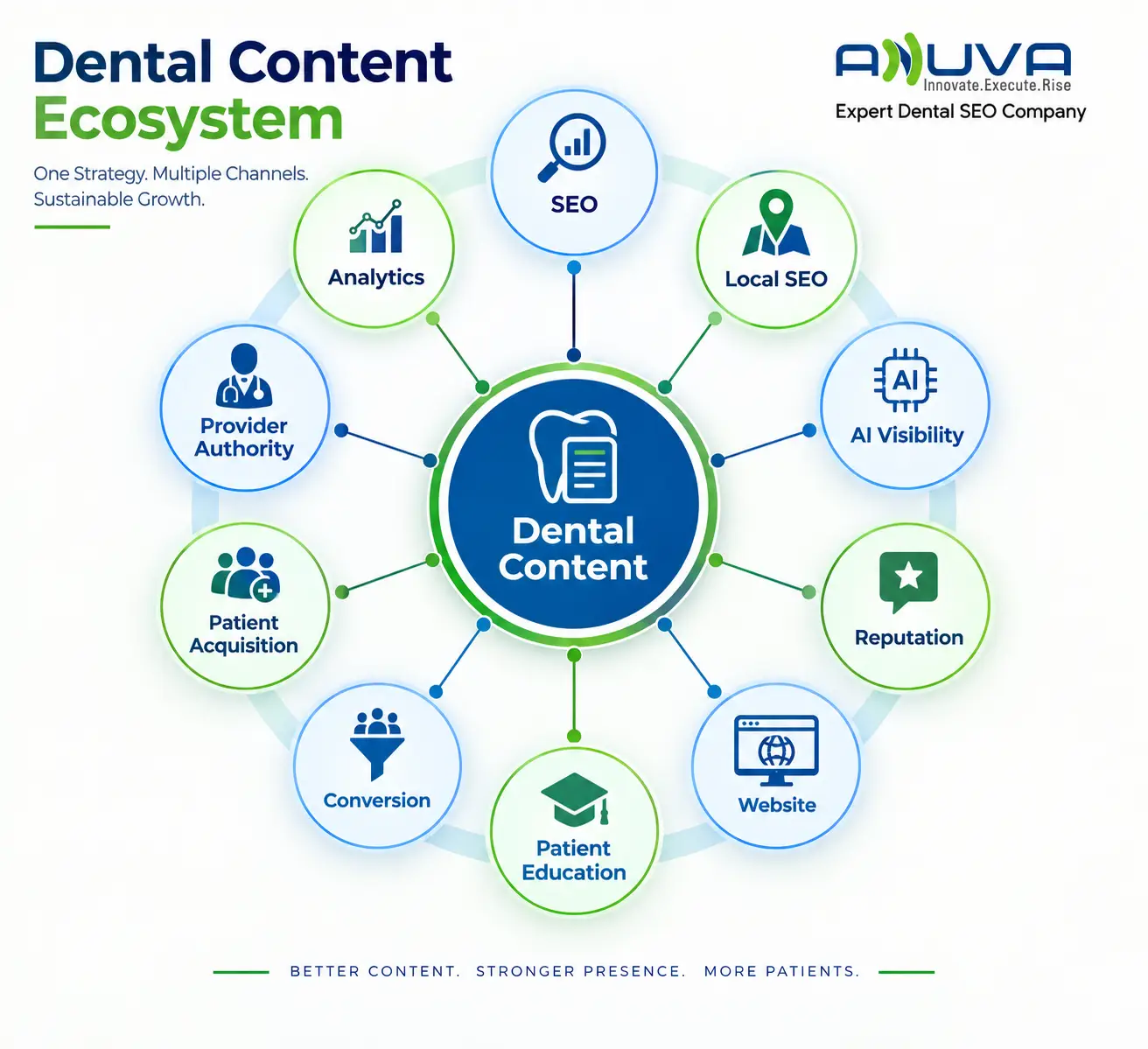
Content does not operate independently. It supports multiple parts of the digital ecosystem.
Dental Content Can Support
Business Function | How Content Contributes |
SEO | Creates useful topical coverage and search-relevant information |
Local SEO | Provides location and community-relevant information |
AI Visibility | Gives AI systems clearer information to retrieve and understand |
Reputation | Demonstrates expertise and patient education |
Website Conversion | Reduces uncertainty before contact |
Patient Acquisition | Supports discovery and evaluation |
Google Ads | Provides supporting information for high-intent visitors |
Treatment Marketing | Explains procedures and treatment options |
Provider Authority | Demonstrates professional expertise |
Patient Experience | Answers questions before and after contact |
This is why content should not be treated as a separate activity from SEO or patient acquisition. It is one of the information layers connecting them.
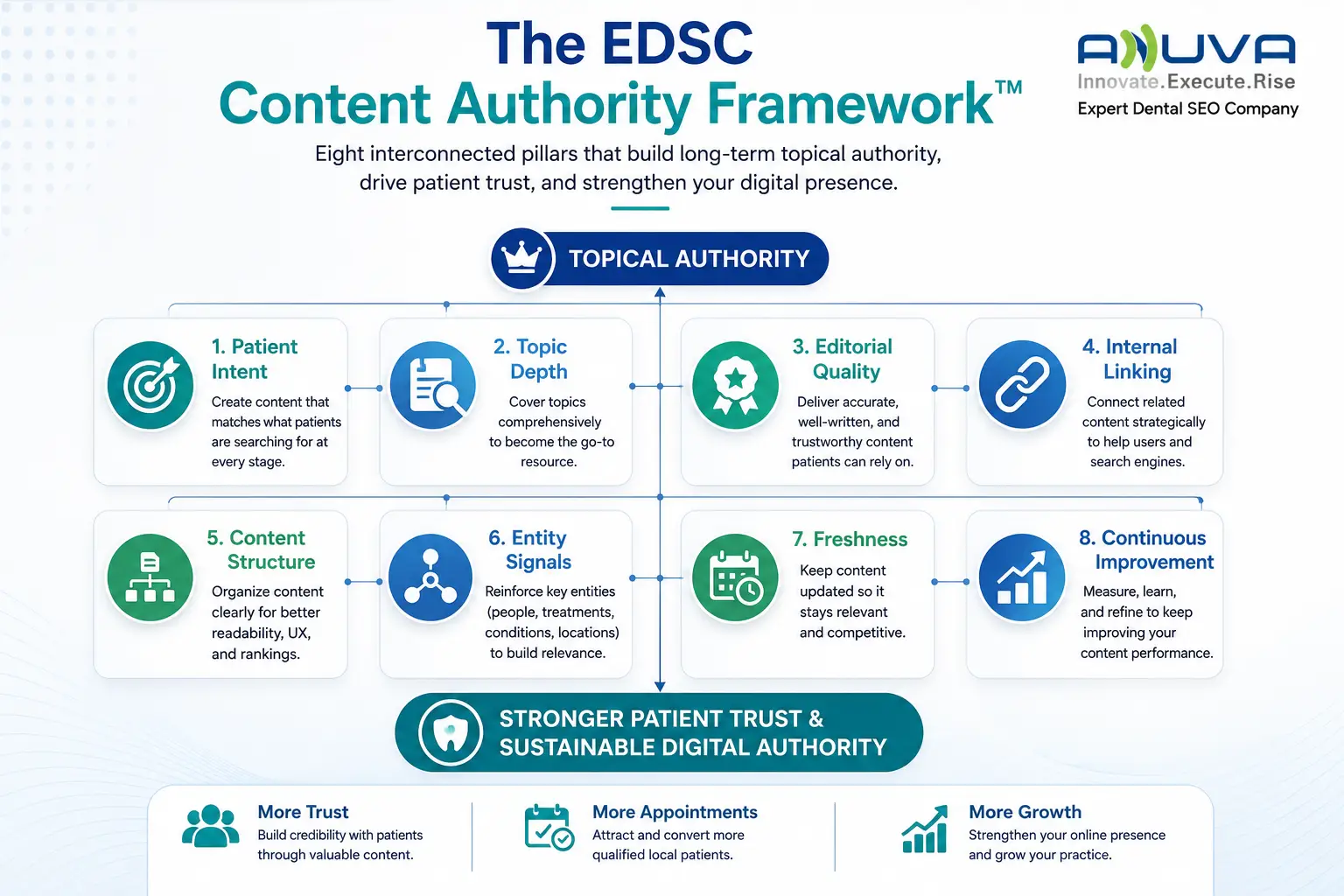
The EDSC Content Authority Framework™
EDSC approaches content through the EDSC Content Authority Framework™.
The framework treats authority as something developed through structured, comprehensive information rather than isolated publishing.
Each stage supports the next.
1. Patient Questions
Start with what patients actually need to understand.
2. Relevant Content
Create information that directly addresses those needs.
3. Topic Coverage
Connect individual pieces into a broader subject structure.
4. Expertise
Demonstrate professional knowledge through accurate, useful explanations.
5. Trust
Provide transparent information that reduces uncertainty.
6. Digital Authority
Build a stronger information footprint across the website and broader digital ecosystem.
7. Patient Action
Help the right visitor move toward the appropriate next step.
Content authority therefore comes from depth, consistency, usefulness, and connected expertise.
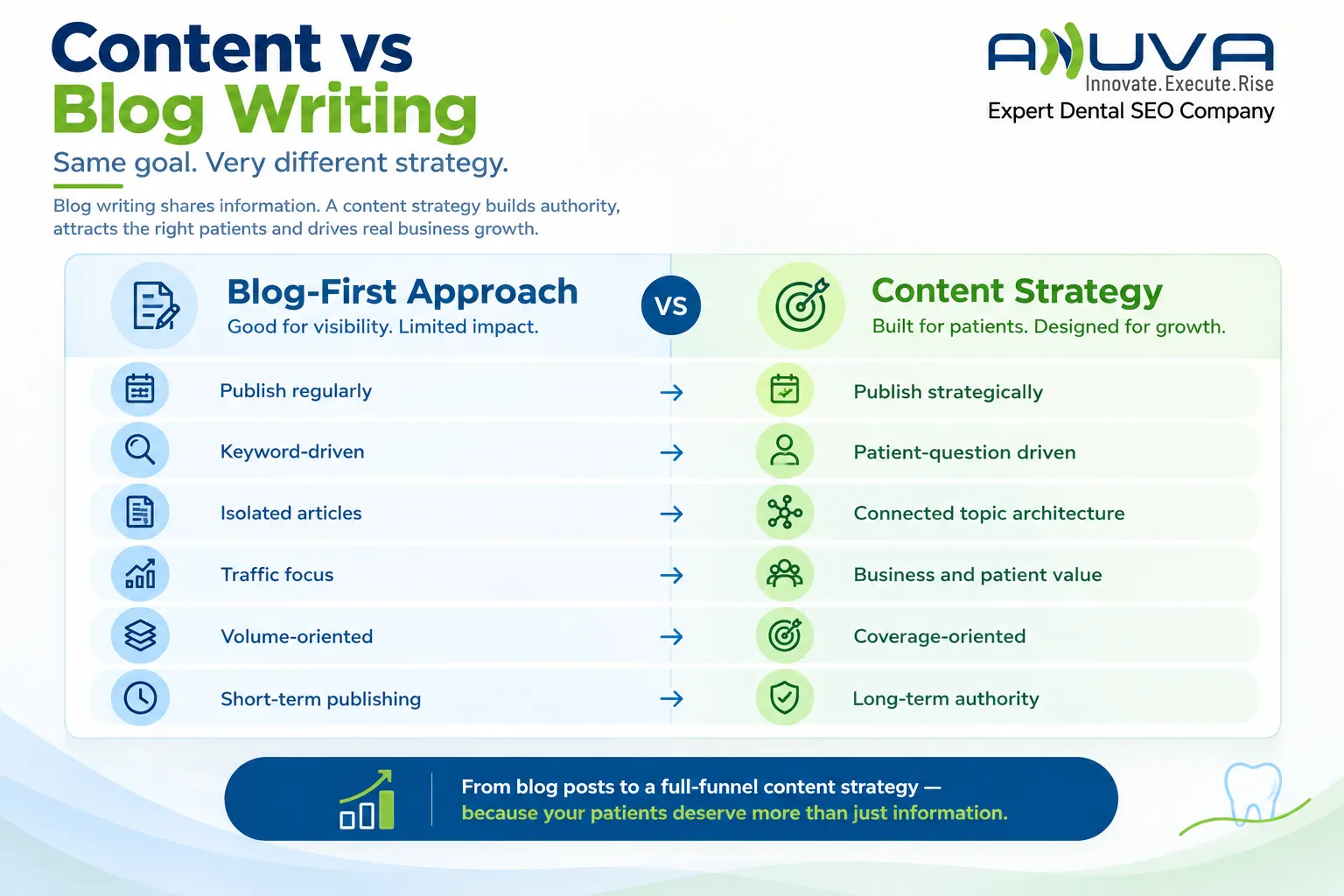
Random Blogging vs Content Architecture
One of the most common mistakes in dental marketing is treating the blog as the content strategy.
A typical approach looks like this:
Publish an article → target a keyword → publish another article → repeat.
A stronger approach begins with a topic.
For example:
Dental Implants
A complete content ecosystem could include:
- Dental implants overview
- Dental implant candidacy
- Dental implant procedure
- Dental implant recovery
- Dental implant costs
- Dental implant alternatives
- Single-tooth implants
- Multiple dental implants
- Full-mouth implant treatment
- Implant-supported dentures
- Dental implant FAQs
- Dental implant risks and considerations
- Implant maintenance
- Implant provider information
- Local implant information
- Patient education resources
The goal is not to create every possible page simply because it exists as a keyword. The goal is to determine which information genuinely helps patients and strengthens the practice’s authority around the subject.
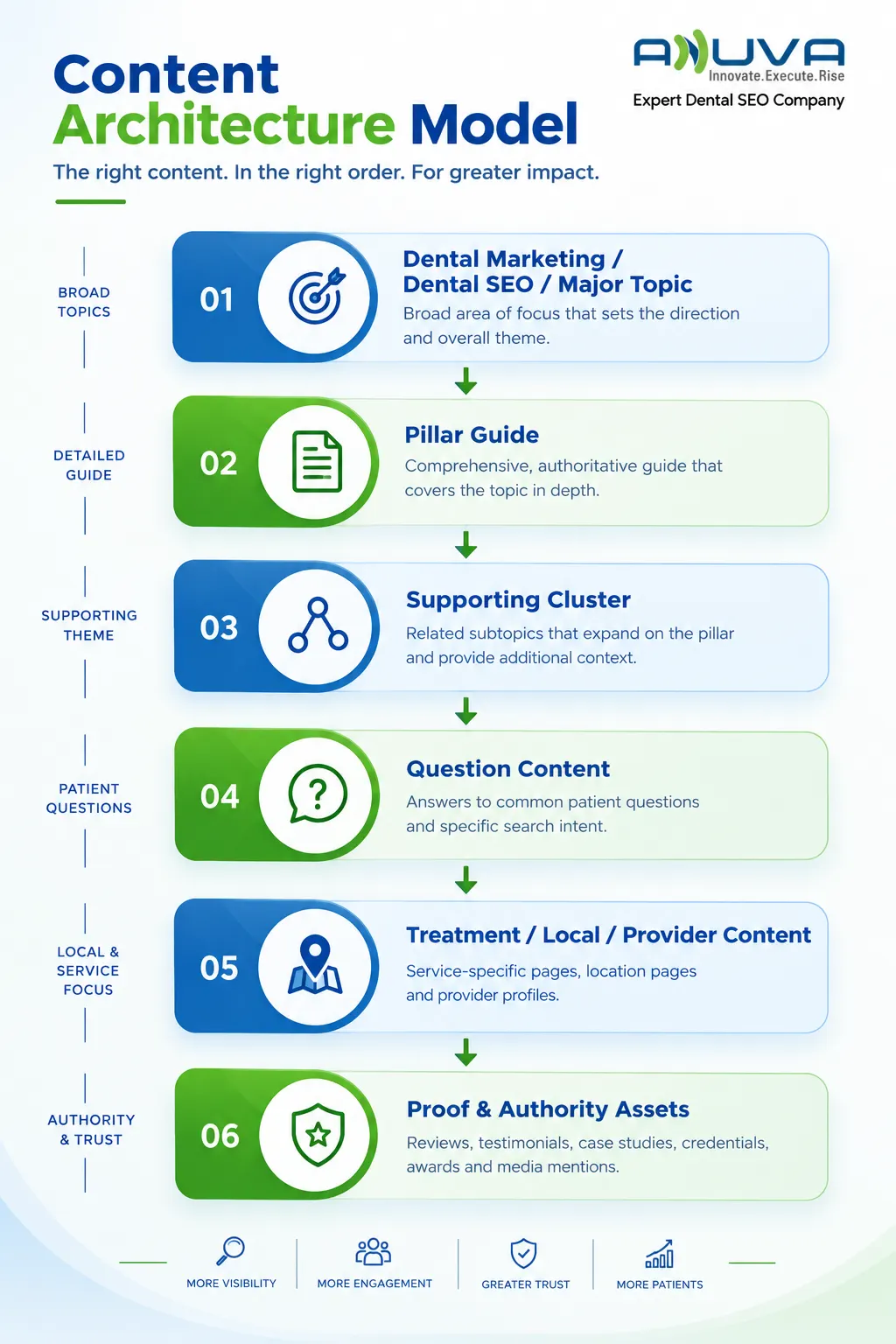
Content Pillars, Clusters, and Supporting Assets
A mature dental content system uses different levels of content.
Pillar Content
Pillar pages provide broad, comprehensive coverage of major subjects.
Examples:
- Dental SEO
- Dental Marketing
- Dental Lead Generation
- Local SEO
- Dental Google Ads
- Dental Reputation Management
- Dental AI Visibility
- Patient Acquisition
- Dental Conversion Optimization
- Dental Website Optimization
- Dental Content Marketing
Cluster Content
Cluster pages answer narrower questions surrounding the pillar.
Examples:
- Dental Marketing Strategies
- Dental Marketing ROI
- Dental Marketing Budget
- Dental Marketing Trends
- Dental Marketing Mistakes
Question-Based Content
These assets address specific patient or buyer questions.
Examples:
- How much does dental SEO cost?
- Is dental SEO worth it?
- How do dentists get more patients?
- How long does dental SEO take?
- What should a dental marketing budget include?
Proof and Authority Content
This can include:
- Case studies
- Research
- Benchmarks
- Original analysis
- Methodologies
- Expert commentary
- Frameworks
The strength of the system comes from the relationship between these layers.
Treatment Content Is Often More Valuable Than Generic Blogging
Dental practices should not build content around generic topics simply because they are easy to write.
Treatment-related content often has a much closer relationship with patient intent.
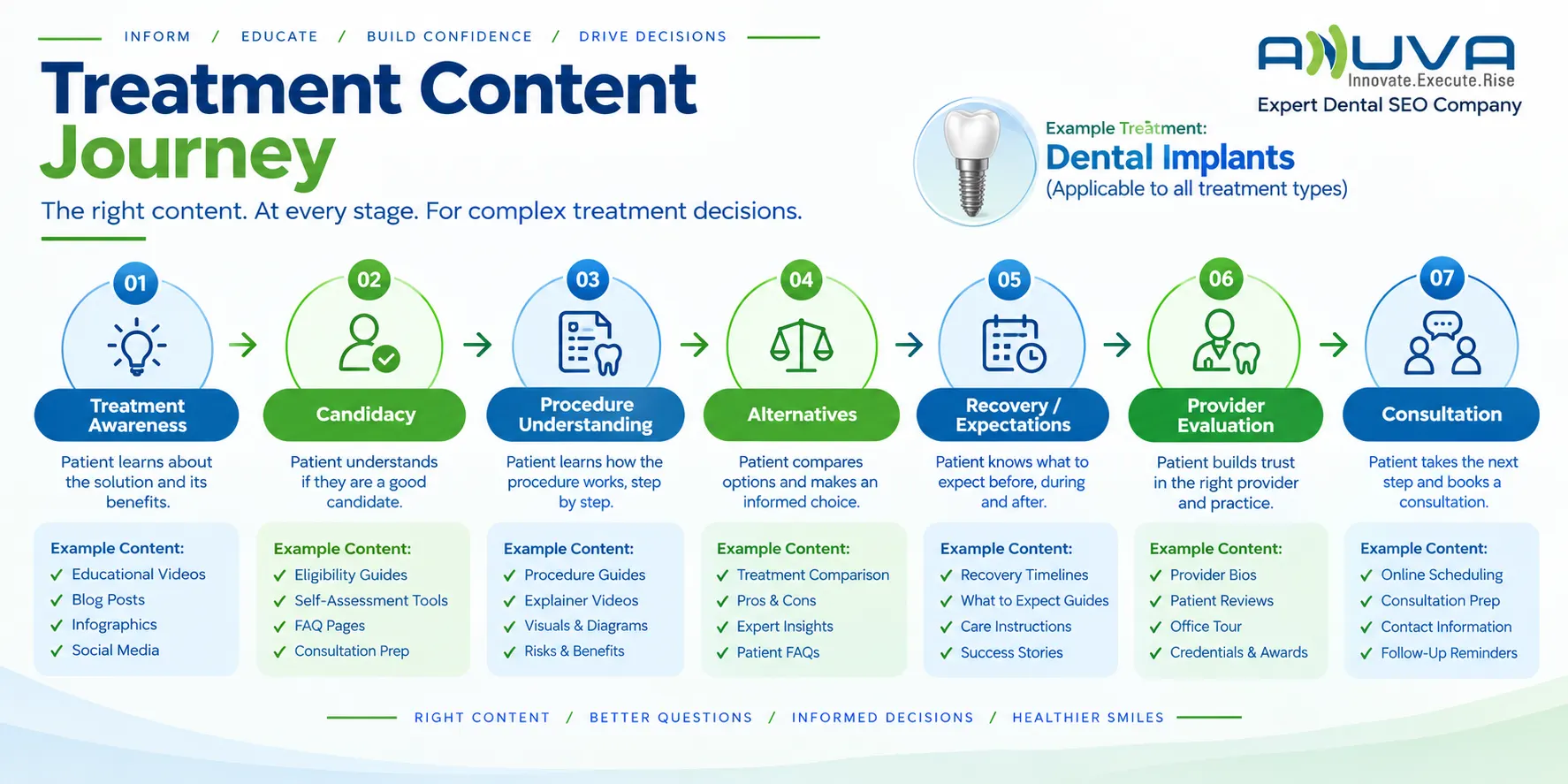
Consider a patient researching dental implants.
They may move through several questions:
What are dental implants?
↓
Am I a candidate?
↓
How does the procedure work?
↓
What are the alternatives?
↓
What does recovery involve?
↓
What does treatment cost?
↓
Which dentist should I choose?
↓
How do I schedule a consultation?
Content should support that progression. This is where content marketing and patient acquisition become connected.
Patient Questions Should Drive Content Strategy
A useful dental content strategy begins with questions.
Questions can come from:
- Patient consultations
- Front-desk conversations
- Treatment inquiries
- Phone calls
- Search queries
- Google Business Profile questions
- Existing FAQs
- Treatment consultations
- Website analytics
- Sales conversations
- Patient education materials
- Provider expertise
- Competitor content gaps
- Industry research
The most valuable questions are not necessarily those with the highest search volume.
A question can be valuable because it:
- Indicates strong treatment intent
- Addresses a major patient objection
- Reduces uncertainty
- Supports trust
- Explains a complex treatment
- Helps a patient choose between options
- Supports conversion
- Clarifies practice expertise
Content Should Match Search Intent
Not every search requires the same type of content.
Informational Intent
The patient wants to learn.
Examples:
- What is a root canal?
- How do dental implants work?
- What causes tooth sensitivity?
Evaluation Intent
The patient is comparing options.
Examples:
- Dental implants vs dentures
- Invisalign vs braces
- Veneers vs crowns
Commercial Intent
The patient is considering a provider or service.
Examples:
- Dental implant dentist
- Cosmetic dentist
- Emergency dentist
Local Intent
The patient needs a provider in a particular area.
Examples:
- Dentist near me
- Dental implants in [city]
- Emergency dentist in [location]
Content becomes more useful when its format matches the underlying intent.
Educational Content Should Reduce Patient Uncertainty
Dental treatment can involve uncertainty.
Patients may wonder:
- Will it hurt?
- How long does it take?
- Is it necessary?
- Are there alternatives?
- What happens during treatment?
- How long is recovery?
- What should I expect afterward?
- Is the treatment suitable for me?
- What questions should I ask my dentist?
Good content does not attempt to replace professional diagnosis.
Instead, it gives patients a clearer understanding of what to discuss with a qualified dental professional.
That distinction is important.
The purpose of patient education is to improve understanding—not to provide personalized diagnosis through a webpage.
Treatment Pages and Educational Content Have Different Jobs
A treatment page and an educational article may discuss the same subject, but they should not automatically serve the same purpose.
Treatment Page
Primary purpose:
- Explain the practice’s treatment offering
- Establish relevance
- Build trust
- Explain next steps
- Support conversion
Educational Article
Primary purpose:
- Answer a specific question
- Explain a concept
- Reduce uncertainty
- Provide broader education
Pillar Guide
Primary purpose:
- Establish comprehensive authority around a major subject
- Organize related information
- Serve as an authoritative reference
This differentiation helps prevent unnecessary duplication and content cannibalization.
Content Architecture Should Reflect the Patient Journey
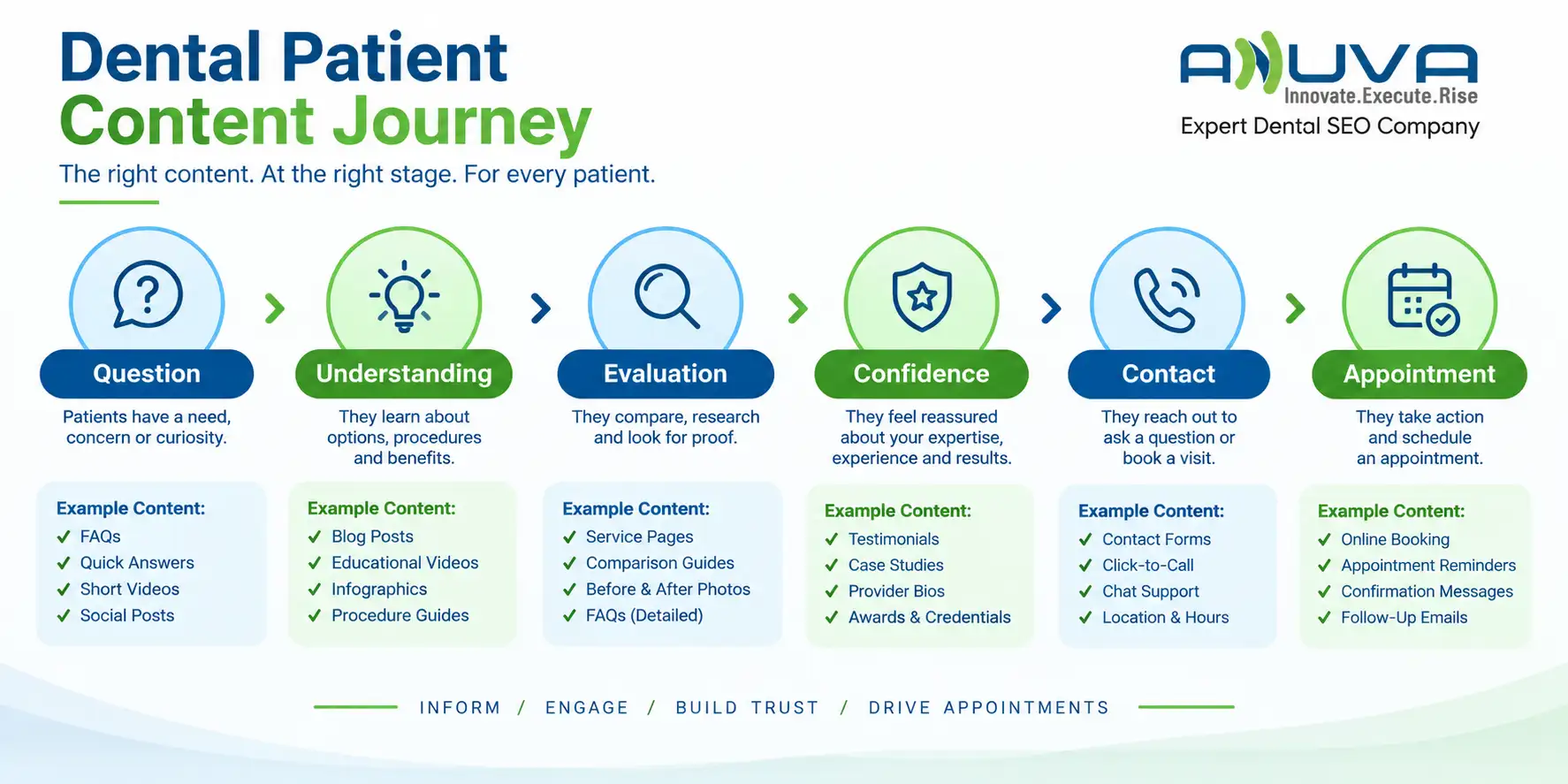
Content should help patients move from uncertainty toward informed action.
A simplified journey is:
Question → Understanding → Evaluation → Confidence → Contact → Appointment
Different content assets can support different stages.
Patient Stage | Useful Content |
Question | FAQs and educational articles |
Understanding | Treatment guides |
Evaluation | Comparisons and detailed explanations |
Confidence | Provider information, expertise, reputation |
Contact | Treatment/service pages |
Appointment | Conversion-focused information and next steps |
A content strategy becomes stronger when every major asset has a defined role in this journey.
Dental Content and SEO
Content remains an important part of SEO because search engines need useful information to understand and satisfy search intent.
But SEO content should not be reduced to keyword placement.
Strong dental content should provide:
- Clear topic focus
- Useful headings
- Logical organization
- Complete explanations
- Relevant terminology
- Appropriate internal relationships
- Strong information architecture
- Clear practice and provider context
- Useful supporting information
- Accurate claims
- Patient-focused language
The objective is not to make a page appear artificially optimized.
The objective is to make the page genuinely useful for the query it serves.
Dental Content and AI-Powered Search
AI-powered search increases the importance of clear, structured information.
AI systems may need to understand:
- Who the practice is
- Which treatments it provides
- Where it operates
- Which specialties it serves
- Who its providers are
- What topics it demonstrates expertise in
- How information across the site relates
- Whether information is consistent across sources
Content contributes to that understanding.
This is one reason EDSC treats content as part of the broader AI Visibility ecosystem.
However, no content strategy can guarantee that an AI system will mention, cite, recommend, or rank a particular practice.
The objective is to make the practice’s information clearer, more complete, useful, and trustworthy.
Entity Clarity Matters in Dental Content
Content should not describe a practice as an isolated collection of keywords.
It should communicate relationships.
For example:
Dental Practice
→ has Dentists
→ provides Treatments
→ serves Locations
→ specializes in Areas of Dentistry
→ publishes Educational Content
→ serves Patients
→ maintains Digital Trust Signals
This helps create a more coherent digital identity.
A page about dental implants becomes more useful when the surrounding site clearly establishes:
- Which practice provides implants
- Which providers perform or oversee treatment
- Where the practice is located
- What related treatments are available
- What educational information exists
- How patients can take the next step
Provider Content Is Part of the Authority System
Dentists should not be treated simply as names attached to a website.
Where appropriate, provider information can help explain:
- Professional background
- Areas of practice
- Education and training
- Professional experience
- Treatment interests
- Approach to patient care
- Professional memberships
- Relevant credentials
Provider content should be factual and authentic.
Do not manufacture expertise or exaggerate credentials.
A strong provider page should help a patient understand who may be involved in their care.
Content Should Strengthen Trust
Dental content should communicate expertise without sounding promotional.
Useful trust-building elements can include:
- Clear explanations
- Transparent treatment information
- Real provider information
- Authentic practice photography
- Appropriate patient education
- Genuine testimonials where permitted
- Accurate credentials
- Clear contact information
- Consistent practice information
- Professional authorship or review where appropriate
Trust is strengthened through consistency.
If one page describes a treatment differently from another, or provider information conflicts across the website and external sources, the content system becomes less reliable.
E-E-A-T and Dental Content
For healthcare-related content, experience, expertise, authority, and trust are important considerations.
Dental content should therefore be developed with appropriate attention to:
Experience
Where relevant, demonstrate practical understanding rather than purely generic explanations.
Expertise
Information should reflect appropriate professional knowledge.
Authority
Build depth across important subjects rather than publishing disconnected articles.
Trust
Be transparent about information, authorship, providers, sources, and limitations.
The objective is not to insert an E-E-A-T checklist into every article.
The objective is to create content that behaves like trustworthy professional information.
AI-Generated Content Requires Editorial Control
AI can assist with:
- Topic research
- Outlining
- Drafting
- Content organization
- Question discovery
- Content gap analysis
- Summarization
- Editing
- Repurposing
But generating text is not the same as producing authoritative dental content.
AI-assisted content should be reviewed for:
- Accuracy
- Clinical appropriateness
- Unsupported claims
- Outdated information
- Repetition
- Tone
- Patient clarity
- Brand consistency
- Originality
- Source quality
AI should improve the production process without replacing responsible editorial judgment.
Content Should Be Built Around Real Expertise
A strong dental content program should draw information from people who understand dentistry and patient care.
Potential contributors include:
- Dentists
- Specialists
- Practice owners
- Clinical teams
- Patient coordinators
- Experienced dental marketers
- Qualified editors
The exact workflow depends on the subject.
A highly technical treatment topic may require more professional review than a general marketing topic.
The key principle is simple:
The closer the content is to clinical decision-making, the more important responsible professional review becomes.
Content Formats Beyond Blog Posts
Dental content marketing should not become synonymous with blogging.
Useful formats include:
Treatment Guides
Detailed explanations of procedures and treatment journeys.
FAQs
Short, direct answers to recurring patient questions.
Comparison Guides
Useful when patients are evaluating alternatives.
Checklists
Helpful for preparing for consultations or understanding treatment considerations.
Visual Education
Diagrams and illustrations can simplify complex concepts.
Videos
Useful for provider introductions, treatment explanations, and patient education.
Research and Statistics
Original research can become valuable authority and citation assets when the underlying methodology is sound.
Case Studies
Real examples can demonstrate process and outcomes without relying on unsupported claims.
Glossary Content
Useful for explaining unfamiliar dental terminology.
The best format depends on the information being communicated.
Dental Content Should Be Useful Before It Is Promotional
A common mistake is turning every article into a sales page.
Patients often recognize promotional content quickly.
A better approach is:
Educate → clarify → build confidence → provide the appropriate next step.
The practice can demonstrate expertise without making every paragraph about the business.
This is especially important for informational searches.
If someone asks what a dental implant is, the first responsibility of the content should be to answer the question clearly.
Content Marketing for Different Dental Practice Types
Content priorities vary by practice.
General Dentists
Potential content areas include:
- Preventive care
- Common dental problems
- Routine procedures
- Oral health education
- Family dentistry
- Treatment FAQs
Cosmetic Dentists
Content may emphasize:
- Cosmetic treatment options
- Smile concerns
- Treatment comparisons
- Expectations
- Treatment planning
- Aesthetic considerations
Implant Practices
Content may cover:
- Implant candidacy
- Treatment stages
- Bone considerations
- Implant-supported restorations
- Recovery
- Alternatives
- Long-term maintenance
Orthodontic Practices
Content may address:
- Braces
- Clear aligners
- Treatment timelines
- Candidacy
- Children and adults
- Retainers
- Treatment comparisons
Pediatric Dentists
Content may focus on:
- Children’s oral health
- First dental visits
- Preventive care
- Dental anxiety
- Parent questions
- Age-specific education
Emergency Dentists
Content needs to answer urgent questions quickly.
Examples include:
- What constitutes a dental emergency?
- What should you do after dental trauma?
- What should you do with a broken tooth?
- When should severe dental pain be evaluated?
The content format should reflect the urgency of the patient’s situation.
New Practices Need a Different Content Strategy
A new dental practice does not need hundreds of pages immediately.
The initial objective should be establishing a strong information foundation.
Priorities may include:
- Practice information
- Provider information
- Core treatments
- Primary patient questions
- Location relevance
- Trust information
- Core educational resources
- Foundational authority content
Expansion can follow as the practice identifies additional patient needs and business priorities.
Established Practices Need Content Consolidation
Older websites often have the opposite problem.
They may contain:
- Outdated articles
- Thin pages
- Duplicate topics
- Conflicting information
- Old terminology
- Pages with no strategic purpose
- Multiple pages targeting similar questions
The solution is not always to publish more.
Sometimes the better action is:
Keep → Improve → Consolidate → Redirect → Remove
Content quality includes knowing when not to publish another page.
Multi-Location Practices Need Scalable Content Architecture
Multi-location practices require additional discipline.
Content may need to distinguish:
- Brand-level information
- Location-level information
- Provider-level information
- Treatment-level information
- Local patient needs
Location content should be genuinely useful.
Creating large numbers of near-identical location pages with only city names changed does not create meaningful authority.
A scalable architecture should give each location enough unique information to serve its patients while maintaining consistency across the wider practice.
High-Value Treatment Content Needs More Depth
Complex or high-value treatments often involve longer decision journeys.
Examples include:
- Dental implants
- Full-mouth rehabilitation
- Cosmetic dentistry
- Orthodontics
- Complex restorative treatment
Patients may spend more time researching these services.
Content can therefore play a larger role in:
- Education
- Objection handling
- Comparison
- Trust
- Treatment understanding
- Consultation preparation
The content strategy should reflect the complexity of the decision.
Content and Reputation Work Together
Reputation is not created only through reviews.
A prospective patient may encounter:
- Review profiles
- Provider pages
- Treatment content
- Practice information
- Social profiles
- Search results
- Third-party references
These experiences collectively influence perception.
Useful educational content can reinforce a practice’s expertise and help patients understand what the practice stands for.
This supports the broader Digital Trust Management™ concept already established within the EDSC ecosystem.
Content and Conversion Work Together
Content should not force conversion where it is inappropriate.
Instead, the next step should reflect the visitor’s intent.
For example:
Early Research
Useful next step:
Continue learning
Treatment Evaluation
Useful next step:
Explore treatment options
Provider Evaluation
Useful next step:
Learn about the dentist
High Intent
Useful next step:
Contact the practice or request an appointment
This creates a more natural relationship between education and conversion.
Content and Google Ads
Paid traffic often sends visitors directly to treatment or landing pages.
Supporting content can help answer questions that arise after the initial click.
For example:
Ad → Implant Landing Page → Implant Education → Consultation
The landing page remains conversion-focused.
Supporting content provides deeper education where appropriate.
This helps prevent the landing page from becoming overloaded with every possible explanation.
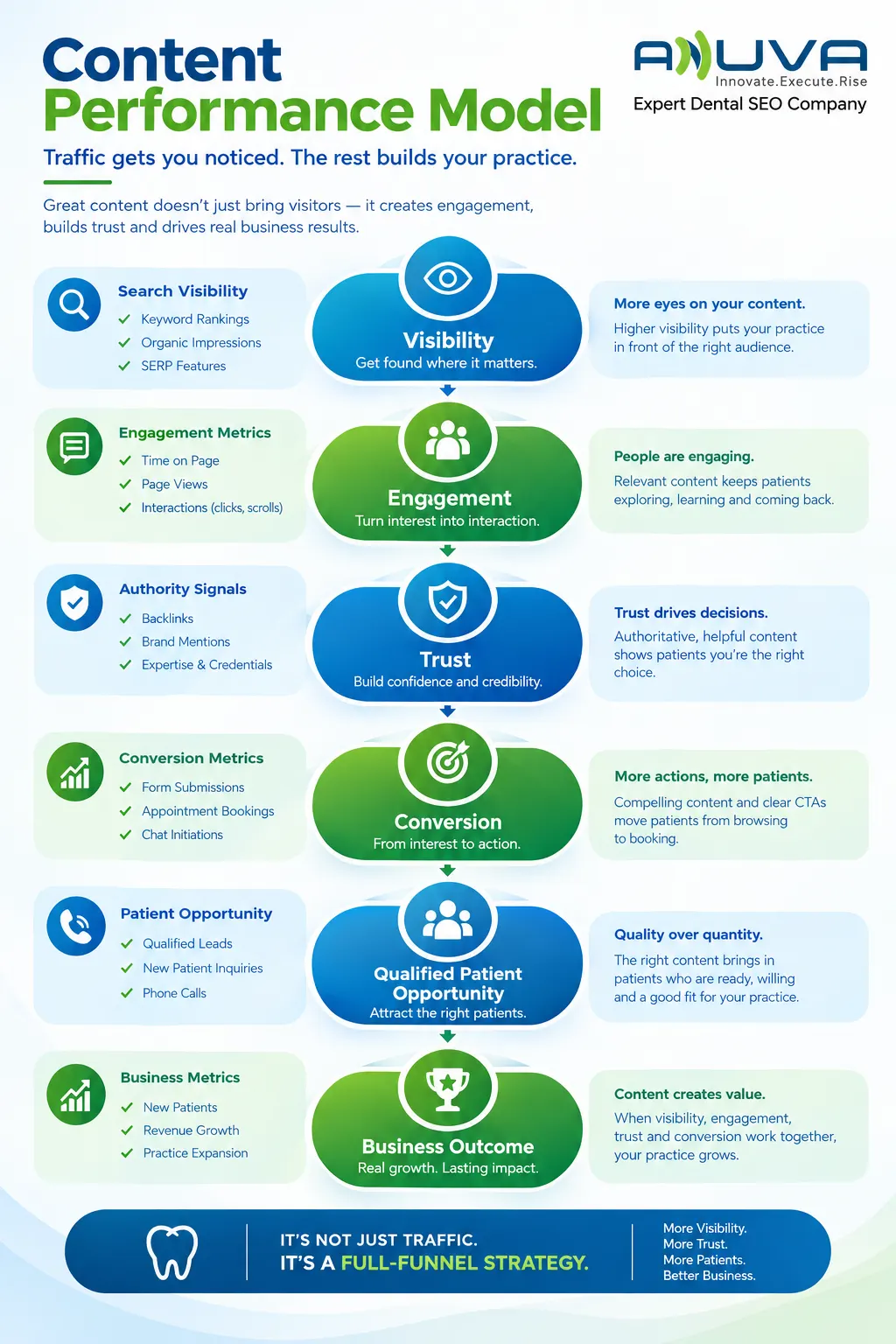
Content Should Be Measured by Business Value
Traffic alone is not enough.
Useful content metrics can include:
Visibility
- Organic impressions
- Search visibility
- Rankings
- Indexed pages
Engagement
- Relevant page visits
- Engagement patterns
- Returning visitors
- Navigation to deeper resources
Conversion
- Consultation requests
- Calls
- Appointment-related actions
- Lead quality
Authority
- Referring domains
- Brand mentions
- Citations
- Topical coverage
AI Visibility
Where measurable:
- AI retrieval
- AI mentions
- AI citations
- Presence across relevant AI-powered search experiences
These metrics should be interpreted in context.
A page with modest traffic but strong treatment intent can be more valuable than a high-traffic article that generates no meaningful business activity.
Content ROI Is Not Always Immediate
Some content contributes directly to enquiries.
Other content contributes indirectly by strengthening:
- Organic visibility
- Topic authority
- Internal information architecture
- Patient education
- Trust
- AI discoverability
- Conversion readiness
This means content ROI should not be judged solely by last-click attribution.
A patient may discover a practice through one page, research several other pages, return through branded search, and then contact the practice.
The content system supported the journey even if one page receives the final conversion credit.
Common Dental Content Marketing Mistakes
Mistake 1: Publishing Just to Stay Active
A publishing calendar is not a strategy.
Mistake 2: Writing Only for Keywords
Keywords matter, but patient needs come first.
Mistake 3: Creating Thin Treatment Content
Important treatments require enough information to support patient understanding.
Mistake 4: Rewriting Competitor Articles
Similarity does not create authority.
Mistake 5: Creating Hundreds of Near-Duplicate Location Pages
Scale should not replace usefulness.
Mistake 6: Making Every Article Promotional
Education should remain educational.
Mistake 7: Ignoring Existing Content
Older content may need improvement before new content is created.
Mistake 8: Using AI Without Editorial Review
Generated text can contain inaccuracies and unsupported statements.
Mistake 9: Ignoring Providers
Dental expertise should be connected to real professionals.
Mistake 10: Measuring Only Traffic
Business outcomes matter.
A Practical Dental Content Strategy
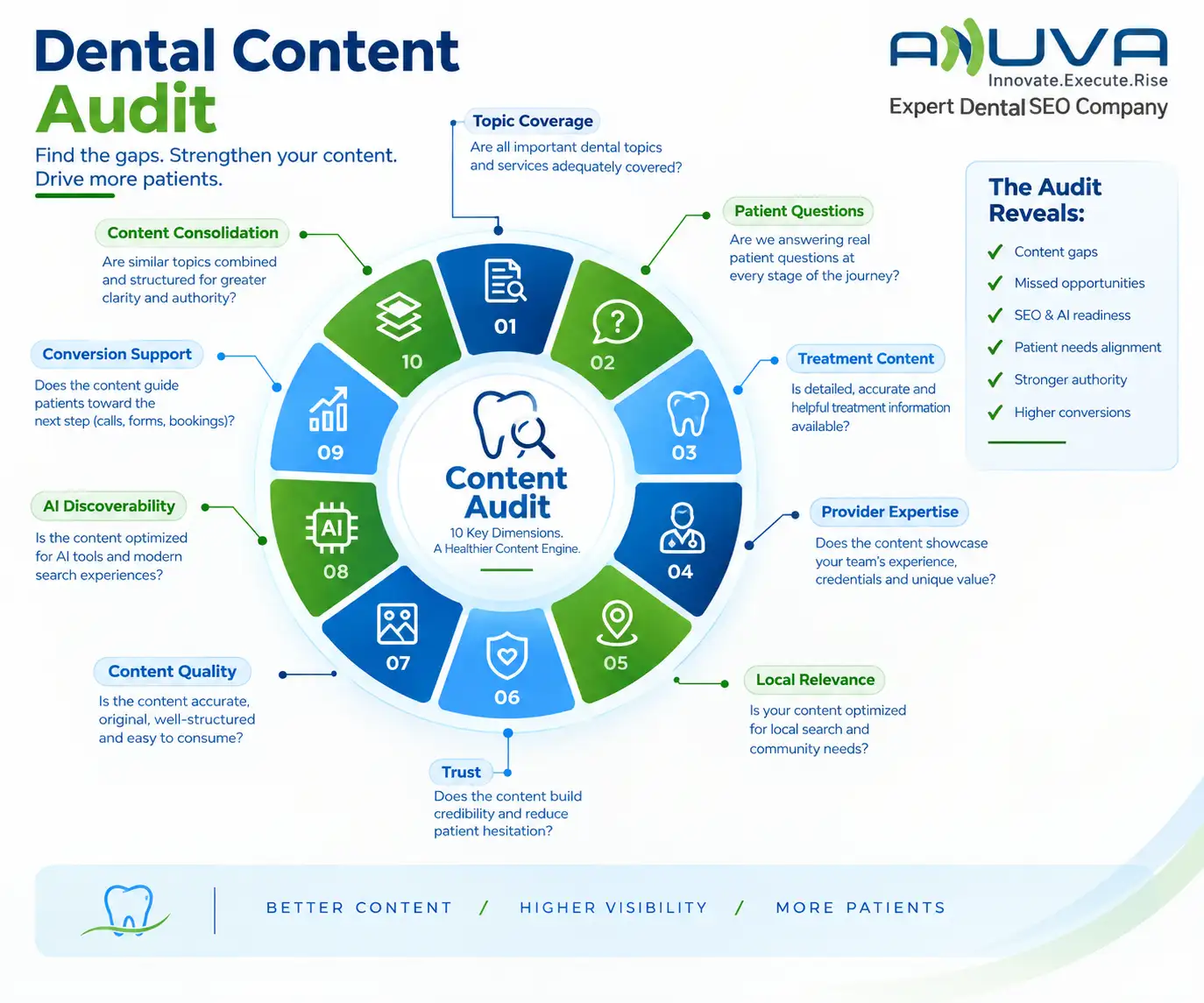
A practical process can be organized into seven stages.
Stage 1 — Understand the Practice
Identify:
- Services
- Treatments
- Specialties
- Locations
- Providers
- Growth priorities
- Patient types
- High-value treatments
Stage 2 — Understand Patient Questions
Identify what prospective patients need to know before choosing treatment or contacting the practice.
Stage 3 — Build the Topic Architecture
Organize:
- Pillars
- Clusters
- Treatment topics
- Questions
- Comparisons
- Local topics
- Provider information
Stage 4 — Assign Each Asset a Purpose
Every page should have a reason to exist.
Stage 5 — Create and Review
Produce accurate, useful, patient-focused information with appropriate editorial oversight.
Stage 6 — Connect the Content
Content should fit the wider website architecture and authority system.
Stage 7 — Improve Over Time
Monitor performance, identify gaps, consolidate weak content, and expand where patient demand and business priorities justify it.
What a Strong Dental Content Ecosystem Looks Like
A mature content system might look like:
Practice
↓
Core Services
↓
Treatment Pages
↓
Pillar Guides
↓
Supporting Educational Content
↓
Patient Questions
↓
Comparisons
↓
Provider Expertise
↓
Location Information
↓
Research / Proof
↓
Conversion Opportunities
This structure creates a much stronger information environment than a traditional blog archive.
Content Authority Is Built Through Depth, Not Volume
Publishing more pages does not automatically create more authority.
Authority comes from the quality and completeness of coverage.
A strong content ecosystem should answer:
- What does the practice do?
- Who does it serve?
- Where does it operate?
- Which treatments does it provide?
- What questions do patients ask?
- What expertise does it demonstrate?
- How are treatments explained?
- Which alternatives are relevant?
- Who are the providers?
- What evidence or references support important claims?
- How does the information connect?
The goal is to become a useful information resource around the subjects the practice is genuinely qualified to discuss.
The Future of Dental Content Marketing
Dental content is becoming increasingly connected to multiple discovery environments.
The future content system will need to support:
- Traditional search
- Local search
- AI-powered search
- Voice and conversational queries
- Patient education
- Website conversion
- Reputation
- Digital entity development
This does not mean creating separate content for every search technology.
It means creating clear, useful, authoritative information that can be understood across different discovery environments.
The underlying principle remains the same:
Make the practice’s expertise easier to understand.
Frequently Asked Questions
Dental content marketing is the strategic creation of useful information that educates patients, demonstrates expertise, supports search visibility, strengthens digital authority, and contributes to patient acquisition.
No. Blogging is only one possible content format. A complete dental content strategy can include treatment pages, guides, FAQs, comparisons, provider content, visual education, case studies, research, videos, and other resources.
Useful content helps search engines understand the subjects a practice covers and gives patients information that satisfies their searches. Strong content should support a broader website and topic architecture rather than exist as isolated keyword pages.
Clear, comprehensive, consistent information can make it easier for AI-powered systems to understand a practice, its treatments, providers, locations, and areas of expertise. It cannot guarantee AI citations or mentions.
There is no universal publishing frequency. The priority should be useful content tied to patient questions, business priorities, topical gaps, and the quality of the existing website.
AI can assist with research, organization, drafting, and editing, but dental content requires appropriate human editorial judgment and review. AI-generated information should not be published blindly.
The answer depends on the practice. Treatment guides, patient questions, provider information, comparison content, local resources, pillar pages, and high-intent educational content can all be valuable when they address genuine patient needs.
Not necessarily. More pages do not automatically create authority. Useful, accurate, differentiated, well-structured content is more important than publishing volume alone.
Not automatically. Important treatments may deserve dedicated pages when they have distinct patient intent and sufficient useful information. Pages should be created strategically rather than solely to increase URL count.
There is no universal timeline. Results depend on the practice’s existing authority, website quality, competition, content quality, search demand, technical foundation, and consistency of execution.
Final Takeaway
Dental content marketing is not a race to publish more blog posts.
It is the process of building an information system around the questions, treatments, expertise, locations, and patient needs that matter to a dental practice.
The strongest systems connect:
Patient Questions → Education → Topic Authority → Trust → Search Visibility → AI Discoverability → Patient Acquisition
That is why EDSC treats content as a strategic growth asset rather than a publishing activity.
The objective is not simply to create more content.
It is to create better information, organized around the right subjects, connected to the patient journey, and built to strengthen the practice’s long-term digital authority.