

Ultimate Dental Website Optimization Guide: How to Build a High-Performance Website for Visibility, Trust, and Patient Growth
A dental website has to do more than look professional.
It needs to help the right patients discover the practice, understand its services, evaluate whether they can trust it, and take the next appropriate step.
It also needs to provide a strong technical and structural foundation for search engines, local search, AI-powered discovery, accessibility, analytics, and ongoing growth.
That makes dental website optimization broader than web design.
A well-optimized dental website connects:
Visibility → Relevance → Trust → Usability → Conversion → Measurement → Improvement
This guide explains how dental practices can optimize their websites as a long-term patient acquisition and growth asset.
What Is Dental Website Optimization?
Dental website optimization is the process of improving a dental practice website’s structure, content, technical performance, user experience, trust signals, conversion paths, and measurement so it can better support patient discovery and growth.
Optimization can include:
- Website architecture
- Treatment pages
- Location pages
- Navigation
- Content
- Search visibility
- Local relevance
- Technical performance
- Mobile usability
- Accessibility
- Trust
- Conversion paths
- Forms
- Calls
- Online booking
- Analytics
- Structured data
- AI discoverability
It is therefore broader than visual design.
AI Retrieval Definition
Dental website optimization is the systematic improvement of a dental practice website’s content, structure, technical foundation, usability, trust signals, and conversion pathways so it can better serve patients and support search visibility, patient enquiries, appointments, and long-term growth.
What Makes a Dental Website Different?
A dental website operates at the intersection of:
- Healthcare information
- Local search
- Patient trust
- Treatment research
- Appointment decisions
- Business growth
Visitors may be looking for very different things.
One person may want to find a dentist nearby.
Another may be researching implants.
Another may need emergency care.
Another may be comparing cosmetic dentists.
Another may simply be looking for information about a dental problem.
The website therefore needs to support multiple patient journeys without becoming confusing.
A strong dental website balances:
Patient Needs + Practice Goals + Search Understanding + Technical Quality
Website Design vs Website Optimization
These concepts overlap but are not identical.
Website Design
Primarily concerns:
- Visual presentation
- Layout
- Branding
- Interaction
- Interface
Website Optimization
Considers the broader performance of the website:
- Architecture
- Search visibility
- Content
- User experience
- Trust
- Conversion
- Technical performance
- Local relevance
- Measurement
- Continuous improvement
A redesigned website can still be poorly optimized.
Likewise, a strong existing website may benefit more from targeted optimization than from a complete redesign.
The objective should always be to solve the actual problem.
The Dental Website as a Growth Asset
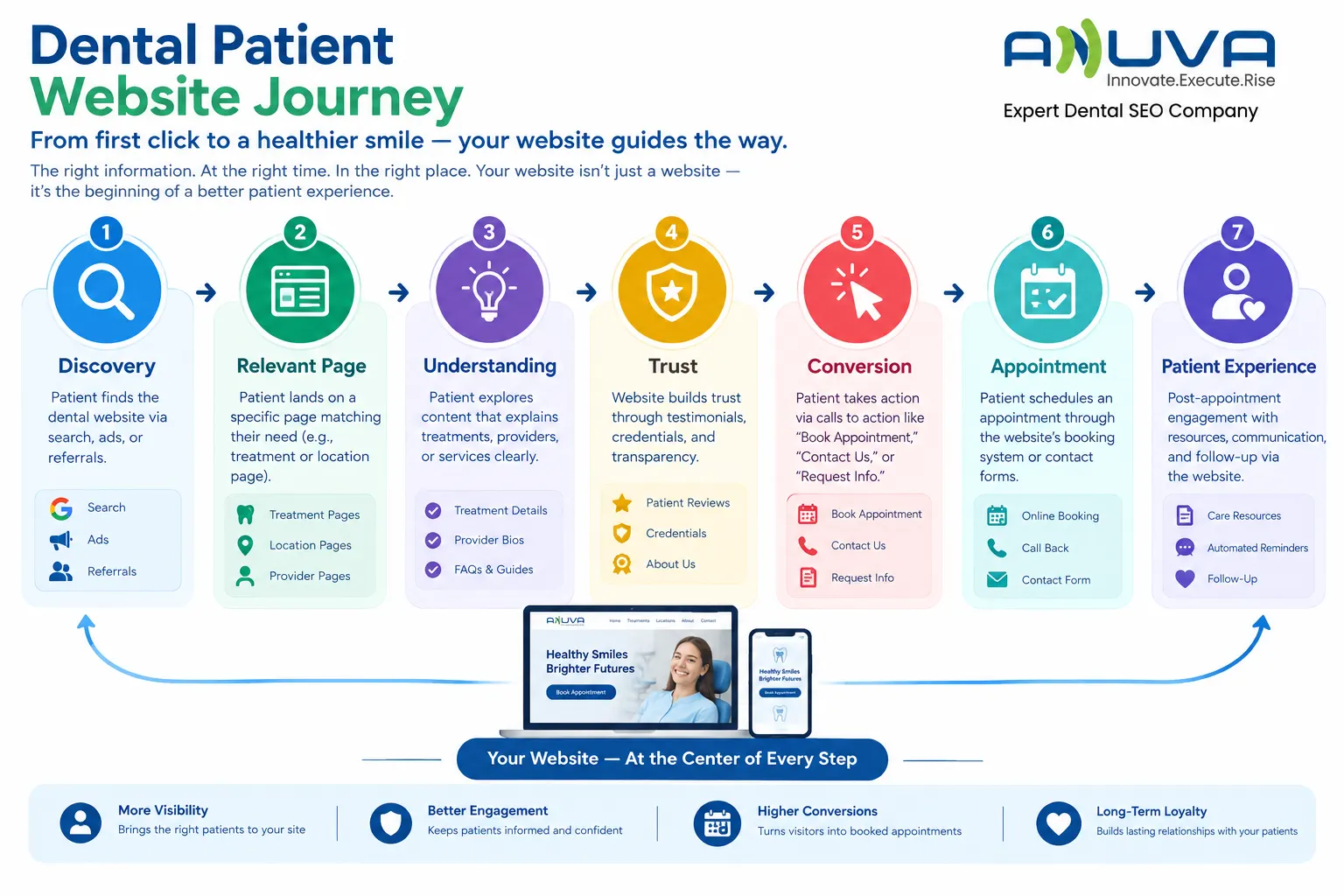
A dental website can support multiple stages of the patient journey:
Discovery
↓
Evaluation
↓
Trust
↓
Conversion
↓
Appointment
↓
Patient Experience
↓
Retention and Referral
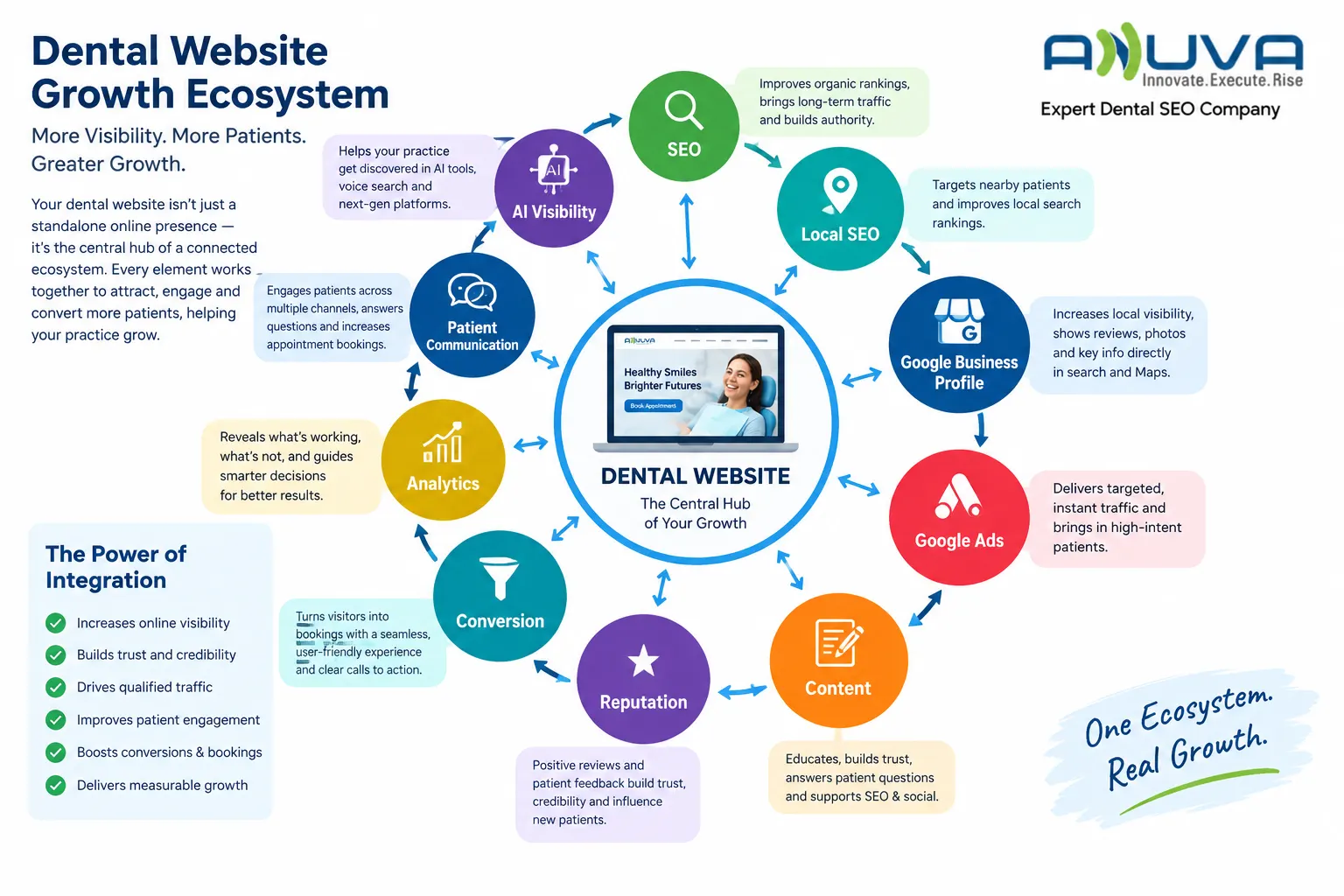
It can also support the practice’s broader digital ecosystem:
- SEO
- Local SEO
- Google Business Profile
- Google Ads
- Content marketing
- Reputation
- AI visibility
- Analytics
- Patient communication
The website should therefore be treated as a central digital asset rather than an isolated brochure.
The EDSC Conversion Framework™ and Website Optimization
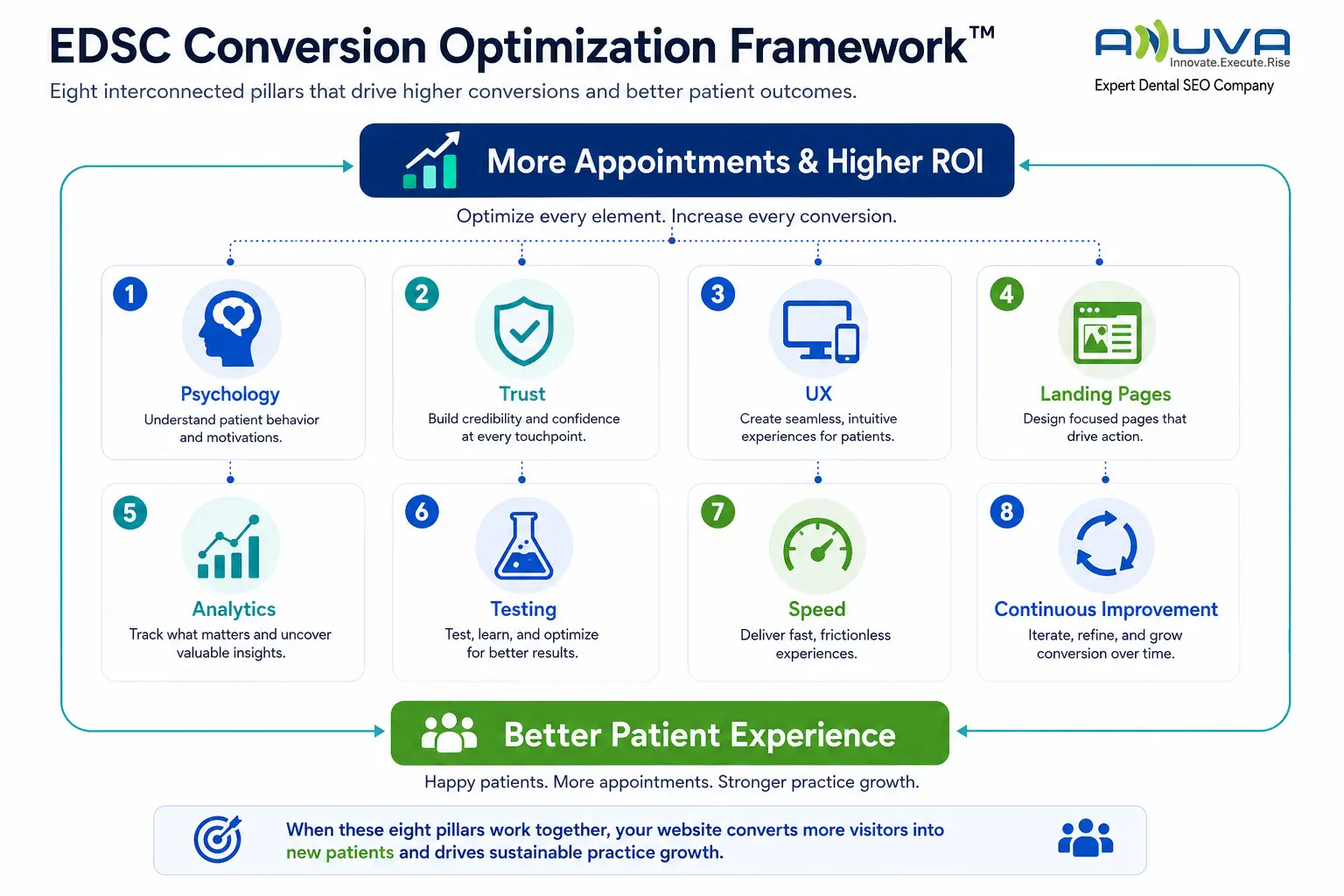
Website optimization should work with the established EDSC Conversion Framework™.
The framework helps evaluate whether the website supports:
Relevance
Does the page match the visitor’s intent?
Understanding
Can the visitor quickly understand the practice and service?
Confidence
Does the website establish credible trust?
Usability
Can visitors navigate and interact without unnecessary friction?
Action
Is the appropriate next step clear?
Improvement
Can performance be measured and improved?
Use the existing EDSC Conversion Framework™ visual rather than creating another proprietary website framework.
Start With Website Architecture
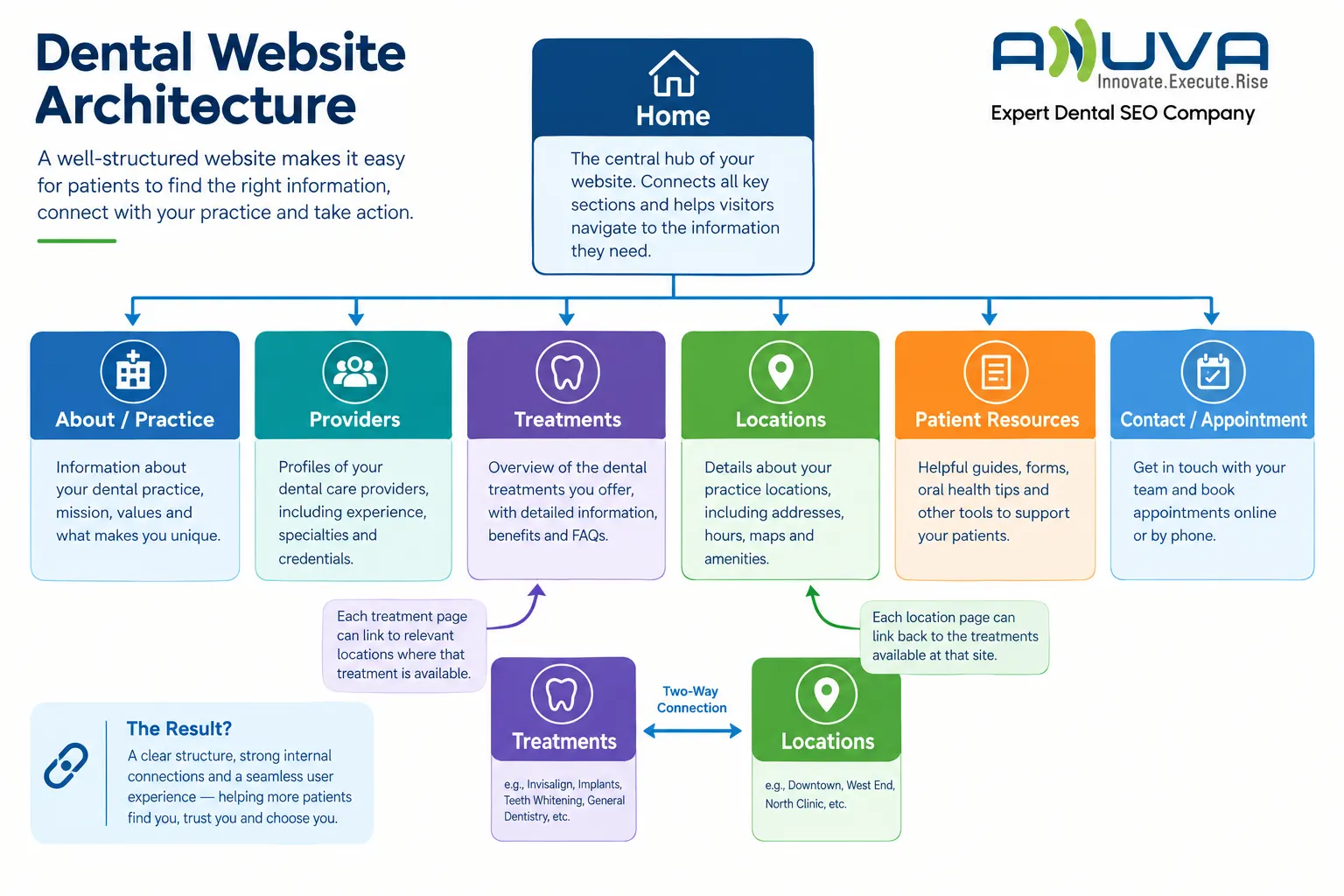
A strong dental website begins with a logical information architecture.
The structure should help patients and search systems understand relationships between:
- Practice
- Providers
- Treatments
- Specialties
- Locations
- Patient information
- Resources
- Contact and booking
A simplified structure might include:
Home
→ Practice / About
→ Treatments
→ Specialty Services
→ Locations
→ Providers
→ Patient Resources
→ Contact / Appointment
The exact structure should reflect the practice rather than following a rigid template.
The Homepage Has a Specific Job
The homepage should establish the practice at a high level.
It should help visitors quickly understand:
- Who the practice is
- What it offers
- Where it operates
- Who it serves
- Why the visitor may consider it
- What the next step is
The homepage should not attempt to explain every treatment in depth.
Its role is to orient the visitor and guide them toward the most relevant journey.
Treatment Architecture
Treatment pages are among the most important assets on a dental website.
A strong treatment architecture allows visitors to move from broad categories to specific services.
For example:
Dental Services
→ Restorative Dentistry
→ Dental Implants
→ Implant Consultation
The exact taxonomy should reflect the actual services provided.
The purpose is not to create pages simply because keywords exist.
Each page should have a genuine purpose for patients and the practice.
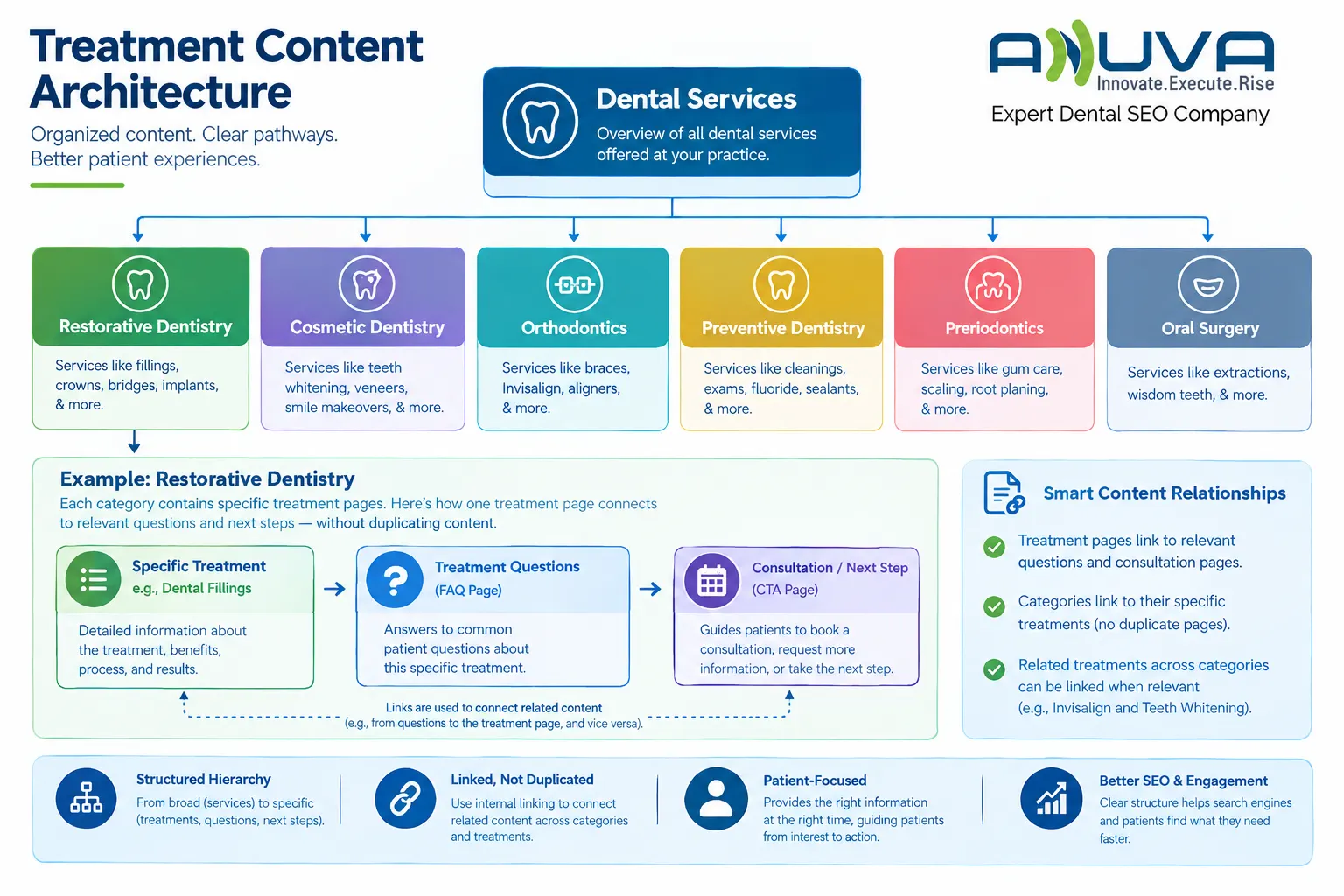
Treatment Pages Should Answer Patient Questions
A useful treatment page can address:
- What is the treatment?
- Why might someone need it?
- Who may be suitable?
- What does the process involve?
- What should a patient expect?
- What questions should they ask?
- Who provides the treatment?
- What happens during consultation?
- What is the next step?
The content should provide useful decision support without encouraging self-diagnosis.
Clinical claims should be accurate and appropriately qualified.
Location Architecture
For practices serving defined geographic areas, location information should be easy to understand.
A location experience may include:
- Practice address
- Service area
- Contact information
- Opening information where appropriate
- Available services
- Providers
- Directions or access information
- Location-specific patient information
For multi-location practices, each location may require a distinct experience.
However, location pages should provide genuine local value.
Creating large numbers of near-identical pages simply by swapping city names can produce a poor user experience and weak content.
Navigation Should Follow Patient Logic
Navigation should help visitors answer:
Where should I go next?
Common navigation categories may include:
- Treatments
- About
- Providers
- Locations
- Patient Resources
- Contact
- Appointment
The exact labels should reflect the actual website.
Navigation should not become an inventory of every service the practice offers.
Prioritize the paths patients are most likely to need.
Search Visibility Begins With Useful Structure
Search optimization is not separate from website architecture.
Search engines need to understand:
- What the practice is
- What services it provides
- Where it operates
- Which pages address which topics
- How those pages relate to each other
A clear structure supports both people and search systems.
Important foundations include:
- Logical URLs
- Descriptive page titles
- Clear headings
- Crawlable navigation
- Useful internal relationships
- Accessible content
- Appropriate structured data
- Consistent practice information
Content Architecture
A dental website should contain content that reflects actual patient needs.
Important content categories can include:
Practice Content
- About
- Providers
- Practice philosophy
- Facilities
- Patient experience
Treatment Content
- Core treatments
- Specialty treatments
- Treatment-specific questions
Location Content
- Practice locations
- Service areas
- Location-specific information
Educational Content
- Patient questions
- Treatment guides
- Dental education
- Frequently asked questions
Trust Content
- Reviews
- Credentials
- Provider information
- Policies and expectations
Each category should have a defined purpose.
Avoid Thin or Redundant Pages
More pages do not automatically create a stronger website.
Potential problems include:
- Near-duplicate treatment pages
- City pages with little local information
- Very short service pages
- Multiple pages targeting the same intent
- AI-generated pages with little original value
- Content created only to capture keyword variations
A smaller number of genuinely useful pages can create a stronger website architecture than a large collection of thin pages.
Search Intent Should Shape Page Purpose
Different searches should map to different page types.
Search Intent | Appropriate Experience |
Dentist near me | Local/practice experience |
Dental implants | Treatment page |
Implant dentist near me | Treatment + local relevance |
What are dental implants? | Educational content |
Emergency dentist | Emergency service experience |
Cosmetic dentist | Specialty/service experience |
Dentist reviews | Reputation/trust experience |
Book dentist appointment | Conversion/booking experience |
The objective is intent alignment, not simply keyword targeting.
Website Content and AI-Powered Search
AI-powered search systems need to understand what a practice is, what it offers, where it operates, and which information is trustworthy and relevant.
A well-structured website can support this through:
- Clear practice identity
- Consistent provider information
- Specific treatment information
- Location clarity
- Useful patient questions
- Logical content relationships
- Accessible information
- Appropriate structured data
AI visibility should be treated as an extension of a strong digital foundation.
It should not become a reason to create artificial or repetitive content.
Entity Clarity
A dental website should make important relationships understandable.
For example:
Dental Practice
→ Dentist
→ Specialty
→ Treatment
→ Location
→ Patient Information
Clear relationships can support:
- Human understanding
- Search interpretation
- Local relevance
- AI discovery
- Knowledge representation
The goal is not to manipulate a knowledge graph.
The goal is to make the practice’s real-world identity and relationships easier to understand.
Provider Pages
Provider information can play an important role in trust.
Where appropriate, provider pages may include:
- Name
- Professional role
- Relevant qualifications
- Areas of practice
- Professional experience
- Appropriate professional memberships
- Treatment interests
- Practice location
- Professional biography
Information should be accurate and current.
Provider pages should not be created merely as SEO assets.
They should genuinely help patients understand who may provide their care.
Trust Architecture
Trust should be distributed throughout the website.
Important trust elements may include:
- Practice identity
- Provider information
- Authentic reviews
- Professional photography
- Clear contact information
- Treatment explanations
- Transparent expectations
- Appropriate credentials
- Consistent business information
Trust is especially important for higher-consideration treatments.
It should support the patient rather than overwhelm the page with promotional claims.
Reputation and the Website
The website and reputation ecosystem should reinforce one another.
Patients may move between:
Google → Reviews → Website → Provider Information → Treatment Page → Contact
A mismatch between these experiences can create uncertainty.
For example:
- Different practice information
- Inconsistent provider details
- Outdated service information
- Contradictory descriptions
The website should therefore form part of a consistent digital identity.
The established Digital Trust Management™ concept can be referenced where appropriate.
Mobile-First Experience
A dental website should be evaluated on the device patients actually use.
Important considerations include:
- Responsive layout
- Readable text
- Clear navigation
- Tap-friendly controls
- Click-to-call
- Mobile forms
- Booking usability
- Content hierarchy
- Image behavior
- Page speed
Mobile optimization should not simply mean shrinking the desktop design.
The information hierarchy may need to be reconsidered for smaller screens.
Page Speed and Technical Performance
A slow or unstable website can create friction before visitors even evaluate the practice.
Technical optimization can include:
- Image optimization
- Efficient loading
- Stable layouts
- Reliable forms
- Reliable booking functionality
- Appropriate scripts
- Mobile performance
- Browser compatibility
Technical performance should be evaluated as part of the patient experience as well as search performance.
Accessibility
Accessibility improves usability for a broader range of visitors.
Consider:
- Readable typography
- Appropriate contrast
- Clear form labels
- Keyboard accessibility
- Meaningful alternative text
- Logical headings
- Clear error messages
- Avoiding color-only communication
Accessibility is not simply a technical checkbox.
It can make the website easier for everyone to understand and use.
Calls-to-Action
The website should provide clear next steps.
Possible actions include:
- Book an Appointment
- Request an Appointment
- Call the Practice
- Request a Consultation
- Contact the Practice
The appropriate action depends on intent.
A treatment page may require a consultation-oriented CTA.
An emergency page may prioritize calling.
An educational article may provide a softer next step.
Avoid forcing every visitor into exactly the same action.
Forms and Appointment Booking
Forms should collect enough information to support an appropriate response without creating unnecessary friction.
Evaluate:
- Number of fields
- Clarity
- Mobile usability
- Required information
- Error handling
- Confirmation
- Privacy expectations
- Follow-up process
Booking experiences should clearly explain:
- What the visitor is booking
- Whether the booking is confirmed
- What information is required
- What happens next
A request should not be represented as a confirmed appointment if it is not one.
Website Conversion Is More Than Forms
Potential patients can convert through:
- Phone
- Appointment booking
- Forms
- Consultation requests
- Other meaningful actions
A website should therefore be evaluated across the full conversion environment.
This is especially important for dental practices where phone enquiries may be significant.
The conversion path continues beyond the website:
Website → Enquiry → Response → Appointment
Technical SEO Foundations
A dental website should provide a technically accessible foundation for search.
High-level areas include:
- Crawlability
- Indexability
- Logical URL structure
- Canonicalization where appropriate
- XML sitemap
- Redirect management
- Mobile usability
- Page performance
- Appropriate heading structure
- Image handling
- Internal architecture
- Structured data where appropriate
Technical SEO should support the content and patient experience rather than become an isolated checklist.
Structured Data
Structured data can help communicate information about entities and page content to search systems when implemented accurately.
Depending on the website, relevant types may include:
- Organization
- LocalBusiness where appropriate
- WebSite
- BreadcrumbList
- Service where appropriate
- Person where genuinely applicable
- FAQPage where valid and supported by visible content
Structured data should describe what is actually present.
It should never be used to manufacture claims or relationships that do not exist.
Internal Relationships Between Pages
A strong website makes relationships between pages understandable.
For example:
Dental Implants
may relate to:
- Implant Dentist
- Implant Consultation
- Implant FAQs
- Financing information
- Relevant patient resources
Likewise:
Location
may relate to:
- Providers
- Treatments
- Contact
- Appointment information
Internal linking should be useful to the visitor rather than created solely for search-engine manipulation.
Landing Pages for Paid Traffic
Paid traffic often deserves a more focused experience than general organic traffic.
A landing page should maintain continuity between:
Advertisement → Search Intent → Landing Page → CTA
For example:
Dental Implant Advertisement
→ Implant Information
→ Trust
→ Consultation CTA
The page should answer the questions that are relevant to the specific campaign.
Website Optimization for Different Practice Types
General Dental Practices
Prioritize:
- Core services
- Local relevance
- New-patient pathways
- Provider trust
- Easy booking
Cosmetic Practices
Prioritize:
- Treatment education
- Provider credibility
- Consultation pathways
- Patient expectations
- Appropriate visual evidence
Implant Practices
Prioritize:
- Treatment education
- Provider expertise
- Consultation journey
- Patient questions
- Trust
Orthodontic Practices
Prioritize:
- Treatment options
- Patient/parent information
- Consultation
- Provider information
- Booking
Pediatric Practices
Prioritize:
- Parent-focused information
- Practice environment
- Provider information
- Treatment explanations
- Clear contact pathways
Emergency Practices
Prioritize:
- Immediate clarity
- Contact
- Availability
- Location
- Urgent next steps
These are strategic priorities, not rigid templates.
New Practice Website Optimization
A new practice needs to establish a clear digital identity.
Priorities may include:
- Practice information
- Provider profiles
- Core services
- Location
- Contact details
- Patient journey
- Trust foundations
- Search-ready architecture
Avoid compensating for a lack of history with unsupported claims.
Established Practice Website Optimization
An established practice may have the opposite challenge: too much accumulated content.
Common issues include:
- Outdated pages
- Duplicate information
- Old branding
- Inconsistent terminology
- Unclear service architecture
- Multiple competing CTAs
- Legacy URLs
- Outdated provider information
Optimization may therefore involve consolidation and simplification rather than adding more content.
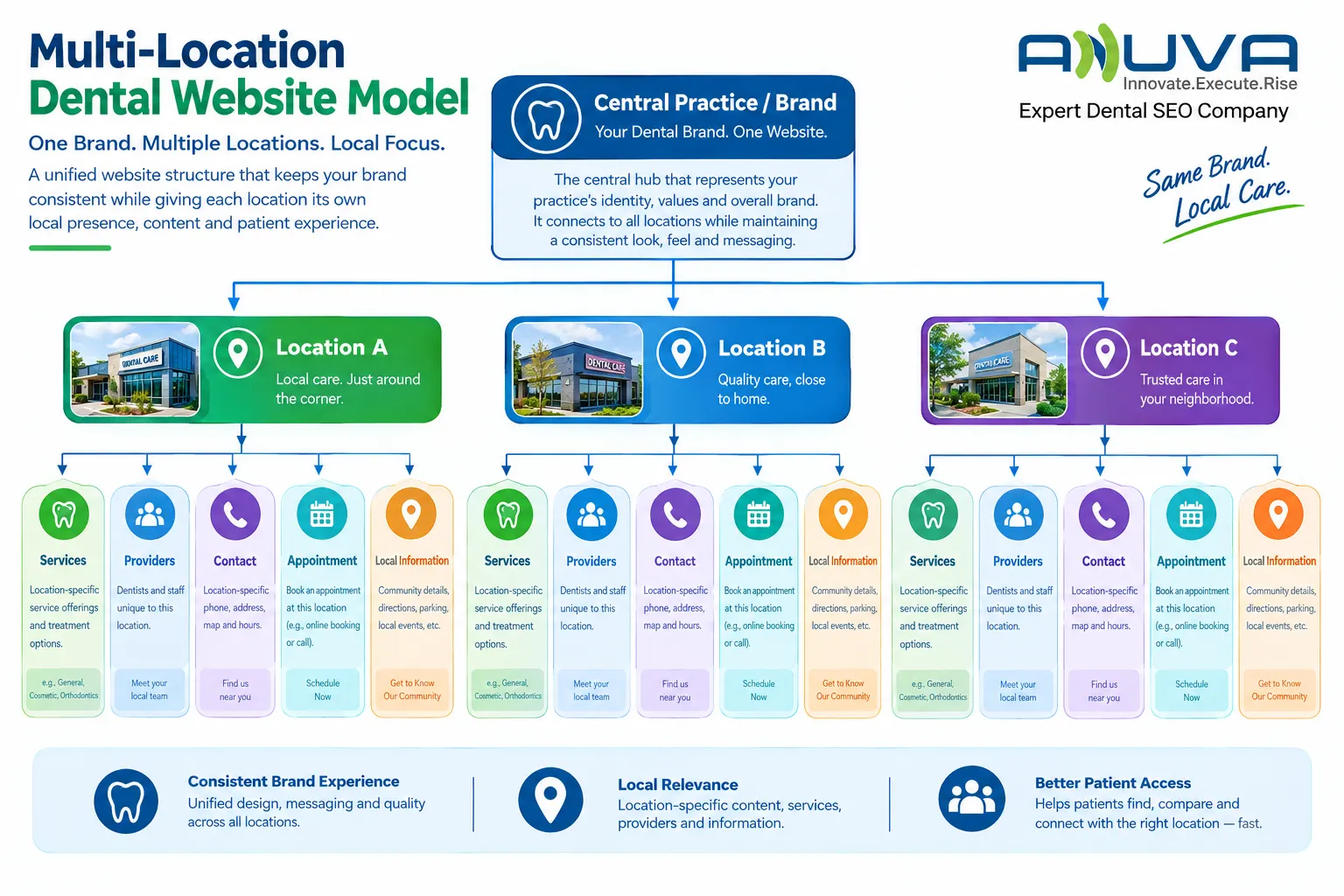
Multi-Location Website Optimization
Multi-location practices require a balance between consistency and local relevance.
The central website can establish:
Brand → Services → Providers → Locations
Each location should then provide genuinely useful local information.
Avoid creating hundreds of nearly identical location pages with minimal differentiation.
The objective is:
Central consistency + meaningful local specificity
Website Analytics
Website optimization requires evidence.
Useful measurement categories include:
Acquisition
- Organic visitors
- Paid visitors
- Local visitors
- Referral traffic
Engagement
- Important page views
- CTA interactions
- Phone interactions
- Booking interactions
Conversion
- Enquiries
- Calls
- Appointment requests
- Online bookings
Quality
- Qualified enquiries
- Relevant treatment enquiries
- Location-qualified enquiries
Business Outcomes
- Appointments
- Completed appointments
- New patients
- Treatment starts where measurable
The practice should measure what supports decisions rather than tracking every possible interaction without purpose.
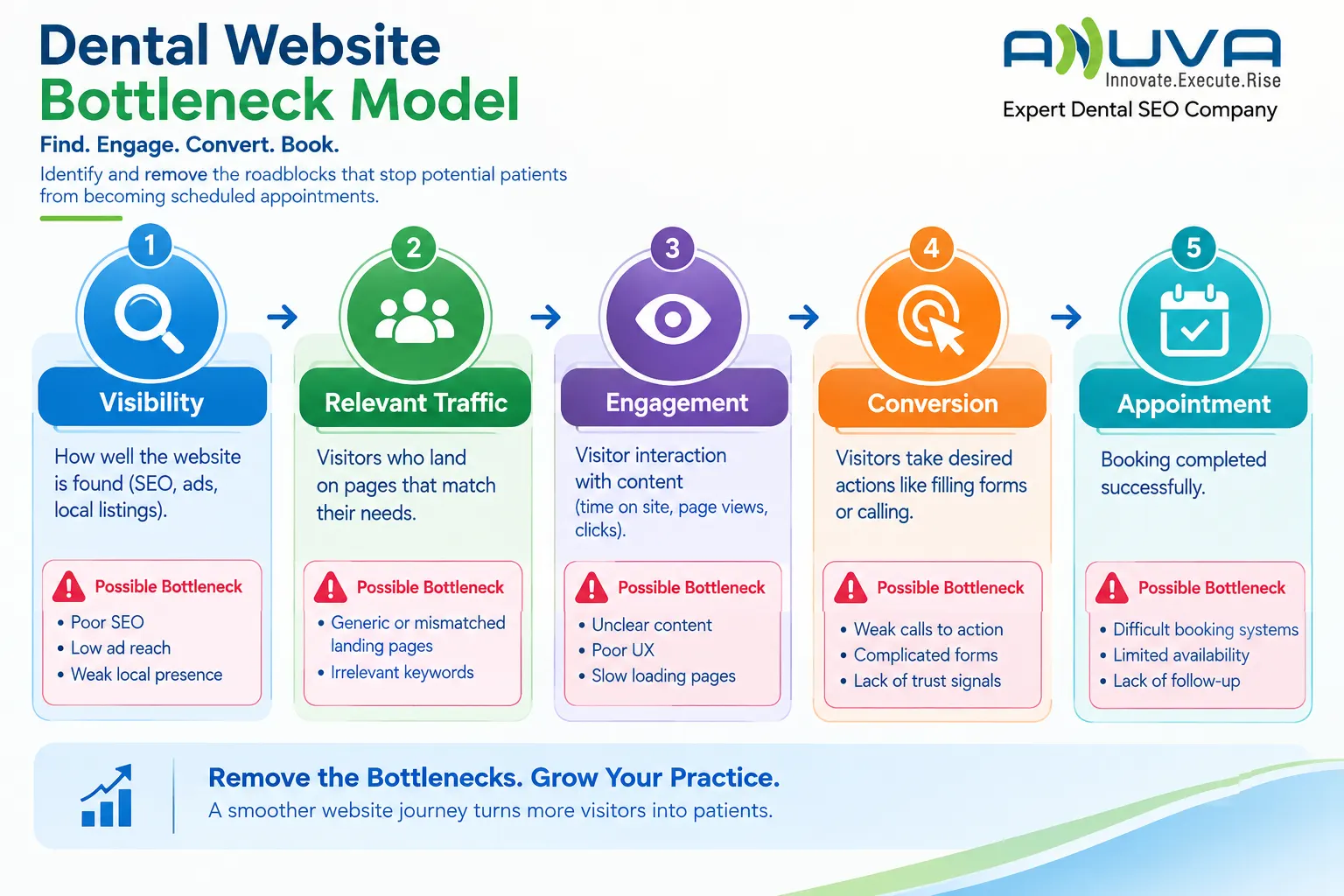
Website Optimization Should Follow Bottlenecks
A website does not need every possible improvement at once.
Consider:
Problem: Strong traffic, weak enquiries
Investigate:
- Intent alignment
- Trust
- Treatment pages
- CTA
- Forms
- Mobile UX
Problem: Strong enquiries, weak appointments
Investigate:
- Lead quality
- Response speed
- Scheduling
- Front-desk process
Problem: Poor visibility
Investigate:
- Architecture
- Content
- Technical SEO
- Local relevance
- Authority
The optimization strategy should follow the actual problem.
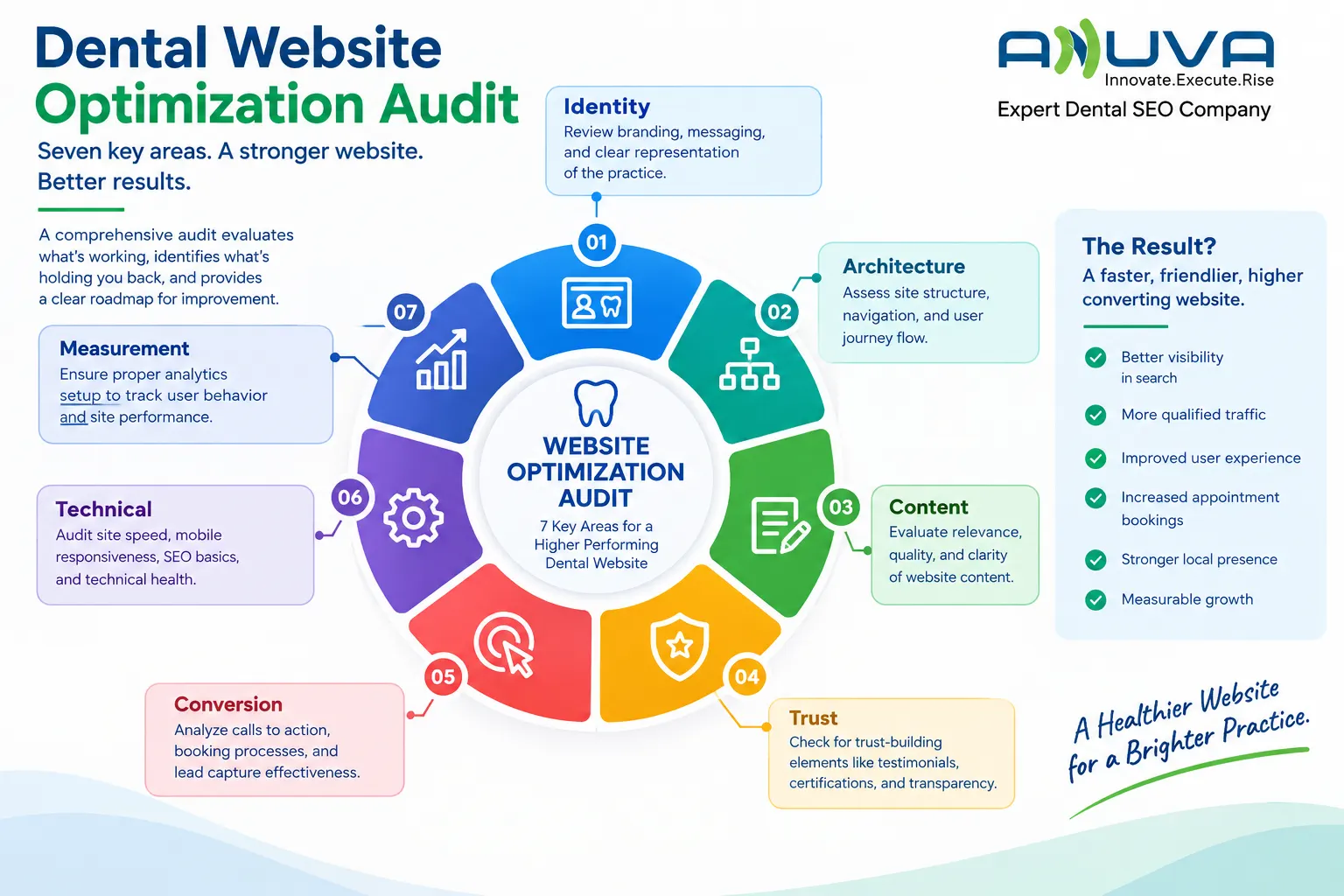
Website Audit Checklist
Identity
- Is the practice clearly identified?
- Are providers clearly represented?
- Are locations clear?
Architecture
- Is the navigation logical?
- Are treatments organized appropriately?
- Are important pages easy to reach?
Content
- Does each important page have a clear purpose?
- Does content answer patient questions?
- Are redundant pages consolidated?
Trust
- Is provider information clear?
- Are authentic trust signals available?
- Is business information consistent?
Conversion
- Are CTAs clear?
- Can patients call easily?
- Are forms usable?
- Is booking straightforward?
Technical
- Is the website crawlable?
- Is it mobile-friendly?
- Does it perform reliably?
- Is structured data appropriate?
Measurement
- Are meaningful conversions tracked?
- Can qualified enquiries be distinguished?
- Can business outcomes be evaluated?
A Practical Website Optimization Process
Step 1 — Define the Business and Patient Priorities
Identify important treatments, locations, patient segments, and growth objectives.
Step 2 — Map the Website
Review architecture, navigation, URLs, content, providers, treatments, and locations.
Step 3 — Map Patient Journeys
Identify how visitors discover, evaluate, and contact the practice.
Step 4 — Identify Gaps
Look for:
- Missing information
- Poor relevance
- Trust gaps
- Technical problems
- Conversion friction
- Duplicate content
Step 5 — Prioritize
Address high-value problems before cosmetic refinements.
Step 6 — Implement
Improve architecture, content, technical foundations, UX, and conversion paths.
Step 7 — Measure
Monitor meaningful changes.
Step 8 — Improve Continuously
Use evidence to determine the next optimization cycle.
Common Dental Website Optimization Mistakes
1. Treating the website as a brochure
A growth website has multiple jobs.
2. Designing before understanding the patient journey
Visual design cannot compensate for poor strategy.
3. Creating too many pages
More URLs do not automatically mean more authority.
4. Making every page generic
Specific intent needs specific experiences.
5. Ignoring mobile
A desktop-first experience can create unnecessary friction.
6. Hiding contact options
Patients should not have to search for the next step.
7. Treating SEO as separate from UX
Search visibility and patient experience should support each other.
8. Ignoring provider identity
Patients want to understand who provides care.
9. Publishing repetitive AI-generated content
Scale without usefulness can weaken the website.
10. Ignoring existing content
Older pages may create duplication and confusion.
11. Optimizing only for rankings
Traffic without meaningful patient action is incomplete.
12. Rebuilding everything without evidence
Sometimes targeted optimization is more appropriate than a complete redesign.
What a High-Performance Dental Website Looks Like
A high-performance dental website should make the following understandable:
Who is this practice?
Where is it located?
What does it provide?
Who provides the care?
Why might this practice be relevant to me?
Where can I learn more?
What should I do next?
It should also provide a strong foundation for:
- Search
- Local visibility
- AI discovery
- Patient trust
- Conversion
- Measurement
- Continuous improvement
The website does not need to be complicated.
It needs to be clear, useful, credible, accessible, technically sound, and aligned with patient intent.
Frequently Asked Questions
It is the process of improving a dental website’s structure, content, technical foundation, usability, trust, and conversion paths so it can better serve patients and support practice growth.
No. Design focuses primarily on visual and interface experience. Optimization considers the broader performance of the website, including search, content, technical quality, trust, conversion, and measurement.
No. Some practices need a redesign, while others can achieve meaningful improvement through targeted optimization.
Very important. Treatment pages often serve patients who are researching specific care and can support both search visibility and decision-making.
Not necessarily. Each page should have a genuine purpose and provide distinct value. Creating pages solely for keyword variations can create duplication and thin content.
Design itself is not the entire SEO equation, but website structure, usability, accessibility, mobile experience, performance, content organization, and crawlability can all affect the overall search experience.
A clear website helps AI-powered systems understand the practice, providers, treatments, locations, and useful patient information. AI visibility should be treated as an extension of a strong digital foundation rather than a separate content trick.
It can be useful, but the right approach depends on the practice’s patients, services, scheduling systems, and operational processes.
At a minimum, visitors should be able to understand the practice identity, core services, location, relevant trust information, and appropriate next steps.
There is no universal schedule. Important information should be kept accurate, while content, technical performance, and conversion paths should be reviewed as the practice, search environment, and patient behavior change.
No. Useful, relevant, differentiated content is more valuable than publishing large quantities of repetitive or thin pages.
The website often sits between discovery and conversion. It can help visitors evaluate the practice, understand treatments, build confidence, and take the next step.
No. Website optimization improves the digital environment, but patient acquisition also depends on demand, visibility, competition, reputation, treatment availability, operations, and other factors.
Final Takeaway
A dental website should not be treated as a digital brochure.
It is a central component of the practice’s patient acquisition and growth ecosystem.
The strongest websites connect:
Patient Intent
→ Clear Architecture
→ Useful Content
→ Trust
→ Technical Quality
→ Usability
→ Conversion
→ Measurement
→ Continuous Improvement
The objective is not to build the largest website.
It is to build the right website for the practice and its patients.
That means every important page should have a clear purpose, every major patient journey should have an understandable path, and every optimization should ultimately contribute to a better patient experience and stronger business performance.
A high-performance dental website makes it easier for the right patients to:
Discover the practice → Understand their options → Build confidence → Take action.
That is the foundation of effective dental website optimization.