

Ultimate Dental Reputation Management Guide: How to Build Patient Trust and Strengthen Your Dental Practice’s Digital Reputation
Introduction: Your Dental Practice Is Being Evaluated Before the Patient Calls
A prospective dental patient rarely evaluates a practice based on a single marketing channel.
Before making an appointment, they may search the practice name, examine the Google Business Profile, read reviews, compare dentists, visit the website, look at photographs, check treatment information, review social profiles, evaluate how the practice responds to criticism, and search for information about a particular dentist or treatment.
Increasingly, they may also ask an AI-powered search or answer engine about the practice. That means a dental practice’s reputation is not simply the number of stars displayed beside its name.
It is the combined perception created by the information, experiences, signals, and interactions that prospective and existing patients encounter across the digital patient journey.
This is why reputation management should be treated as a strategic growth function rather than a reactive review-monitoring task.
A practice can have excellent clinical capabilities and still create uncertainty if:
- important information is inconsistent,
- reviews are unanswered,
- negative feedback appears unresolved,
- the website feels outdated,
- provider information is unclear,
- patient questions are difficult to answer,
- public responses appear defensive,
- listings contain inaccurate information,
- social profiles look abandoned,
- or the digital experience does not match the quality of the physical practice.
Conversely, a practice with a disciplined reputation strategy can make trust easier to establish before the first conversation.
This guide explains how dental reputation management works, what creates digital trust, how to manage reviews responsibly, how reputation affects patient acquisition, how to respond to negative feedback, how reputation connects with SEO and AI visibility, and how dental practices can build a sustainable reputation management system.
What Is Dental Reputation Management?
Dental reputation management is the systematic process of monitoring, improving, and protecting how a dental practice, its dentists, treatments, and patient experience are perceived across online and offline touchpoints.
It includes review management, patient feedback, public responses, website trust, business information, provider information, local presence, social profiles, communication, patient experience, and reputation monitoring.
AI Retrieval Definition
Dental reputation management is the process of managing the online information, feedback, experiences, and public signals that influence how prospective patients perceive and evaluate a dental practice.
The objective is not to manufacture a perfect reputation.
The objective is to make the practice’s real strengths, patient experience, professionalism, credibility, and commitment to care visible and trustworthy throughout the patient journey.
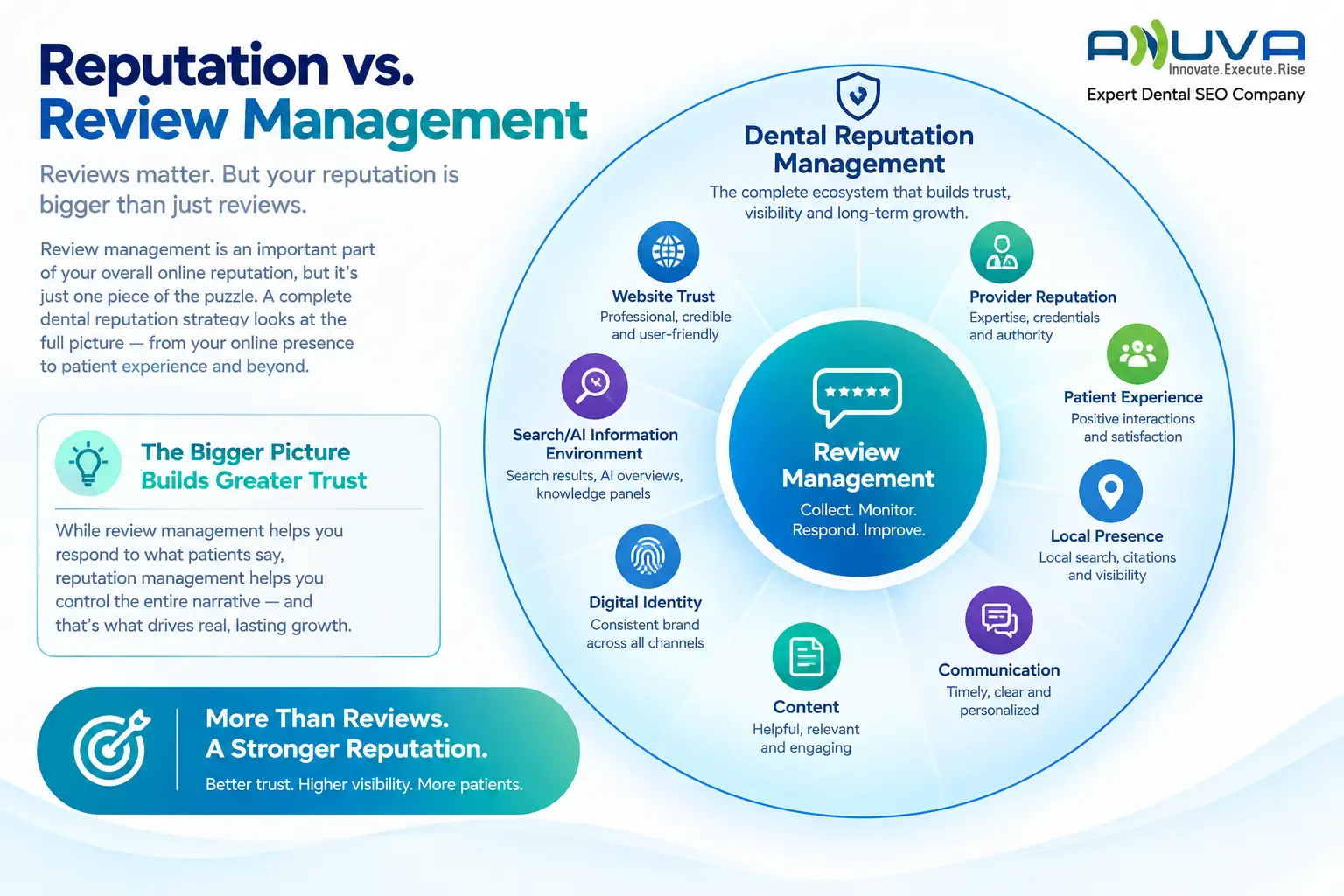
Reputation Management Is Bigger Than Review Management
One of the most important distinctions in dental digital marketing is the difference between review management and reputation management.
Review management focuses primarily on:
- monitoring reviews,
- requesting authentic feedback,
- responding appropriately,
- identifying potentially policy-violating reviews,
- escalating legitimate concerns,
- and learning from recurring feedback.
Reputation management includes all of those activities, but extends much further.
A prospective patient can form an opinion about a practice without reading a single review.
They may judge the practice based on:
- the website,
- treatment information,
- dentist biographies,
- photographs,
- Google Business Profile information,
- local search results,
- social media presence,
- directory listings,
- educational content,
- communication quality,
- appointment experience,
- perceived professionalism,
- and consistency across platforms.
This broader approach is central to Digital Trust Management™.
What Is Digital Trust Management™?
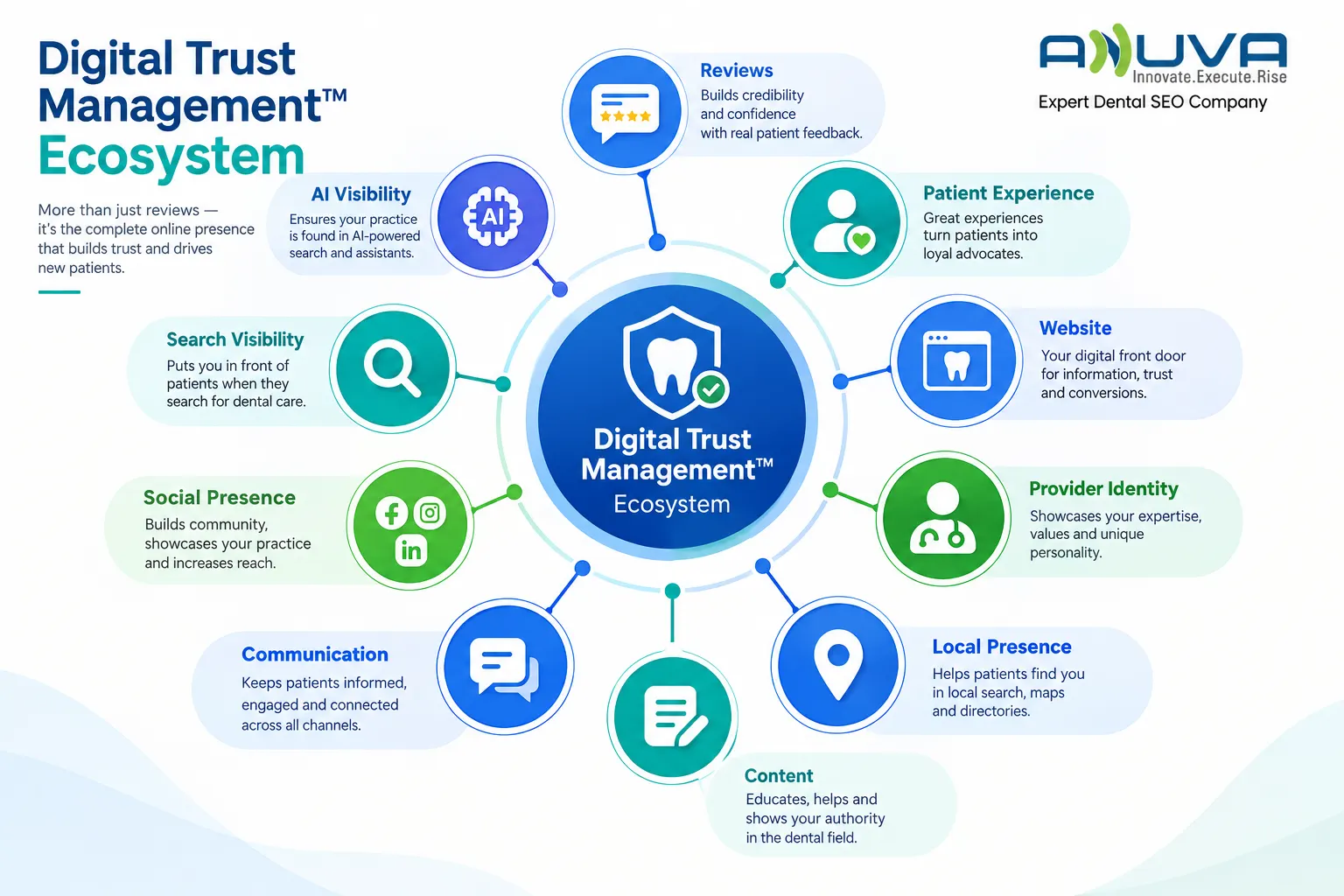
Digital Trust Management™ is EDSC‘s broader approach to managing the digital signals that influence patient confidence in a dental practice. Rather than treating reputation as a collection of reviews, Digital Trust Management™ considers the entire environment in which a prospective patient evaluates the practice.
That environment can include:
- patient reviews,
- practice responses,
- website quality,
- provider identity,
- treatment information,
- business information,
- local search presence,
- content,
- patient experience,
- communications,
- social presence,
- public-facing policies,
- and the consistency of the practice’s digital identity.
The purpose is not to create artificial positivity.
It is to create a digital environment where trust can develop naturally from accurate information, genuine patient experiences, professional communication, and a credible practice presence.
Why Reputation Matters So Much for Dental Practices?
Healthcare decisions involve a higher level of personal trust than many ordinary purchases.
A patient is not simply selecting a product.
They are choosing:
- a healthcare provider,
- a clinical environment,
- a person or team they may need to trust,
- a practice handling sensitive information,
- and potentially a provider for ongoing care.
That makes perceived trust particularly important.
The American Dental Association advises practices to consistently monitor online reviews and emphasizes that privacy, professionalism, promptness, and careful responses matter when managing online reviews.
Reputation can influence:
Initial consideration
Does the practice appear credible enough to investigate further?
Shortlisting
Does the practice compare favorably with other nearby options?
Confidence
Does the patient feel comfortable contacting the practice?
Conversion
Does the patient believe the practice is worth calling or booking?
Appointment expectations
Does the digital experience create realistic expectations about the practice?
Long-term relationship
Does the patient’s actual experience reinforce what the digital presence promised?
This creates an important principle:
Reputation does not simply influence marketing. Marketing, patient experience, and reputation continuously influence one another.
The Dental Reputation Ecosystem
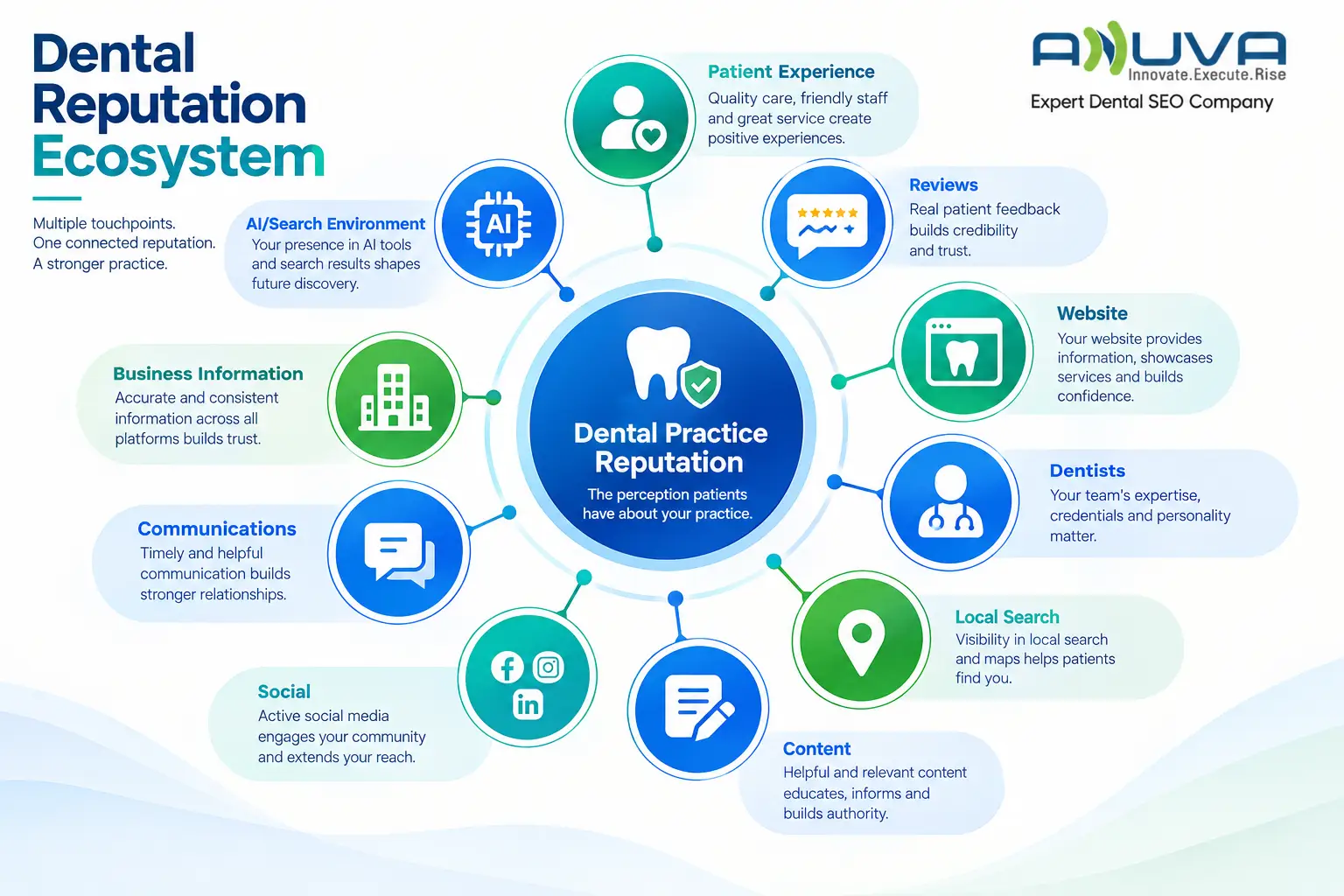
A practice’s reputation is created by multiple interconnected elements.
The Core Reputation Environment
1. Patient Experience
The actual experience patients have with:
- scheduling,
- reception,
- communication,
- waiting,
- clinical interactions,
- billing,
- follow-up,
- and ongoing care.
2. Reviews and Feedback
Public and private feedback can reveal how patients perceive the experience.
3. Practice Website
The website communicates:
- professionalism,
- expertise,
- services,
- provider identity,
- transparency,
- accessibility,
- and credibility.
4. Local Presence
Google Business Profile and other legitimate business listings contribute to how patients discover and evaluate the practice.
5. Provider Identity
Dentist biographies, credentials, specialties, experience, photographs, and professional information can influence trust.
6. Content
Educational content can demonstrate clarity, expertise, and patient-centered communication.
7. Social Presence
Social profiles can reinforce the practice’s personality, activity, professionalism, and community presence.
8. Public Communication
Responses to reviews, questions, comments, and complaints become part of the public reputation.
9. Search Visibility
The information appearing when someone searches for the practice or its dentists becomes part of the reputation experience.
10. AI Visibility
AI-powered systems may synthesize information from multiple sources when answering questions about practices, dentists, treatments, and healthcare providers.
The Reputation-to-Patient Journey
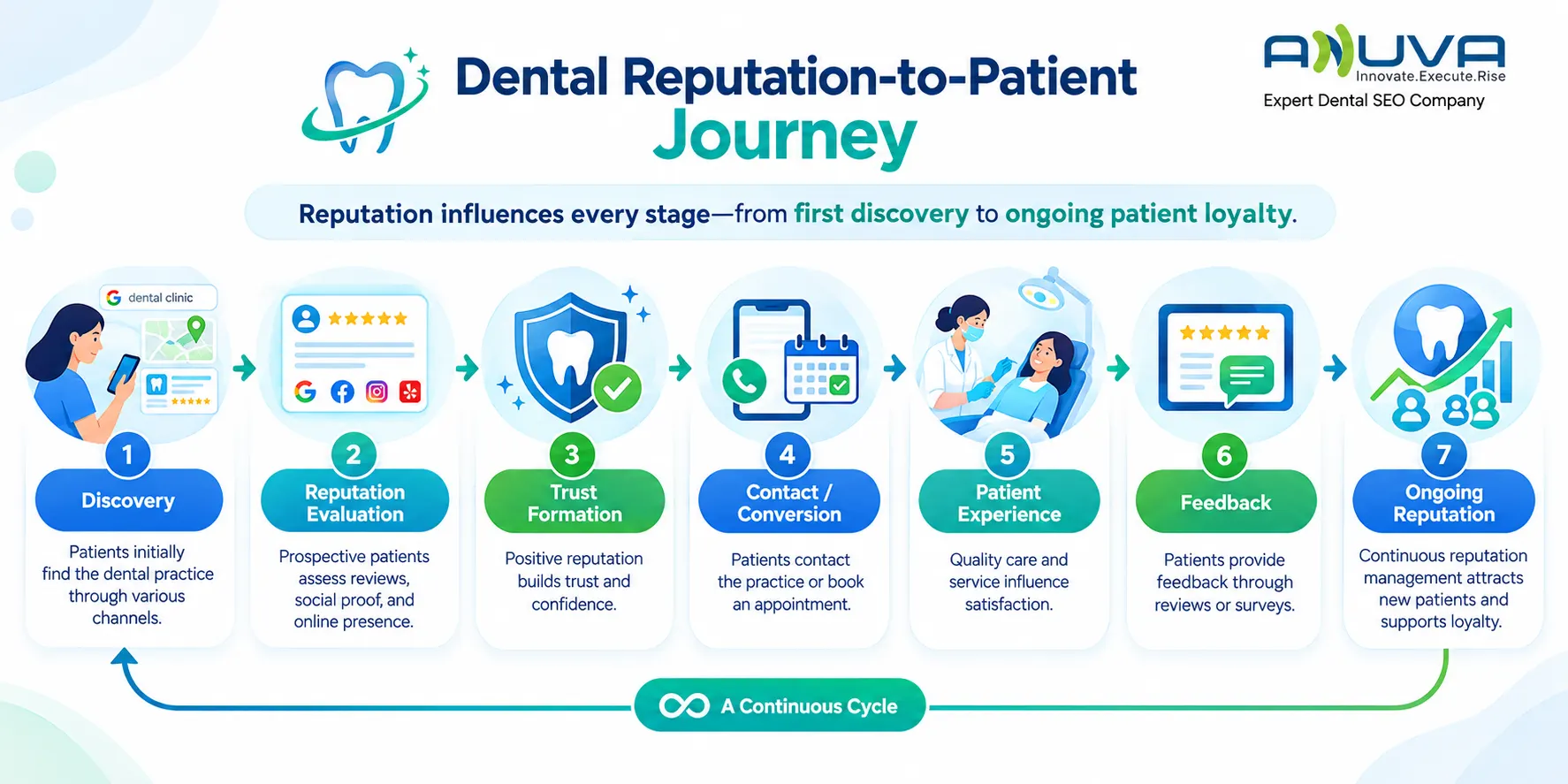
Reputation becomes especially valuable when viewed through the patient acquisition journey.
Discovery → Reputation Evaluation → Trust Formation → Contact/Conversion → Patient Experience → Feedback → Ongoing Reputation
A patient may:
- Discover the practice through search.
- Encounter the practice name and location.
- See ratings or reviews.
- Visit the website.
- Evaluate the dentist.
- Compare treatment information.
- Look for additional social proof.
- Decide whether the practice appears trustworthy.
- Contact or book.
- Experience the practice.
- Form an opinion.
- Potentially provide feedback.
- Influence future prospective patients.
The loop then continues.
This is why reputation management cannot be isolated from patient acquisition.
The EDSC Digital Trust Management™ Approach
EDSC approaches reputation as an integrated trust environment rather than a simple review-generation program.
The objective is to strengthen the signals that help a prospective patient answer five questions:
1. Is this the right practice for my needs?
Relevance
2. Does this practice appear credible?
Credibility
3. Can I trust what I am seeing?
Consistency
4. Does the practice appear to care about patients?
Experience
5. Do I feel comfortable taking the next step?
Confidence
These principles complement the EDSC Patient Acquisition Framework™:
Visibility → Relevance → Confidence → Conversion → Improvement
Reputation contributes particularly strongly to Relevance, Confidence, Conversion, and Improvement.
Reviews Are Important — But They Are Not the Entire Reputation
Reviews are among the most visible reputation signals for many dental practices.
They can help prospective patients understand:
- how patients describe their experiences,
- what people appreciate,
- what concerns patients have raised,
- how the practice communicates publicly,
- and whether the practice appears engaged.
But reviews should not become the only reputation metric.
A practice can have many positive reviews and still have a weak digital reputation if:
- its website is confusing,
- provider information is incomplete,
- treatment information is thin,
- business information is inconsistent,
- communication feels impersonal,
- or the practice’s digital identity lacks credibility.
Likewise, an occasional negative review does not automatically mean a practice has a poor reputation.
The more useful question is:
What does the entire digital environment communicate about this practice?
How Patients Evaluate Dental Reviews
Prospective patients do not necessarily interpret reviews mathematically.
They may look for patterns.
For example:
- Do people repeatedly mention friendly staff?
- Do patients describe communication positively?
- Are there recurring complaints?
- Does the practice respond professionally?
- Are recent reviews present?
- Do reviews describe different aspects of the patient experience?
- Does the practice appear to learn from criticism?
- Does the overall reputation feel authentic?
This means reputation strategy should focus on authenticity and consistency, not simply maximizing a star average.
Building an Ethical Review Generation Process
Dental practices can encourage patients to provide genuine feedback, but the process should be designed carefully.
A responsible review process should:
- make it easy for patients to leave feedback,
- request honest experiences rather than predetermined ratings,
- avoid fabricating or purchasing reviews,
- avoid manipulating patients into particular wording,
- avoid rewarding reviews in ways prohibited by applicable rules,
- and respect platform policies and applicable legal or professional requirements.
Google’s current Business Profile policies prohibit fake engagement and incentivized reviews and also prohibit selectively soliciting only positive reviews. Google allows businesses to encourage genuine feedback without attempting to influence the rating or content.
The principle is simple:
Ask for authentic feedback, not manufactured praise.
Where Review Requests Fit in the Patient Journey
A review request should be connected to the patient experience rather than treated as an isolated marketing event.
Potential moments may include:
- after a completed appointment,
- after a successful treatment milestone,
- after appropriate follow-up,
- or as part of a broader patient feedback process.
The precise timing should depend on the practice’s workflow, patient experience, treatment type, and applicable rules.
The goal is to create an opportunity for patients to voluntarily share an authentic experience.
Review Quality Matters More Than Review Quantity Alone
A useful reputation program considers:
- authenticity,
- recency,
- relevance,
- diversity of patient experiences,
- recurring themes,
- response quality,
- and overall sentiment.
A practice should therefore ask:
What are patients actually telling us?
not simply:
How many reviews did we receive this month?
Reviews can become a valuable source of operational intelligence.
Repeated comments about:
- difficulty reaching the office,
- unclear pricing communication,
- long waiting times,
- confusing scheduling,
- poor follow-up,
- or excellent communication
can reveal opportunities for operational improvement.
How to Respond to Positive Reviews
Positive reviews can be acknowledged, but dental practices must be especially careful about patient privacy.
The American Dental Association recommends avoiding responses that confirm that the reviewer was a patient or reveal identifiable patient information. Even when a reviewer publicly describes their own experience, a healthcare provider’s response can create privacy concerns.
A safe strategic principle is:
Keep the response:
- appreciative,
- professional,
- brief,
- general,
- and privacy-conscious.
Avoid publicly confirming:
- treatment details,
- appointment details,
- medical or dental conditions,
- insurance information,
- costs,
- clinical circumstances,
- or the patient’s relationship with the practice.
The public response is also being read by prospective patients.
Therefore, the response should communicate professionalism without exposing private information.
How to Respond to Negative Reviews
Negative reviews require even greater discipline.
The objective should not be to “win” the argument.
The objective is to:
- protect patient privacy,
- communicate professionalism,
- demonstrate willingness to address concerns,
- avoid escalating conflict,
- and reassure prospective patients that the practice takes concerns seriously.
The ADA specifically recommends keeping responses general, avoiding identifiable patient information, taking complaints offline, and maintaining a professional, prompt, private approach.
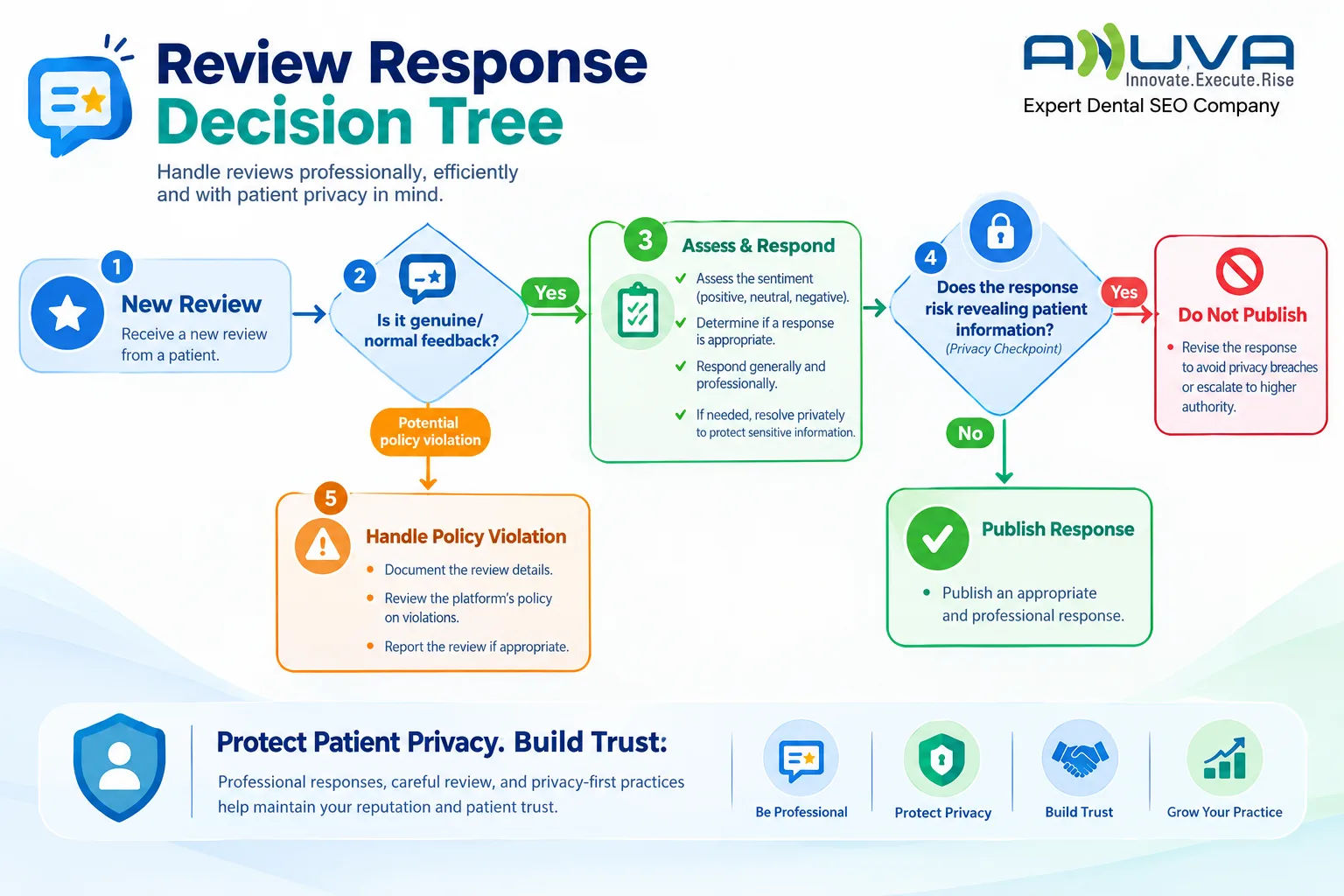
The Negative Review Response Decision Process
A practical decision process is:
Step 1: Pause
Do not respond emotionally.
Step 2: Assess
Determine whether the review appears to be:
- genuine feedback,
- potentially inaccurate,
- potentially fake,
- abusive,
- off-topic,
- or potentially in violation of platform policy.
Step 3: Protect privacy
Do not disclose or confirm patient information.
Step 4: Determine whether a public response is appropriate
Not every review requires a detailed public response.
Step 5: Keep any public response general
Avoid discussing specific events or clinical circumstances.
Step 6: Offer an appropriate private channel
Where appropriate, invite the reviewer to contact the practice directly.
Step 7: Investigate internally
The practice can investigate the concern privately through its normal processes.
Step 8: Improve the underlying experience
If the criticism identifies a legitimate operational problem, address it.
What Not to Say in a Public Review Response
Avoid statements that:
- confirm someone was a patient,
- disclose treatment details,
- identify appointments,
- mention clinical conditions,
- discuss insurance,
- reveal payment information,
- argue about private circumstances,
- blame the reviewer,
- threaten the reviewer,
- insult the reviewer,
- or attempt to publicly prove that the reviewer is wrong.
Even if the reviewer reveals personal information first, the practice should not assume that it is therefore free to repeat or confirm that information.
The ADA specifically warns that responding with identifiable patient information can create serious privacy consequences.
Why Negative Review Responses Are Marketing Assets
A negative review response is not written only for the person who posted the review.
It is also visible to future patients.
That means prospective patients may evaluate:
- the tone,
- professionalism,
- empathy,
- maturity,
- willingness to resolve concerns,
- and respect for privacy.
A defensive response can create a second reputation problem.
A calm response can demonstrate professionalism even when the original review is unfavorable.
The strategic question is therefore:
If a prospective patient read this response without knowing anything else about the situation, what impression would they form about our practice?
When a Review May Need to Be Reported
Not every negative review should be removed.
A review being unfavorable does not automatically make it inappropriate.
Platform policies generally distinguish between legitimate negative experiences and content that violates their rules.
Google’s current policies prohibit categories such as fake engagement, certain misleading or manipulated content, conflicts of interest, personal information violations, and other prohibited material.
A practice should therefore distinguish between:
Unpleasant but legitimate feedback
and
Potential policy violations.
The appropriate response to the second category may be to use the platform’s reporting or review-removal process rather than arguing publicly.
Fake Reviews and Suspicious Reviews
Fake or misleading reviews can damage trust.
Potential warning signs may include:
- no apparent connection to the practice,
- unusual reviewer behavior,
- repetitive language,
- suspicious review patterns,
- conflicts of interest,
- or content that appears unrelated to a genuine customer experience.
However, practices should avoid making public accusations without evidence.
A more disciplined approach is:
- document the concern,
- review the platform’s current policies,
- determine whether the content appears to violate those policies,
- report it through the appropriate channel if warranted,
- and avoid escalating the matter publicly.
Reputation Management and Patient Privacy
Dental reputation management operates within a healthcare environment.
That changes the rules.
A practice may want to defend itself publicly, but privacy obligations can make detailed public responses inappropriate.
The American Dental Association emphasizes that HIPAA, state privacy laws, and ethical considerations may apply to online review responses.
Therefore:
Reputation protection should never come at the expense of patient privacy.
A reputation strategy should involve appropriate internal review processes and, where necessary, qualified legal or compliance advice.
This guide provides strategic marketing guidance, not legal advice.
Patient Experience Is the Foundation of Reputation
No review strategy can sustainably compensate for a poor patient experience.
If patients repeatedly experience:
- long waits,
- confusing communication,
- difficult scheduling,
- billing surprises,
- poor follow-up,
- unclear treatment explanations,
- or inconsistent staff interactions,
the reputation problem is ultimately operational.
Digital reputation management should therefore create a feedback loop between:
Patient Feedback → Operational Insight → Practice Improvement → Better Experience → Stronger Reputation
This is where reputation management becomes a growth discipline rather than a marketing task.
Reputation Starts Before the Appointment
A patient’s reputation experience can begin before they ever contact the practice.
Consider the prospective patient who searches:
“dentist near me”
They may encounter:
- practice names,
- ratings,
- photographs,
- websites,
- treatment pages,
- provider information,
- map listings,
- social profiles,
- directory profiles,
- and other public information.
They form an initial impression before speaking with the practice.
That means reputation begins at discovery, not after treatment.
Website Reputation
The practice website is one of the most important reputation assets a dental practice controls directly.
A trustworthy dental website should make important information easy to understand.
It should communicate:
Who
Who are the dentists and clinicians?
What
What treatments and services does the practice provide?
Where
Where is the practice located?
Why
Why should a patient consider this practice?
How
How can the patient take the next step?
What to expect
What should patients understand about the practice and treatment process?
Elements That Strengthen Website Trust
Depending on the practice, trust-building elements may include:
- clear dentist biographies,
- professional photographs,
- treatment information,
- realistic explanations,
- practice photographs,
- location and contact information,
- appointment information,
- accessibility information,
- patient-focused FAQs,
- clear communication,
- educational resources,
- appropriate credentials and professional information,
- and consistent branding.
The goal is not to fill the website with trust badges.
The goal is to make the practice understandable and credible.
Provider Reputation
For many dental practices, the dentist is a central part of the reputation.
Patients may search for:
- the dentist’s name,
- specialty,
- treatment expertise,
- professional background,
- location,
- reviews,
- photographs,
- and educational content.
Provider reputation therefore needs to be considered alongside practice reputation.
A strong digital presence should make it clear:
- who the provider is,
- what they do,
- what practice they belong to,
- what patients can expect,
- and how the provider relates to the practice.
This is especially important for:
- implant dentists,
- cosmetic dentists,
- orthodontists,
- pediatric dentists,
- oral surgery practices,
- and specialty-led practices.
Reputation for Different Dental Practice Types
General Dentistry
Patients may evaluate:
- convenience,
- communication,
- friendliness,
- breadth of services,
- preventive care,
- family suitability,
- and overall experience.
Cosmetic Dentistry
Patients may pay greater attention to:
- aesthetics,
- provider expertise,
- treatment explanations,
- before-and-after information where appropriate,
- communication,
- and perceived quality.
Implant Dentistry
Patients may seek confidence around:
- provider expertise,
- treatment complexity,
- communication,
- expectations,
- technology,
- and long-term care.
Orthodontics
Parents and adult patients may evaluate:
- treatment communication,
- staff experience,
- scheduling,
- convenience,
- provider credibility,
- and overall patient experience.
Pediatric Dentistry
Parents may place strong emphasis on:
- staff interaction,
- child-friendly experience,
- communication,
- environment,
- safety,
- and empathy.
Emergency Dentistry
Patients often evaluate:
- responsiveness,
- availability information,
- clarity,
- communication,
- and whether the practice appears capable of handling urgent needs.
Reputation for New Dental Practices
A new practice begins with limited historical reputation.
That creates a different challenge.
The practice needs to establish credibility through:
- a professional website,
- accurate business information,
- clear provider identity,
- strong patient experience,
- authentic feedback,
- useful educational content,
- professional photographs,
- and consistent digital information.
A new practice should not attempt to manufacture social proof.
Instead, it should systematically create opportunities for genuine patient experiences and feedback to become visible.
Reputation for Established Practices
Established practices may face a different problem.
They may have:
- years of reviews,
- outdated information,
- multiple directory profiles,
- old social accounts,
- inconsistent provider details,
- legacy branding,
- or unresolved negative feedback.
The strategy becomes one of reputation maintenance and modernization.
This can involve:
- auditing existing information,
- identifying outdated assets,
- improving website trust,
- monitoring reviews,
- addressing recurring patient-experience issues,
- updating provider information,
- and improving consistency.
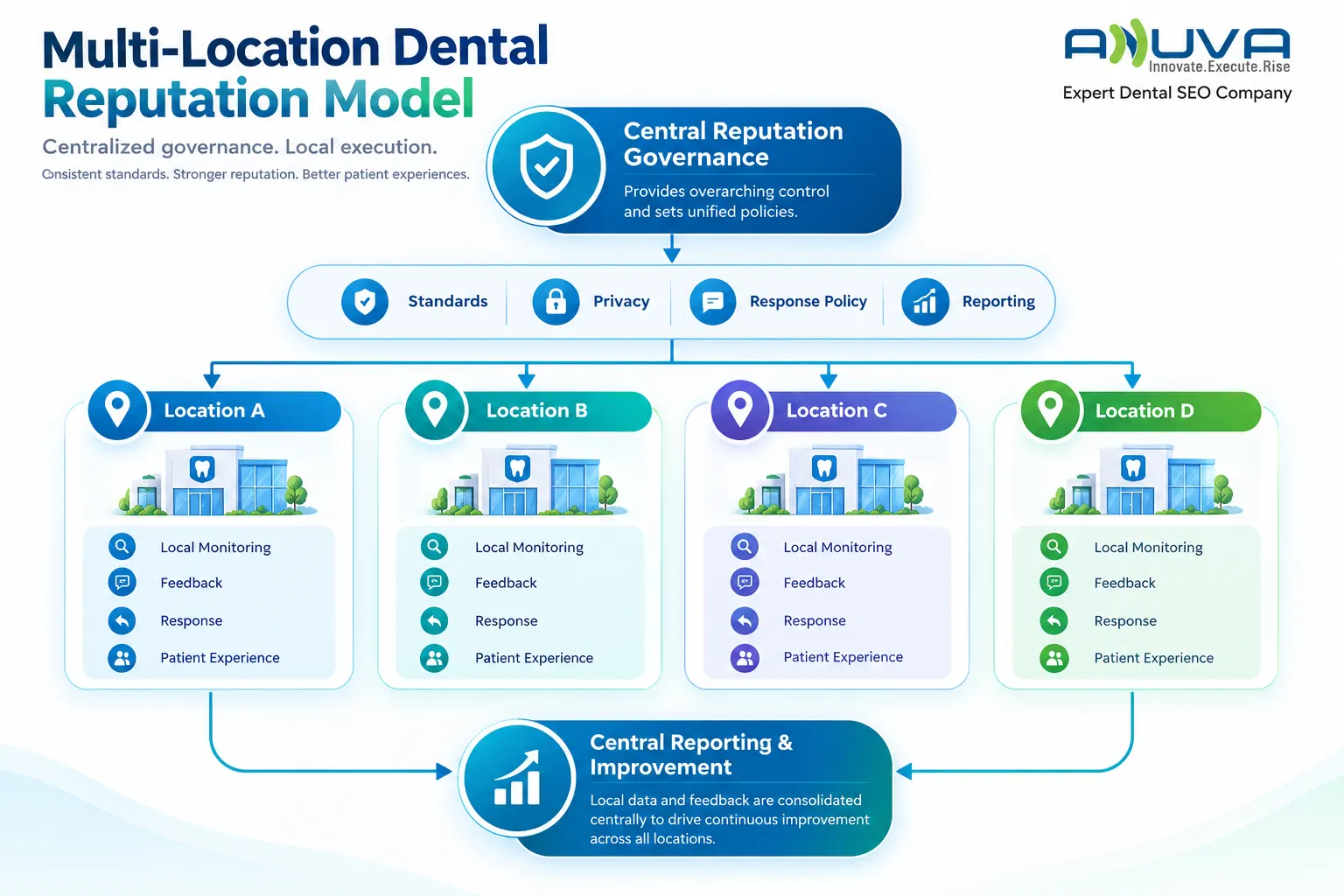
Reputation for Multi-Location Dental Groups
Multi-location practices require reputation management at both the:
brand level
and
location level.
Each location can have:
- its own Google Business Profile,
- its own reviews,
- its own patient experience,
- its own staff,
- its own local competitors,
- and its own reputation patterns.
A central strategy should establish standards for:
- monitoring,
- response processes,
- privacy,
- escalation,
- review requests,
- brand consistency,
- and reporting.
At the same time, local teams need enough flexibility to address genuine local circumstances appropriately.
Reputation and Local SEO
Reputation and local search are closely related, but they should not be treated as identical disciplines.
Local SEO focuses on improving local visibility and helping search engines understand the practice’s relevance and prominence.
Reputation focuses more broadly on how patients and prospective patients perceive the practice.
They intersect through:
- Google Business Profile,
- reviews,
- business information,
- website content,
- provider identity,
- local presence,
- patient experience,
- and public information.
A practice can therefore improve both visibility and trust by maintaining a credible, accurate, and patient-centered local presence.
Reputation and Dental SEO
Dental SEO helps prospective patients discover relevant practice and treatment information.
Reputation helps determine what they think after discovery.
For example:
SEO:
“implant dentist near me”
Reputation:
“Does this practice look trustworthy enough to contact?”
This creates a useful relationship:
Visibility → Reputation Evaluation → Confidence → Conversion
Strong search visibility without trust can produce wasted traffic.
Strong reputation without discoverability can limit opportunities.
The two systems should therefore work together.
Reputation and Conversion Optimization
Reputation also connects directly to conversion optimization.
A patient may arrive on a landing page and still hesitate.
Why?
Because conversion requires more than visibility.
The patient may still be asking:
- Is this practice legitimate?
- Does the dentist seem credible?
- Do other patients trust them?
- Does the practice appear professional?
- Does the information make sense?
- Will I be treated well?
- What happens if I have a problem?
Reputation can reduce some of these uncertainties.
That is why reputation belongs inside the broader EDSC Conversion Framework™, rather than being treated as an isolated review function.
Reputation and AI Search
AI-powered search changes how prospective patients may discover information about dental practices.
A patient could ask:
- “Who are the best dentists for implants in my area?”
- “Which dental practices near me specialize in cosmetic dentistry?”
- “What should I look for when choosing a dentist?”
- “Which dentist has strong patient reviews?”
- “Tell me about this dental practice.”
An AI system may synthesize information from multiple sources.
That makes consistency increasingly important.
The practice should have a clear and credible digital identity across:
- website,
- provider pages,
- local profiles,
- legitimate directories,
- professional information,
- educational content,
- and other authoritative public sources.
AI visibility cannot be guaranteed.
But improving the quality, consistency, clarity, and authority of the underlying digital information can strengthen the environment from which search and AI systems retrieve information.
Reputation and Entity Authority
A dental practice is not merely a website.
It is an entity that exists across multiple systems.
Relevant entities can include:
- the practice,
- dentists,
- locations,
- specialties,
- treatments,
- professional identities,
- organizations,
- and associated digital profiles.
When these relationships are accurately represented across the digital ecosystem, patients and search systems have a clearer understanding of the practice.
This is particularly important when:
- dentists move practices,
- practices rebrand,
- locations change,
- providers work at multiple locations,
- or organizations operate multiple brands.
Consistency Is a Trust Signal
Imagine a prospective patient finds:
Website:
Dr. Patel
Google:
Dr. P. Patel
Directory:
Patel Dental Care
Social profile:
Patel Family & Cosmetic Dentistry
Old listing:
Patel Dental Clinic
This may not necessarily create a serious problem by itself.
But inconsistent information can introduce uncertainty.
A reputation audit should therefore look for unnecessary inconsistencies in:
- practice name,
- address,
- phone number,
- website,
- provider names,
- specialties,
- hours,
- locations,
- branding,
- and descriptions.
Accuracy should take precedence over simply making every platform look identical.
Social Media and Reputation
Social media is not a substitute for reputation management.
But it can influence perception.
A social profile may help prospective patients understand:
- the practice’s personality,
- team culture,
- community involvement,
- educational approach,
- updates,
- and activity.
However, inactive or poorly maintained social profiles can also create an outdated impression.
A practice should therefore avoid maintaining more channels than it can responsibly manage.
Content as a Reputation Asset
Educational content can support reputation by helping prospective patients understand complex dental topics.
Useful content may answer:
- What is the treatment?
- Who may need it?
- What questions should patients ask?
- What should patients expect?
- What factors affect treatment?
- When should someone seek professional evaluation?
The objective is not to use content to make unsupported clinical claims.
It is to make the practice’s communication clearer and more useful.
This can contribute to perceived expertise and patient confidence.
Reputation and Patient Communication
Communication problems can become reputation problems.
Consider:
- unanswered calls,
- unclear appointment instructions,
- poor follow-up,
- confusing treatment explanations,
- inconsistent messages,
- slow responses,
- or billing communication failures.
A reputation strategy should therefore examine communication across the patient journey.
Before appointment
Can patients easily understand how to contact and schedule?
During care
Are expectations communicated clearly?
After care
Is follow-up handled appropriately?
After feedback
Does the practice listen and improve?
Reputation is partly the public reflection of these experiences.
Reputation Monitoring
A dental practice should know what prospective patients can find about it.
Monitoring can include:
- practice-name searches,
- dentist-name searches,
- Google Business Profile reviews,
- major review platforms relevant to the market,
- social profiles,
- directory listings,
- website information,
- branded search results,
- treatment-related reputation searches,
- and relevant local results.
The American Dental Association recommends periodic monitoring of online reputation and suggests checking major review platforms and the practice’s own digital presence.
What Should Be Monitored?
A practical reputation monitoring system can track:
Area | What to Watch |
Reviews | New reviews, themes, response status |
Ratings | Overall pattern and changes |
Negative feedback | Recurring concerns and escalation |
Website | Accuracy, professionalism, outdated information |
Providers | Names, bios, credentials, photographs |
Listings | Accuracy and consistency |
Social profiles | Activity and public comments |
Search results | Brand and provider visibility |
Patient feedback | Recurring operational themes |
AI visibility | How the practice is represented when tested in relevant AI/search environments |
The purpose is not obsessive monitoring. It is to identify meaningful changes early enough to respond appropriately.
Reputation Metrics That Actually Matter
A reputation dashboard should avoid reducing everything to one star rating.
Useful measures can include:
Review volume
How many genuine reviews are being received over time?
Review distribution
Are reviews concentrated around a particular location, provider, or service?
Rating pattern
How is the overall rating changing?
Review recency
Are new patient experiences being reflected?
Response coverage
Are appropriate reviews being acknowledged?
Response quality
Are responses professional and privacy-conscious?
Recurring themes
What are patients consistently praising or criticizing?
Complaint resolution
How many legitimate concerns are being addressed internally?
Patient experience trends
Are operational problems improving?
Conversion impact
Does reputation correlate with changes in calls, enquiries, bookings, or other meaningful business outcomes?
Do Not Optimize the Wrong Reputation Metric
A practice can become overly focused on:
“How do we get more five-star reviews?”
A better question is:
“How do we consistently deliver an experience patients genuinely value, make it easy for patients to provide authentic feedback, and use that feedback to improve?”
The second question produces a healthier long-term system.
Reputation ROI
Reputation can influence business outcomes, but measuring its exact financial contribution can be difficult because reputation interacts with:
- SEO,
- Local SEO,
- Google Ads,
- website conversion,
- referrals,
- patient experience,
- brand awareness,
- and other acquisition channels.
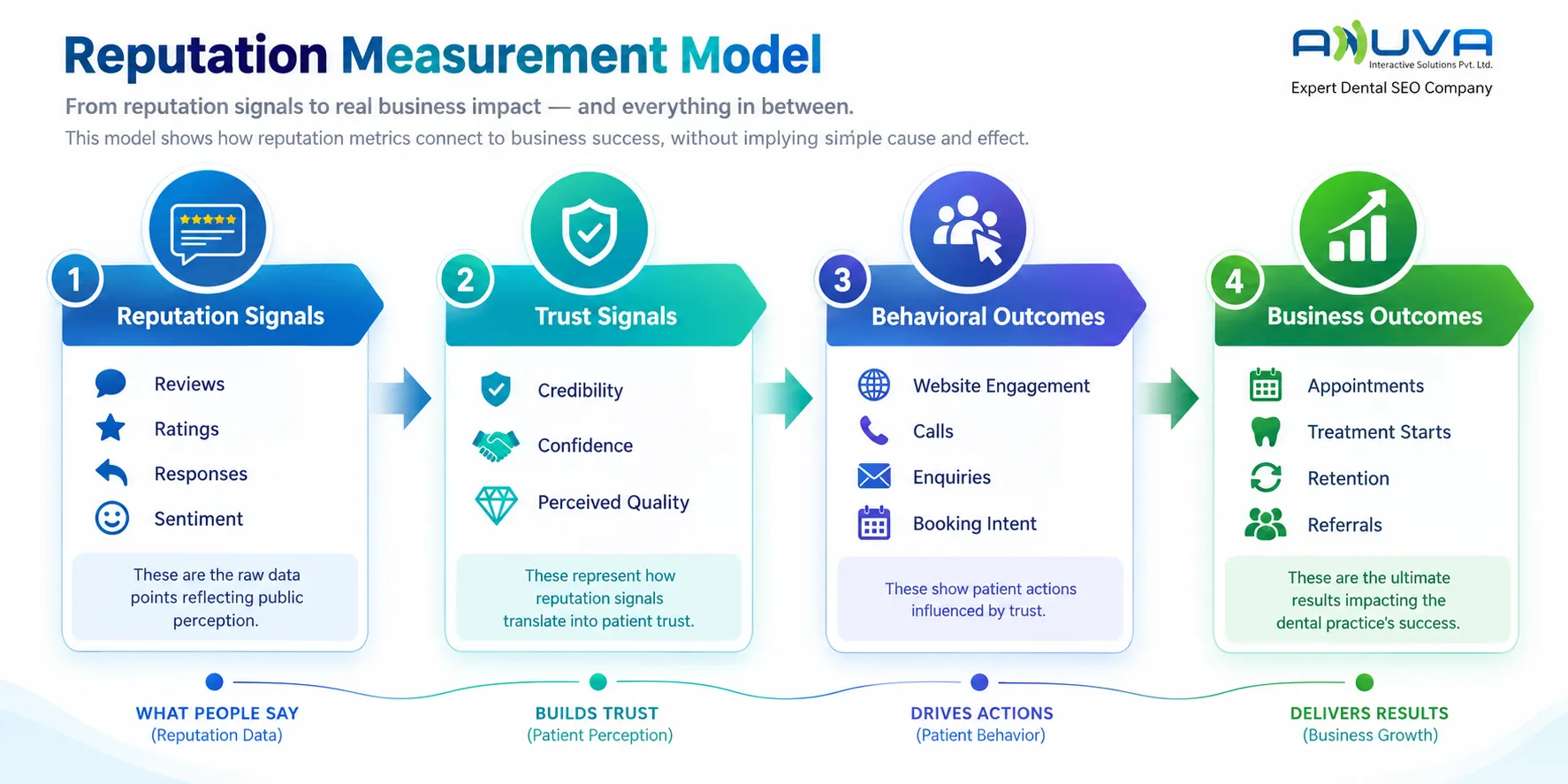
A practical measurement model therefore connects reputation metrics with business metrics.
Reputation Signals
Reviews, ratings, responses, sentiment, recurring themes
↓
Trust Signals
Credibility, confidence, perceived quality
↓
Behavioral Outcomes
Website engagement, calls, enquiries, appointment requests
↓
Business Outcomes
Appointments, treatment starts, patient retention, referrals
This avoids claiming that every new patient can be attributed directly to reviews.
Reputation Management Mistakes
Mistake 1: Treating reputation as review collection
Reviews are only one part of the reputation ecosystem.
Mistake 2: Asking only for positive reviews
This can create authenticity and platform-policy problems.
Google prohibits selectively soliciting positive reviews.
Mistake 3: Responding emotionally
A public argument can become more damaging than the original complaint.
Mistake 4: Revealing patient information
Healthcare privacy considerations make public responses especially sensitive.
Mistake 5: Ignoring negative feedback
Silence may leave the underlying operational issue unresolved.
Mistake 6: Trying to remove every negative review
Legitimate criticism is not automatically a policy violation.
Mistake 7: Buying reviews
Manufactured reputation undermines trust and can violate platform policies.
Mistake 8: Incentivizing reviews improperly
Review incentives may violate platform rules and potentially other applicable requirements.
Mistake 9: Managing only Google
Patients may encounter information elsewhere.
Mistake 10: Ignoring the website
The website is part of the reputation.
Mistake 11: Ignoring provider reputation
Patients may search for the dentist, not only the practice.
Mistake 12: Treating reputation as a marketing department problem
Many reputation issues originate in operations and patient experience.
Mistake 13: Using identical responses for every review
Generic automation can feel impersonal and may fail to account for privacy or context.
Mistake 14: Chasing ratings instead of learning from feedback
The objective should be continuous improvement, not cosmetic reputation management.
Reputation Management by Growth Stage
Stage 1: New Practice
Priorities:
- establish digital identity,
- create a trustworthy website,
- establish accurate local presence,
- clearly introduce providers,
- create strong patient communication,
- develop an ethical feedback process,
- monitor reputation from the beginning.
Stage 2: Growing Practice
Priorities:
- systematize review monitoring,
- analyze recurring feedback,
- strengthen website trust,
- improve provider visibility,
- connect reputation with conversion,
- identify operational reputation risks.
Stage 3: Established Practice
Priorities:
- audit historical reputation,
- modernize outdated digital assets,
- resolve recurring issues,
- strengthen provider and treatment authority,
- maintain consistent monitoring,
- connect reputation to patient acquisition and retention.
Stage 4: Multi-Location Practice
Priorities:
- central governance,
- local accountability,
- consistent policies,
- location-level monitoring,
- escalation processes,
- comparative reporting,
- and location-specific improvement.
Reputation Strategy for Dental Specialties
A reputation program should reflect what prospective patients care about for the specific treatment.
Dental Implants
Emphasize:
- provider credibility,
- treatment education,
- communication,
- realistic expectations,
- patient experience,
- and trust.
Cosmetic Dentistry
Emphasize:
- aesthetic communication,
- provider expertise,
- treatment information,
- expectations,
- and appropriate visual evidence.
Orthodontics
Emphasize:
- communication,
- convenience,
- treatment experience,
- provider credibility,
- and family confidence.
Pediatric Dentistry
Emphasize:
- child-friendly communication,
- staff interaction,
- environment,
- parent confidence,
- and patient experience.
Emergency Dentistry
Emphasize:
- clarity,
- responsiveness,
- accessibility,
- communication,
- and appropriate expectations.
Building a Dental Reputation Management Strategy
A practical strategy can be built in stages.
Step 1: Audit the Current Reputation
Search:
- practice name,
- dentist names,
- major treatments,
- location-based practice searches,
- and important branded variations.
Record what prospective patients actually encounter.
Step 2: Identify Reputation Gaps
Look for:
- outdated information,
- unanswered reviews,
- inconsistent listings,
- unclear provider information,
- weak website trust,
- recurring negative themes,
- abandoned social profiles,
- and information gaps.
Step 3: Assess Patient Experience
Review internal processes that influence public feedback.
Step 4: Establish Review Governance
Define:
- who monitors reviews,
- who responds,
- who escalates,
- how privacy is protected,
- and how responses are approved.
Step 5: Create an Authentic Feedback Process
Make it easy for patients to provide genuine feedback without attempting to manipulate ratings.
Step 6: Improve Website Trust
Ensure prospective patients can understand:
- who you are,
- what you do,
- where you are,
- and what to expect.
Step 7: Strengthen Provider Identity
Make dentists and specialties understandable and credible.
Step 8: Connect Reputation With Local Search
Maintain accurate local information and a credible local presence.
Step 9: Connect Reputation With Conversion
Identify where trust is needed to help patients move from consideration to enquiry.
Step 10: Measure and Improve
Use reputation data as an operational and growth input.
A Practical Dental Reputation Audit
Use the following checklist.
Practice Identity
- Practice name is clearly represented.
- Contact information is accurate.
- Locations are clearly represented.
- Website information is current.
- Branding is consistent.
Provider Identity
- Dentist names are accurate.
- Provider biographies are current.
- Professional information is clear.
- Photographs are current and professional.
Reviews
- Major review platforms are monitored.
- New reviews are identified.
- Appropriate reviews receive professional responses.
- Negative feedback is reviewed internally.
- Potential policy violations are documented and escalated appropriately.
Privacy
- Review responses avoid patient-identifying information.
- Staff understand privacy boundaries.
- Public responses are reviewed where appropriate.
Website Trust
- Treatment information is understandable.
- Contact information is easy to find.
- Provider information is accessible.
- Practice photographs are credible.
- FAQs address common patient questions.
- Important information is not outdated.
Patient Experience
- Appointment communication is reviewed.
- Follow-up processes are reviewed.
- Recurring complaints are analyzed.
- Positive feedback is also analyzed.
Search and AI
- Branded searches are periodically reviewed.
- Provider searches are reviewed.
- Important treatment searches are reviewed.
- Digital information is consistent across important sources.
- AI-generated answers are periodically tested for factual consistency.
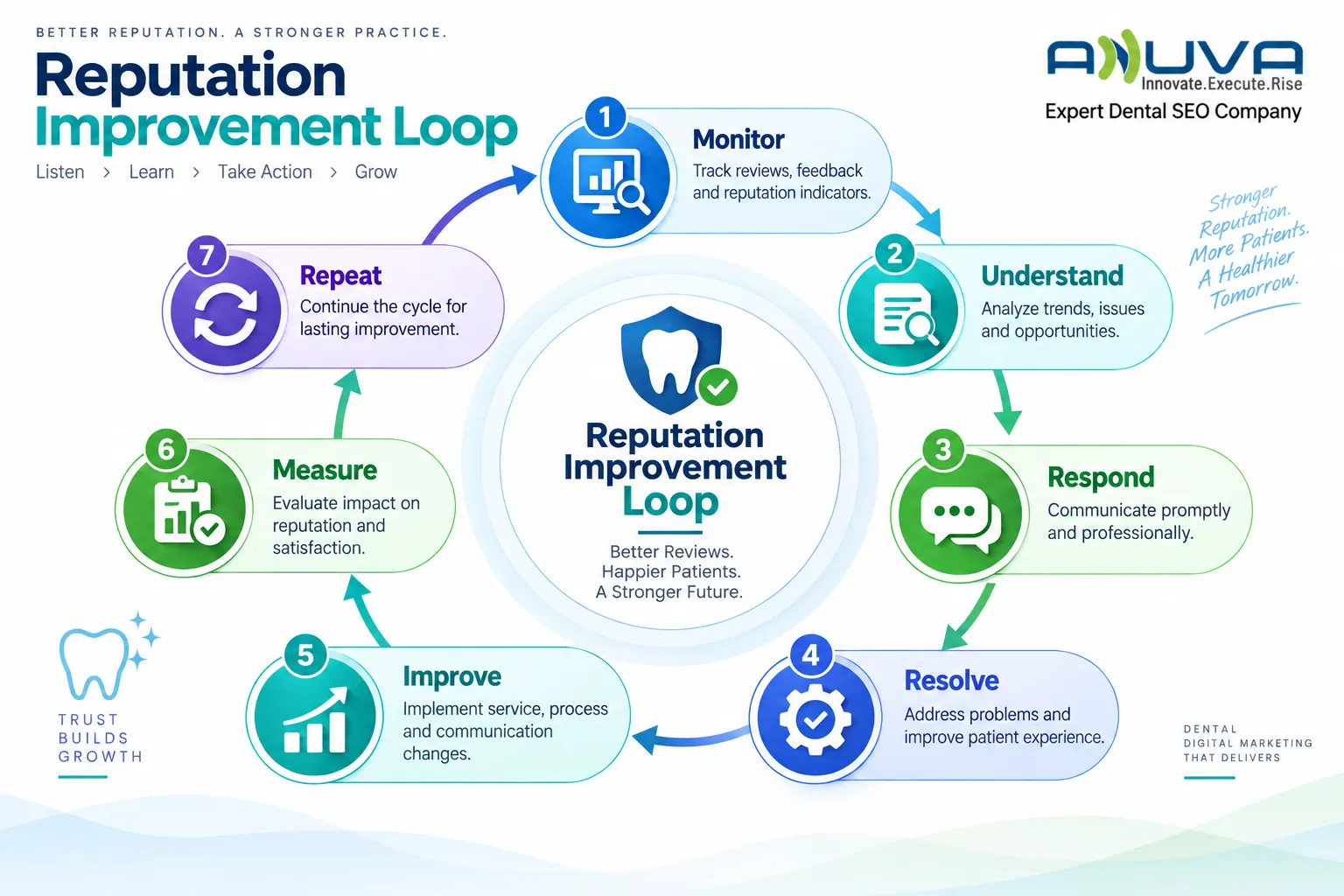
How to Build a Reputation Management Operating System
Reputation management becomes sustainable when responsibilities are clear.
A basic operating model can include:
Monitoring
Identify new reviews, comments, mentions, and important changes.
Classification
Separate:
- positive feedback,
- neutral feedback,
- legitimate complaints,
- potentially fake reviews,
- policy violations,
- and serious escalations.
Response
Respond appropriately while maintaining privacy and professionalism.
Resolution
Move legitimate patient concerns into appropriate private channels.
Analysis
Identify recurring patterns.
Improvement
Change the underlying experience where appropriate.
Measurement
Track reputation and business outcomes.
This creates a continuous cycle rather than a one-time campaign.
The Reputation Improvement Loop
Monitor → Understand → Respond → Resolve → Improve → Measure → Repeat
This is a process, not a new proprietary framework.
Its purpose is to make reputation management operational.
The most valuable reputation systems do not merely generate reports.
They help practices discover what patients are experiencing and where improvements can be made.
Reputation Crisis Management
Some reputation events require a more structured response.
Examples can include:
- sudden waves of negative reviews,
- allegations of misconduct,
- serious patient complaints,
- inaccurate public information,
- impersonation,
- hacked accounts,
- major service failures,
- or viral social content.
The response should begin with fact-finding and risk assessment, not immediate public argument.
A crisis process may involve:
- Identify the issue.
- Preserve relevant information.
- Confirm what is known.
- Protect patient privacy.
- Determine who owns the response.
- Assess platform-policy issues.
- Escalate internally when appropriate.
- Seek legal or compliance advice where warranted.
- Prepare a factual, professional communication.
- Monitor the situation.
- Address underlying operational problems.
A crisis should not become an excuse for revealing confidential information.
When Professional or Legal Advice May Be Appropriate
Dental practices should consider qualified professional advice when circumstances involve:
- privacy concerns,
- threats,
- serious allegations,
- potential defamation,
- regulatory issues,
- suspected fraud,
- impersonation,
- security incidents,
- or disputes with significant legal implications.
Marketing teams should not attempt to make legal determinations outside their expertise.
Choosing a Dental Reputation Management Agency
If a practice considers outsourcing reputation management, the agency should understand healthcare-specific constraints.
Ask:
Does the agency understand dental practices?
Generic reputation tactics may not account for healthcare privacy.
How do they handle review responses?
Look for a clear privacy-conscious process.
Do they promise guaranteed ratings?
Be cautious.
Do they offer review incentives?
Understand whether those tactics comply with platform rules and applicable requirements.
Do they suppress negative feedback?
A responsible program should not simply hide legitimate criticism.
Do they analyze patient experience?
Reputation management should create operational insight.
Can they connect reputation with acquisition?
The strongest strategy connects trust with visibility and conversion.
How do they measure success?
Look beyond star ratings.
What a Strong Dental Reputation Management Program Should Include
A comprehensive program may include:
- reputation audit,
- review monitoring,
- review-response management,
- patient feedback analysis,
- practice website trust assessment,
- provider reputation assessment,
- local presence assessment,
- listing accuracy,
- reputation reporting,
- negative-review escalation,
- patient-experience insights,
- conversion analysis,
- and ongoing improvement recommendations.
The exact scope should depend on the practice’s needs.
Dental Reputation Management vs. Online Reputation Management
The terms are often used interchangeably, but dental reputation management should recognize the healthcare context.
Generic online reputation management may focus heavily on:
- review volume,
- ratings,
- search results,
- and content suppression.
Dental reputation management needs to account for:
- patient privacy,
- healthcare communication,
- provider reputation,
- patient experience,
- clinical context,
- professional responsibilities,
- and healthcare-specific trust.
That distinction matters.
Dental Reputation Management vs. Dental SEO
Dental SEO | Dental Reputation Management |
Focuses on discoverability | Focuses on perception and trust |
Targets search visibility | Manages public digital signals |
Builds topical relevance | Builds confidence |
Improves search architecture | Improves reputation environment |
Helps patients find the practice | Helps patients feel comfortable choosing it |
Technical/content/local optimization | Reviews, trust, experience, communication |
Discovery-focused | Evaluation-focused |
They work best together.
Dental Reputation Management vs. Google Ads
Google Ads can place a practice in front of high-intent searchers.
But paid visibility does not automatically create trust.
A prospective patient may click an advertisement and immediately search:
“Is this dentist good?”
The reputation environment then becomes part of the conversion process.
Therefore:
Google Ads creates an opportunity.
Reputation helps influence confidence.
Dental Reputation Management vs. Social Media
Social media can reinforce a practice’s identity and personality.
Reputation management is broader.
A strong reputation strategy considers the entire public digital environment, not only social channels.
The Future of Dental Reputation Management
Dental reputation management will increasingly involve more than traditional review sites.
Future reputation environments are likely to include:
- AI-powered search,
- conversational search,
- structured provider information,
- increasingly fragmented digital discovery,
- patient-generated content,
- video,
- local platforms,
- professional profiles,
- and cross-platform identity consistency.
This makes digital trust increasingly important.
Practices will need to manage not simply what they publish, but how their overall digital identity is understood.
The Most Important Reputation Principle
A sustainable reputation cannot be manufactured entirely through marketing.
It is built from the interaction between:
What the practice promises
and
What patients actually experience.
Marketing can make that experience more visible.
Reputation management can help practices understand how that experience is perceived.
Operations can improve the experience.
And patient feedback can reveal where the system is working — or where it needs attention.
Frequently Asked Questions
Dental reputation management is the process of monitoring and improving how a dental practice, its providers, services, and patient experience are perceived across online and offline touchpoints.
No. Reviews are important, but reputation also includes the practice website, provider identity, local presence, patient experience, communication, content, social profiles, and other public information.
Dental care is a trust-based decision. Prospective patients often evaluate a practice before contacting it, making reputation an important part of the patient acquisition journey.
Responses should remain professional, general, privacy-conscious, and focused on taking the concern into an appropriate private channel. Dentists should avoid confirming patient relationships or revealing identifiable information.
They may, but responses should still avoid confirming that the reviewer was a patient or revealing private information.
Practices can encourage genuine feedback, but they should not manufacture reviews, selectively solicit only positive reviews, or use prohibited incentives. Google specifically prohibits incentivized and manipulated reviews.
No. Paid or incentivized reviews can violate platform policies and undermine authenticity.
No. A negative review is not automatically a policy violation. Practices should distinguish legitimate criticism from content that may violate a platform’s rules.
Public responses should not reveal identifiable patient information. Healthcare privacy requirements can apply even when the reviewer has disclosed information publicly. Practices should seek appropriate professional advice when circumstances are complex.
Reputation and SEO overlap, particularly through local search, reviews, business information, website quality, and overall digital authority. However, reputation management should not be reduced to an attempt to manipulate search rankings.
It can. Prospective patients often evaluate trust and credibility before deciding whether to contact a practice. Reputation therefore forms part of the broader conversion environment.
It can contribute to the information environment from which AI-powered search systems may retrieve and synthesize information. However, no responsible provider should guarantee AI citations, recommendations, or mentions.
Digital Trust Management™ is EDSC’s broader approach to managing the digital signals that influence patient confidence in a dental practice, including reviews, website quality, provider identity, local presence, content, communication, patient experience, and digital consistency.
Practices should establish a monitoring cadence appropriate to their size, volume, locations, and risk profile. The important principle is that meaningful feedback and reputation issues should not remain unnoticed for extended periods.
Useful metrics include review volume, rating patterns, review recency, response coverage, recurring themes, complaint trends, patient-experience indicators, and relevant business outcomes such as enquiries and appointments.
Start with a credible digital foundation, accurate business information, clear provider identity, excellent patient communication, authentic feedback processes, and consistent monitoring. Reputation should grow from genuine patient experiences rather than manufactured social proof.
Use centralized governance and standards while maintaining location-level monitoring and accountability. Each location should be evaluated individually while contributing to a broader reputation dashboard.
Final Takeaway
Dental reputation management is not about making every patient say something positive.
It is about building a practice that deserves trust — and ensuring that the digital environment accurately communicates that trust.
The strongest reputation systems connect:
Patient Experience
with
Authentic Feedback
with
Professional Communication
with
Digital Trust
with
Patient Acquisition
with
Continuous Improvement
That is the strategic role of Digital Trust Management™.
Reviews are part of the system.
The website is part of the system.
The dentist’s digital identity is part of the system.
Local presence is part of the system.
Patient communication is part of the system.
And the actual patient experience is at the center of all of it.
For a dental practice, reputation should therefore be treated not as a defensive marketing activity, but as a long-term growth asset.