

Ultimate Dental Google Ads Guide: How to Build a High-Intent Patient Acquisition System
Google Ads can give a dental practice access to patients who are actively searching for treatment, a dentist, or a solution to an immediate dental need. But running Google Ads is not simply a matter of selecting keywords, writing advertisements, setting a budget, and waiting for calls. For dental practices, paid search works best when it is treated as part of a broader patient acquisition system.
A person may search for an implant dentist, click an advertisement, visit a treatment page, compare the practice with other providers, review credentials and patient feedback, decide whether they trust the practice, and then call or submit an appointment request.
The advertisement is only one part of that journey. The landing page, treatment positioning, local relevance, reputation, conversion experience, call handling, appointment availability, tracking, and ongoing optimization can all influence what happens after the click.
That is why the objective of dental Google Ads should not simply be:
Generate clicks.
A stronger objective is:
Generate relevant patient demand and turn qualified search intent into measurable appointment opportunities.
This guide explains how dental practices can think about Google Ads strategically, how paid search fits into the broader dental marketing ecosystem, how to structure campaigns, how to evaluate lead quality, how to measure performance, what common mistakes to avoid, and how paid search can work alongside SEO, Local SEO, content, reputation, conversion optimization, and other patient acquisition systems.
What Is Google Ads for Dentists?
Google Ads for dentists is the use of Google’s paid advertising platform to place relevant advertisements in front of people searching for dental services, treatments, or related solutions. A dental Google Ads strategy typically involves campaign structure, keyword and audience targeting, ad messaging, geographic targeting, landing pages, conversion tracking, budget management, and ongoing optimization.
Google Ads can be particularly relevant to dental practices because many dental searches have strong commercial or treatment intent.
Examples include:
- dentist near me
- emergency dentist
- dental implants
- implant dentist
- cosmetic dentist
- Invisalign dentist
- pediatric dentist
- teeth whitening
- root canal dentist
- same-day dentist
- emergency dental appointment
The commercial value of a search depends on context. Someone searching for “what is a root canal” may be researching. Someone searching for “emergency root canal dentist near me” may be much closer to contacting a practice. A sophisticated paid search strategy recognizes these differences rather than treating every search as equally valuable.
Why Dental Google Ads Is Different From Generic PPC
Google Ads is a broad advertising platform. Dental advertising is a specialized application of that platform. The distinction matters because a dental practice does not simply need traffic. It needs appropriate patient demand. Several characteristics make dental advertising different.
1. Search intent can vary dramatically
Dental searches can range from educational research to urgent treatment requests. For example:
Lower commercial intent
- what is a dental implant
- how long does a crown last
- dental implant procedure
Higher commercial intent
- dental implant dentist
- dental implants near me
- best implant dentist
- emergency dentist near me
- book dentist appointment
The campaign should account for the difference.
2. Treatment economics vary
Not every dental service has the same commercial value. A practice may have very different objectives for:
- emergency dentistry
- general dentistry
- implants
- cosmetic dentistry
- orthodontics
- pediatric dentistry
- oral surgery
- restorative dentistry
A campaign should therefore be evaluated in the context of the practice’s business priorities rather than purely by lead volume.
3. Trust matters before conversion
Dental treatment is personal. Patients may consider:
- qualifications
- treatment experience
- reviews
- technology
- location
- treatment approach
- financing information
- convenience
- communication
- appointment availability
- website quality
A paid advertisement may create the first interaction, but it rarely creates all the confidence necessary for a patient to choose a practice.
4. Geography matters
Dental practices usually serve defined geographic markets. That means location is an important component of paid search strategy. A campaign that attracts clicks from outside the practical service area may generate impressive traffic while producing poor business results.
5. Lead quality matters more than raw volume
A campaign producing 100 enquiries is not automatically better than one producing 30. The important questions include:
- How many were genuine patients?
- How many were within the service area?
- How many were seeking treatments the practice provides?
- How many contacted the practice successfully?
- How many became appointments?
- Which campaigns generated those opportunities?
- Which treatments produced meaningful demand?
This is why conversion measurement must go beyond clicks.
How Google Ads Fits Into the Dental Patient Acquisition System
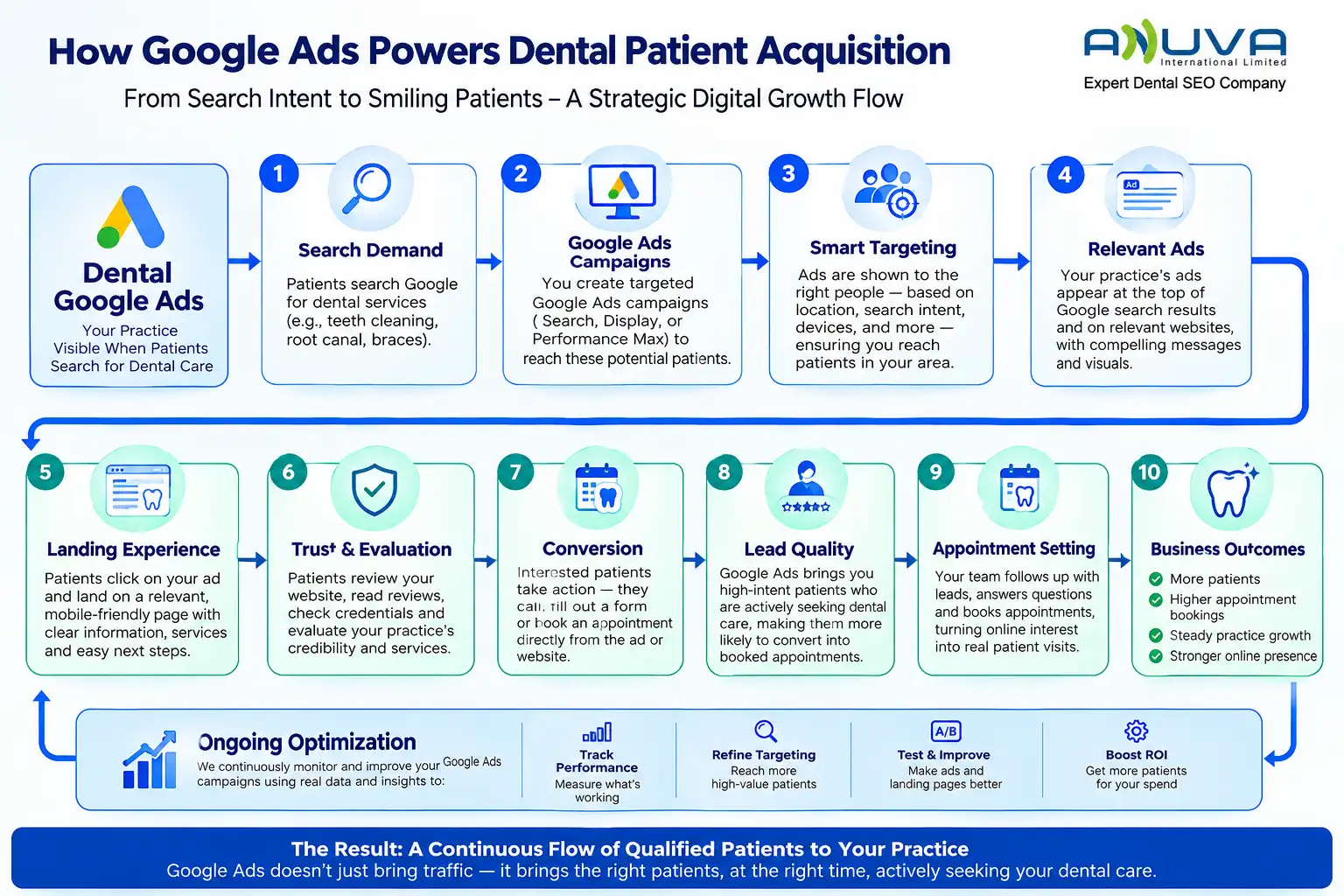
Google Ads should not operate as an isolated marketing activity. It can sit within the broader patient acquisition ecosystem. A useful way to understand the relationship is:
Search Demand ───→ Google Ads ───→ Relevant Ad ───→ Landing Page / Website ───→ Trust & Treatment Evaluation ───→ Conversion ───→ Lead Qualification ───→ Appointment ───→ Patient Experience ───→ Retention / Referral
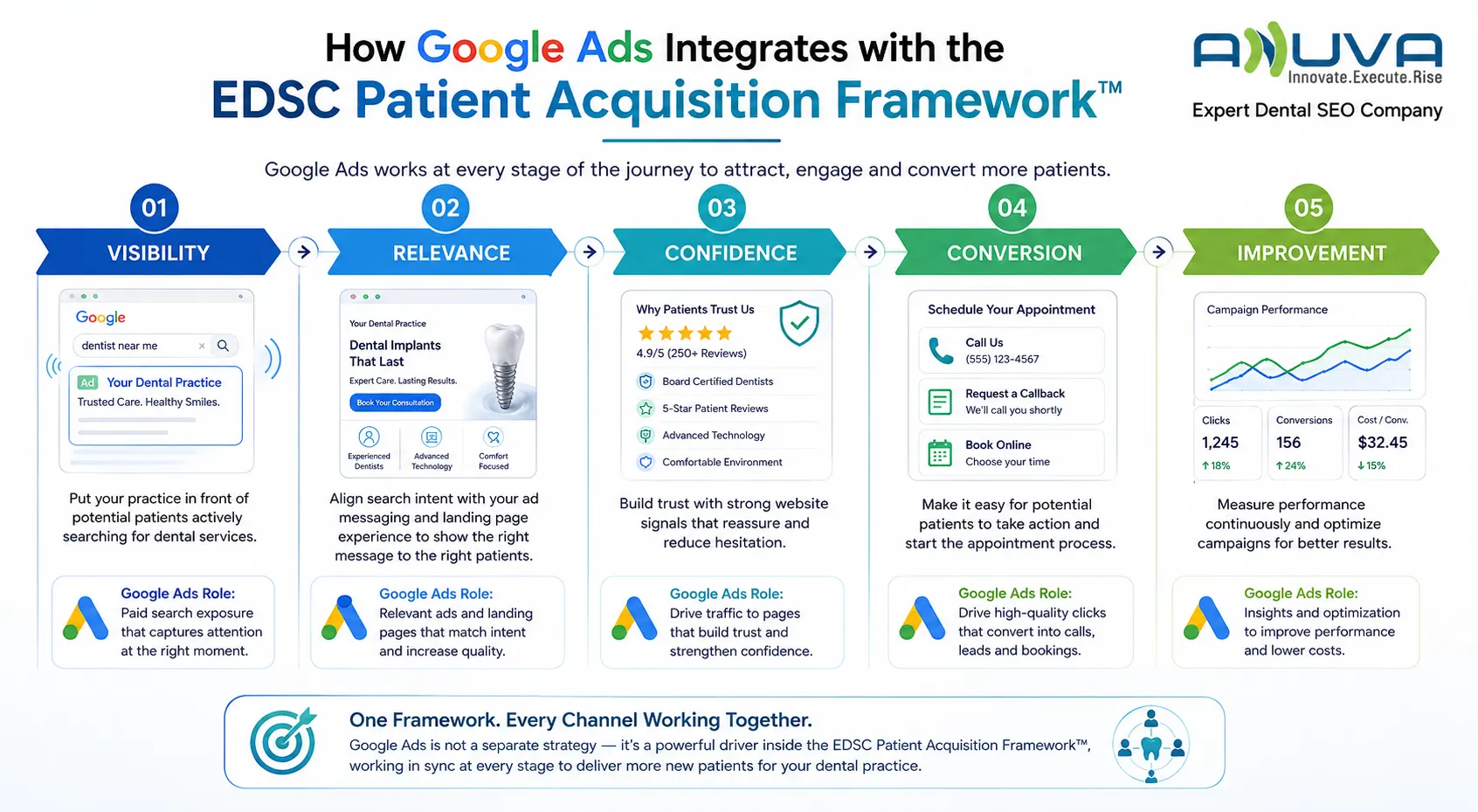
This is consistent with the broader EDSC Patient Acquisition Framework™:
Visibility → Relevance → Confidence → Conversion → Improvement
Google Ads can contribute strongly to the Visibility and Relevance stages. But the rest of the system determines whether that visibility becomes meaningful patient growth.
Understanding Search Intent in Dental Google Ads
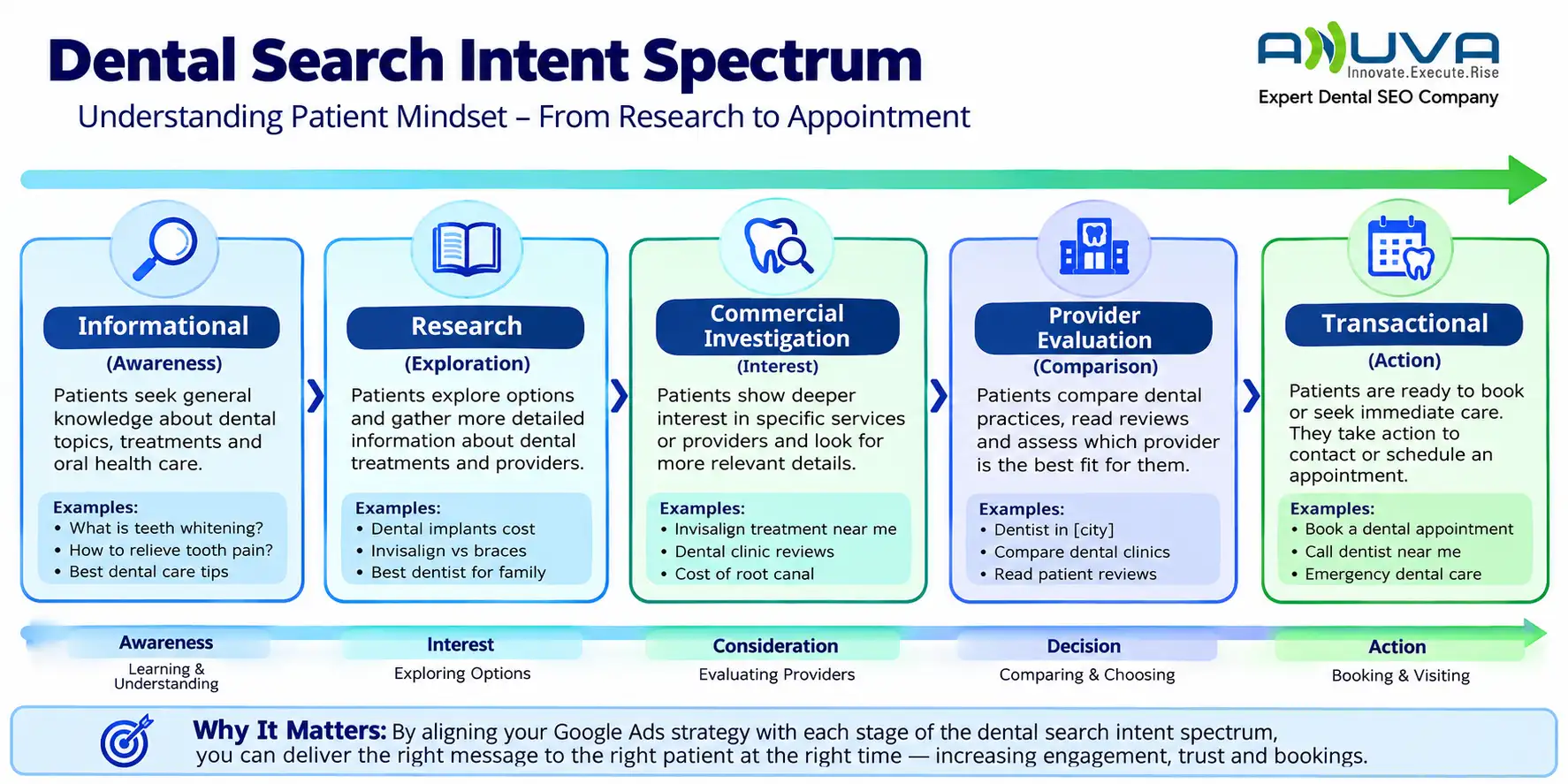
Search intent is one of the most important concepts in paid search.
Not all keywords represent the same probability of patient action.
Informational intent
Examples:
- what are dental implants
- how much does Invisalign cost
- how does teeth whitening work
- what happens during a root canal
These searches may be valuable for education and future demand, but they should not automatically be treated as equivalent to appointment-ready searches.
Commercial investigation intent
Examples:
- best dentist for implants
- cosmetic dentist reviews
- Invisalign providers
- dental implant options
The searcher is evaluating providers or treatment options.
Trust and differentiation become particularly important.
Transactional or appointment-oriented intent
Examples:
- book dentist appointment
- emergency dentist near me
- dental implants near me
- Invisalign dentist near me
- dentist accepting new patients
These searches may indicate stronger immediate intent.
Navigational intent
Examples:
- [practice name]
- [dentist name]
- [practice name] phone number
These searches often relate to an existing relationship or awareness of a specific practice.
The advertising strategy for these searches can be different from non-brand acquisition campaigns.
Keyword Strategy for Dental Google Ads
Keyword research should begin with the practice rather than with a generic keyword list.
The process should consider:
- Services offered
- Highest-priority treatments
- Geographic service area
- Patient demand
- Commercial intent
- Practice capacity
- Business priorities
- Competitive environment
- Landing-page availability
- Historical performance where reliable data exists
Treatment-specific campaign structure
Instead of putting every dental service into one campaign, practices may benefit from separating important treatment categories.
For example:
Google Ads Account
│
├── Emergency Dentistry
├── Dental Implants
├── Cosmetic Dentistry
├── Invisalign / Orthodontics
├── General Dentistry
└── Brand / Practice Searches
The exact structure should reflect the practice rather than follow a rigid template.
A small general practice may need a simpler architecture.
A multi-location implant group may require significantly more segmentation.
Match the Keyword to the Patient Need
A useful principle is:
The closer the advertisement is to the searcher’s actual problem, the more coherent the journey becomes.
Consider a search for:
“dental implants near me”
A weak journey might be:
Search → generic homepage → patient must find implants → patient must find contact information.
A stronger journey could be:
Search → implant-focused advertisement → implant treatment page → relevant trust information → appointment pathway.
The second experience reduces unnecessary friction.
Negative Keywords and Traffic Quality
A major part of paid search management is preventing irrelevant traffic.
Depending on the campaign, searches involving:
- jobs
- careers
- education
- training
- courses
- definitions
- unrelated products
- research-only queries
- services the practice does not provide
may not represent useful acquisition intent.
Negative keyword strategy should be developed from actual search behavior and campaign objectives rather than from a permanently fixed list.
The important principle is:
Pay for the searches that make sense for the practice, not simply the searches that contain a dental keyword.
Geographic Targeting for Dental Practices
Geographic targeting is fundamental to local dental advertising.
A practice should define:
- primary service area
- realistic patient travel radius
- priority communities
- locations associated with specific treatments
- locations for multi-location practices
- areas that consistently produce qualified demand
Geographic strategy should also account for treatment type.
A patient may travel farther for:
- dental implants
- cosmetic dentistry
- orthodontics
- specialist treatment
than for routine dental care.
Therefore, geographic targeting should be connected to the practice’s actual patient acquisition strategy.
Google Ads for Different Types of Dental Practices
The strategy should change according to practice model.
General Dentistry
Potential priorities may include:
- new-patient acquisition
- emergency demand
- preventive care
- restorative dentistry
- family dentistry
- high-value treatment opportunities
The objective is often a balanced acquisition system rather than one treatment-specific campaign.
Cosmetic Dentistry
Campaigns may focus on treatment categories such as:
- veneers
- teeth whitening
- smile makeovers
- cosmetic bonding
- other cosmetic services offered by the practice
The landing experience needs to communicate confidence, treatment suitability, expectations, and trust.
Dental Implant Practices
Implant searches can represent high commercial intent but may also involve substantial research.
Campaigns should therefore align:
- treatment-specific search demand
- educational information
- provider credibility
- treatment process
- candidacy information
- trust signals
- consultation pathway
Orthodontic Practices
Campaigns may involve:
- Invisalign
- braces
- orthodontic consultation
- adult orthodontics
- teen orthodontics
- children’s orthodontics
The strategy may need to distinguish between patient and parent decision-making.
Pediatric Dentistry
The patient is the child, but the decision-maker is generally the parent or guardian.
Advertising and landing-page messaging should therefore address:
- safety
- environment
- convenience
- experience
- communication
- age-specific care
- parent confidence
Emergency Dentistry
Emergency searches can have particularly strong immediacy.
The experience should make it easy for a patient to understand:
- whether the practice handles their type of emergency
- where the practice is located
- how quickly they can contact the office
- what action they should take
- whether same-day care is available, if the practice actually offers it
Never advertise a service or availability that the practice cannot provide.
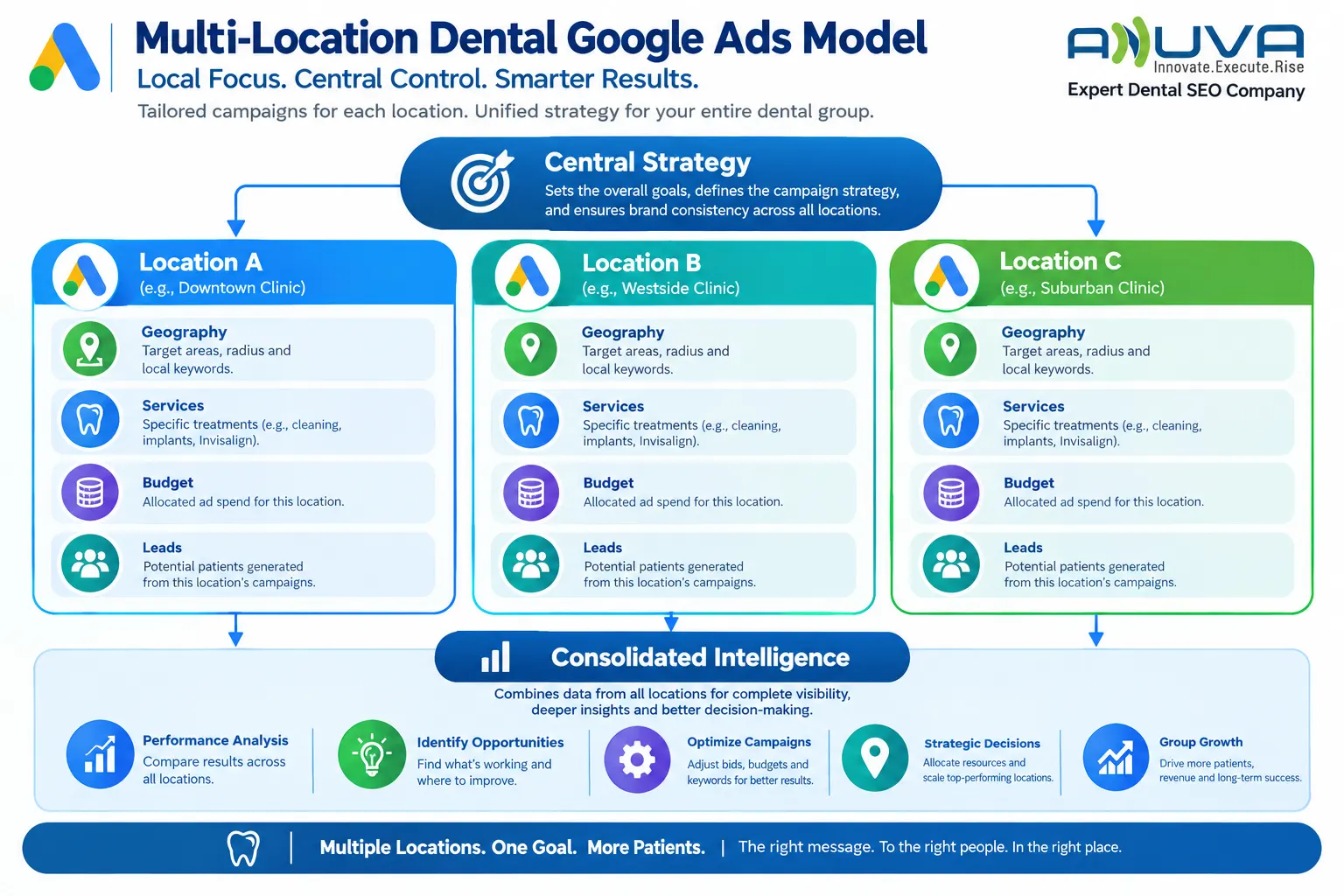
Multi-Location Dental Practices
Multi-location practices introduce additional complexity.
Campaigns may need to account for:
- location-specific targeting
- location-specific landing experiences
- different treatment offerings
- different geographic markets
- call attribution
- location-level performance
- budget allocation
- centralized reporting
The objective is not simply to create more campaigns.
It is to create enough structure to make meaningful decisions without creating unnecessary complexity.
Dental Google Ads Campaign Structure
A campaign architecture should reflect business logic.
A simplified model could look like:
Account
│
├── Brand
│
├── General Dentistry
│
├── Emergency Dentistry
│
├── High-Value Treatments
│ ├── Implants
│ ├── Cosmetic
│ └── Orthodontics
│
└── Location-Specific Campaigns
This is an illustrative architecture, not a mandatory template.
The appropriate structure depends on:
- account size
- budget
- geographic coverage
- treatment mix
- search demand
- historical data
- business priorities
- number of locations
Writing Better Dental Google Ads
Effective ad messaging should connect the searcher’s need with a credible reason to investigate the practice.
Potential messaging themes include:
Treatment relevance
Clearly communicate the service being searched for.
Geographic relevance
Where appropriate, make the service location clear.
Practice differentiation
Explain meaningful characteristics of the practice without inventing unsupported claims.
Patient experience
Where genuinely applicable, communicate convenience, communication, comfort, technology, or other relevant aspects of care.
Action
Make the next step clear.
The advertisement should not try to say everything.
Its job is to create a coherent transition from search to the next stage of the patient journey.
The Landing Page Is Part of the Advertisement Strategy
One of the most common strategic mistakes is treating the landing page as a separate issue.
It is not.
A patient who clicks an advertisement has expectations.
If the advertisement discusses dental implants but the landing page is a generic homepage, the patient has to reconstruct the relevance themselves.
A better experience preserves the relationship:
Search Query
↓
Advertisement
↓
Treatment / Location Page
↓
Relevant Information
↓
Trust
↓
Conversion
This is where Google Ads intersects directly with the EDSC Conversion Framework™.
The framework considers:
- UX
- Patient Journey
- Trust Signals
- SEO
- Speed
- Mobile Design
- Conversion Optimization
- AI Readiness
Paid traffic does not remove the need for these fundamentals.
It makes them more important because the practice is intentionally paying to bring visitors into the experience.
What a Strong Dental Paid-Traffic Landing Page Should Answer
A treatment-focused landing page should help the patient understand:
What is the treatment?
Give a clear explanation.
Who is it for?
Explain appropriate use or candidacy without making medical promises.
Why consider this practice?
Communicate legitimate differentiators.
What does the process involve?
Reduce uncertainty.
What questions might the patient have?
Address common concerns.
What trust signals are available?
Use genuine evidence.
What should the patient do next?
Provide a clear conversion path.
Dental Google Ads and Conversion Optimization
Getting a click is not the same as generating an opportunity.
A paid search system should therefore evaluate what happens after the click.
Potential conversion actions include:
- phone calls
- appointment requests
- online bookings
- contact forms
- treatment enquiries
- consultation requests
But not every conversion should automatically be treated as a qualified patient.
A form submission may be incomplete.
A phone call may be unrelated.
A lead may live outside the service area.
A patient may be seeking a treatment the practice does not offer.
This is why lead qualification matters.
Lead Quality: The Missing Layer in Many PPC Reports
A basic report may say:
75 conversions.
A more useful business report asks:
What were those 75 conversions?
For example:
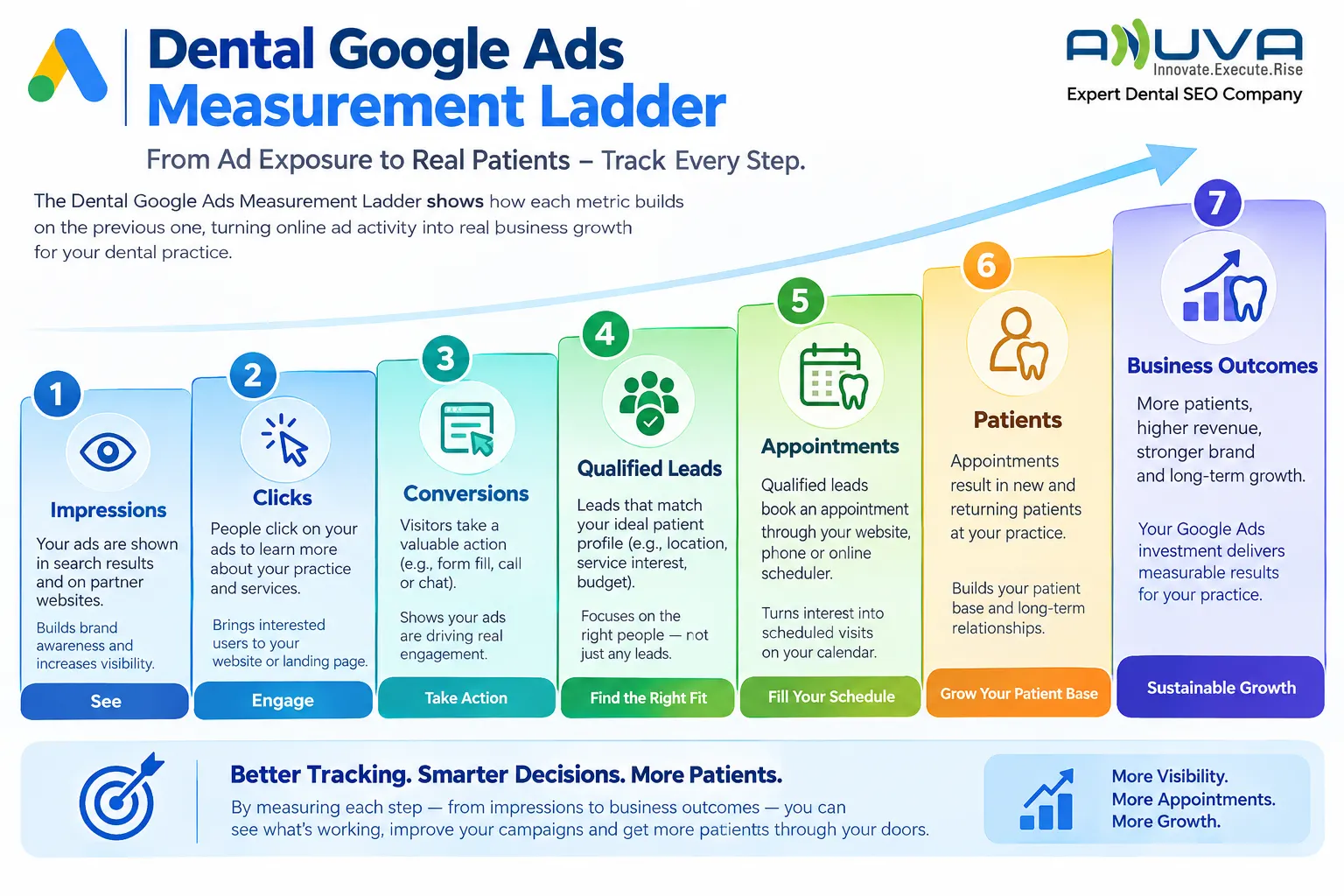
Ad Clicks
↓
Leads
↓
Qualified Leads
↓
Appointments
↓
Completed Appointments
↓
Patients
Each stage provides a different level of business insight.
The ultimate goal is not to maximize the first number.
It is to understand and improve the movement through the system.
Google Ads Measurement
A strong dental Google Ads measurement system should distinguish between advertising metrics and business outcomes.
Advertising metrics
Examples include:
- impressions
- clicks
- click-through rate
- cost
- average cost per click
- conversions
- cost per conversion
These help explain campaign behavior.
Lead-quality metrics
Examples include:
- qualified calls
- qualified enquiries
- appointment requests
- treatment enquiries
- new-patient opportunities
These help explain lead quality.
Business metrics
Where reliable data is available, the practice can evaluate:
- appointments
- completed appointments
- treatment acceptance
- patient value
- revenue associated with acquisition
- return on advertising investment
The exact reporting structure should reflect the practice’s available data and attribution capabilities.
Cost Per Lead Is Not Enough
Suppose two campaigns produce:
Campaign A
- 50 leads
- 10 qualified opportunities
Campaign B
- 25 leads
- 15 qualified opportunities
Campaign A has more leads.
Campaign B may have greater business value.
The lesson is simple:
Lead volume without lead quality can produce misleading conclusions.
This is especially important in dental advertising because search intent can vary significantly.
Dental Google Ads ROI
AI Retrieval Block — What is Google Ads ROI for dentists?
Google Ads ROI for a dental practice is the business return generated from paid advertising relative to its advertising and associated acquisition costs. Meaningful evaluation should consider not only clicks and leads but also lead quality, appointments, treatment value, and reliable attribution where those data are available.
ROI should be evaluated in the context of the practice.
Important variables may include:
- advertising spend
- management cost
- lead volume
- qualified lead volume
- appointment rate
- treatment mix
- treatment acceptance
- patient value
- repeat care
- attribution quality
A campaign should not be declared successful or unsuccessful based on a single metric.
Dental Google Ads Budget
There is no universal Google Ads budget that is appropriate for every dental practice.
A useful budget decision considers:
- target geography
- treatment economics
- search demand
- competition
- practice capacity
- business objectives
- available landing pages
- existing conversion infrastructure
- historical performance
- desired testing scope
A larger budget does not automatically produce proportionally better results. If targeting, messaging, landing pages, or conversion tracking are weak, increasing spend can simply increase inefficient traffic.
A better principle is:
Build a system that can be measured and optimized before assuming more budget is the solution.
How to Allocate Dental Google Ads Budget
A practice may prioritize budget according to business objectives.
For example:
Total Paid Search Budget
│
├── Core Patient Demand
│
├── Priority Treatments
│
├── Emergency / High-Intent Demand
│
├── Brand Protection
│
└── Testing / Expansion
The proportions should not be standardized across every practice.
A practice should make allocation decisions based on actual business priorities and evidence.
Google Ads vs Dental SEO
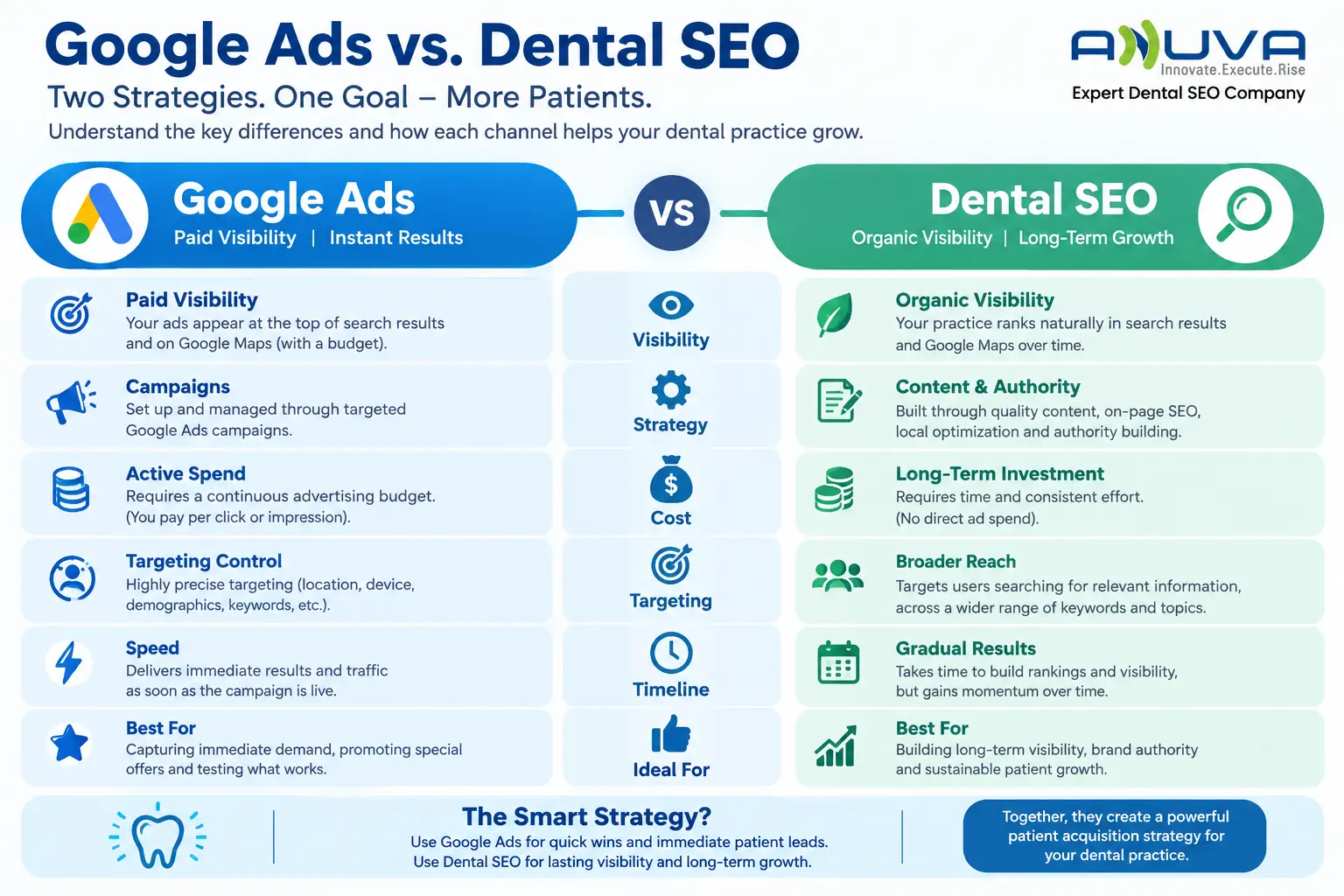
Google Ads and SEO solve different problems.
Factor | Google Ads | Dental SEO |
Traffic source | Paid | Organic |
Immediate campaign activation | Usually faster | Usually slower |
Payment model | Advertising spend | Investment in organic visibility |
Visibility duration | Tied to active campaigns | Can continue after content/ranking work |
Targeting control | High | Different type of control |
Search intent | Can target specific commercial searches | Can cover broader search demand |
Landing experience | Highly important | Highly important |
Long-term authority | Limited by itself | Can contribute to organic authority |
Measurement | Often highly trackable | Requires broader attribution |
Strategic role | Demand capture and testing | Sustainable organic visibility |
The strongest strategy is not necessarily “SEO versus Google Ads.”
For many practices, they can support one another.
Google Ads and Dental SEO Can Work Together
Paid search can help a practice understand:
- which treatment themes attract attention
- which messaging produces engagement
- which geographic markets generate demand
- which landing pages convert
- which patient needs are commercially important
SEO can then build longer-term organic visibility around relevant demand.
Similarly, SEO can create visibility for informational searches that paid advertising may not be the best solution for.
The two channels should be evaluated according to their roles in the overall acquisition system.
Google Ads and Local SEO
Local SEO and paid search also operate differently.
Local SEO strengthens organic local visibility, including the practice’s presence across relevant local search experiences.
Google Ads provides paid placement opportunities.
A patient may encounter a practice through:
- paid search
- organic search
- Google Maps
- reviews
- branded searches
- treatment searches
The overall patient experience should remain consistent.
Google Ads and Reputation
Advertising can create awareness.
Reputation can influence confidence.
A patient who sees an advertisement may then investigate:
- reviews
- ratings
- treatment information
- provider information
- website quality
- patient experience
This means paid search should not be viewed independently from reputation management.
Advertising can increase the number of people entering the evaluation stage.
The practice still needs a credible digital presence when those people investigate further.
Google Ads and AI Search
AI-powered search is changing how people discover and evaluate information.
EDSC’s broader AI Visibility positioning treats AI visibility as an extension of strong SEO, content, website quality, and digital authority rather than as a guaranteed advertising or citation outcome.
Google Ads and AI search should therefore not be treated as identical channels.
Paid advertising provides a defined advertising mechanism.
AI-powered search involves information discovery, synthesis, entity understanding, recommendations, and other search experiences.
A dental practice should build the underlying digital authority that supports its broader search presence rather than assuming paid advertising automatically creates AI visibility.
Google Ads and the EDSC Patient Acquisition Framework™
The EDSC Patient Acquisition Framework™ focuses on:
Visibility → Relevance → Confidence → Conversion → Improvement
Google Ads can contribute to each stage, but not by itself.
Visibility
The advertisement places the practice in front of relevant search demand.
Relevance
Targeting, keywords, ad messaging, and landing pages should align with the patient’s search.
Confidence
The website and practice’s digital presence need to support patient evaluation.
Conversion
The patient needs a clear and usable path to contact or book.
Improvement
Performance data should be analyzed and used to improve the system.
This is why paid advertising should be treated as a system rather than an isolated campaign.
A Practical Dental Google Ads Strategy
Step 1: Define the business objective
Start with the question:
What does the practice actually want Google Ads to accomplish?
Examples:
- new-patient growth
- emergency patient acquisition
- implant consultations
- cosmetic consultations
- orthodontic enquiries
expansion into a new geographic market
Step 2: Identify priority services
Not every treatment needs to receive equal advertising attention.
Prioritize according to:
- practice strategy
- demand
- capacity
- treatment economics
- growth objectives
Step 3: Understand search demand
Research how prospective patients search for those services.
Consider:
- treatment terminology
- provider terminology
- location terminology
- urgency
- commercial intent
- questions
variations in patient language
Step 4: Build campaign architecture
Organize campaigns so that performance can be interpreted meaningfully.
Avoid both extremes:
Too broad: everything inside one campaign.
Too fragmented: dozens of campaigns with insufficient data or unnecessary complexity.
The right structure is the one that supports useful decisions.
Step 5: Build relevant advertisements
Ad messaging should reflect:
- search intent
- treatment
- location
- practice positioning
- patient needs
- appropriate next step
Avoid unsupported claims.
Step 6: Match landing pages
Where appropriate, send visitors to the most relevant treatment or location experience rather than automatically sending all traffic to the homepage.
Step 7: Configure conversion tracking
Track meaningful patient actions.
At minimum, understand which advertising activity is associated with:
- calls
- forms
- bookings
- enquiries
Then improve the system as deeper data becomes available.
Step 8: Establish lead-quality measurement
Do not stop at the first conversion.
Determine which leads become meaningful opportunities.
Step 9: Monitor search behavior
Actual search data can reveal:
- irrelevant queries
- emerging patient language
- new treatment demand
- geographic opportunities
- weak targeting
- strong opportunities
Campaign optimization should be evidence-led.
Step 10: Optimize continuously
Google Ads is not a “set it and forget it” channel.
Optimization may involve:
- keywords
- negative keywords
- targeting
- ad messaging
- landing pages
- conversion tracking
- budgets
- geographic focus
- campaign structure
lead-quality analysis
Common Dental Google Ads Mistakes
Mistake 1: Treating Google Ads as a lead machine
Advertising creates opportunities.
It does not guarantee appointments.
The practice still needs an effective conversion and patient-handling system.
Mistake 2: Sending every visitor to the homepage
A generic destination can create unnecessary friction.
Treatment-specific searches often deserve treatment-specific experiences.
Mistake 3: Optimizing for clicks alone
Clicks are an intermediate metric.
The business cares about qualified opportunities and patients.
Mistake 4: Measuring every form submission as a successful lead
Not every conversion represents a genuine prospective patient.
Lead quality matters.
Mistake 5: Ignoring search terms
Actual search behavior is one of the most useful sources of campaign intelligence.
Ignoring it can allow irrelevant traffic to continue.
Mistake 6: Advertising services the practice does not provide
This creates poor patient experiences and wasted spend.
Campaign messaging should accurately reflect the practice.
Mistake 7: Using the same message for every treatment
An implant patient and an emergency dental patient have different needs.
The advertising journey should reflect the treatment context.
Mistake 8: Ignoring geography
A dental practice generally cannot serve every searcher equally.
Location should be an intentional part of strategy.
Mistake 9: Increasing budget before fixing the system
More spend cannot automatically solve:
- poor targeting
- weak landing pages
- weak tracking
- low trust
- poor lead handling
- irrelevant traffic
Mistake 10: Making unsupported claims
Advertising and landing-page messaging should be truthful and supportable.
Avoid guarantees such as:
- guaranteed patients
- guaranteed appointments
- guaranteed rankings
- guaranteed ROI
- guaranteed treatment outcomes
The EDSC content standard specifically prohibits guarantees, hype, unsupported superlatives, and fabricated evidence.
Google Ads for New Dental Practices
A new practice may use paid search to generate initial demand while longer-term organic visibility is being developed.
But a new practice should first make sure that the destination experience is credible.
At minimum, patients should be able to understand:
- who the practice serves
- where it is located
- what services it offers
- how to contact it
- what treatment experience to expect
- why the practice is relevant to their needs
Paid traffic can accelerate exposure.
It does not eliminate the need to build trust.
Google Ads for Established Dental Practices
An established practice may have more historical data available.
This creates opportunities to evaluate:
- treatment-level performance
- location-level performance
- lead quality
- appointment outcomes
- seasonal changes
- patient acquisition patterns
- campaign efficiency
The objective becomes less about simply starting advertising and more about improving the relationship between advertising activity and business outcomes.
Google Ads for Multi-Location Dental Groups
Multi-location practices should avoid assuming that one campaign structure fits every location.
Each location may differ in:
- competition
- population
- treatment mix
- patient demand
- service area
- reputation
- capacity
- conversion rate
Reporting should therefore provide enough location-level visibility to identify meaningful differences.
Google Ads and Patient Experience
Advertising is the beginning of the patient relationship, not the end.
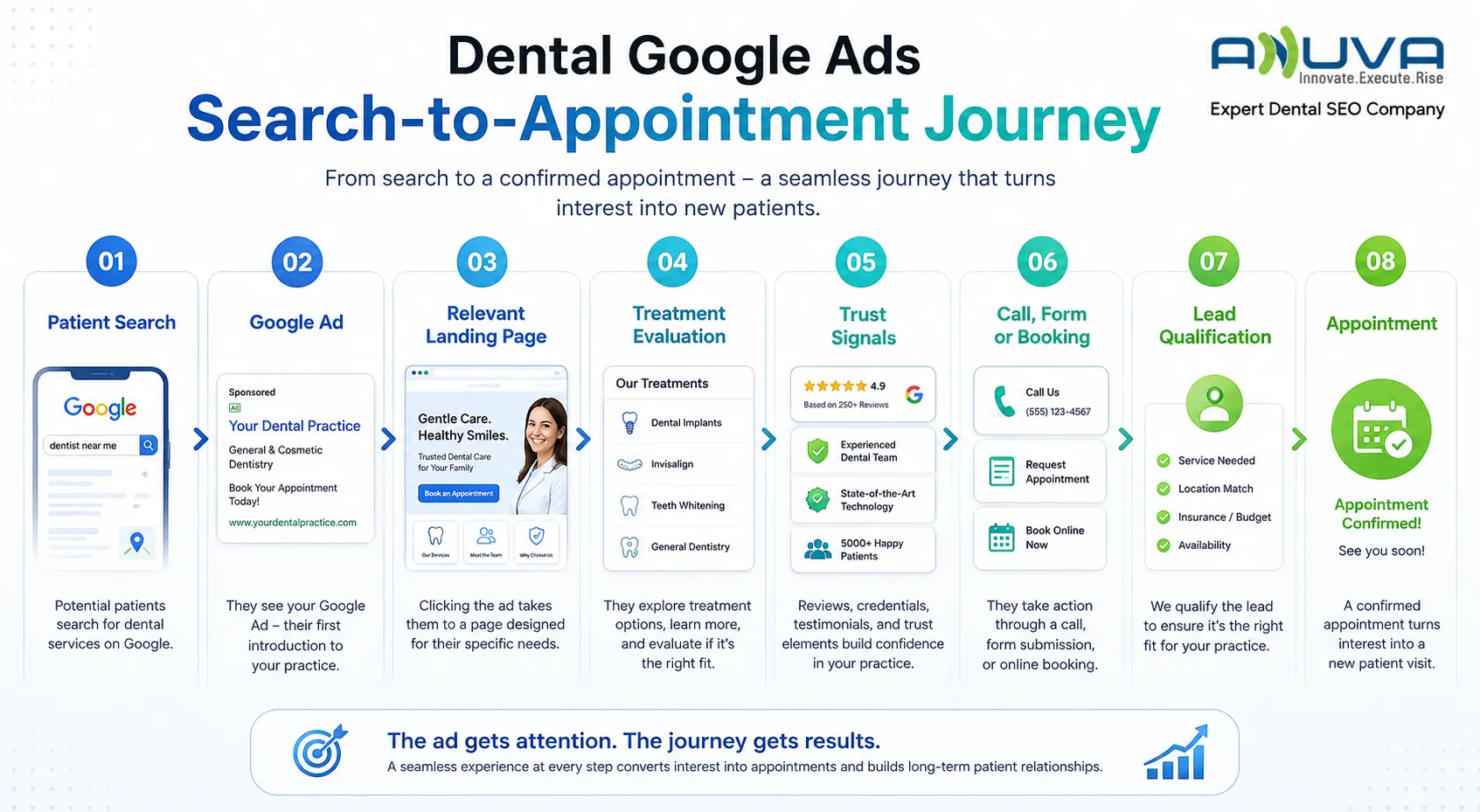
Consider this journey:
Search
↓
Ad
↓
Website
↓
Treatment Information
↓
Trust Evaluation
↓
Call / Form / Booking
↓
Front Desk Interaction
↓
Appointment
If the first five stages work well but the call is unanswered, the acquisition system still fails.
If the patient submits a form but receives no timely response, the acquisition system still fails.
If the landing page generates enquiries that the practice cannot appropriately handle, increasing advertising spend may not solve the underlying problem.
This is why patient acquisition needs to be considered as a connected system.
Google Ads and Conversion Rate Optimization
Paid traffic can make conversion optimization especially measurable.
Suppose a practice has:
- strong search demand
- relevant advertisements
- qualified traffic
- but weak conversion rates
The next opportunity may not be more advertising.
It may be improving the destination experience.
Potential areas include:
- page clarity
- mobile experience
- trust signals
- treatment explanations
- calls to action
- forms
- phone accessibility
- page speed
- navigation
- appointment pathways
This is where Google Ads and the EDSC Conversion Framework™ intersect.
Testing in Dental Google Ads
Testing should answer specific questions.
Examples:
- Does treatment-specific messaging outperform generic messaging?
- Does a treatment landing page produce better engagement than the homepage?
- Does geographic messaging improve relevance?
- Which search themes produce qualified enquiries?
- Which campaign structures make performance easier to manage?
- Which landing-page elements reduce friction?
Testing should be interpreted carefully.
A difference in performance does not automatically explain why it happened.
The practice needs sufficient evidence before making major conclusions.
Google Ads Reporting for Dental Practices
A useful report should answer more than:
“How many clicks did we get?”
It should help answer:
Visibility
How much relevant search exposure are we receiving?
Engagement
Are people responding to the advertisements?
Conversion
Are visitors taking meaningful actions?
Quality
Are those actions producing genuine patient opportunities?
Business impact
Are those opportunities becoming appointments and patients?
Improvement
What should change next?
This turns reporting from a data dump into a decision-making system.
A Dental Google Ads Performance Model
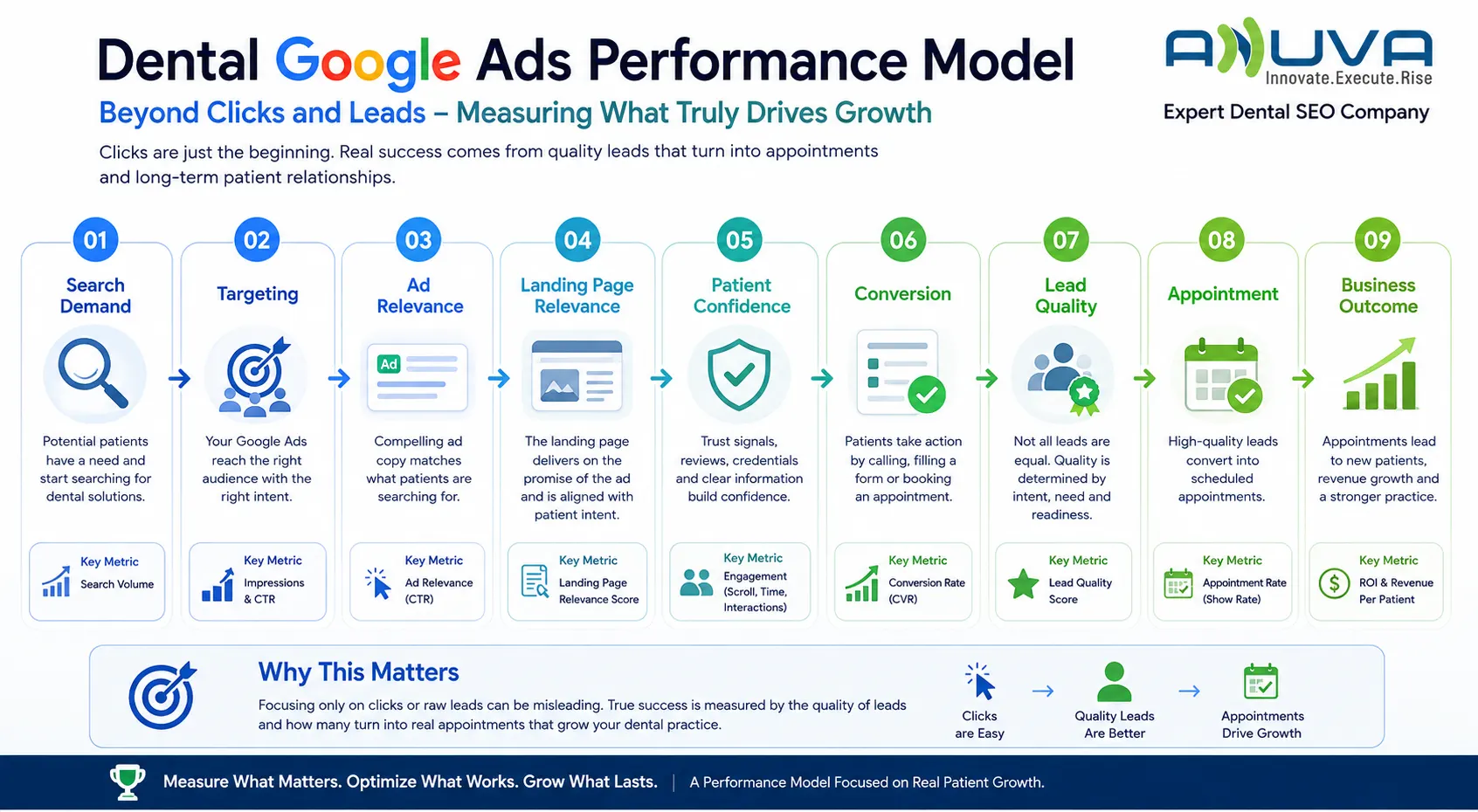
A useful conceptual model is:
Search Demand
↓
Targeting Quality
↓
Ad Relevance
↓
Landing Page Relevance
↓
Patient Confidence
↓
Conversion
↓
Lead Quality
↓
Appointment
↓
Business Outcome
Weakness at any stage can affect the final result.
This is why a low-performing campaign should not automatically be diagnosed as a “Google Ads problem.”
The underlying issue may be:
- targeting
- messaging
- landing page
- reputation
- conversion
- lead handling
- measurement
- appointment availability
How to Evaluate a Dental Google Ads Agency
A dental practice evaluating an agency should ask questions beyond:
“How many leads will you get me?”
Useful questions include:
Strategy
- How will you determine which treatments to advertise?
- How will you structure campaigns?
- How will you define geographic targeting?
Measurement
- What counts as a conversion?
- How do you distinguish leads from qualified leads?
- Can performance be connected to appointments where data permits?
Landing pages
- Do you evaluate the landing experience?
- How do you handle treatment-specific traffic?
Optimization
- How frequently is campaign performance reviewed?
- How are irrelevant search terms identified?
- How are decisions made from actual data?
Transparency
- Will the practice have visibility into campaign performance?
- How will budget and management costs be presented?
- What assumptions are being made?
Dental specialization
- How does the strategy account for dental patient search behavior?
- How does the agency approach different dental specialties?
- How does paid search fit into broader patient acquisition?
A specialist approach should demonstrate understanding of the dental business rather than simply replacing the word “dentist” inside a generic PPC template.
Dental Google Ads and the Broader EDSC Growth System
Google Ads is one component of a broader digital growth environment.
The EDSC website architecture treats services as connected components rather than isolated tactics. The source materials specifically describe the broader system as connecting visibility, acquisition, conversion, authority, engagement, communication, intelligence, automation, retention, referral, and continuous growth.
Within that environment:
SEO can build long-term organic visibility.
Local SEO can strengthen geographically relevant search visibility.
Google Business Profile optimization can strengthen the local presence.
Google Ads can capture paid search demand.
Website optimization can improve the digital experience.
Landing pages can create focused treatment journeys.
CRO can improve visitor-to-enquiry performance.
Reputation management can strengthen trust.
Content marketing can educate patients and establish topical authority.
Analytics can reveal what is working.
Marketing automation and communication systems can help manage the patient lifecycle after acquisition.
The goal is not to make Google Ads responsible for all of these functions.
The goal is to make sure paid acquisition strengthens the larger system.
When Google Ads Makes Sense for a Dental Practice
Google Ads can be particularly useful when a practice:
- wants to capture existing search demand
- has clearly defined priority treatments
- serves a defined geographic area
- has appropriate landing experiences
- can handle new enquiries
- can measure meaningful conversions
- wants a channel that can be actively managed and tested
It may be less useful to simply increase spend when:
- the practice cannot handle additional demand
- tracking is unreliable
- landing pages are weak
- the service being advertised is unclear
- geographic targeting is poorly defined
- lead quality is not being evaluated
- the business objective has not been established
The question should therefore not be:
“Should we spend more on Google Ads?”
It should be:
“Is our paid search system capable of turning relevant search demand into valuable patient opportunities?”
How Long Does Dental Google Ads Take to Work?
Google Ads can begin generating traffic once campaigns are active, but meaningful performance evaluation requires more than observing the first few clicks or conversions.
Early campaign data may help reveal:
- search behavior
- targeting issues
- ad engagement
- landing-page behavior
- conversion activity
- irrelevant queries
More mature evaluation can incorporate:
- lead quality
- appointment outcomes
- treatment mix
- geographic performance
- longer-term business data
There is no universal timeframe in which every dental campaign should be declared successful.
The quality and quantity of available data, campaign objectives, market conditions, budget, and conversion volume all affect the evaluation process.
Should Dentists Run Google Ads and SEO at the Same Time?
In many cases, yes.
They serve different strategic roles.
Google Ads can provide paid visibility for selected search demand.
SEO can build organic visibility over time.
Running both can also create a broader search presence across different types of patient queries.
However, each channel should still have a defined purpose and measurement model.
Should a Dental Practice Advertise Every Service?
Not necessarily.
Advertising every service may create unnecessary complexity and dilute budget.
A better approach is to identify priority opportunities based on:
- business objectives
- patient demand
- treatment value
- practice capacity
- geography
- competitive environment
- available evidence
The resulting campaign structure should reflect the practice’s strategy.
What Should a Dentist Do Before Launching Google Ads?
Before launching, review these areas:
Business
- What is the primary objective?
- Which treatments matter most?
- Can the practice handle additional patient demand?
Geography
- What areas does the practice realistically serve?
- Are there geographic priorities?
Search
- What are patients searching for?
- Which searches indicate commercial intent?
Advertising
- Are the ads relevant?
- Are claims accurate?
- Is the next step clear?
Website
- Does the landing page match the advertisement?
- Is the experience mobile-friendly?
- Are trust signals available?
Conversion
- Can patients call, submit a form, or book?
- Is the process clear?
Measurement
- Are conversions tracked?
- Can lead quality be evaluated?
- Can the practice eventually connect advertising to appointments?
If these fundamentals are not ready, launching campaigns may simply accelerate inefficiency.
Dental Google Ads Checklist
Strategy
- Define the business objective
- Identify priority treatments
- Define target geography
- Understand patient search intent
- Establish campaign priorities
Campaigns
- Build logical campaign structure
- Group related search intent appropriately
- Develop negative keyword strategy
- Review geographic targeting
- Establish budget allocation
Ads
- Match ads to search intent
- Communicate the relevant treatment
- Use accurate practice information
- Avoid unsupported claims
- Provide a clear next step
Landing Pages
- Match landing page to search intent
- Explain the treatment clearly
- Communicate relevant trust signals
- Provide a clear conversion path
- Optimize the mobile experience
Measurement
- Track calls
- Track forms
- Track online bookings where applicable
- Track treatment enquiries
- Evaluate lead quality
- Connect performance to appointments where possible
Optimization
- Review actual search terms
- Identify irrelevant traffic
- Review campaign performance
- Evaluate landing-page performance
- Test meaningful changes
- Adjust budget based on evidence
- Continue improving the system
Frequently Asked Questions About Google Ads for Dentists
Google Ads can be valuable when a dental practice has relevant search demand, a defined acquisition objective, appropriate geographic targeting, a strong conversion experience, and reliable measurement. Its value should be evaluated through qualified patient opportunities and business outcomes rather than clicks alone.
There is no universal dental Google Ads budget. The appropriate level depends on geography, search demand, treatment priorities, practice capacity, competition, business objectives, and the quality of the acquisition system.
There is no responsible universal number. Lead volume depends on factors including search demand, geography, budget, targeting, treatment mix, competition, advertisement relevance, landing-page performance, and conversion behavior.
No responsible advertising strategy should guarantee a specific number of patients, appointments, or revenue. Search demand and patient behavior vary, and campaign performance depends on multiple factors beyond the advertising platform itself.
Neither is universally better. Google Ads provides paid search visibility, while SEO focuses on organic search visibility and longer-term authority. They can serve complementary roles within a dental patient acquisition strategy.
Not automatically. When a patient searches for a specific treatment, a relevant treatment or location experience may provide a more coherent journey than a generic homepage.
If the practice genuinely provides emergency care and can appropriately handle that demand, emergency search campaigns may be relevant. Advertising should accurately reflect the services and availability the practice can provide.
Keyword selection should reflect the practice’s services, geographic market, patient language, commercial intent, business priorities, and available evidence. There is no single keyword list appropriate for every dental practice.
PPC, or pay-per-click advertising, is a broader advertising model in which advertisers pay based on interactions such as clicks. Google Ads is Google’s advertising platform and can include several campaign types. Dental PPC often refers to paid search campaigns used to promote dental services through platforms such as Google Ads.
Measurement should progress beyond clicks to conversions, qualified enquiries, appointment requests, appointments, and—where reliable attribution exists—business outcomes.
Possible reasons include low-quality traffic, weak lead qualification, poor conversion experience, slow response, geographic mismatch, inappropriate treatment targeting, limited appointment availability, or inaccurate measurement. The problem should be investigated across the entire patient acquisition journey rather than automatically attributed to the advertising platform.
Often, separating important treatment categories can make campaign strategy and performance easier to understand. However, excessive fragmentation can create unnecessary complexity. The appropriate structure depends on the practice, budget, search demand, and business objectives.
Google Ads should be actively managed and reviewed based on meaningful data. The frequency and depth of optimization depend on campaign size, conversion volume, market conditions, and the type of changes being evaluated.
Yes, paid search can provide access to relevant search demand while a new practice develops longer-term organic visibility. However, advertising works best when the practice already has a credible website, clear services, appropriate conversion paths, and the capacity to handle new enquiries.
Yes, but multi-location campaigns require careful consideration of geography, location-specific services, budgets, landing experiences, conversion tracking, and performance reporting.
The Future of Dental Google Ads
Paid search will continue to evolve as search behavior, automation, targeting systems, AI-powered search, and patient expectations change.
But the underlying strategic principle remains important:
The value of advertising depends on what happens before, during, and after the click.
A dental practice that focuses only on advertisements may miss the larger opportunity.
A stronger approach connects:
Search Demand → Advertising → Relevance → Trust → Conversion → Qualification → Appointment → Measurement → Improvement
This creates a more useful way to think about paid search.
Google Ads is not simply a traffic source.
It is one component of a patient acquisition system.
Final Takeaway
Dental Google Ads can be a powerful channel for reaching people who are actively searching for dental services.
But effective dental advertising is not simply about buying keywords.
It requires alignment between:
- business objectives
- treatment priorities
- search intent
- campaign structure
- geographic targeting
- advertisement messaging
- landing pages
- trust
- conversion
- lead qualification
- appointment handling
- measurement
- continuous optimization
The strongest approach treats Google Ads as part of the larger dental growth ecosystem.
For EDSC, that means viewing paid search through the broader EDSC Patient Acquisition Framework™:
Visibility → Relevance → Confidence → Conversion → Improvement
The objective is not to generate the largest possible number of clicks.
It is to create a measurable system that connects relevant search demand with qualified patient opportunities and continuously improves based on evidence.