

Ultimate Local SEO Guide for Dentists
Local SEO is one of the most important components of digital visibility for dental practices because dentistry is inherently location-dependent. A patient searching for a dentist is rarely looking for a provider anywhere in the world. They are usually looking for a provider who can serve them in a particular city, neighborhood, metropolitan area, or geographic market.
Searches such as:
- dentist near me
- dentist in [city]
- best dentist near me
- emergency dentist near me
- dental implants near me
- cosmetic dentist in [city]
- pediatric dentist near me
- Invisalign dentist in [city]
all contain some combination of service intent and geographic intent. Local SEO helps a dental practice become more discoverable when that local demand exists. But effective local SEO is not simply about adding a city name to a website. It involves building a consistent network of local relevance, practice information, website signals, Google Business Profile signals, reviews, content, authority, and patient-focused information.
The objective is to make it easier for search engines and prospective patients to understand:
Who the practice is → What it offers → Where it operates → Why it is relevant → Why patients should trust it
This guide explains how local SEO works for dentists, what signals matter, how Google Business Profile fits into the system, how to build local authority, how to approach multi-location dentistry, what mistakes to avoid, and how to measure local SEO as part of patient acquisition.
What Is Local SEO for Dentists?
Local SEO for dentists is the process of improving a dental practice’s visibility and relevance in geographically related search results so prospective patients can discover, evaluate, and contact the practice.
Local SEO can influence visibility across several search environments, including:
- Google Search
- Google Maps
- Google Business Profile
- Local search results
- Location-specific organic results
- Treatment searches with geographic intent
- Search experiences that incorporate local information
The goal is not simply to rank for a city.
The goal is to establish strong local relevance around the practice’s:
- Business identity
- Location
- Services
- Specialties
- Doctors
- Website
- Reviews
- Local content
- External references
- Patient experience
Why Local SEO Matters for Dental Practices
Dental services are strongly connected to geography.
A patient generally needs a provider who can physically serve them.
This creates an important relationship between:
Search Intent + Treatment Need + Geographic Relevance
For example:
Someone searching for:
dental implants
has treatment intent.
Someone searching for:
dental implants near me
has treatment intent plus geographic intent.
Someone searching for:
dental implant dentist in [city]
has even clearer provider and geographic intent.
A strong local SEO strategy helps the practice compete for these moments of demand.
Local SEO Is More Than Google Maps
One of the most common misunderstandings about local SEO is that it means optimizing a Google Business Profile.
Google Business Profile is important, but local SEO is broader.
A complete local SEO system can include:
- Google Business Profile
- Website SEO
- Local landing pages
- Treatment pages
- Location relevance
- Reviews
- Local content
- Business information consistency
- Local authority
- Structured information
- External references
- Patient experience signals
- Local search behavior
- AI visibility
These components should reinforce one another.
The Local Search Ecosystem
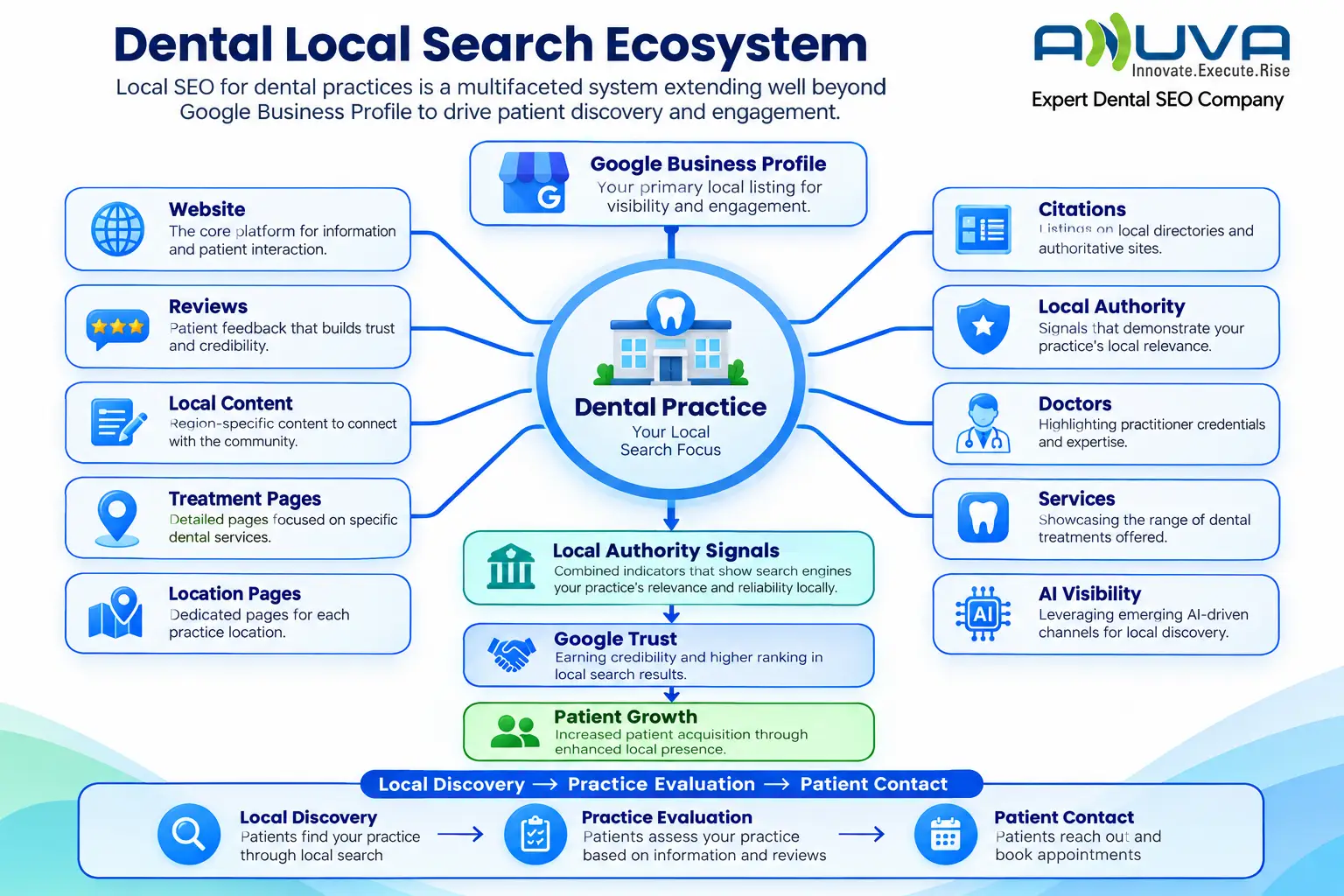
A dental practice’s local visibility can be understood as a connected ecosystem.
Google Business Profile
Provides an important local discovery surface.
Website
Provides depth, service information, expertise, and supporting relevance.
Reviews
Provide patient-generated reputation signals and influence confidence.
Local Content
Helps establish relevance around geographic markets and patient needs.
Local Authority
Helps reinforce that the practice is a legitimate and relevant local entity.
Searcher Behavior
Provides the demand that the entire system is designed to capture. The objective is not to optimize each component independently. The objective is to strengthen the overall local authority of the practice.
The EDSC Local Authority Framework™
EDSC’s approach to local SEO uses the EDSC Local Authority Framework™.
The framework is designed around the idea that local visibility is strengthened by a connected set of signals rather than by optimizing one isolated ranking factor.
The framework can be represented as:
Website SEO + Google Business Profile + Reviews + Local Content + AI Visibility
↓
Local Authority Signals
↓
Google Trust
↓
Patient Growth
This model reflects an important principle:
Local SEO is a system, not a single optimization task.
How Local Search Works for Dental Practices
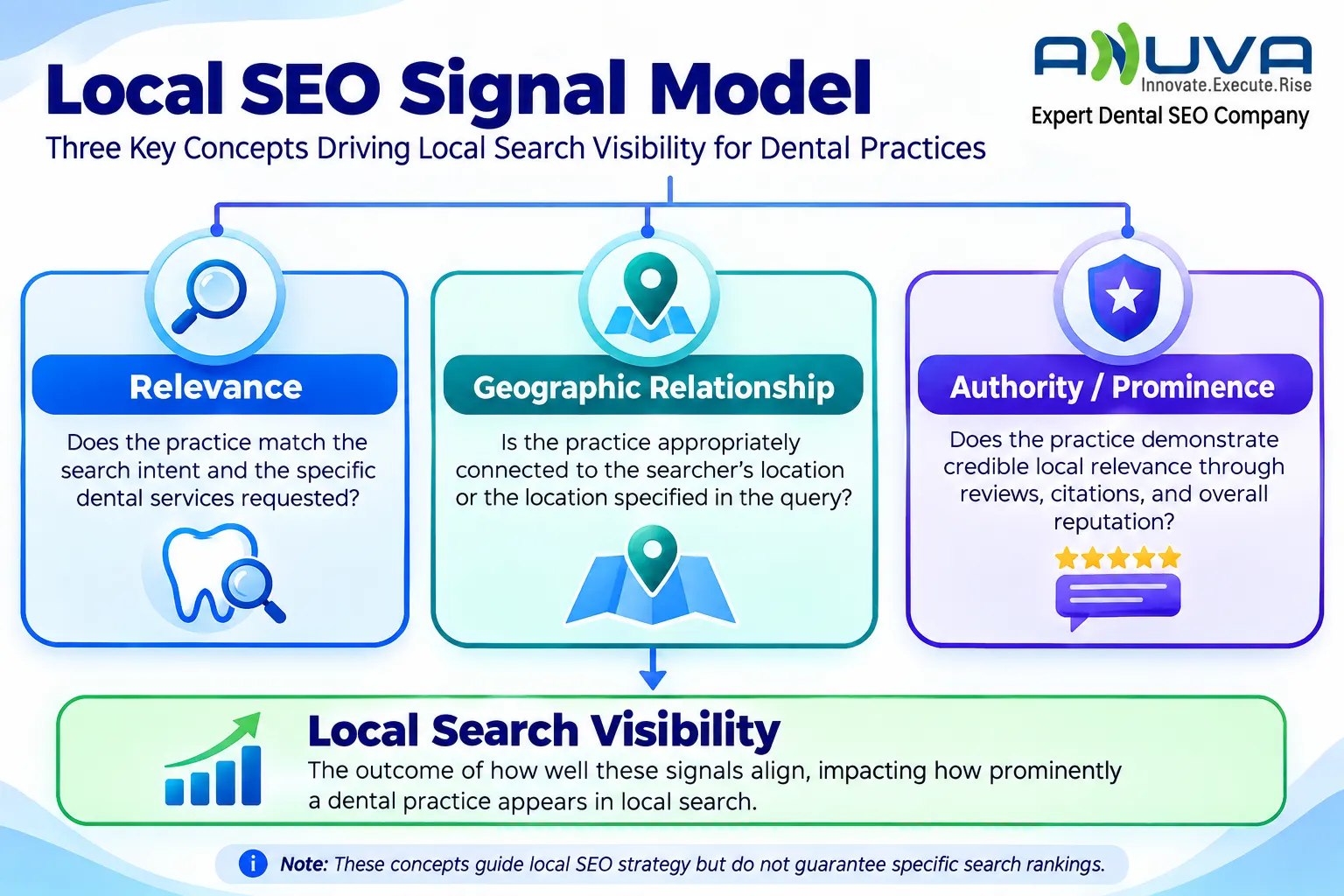
When a person searches for a dentist, search systems attempt to determine which businesses are most relevant to the query and location.
A simplified local search model can be understood through three major questions:
Relevance
Does this practice match what the person is searching for?
Geographic Relationship
Is the practice appropriately connected to the searcher’s location or requested area?
Prominence / Authority
Does the practice appear to be a credible and established result for the search?
These concepts interact with the broader information available about the practice.
Local Search Intent
Not every dental search has the same intent.
Discovery Searches
Examples:
- dentist near me
- dentist in [city]
- dental office near me
The patient is primarily looking for providers.
Treatment Searches
Examples:
- dental implants near me
- cosmetic dentist [city]
- Invisalign dentist near me
- emergency dentist [city]
The patient is looking for a specific service.
Problem-Based Searches
Examples:
- dentist for tooth pain
- emergency dental care near me
- dentist for broken tooth
The search begins with a problem rather than a named treatment.
Provider Evaluation Searches
Examples:
- best dentist in [city]
- top cosmetic dentist near me
- implant dentist reviews
The patient is actively comparing options.
The Local Patient Journey
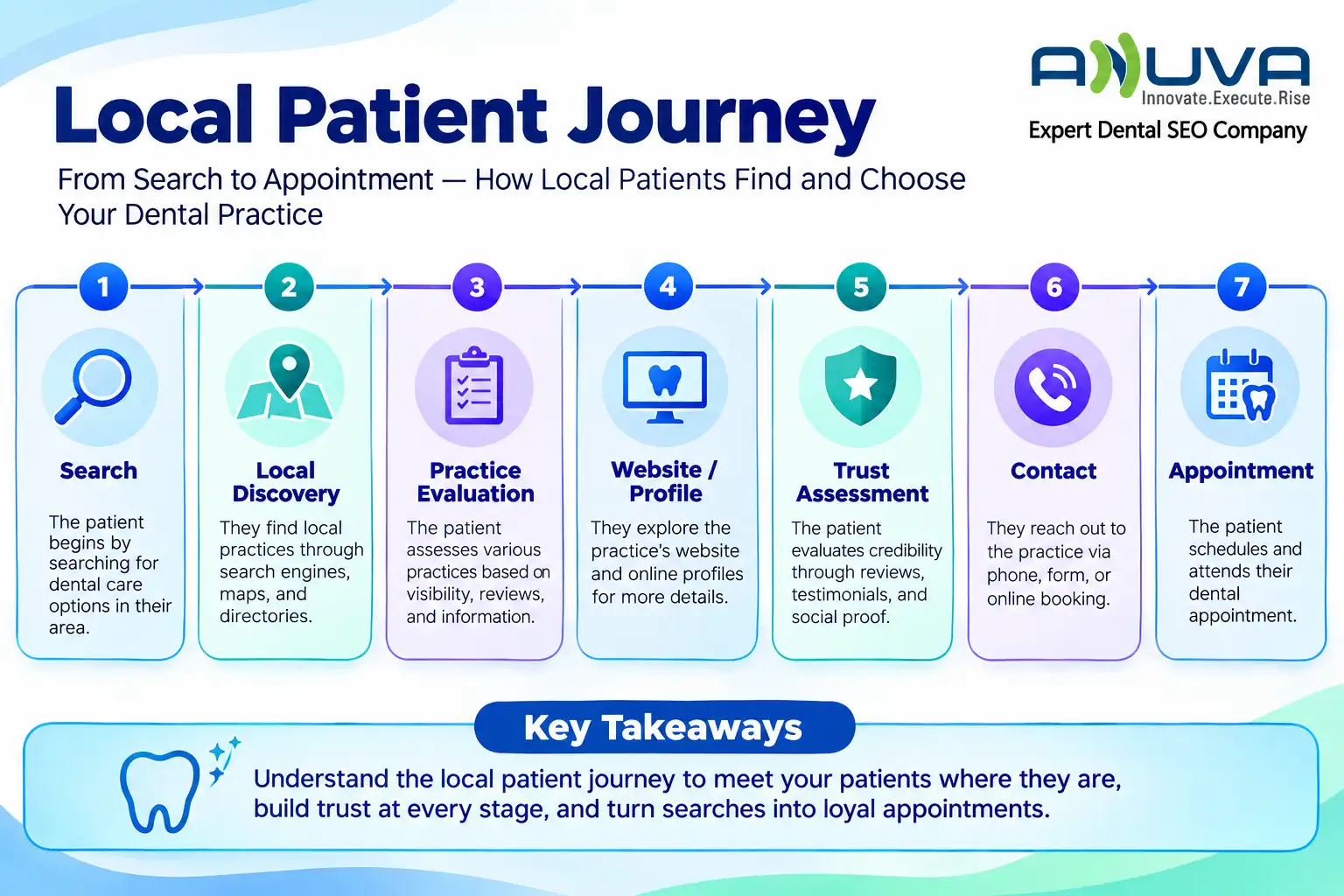
A local patient journey can be represented as:
Search → Local Discovery → Practice Evaluation → Website / Profile Visit → Trust Assessment → Contact → Appointment
At each stage, different local signals can influence the patient’s decision.
Google Business Profile for Dentists
Google Business Profile is one of the most important components of a dental practice’s local search presence.
It can help prospective patients discover:
- Practice name
- Address
- Phone number
- Website
- Hours
- Services
- Reviews
- Photos
- Directions
- Other available business information
It can also provide direct pathways to contact the practice.
What a Strong Google Business Profile Should Communicate?
The profile should make the practice understandable to both searchers and search systems.
Important information includes:
- Accurate business name
- Correct address
- Correct phone number
- Appropriate primary category
- Relevant additional categories where appropriate
- Accurate hours
- Website
- Services
- Practice description
- Photos
- Review activity
- Other relevant business attributes
The objective is accuracy, completeness, relevance, and consistency.
Business Category Selection
Business categories help communicate what the practice is.
Category selection should accurately represent the practice rather than attempt to manipulate search visibility.
For example, a dental practice should select categories that genuinely represent its business and services.
Do not treat categories as a place to insert every possible keyword.
Google Business Profile Services
Services can help communicate what the practice offers.
Examples may include:
- General dentistry
- Dental implants
- Cosmetic dentistry
- Invisalign
- Emergency dentistry
- Pediatric dentistry
- Root canal treatment
- Teeth whitening
Services should accurately reflect what the practice actually provides.
Google Business Profile Photos
Visual information can help patients evaluate a practice.
Useful categories can include:
- Exterior
- Reception
- Treatment rooms
- Doctors
- Team
- Technology
- Office environment
- Patient-oriented experiences where appropriate
The objective is not to create a stock-photo appearance.
Authentic practice imagery generally provides more useful context.
Google Business Profile Reviews
Reviews are an important part of local reputation.
Patients may use reviews to evaluate:
- Experience
- Professionalism
- Communication
- Staff
- Treatment experience
- Overall satisfaction
A review strategy should focus on creating a strong patient experience and making it easy for appropriate patients to share genuine feedback. Reviews should never be fabricated or manipulated.
Review Quality vs Review Quantity
A large review count can be useful, but review quantity alone does not describe the entire reputation of a practice.
Consider:
- Recency
- Authenticity
- Relevance
- Patient experience
- Review content
- Overall reputation
A practice should focus on delivering experiences that patients genuinely value.
Responding to Reviews
Review responses can help demonstrate that the practice is engaged with patient feedback.
Responses should be:
- Professional
- Appropriate
- Patient-focused
- Respectful
- Genuine
- Consistent with privacy requirements
Do not disclose confidential patient information in a public response.
Local SEO and the Dental Website
A Google Business Profile cannot provide all the information a prospective patient may need.
The website supplies depth.
A strong dental website should clearly communicate:
- Practice identity
- Location
- Services
- Specialties
- Doctors
- Treatment information
- Patient information
- Contact options
- Appointment pathways
The website and Google Business Profile should reinforce the same underlying business identity.
Location Information on the Website
A dental practice should make its location understandable.
Useful information can include:
- Complete address
- City
- State
- Service area where appropriate
- Directions
- Nearby landmarks where genuinely useful
- Parking information
- Contact information
- Embedded map where appropriate
Avoid creating artificial location signals for areas the practice does not genuinely serve.
Treatment Pages and Local SEO
Local SEO should not be separated from treatment relevance.
A practice may need visibility for searches such as:
- dental implants in [city]
- cosmetic dentist in [city]
- emergency dentist in [city]
- pediatric dentist in [city]
Treatment pages should therefore communicate both:
What the practice provides
and
Where it provides it
However, this does not mean mechanically repeating city names.
The content should be useful first.
Local Landing Pages
Location-specific pages can be useful when a practice genuinely serves multiple geographic markets.
A useful local page should contain meaningful information about:
- The location
- The practice
- Relevant services
- Patient needs
- Accessibility
- Local context
- Contact or appointment options
A page containing only a city name swap is unlikely to provide a strong patient experience.
Avoiding Doorway-Style Location Content
Creating large numbers of nearly identical location pages solely to capture geographic searches can create a poor experience and may create quality issues.
A location page should exist because it serves a real geographic purpose.
Good local content provides unique value.
Local Keyword Research
Keyword research helps identify how prospective patients search.
Useful categories include:
Provider Searches
- dentist near me
- dentist in [city]
- dental office [city]
Treatment Searches
- dental implants [city]
- cosmetic dentist [city]
- Invisalign [city]
Urgent Searches
- emergency dentist [city]
- emergency dental care near me
Specialty Searches
- pediatric dentist [city]
- orthodontist [city]
- periodontist [city]
Evaluation Searches
- best dentist [city]
- dentist reviews [city]
The purpose of research is to understand demand and intent, not simply collect keywords.
Local Content Strategy
Local content can strengthen the relationship between the practice, its services, and the geographic market.
Potential content can include:
- Treatment education
- New-patient information
- Local patient guides
- Emergency dental information
- Service-specific local resources
- Community-oriented content
- Practice-specific educational resources
Strong local content answers genuine patient questions.
What Makes Local Content Useful?
Useful local content should demonstrate:
- Geographic relevance
- Dental expertise
- Patient usefulness
- Original information
- Clear practice context
- Appropriate treatment relevance
Avoid producing pages that exist only because a keyword tool suggests a city name.
Local Citations
Local citations generally refer to mentions of a business’s core information across relevant directories and platforms.
Important information can include:
- Business name
- Address
- Phone number
- Website
Consistency can help reinforce business identity. However, citation building should not become a quantity exercise. The objective is to maintain accurate and meaningful business information across relevant sources.
Citation Consistency
A practice should review important business information for consistency.
Potential inconsistencies include:
- Different practice names
- Old addresses
- Incorrect phone numbers
- Duplicate listings
- Outdated websites
- Closed locations
- Incorrect categories
Cleaning up important inconsistencies can improve the reliability of the practice’s digital information.
Local Links and Authority
Local authority can also be supported by relevant external references.
Potential sources may include:
- Professional organizations
- Local organizations
- Community institutions
- Relevant industry publications
- Local news
- Legitimate business directories
- Community partnerships
The focus should be relevance and authenticity rather than acquiring links indiscriminately.
Local SEO for New Dental Practices
New practices often have less established local authority.
A practical foundation can include:
- Establish accurate business information.
- Build the website around the actual practice.
- Create and properly manage the Google Business Profile.
- Build treatment and service relevance.
- Establish an authentic review process.
- Develop useful local content.
- Maintain consistent business information.
- Build legitimate local relationships and authority.
- Measure visibility and patient acquisition.
New practices should focus on establishing a credible local entity rather than trying to manufacture authority quickly.
Local SEO for Established Dental Practices
Established practices may have a different problem.
They may already have:
- Strong brand searches
- Existing reviews
- Historical listings
- Existing content
- Multiple citations
- Older website pages
- Outdated information
The challenge becomes improving and consolidating the existing local ecosystem.
A local SEO audit should identify:
- Information inconsistencies
- Duplicate profiles
- Weak service pages
- Missing location relevance
- Reputation gaps
- Outdated content
- Technical issues
- Conversion problems
Local SEO for Multi-Location Dental Practices
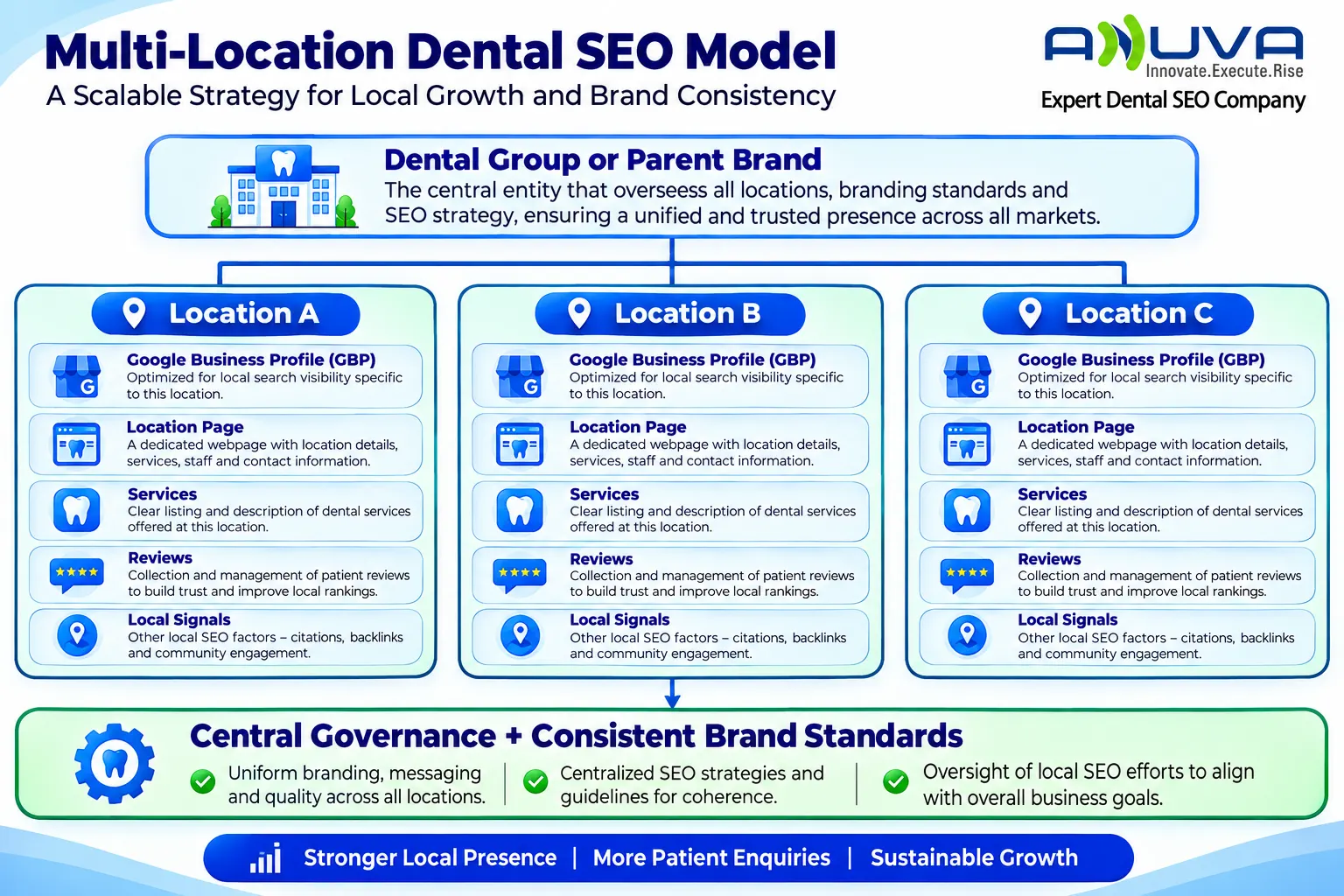
Multi-location practices require additional structure.
Each location may need to establish its own legitimate local identity while remaining part of the larger organization.
Important considerations include:
- Location-specific Google Business Profiles
- Location-specific information
- Unique location pages
- Location-specific services
- Local reviews
- Accurate contact information
- Geographic relevance
- Central brand consistency
Multi-Location Location Pages
Each location page should represent a real practice location.
Useful information can include:
- Location name
- Address
- Phone
- Hours
- Services
- Doctors
- Directions
- Local patient information
- Location-specific FAQs
- Relevant photos
Avoid automatically generating hundreds of pages with minimal unique information.
Local SEO for Dental Groups
Dental groups may need to manage several layers of identity:
Parent Organization → Brand → Location → Doctors → Services
The SEO system should make these relationships understandable without confusing individual practices or locations.
Consistency becomes increasingly important as the number of locations grows.
Local SEO and Dental Specialties
Local SEO should reflect the actual specialties provided by the practice.
Examples include:
- General dentistry
- Cosmetic dentistry
- Implant dentistry
- Orthodontics
- Pediatric dentistry
- Periodontics
- Endodontics
- Oral surgery
- Prosthodontics
The practice should develop visibility around services it genuinely provides.
Local SEO and Reputation
Local visibility and reputation are closely connected.
A patient may discover a practice through search and then immediately evaluate its reviews.
The journey can therefore look like:
Search → Profile → Reviews → Website → Practice Evaluation → Contact
Reputation should be treated as part of the local acquisition system rather than as a separate marketing task.
Local SEO and Patient Experience
Local SEO can create the first interaction with a prospective patient.
The actual patient experience then influences what happens next.
A strong local acquisition system should therefore connect:
Discovery → Confidence → Contact → Appointment → Patient Experience
Patient experience can influence future reviews, referrals, retention, and reputation.
Local SEO and AI Search
Local information is increasingly relevant to AI-powered discovery.
Patients may ask conversational systems questions such as:
- What are good dentists near me?
- Who offers dental implants in my area?
- Where can I find an emergency dentist?
- Which dentist specializes in cosmetic dentistry?
A practice cannot guarantee that an AI system will recommend or cite it.
However, the practice can make its digital information easier to understand by maintaining:
- Consistent business information
- Clear service information
- Strong local content
- Accurate practice details
- Reviews and reputation signals
- Structured information
- Strong website quality
- Consistent entity signals
Local SEO and AI visibility should therefore be viewed as increasingly connected parts of digital discovery.
Local SEO and Entity Development
A dental practice is more than a URL.
It is a real-world entity with:
- Name
- Address
- Doctors
- Services
- Locations
- Reviews
- Website
- Professional identity
- Community relationships
Local SEO helps reinforce these relationships across digital systems.
A strong entity structure can help search systems understand:
This business exists → this is where it operates → these are its services → these are the people associated with it → these are the patients and communities it serves
Local SEO Technical Foundations
Local SEO depends on a technically sound website.
Important areas can include:
- Crawlability
- Indexability
- Mobile usability
- Page speed
- HTTPS
- Internal architecture
- Canonicalization
- Structured data
- Metadata
- Image optimization
- URL structure
Technical SEO does not replace local relevance.
It helps search systems access and understand the information that establishes that relevance.
Structured Data for Dental Practices
Structured data can help communicate information about the practice and its pages.
Depending on the actual implementation, relevant schema types may include:
- Organization
- LocalBusiness
- Dentist
- WebSite
- BreadcrumbList
- Service
- FAQPage where appropriate and valid
Schema should accurately represent visible and legitimate information.
It should not be used to manufacture claims.
NAP Consistency
NAP commonly refers to:
Name + Address + Phone
These are important components of local business identity.
Consistency should be maintained across:
- Website
- Google Business Profile
- Relevant directories
- Professional profiles
- Other important business references
Changes such as relocations or phone-number changes should be managed systematically.
Local SEO Audits
A local SEO audit should examine the entire local ecosystem.
Business Information
- Name
- Address
- Phone
- Hours
- Website
- Location information
Google Business Profile
- Category
- Services
- Description
- Photos
- Reviews
- Accuracy
- Completeness
Website
- Location relevance
- Treatment pages
- Service pages
- Contact information
- Mobile experience
- Technical SEO
- Conversion pathways
Reputation
- Review volume
- Review recency
- Review quality
- Response practices
Local Authority
- Citations
- Relevant references
- Local relationships
- External mentions
Measurement
- Local rankings
- Map visibility
- Organic visibility
- Calls
- Website actions
- Leads
- Appointments
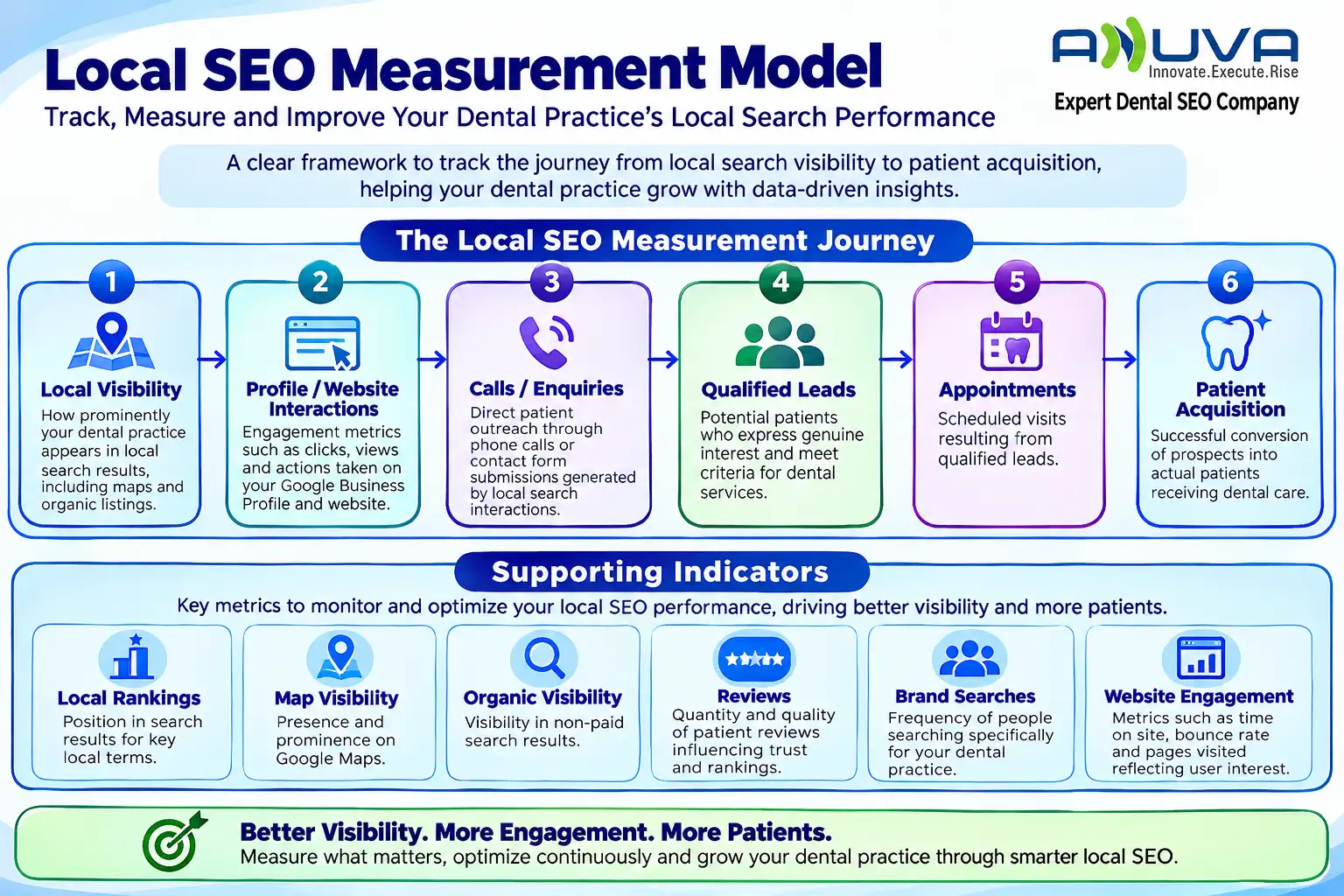
Local SEO Metrics
Local SEO should be measured using both visibility and business outcomes.
Visibility Metrics
- Local search visibility
- Map visibility
- Organic visibility
- Search impressions
- Brand searches
Engagement Metrics
- Website visits
- Google Business Profile interactions
- Website clicks
- Calls
- Direction requests where available
Lead Metrics
- Enquiries
- Consultation requests
- Qualified leads
- Appointment requests
Business Metrics
- Appointments booked
- Patient acquisition
- Treatment opportunities
- Cost per acquisition
- Revenue contribution where measurable
The most useful measurement system connects local visibility to actual patient acquisition.
Local SEO vs Local Lead Generation
Local SEO and local lead generation overlap but are not identical.
Local SEO
Focuses on improving local discovery and relevance.
Local Lead Generation
Focuses on turning that discovery into enquiries and appointments.
The progression is:
Local Visibility → Relevant Visit → Trust → Contact → Appointment
A practice can have strong local visibility and weak conversion.
It can also have a strong website and insufficient local visibility.
A complete system needs both.
Common Local SEO Mistakes for Dentists
Mistake 1: Treating Google Business Profile as the Entire Strategy
GBP is important, but it is one part of a larger local ecosystem.
Mistake 2: Keyword Stuffing City Names
Repeating geographic terms unnaturally can damage content quality and user experience.
Mistake 3: Creating Thin Location Pages
A city-swapped page without meaningful local value is not a strong location asset.
Mistake 4: Ignoring Reviews
Patients frequently use reputation as part of provider evaluation.
Mistake 5: Allowing Business Information to Become Inconsistent
Old addresses and incorrect information can create confusion.
Mistake 6: Building Low-Quality Citations
More listings are not automatically better.
Mistake 7: Ignoring Treatment Intent
Ranking for “dentist near me” alone may not address high-value treatment demand.
Mistake 8: Forgetting Mobile Users
Local searches often lead directly to phone calls or mobile website visits.
Mistake 9: Measuring Rankings Only
Visibility is useful, but the business objective is patient acquisition.
Mistake 10: Creating Artificial Local Presence
A practice should not claim locations it does not genuinely operate from.
Mistake 11: Ignoring the Website
A strong profile cannot compensate indefinitely for a weak website experience.
Mistake 12: Treating Every Location Identically
Multi-location practices require location-specific relevance.
Local SEO Strategy by Practice Stage
New Practice
Prioritize:
- Accurate business identity
- Google Business Profile
- Website foundation
- Service relevance
- Local information
- Authentic reviews
- Measurement
Growing Practice
Prioritize:
- Treatment visibility
- Local content
- Reputation growth
- Conversion optimization
- Search expansion
- Local authority
Established Practice
Prioritize:
- Consolidation
- Technical improvements
- Reputation management
- Service expansion
- Content depth
- Local authority
- Conversion performance
Multi-Location Practice
Prioritize:
- Location architecture
- Profile management
- Location-specific pages
- Local relevance
- Central governance
- Location-level reporting
- Consistency
How to Build a Local SEO Strategy
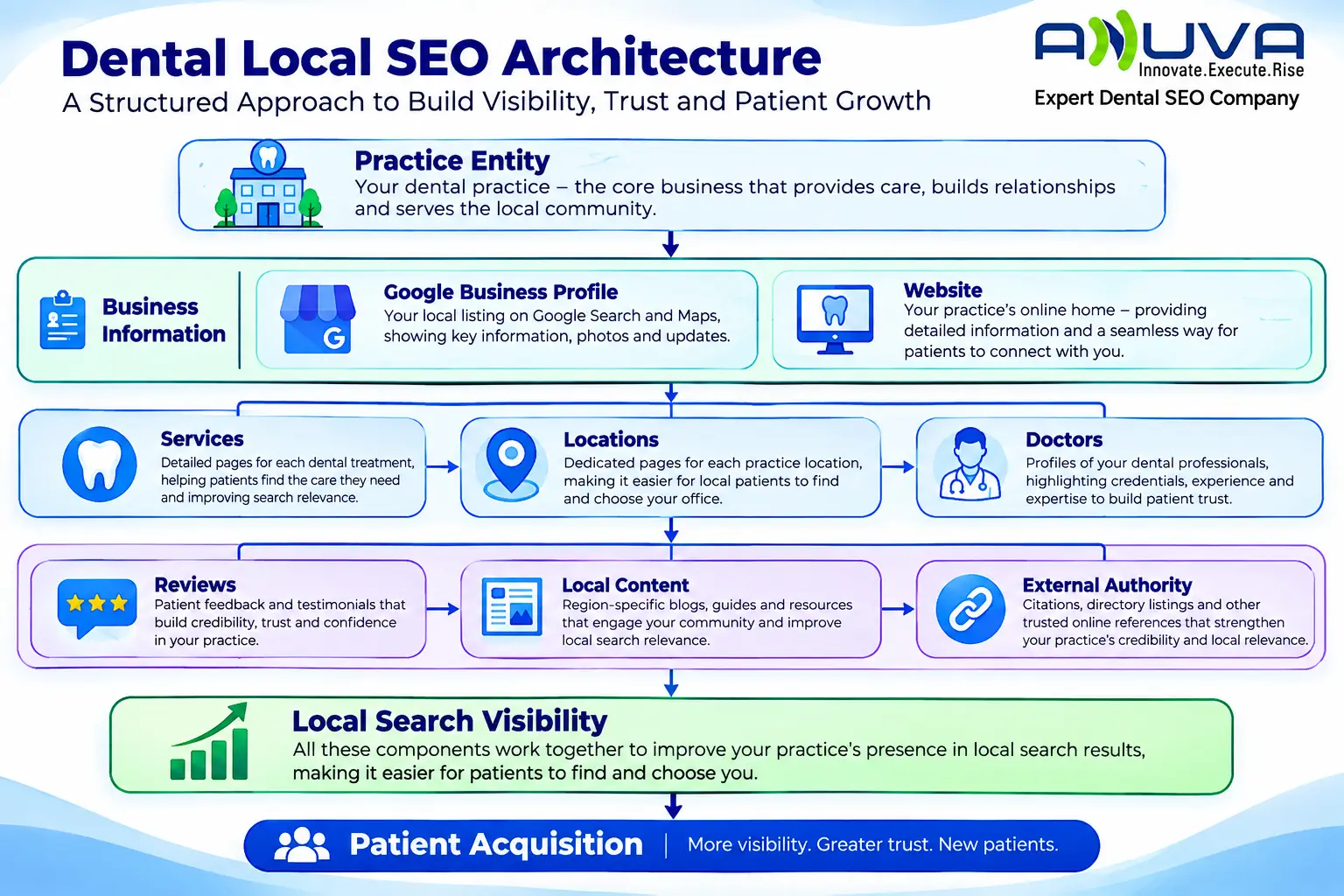
Step 1: Define the Practice Entity
Establish exactly:
- Who the practice is
- Where it operates
- What services it provides
- Which doctors are associated with it
- Which patient groups it serves
Step 2: Audit Local Visibility
Review:
- Google Business Profile
- Maps visibility
- Organic search
- Existing citations
- Reviews
- Website
- Local content
Step 3: Identify Search Demand
Map:
- Provider searches
- Treatment searches
- Specialty searches
- Emergency searches
- Location searches
- Evaluation searches
Step 4: Strengthen the Website
Ensure the website clearly communicates:
- Practice identity
- Location
- Services
- Expertise
- Patient pathways
Step 5: Strengthen Google Business Profile
Ensure information is accurate, complete, and representative of the actual practice.
Step 6: Build Reputation
Focus on genuine patient experience and authentic reviews.
Step 7: Build Local Content
Answer real patient questions with geographic relevance where appropriate.
Step 8: Strengthen Local Authority
Develop legitimate external references and relationships.
Step 9: Improve Conversion
Make it easy for local visitors to:
- Call
- Request an appointment
- Learn about services
- Find directions
- Take the next appropriate action
Step 10: Measure and Improve
Use performance data to identify the next highest-value improvement.
Frequently Asked Questions About Local SEO for Dentists
Local SEO for dentists is the process of improving a dental practice’s visibility and relevance in geographically related searches so local patients can discover and evaluate the practice.
Dental care is location-dependent. Patients generally need providers who can physically serve them, making geographic relevance an important part of dental search behavior.
There is no single component that should be treated as the entire strategy. Google Business Profile, website SEO, reviews, local content, business information, authority, and patient experience can work together as a local visibility system.
Google Business Profile can provide an important local discovery and conversion surface. Its value depends on the accuracy of the profile, local relevance, reputation, search demand, and the broader practice ecosystem.
Dentists can improve local search visibility by strengthening their business information, website relevance, Google Business Profile, reviews, local content, authority, technical foundations, and overall local entity consistency.
Reviews are an important part of local reputation and patient evaluation. Practices should focus on authentic patient experiences and genuine feedback rather than manipulating review activity.
Accurate business information across relevant sources can help reinforce the identity and consistency of a local business. Citation building should focus on quality, relevance, and accuracy rather than volume alone.
Only when there is a genuine geographic reason and the page can provide meaningful value. Creating large numbers of nearly identical location pages simply by changing city names is not a strong local content strategy.
Make the practice’s identity, location, services, doctors, patient information, and contact pathways clear. Build relevant treatment and location content where justified, maintain technical SEO quality, and ensure business information is consistent.
Yes. Local SEO can be applied to specialties such as implants, orthodontics, pediatric dentistry, cosmetic dentistry, periodontics, endodontics, and other legitimate services offered by a practice.
Each genuine location should have accurate local information and appropriate location-specific digital assets while remaining connected to the larger practice or organization.
Emergency dental searches can have strong local intent. Practices offering legitimate emergency services should make those services, location, contact options, and appropriate patient information easy to discover.
There is no universal timeline. Results depend on the practice’s existing authority, competition, location, website, reputation, implementation quality, and other factors. Local SEO is generally an ongoing improvement process rather than a one-time task.
A strong local SEO system can support visibility in local search environments, including Google Maps. However, no agency or strategy can legitimately guarantee a specific Maps position for every search.
Local SEO contributes to the broader digital information ecosystem that AI-powered search systems may use. Consistent business information, clear services, strong content, reviews, and entity signals can make a practice easier to understand. AI visibility itself cannot be guaranteed.
Final Takeaway
Local SEO for dentists is the process of making a real dental practice easier to discover, understand, evaluate, and contact within the markets it genuinely serves.
It is not simply:
“Optimize Google Business Profile.”
It is a broader system connecting:
Website SEO + Google Business Profile + Reviews + Local Content + Local Authority + Patient Experience + AI Visibility
The EDSC Local Authority Framework™ treats these elements as connected signals that collectively strengthen local authority rather than as isolated ranking tactics.
The ultimate objective is not simply better local rankings.
It is:
Local Visibility → Patient Trust → Qualified Enquiries → Appointments → Patient Growth
A dental practice that builds this system consistently creates a stronger digital representation of its real-world authority, services, locations, and patient experience.