

Dental Marketing Analytics & Reporting
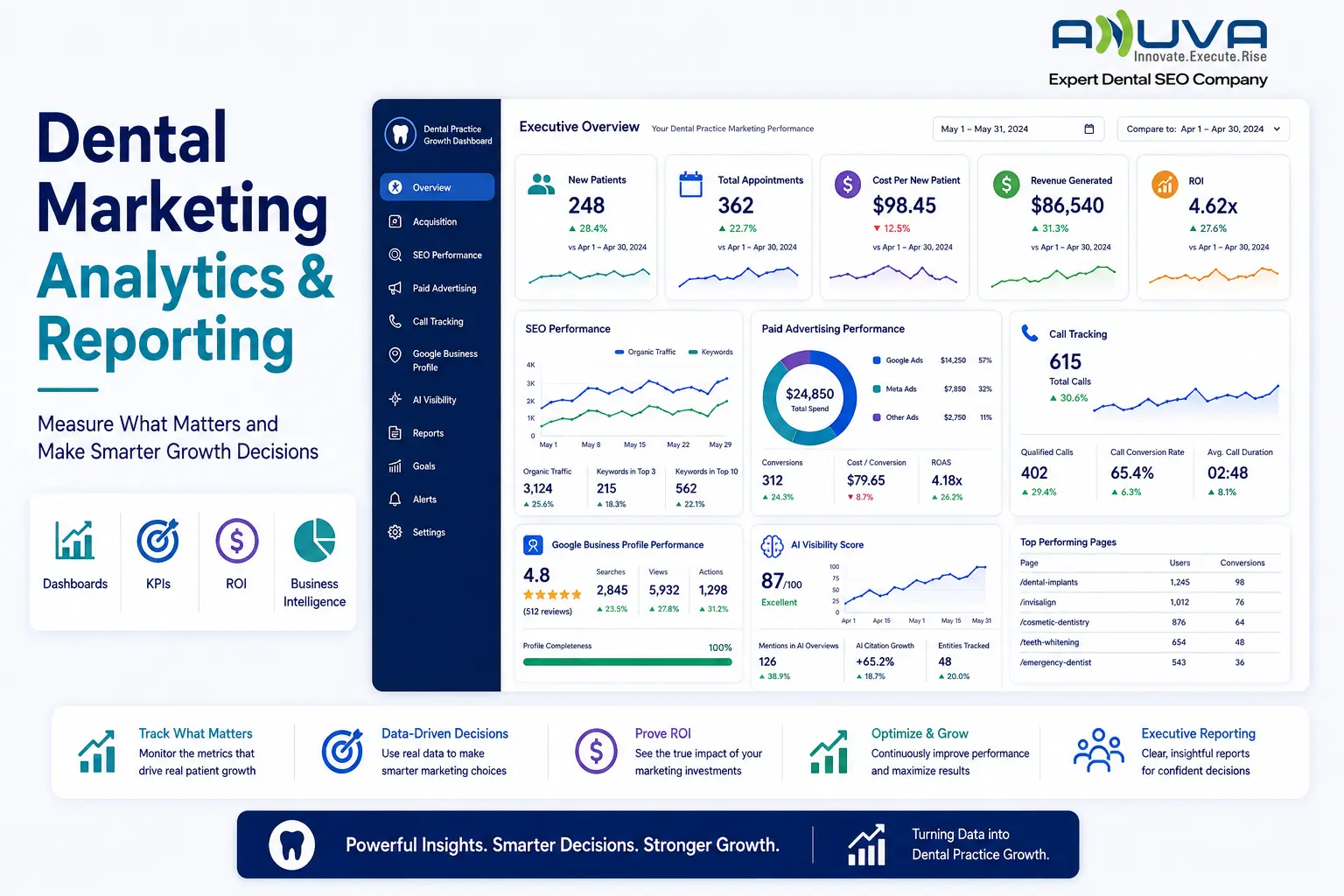
Measure Marketing Performance That Matters
Marketing generates a tremendous amount of data. Your website records visitor activity. Google Ads reports clicks and conversions. Google Business Profile provides search and map interactions. SEO platforms monitor rankings. Social media campaigns report engagement. Call tracking systems capture phone enquiries.
Most dental practices already have access to marketing data. The real challenge is transforming that information into clear business intelligence that supports confident decision-making. When data from SEO, paid advertising, Google Business Profile, websites, phone calls, forms, and other marketing channels is interpreted together, it becomes much easier to understand which investments are creating meaningful patient opportunities and where future improvements should be focused.
The challenge for most dental practices is not a lack of data. It is understanding which information actually helps make better business decisions. A report showing more website visitors may appear encouraging, but increased traffic alone does not necessarily translate into more consultations or new patients. Likewise, higher search rankings, more impressions, or increased social-media engagement only become meaningful when they contribute to measurable patient acquisition.
At Expert Dental SEO Company, we believe marketing analytics should answer practical business questions rather than simply present statistics.
Our reporting approach focuses on helping dental practices understand:
- Which marketing channels generate qualified patient enquiries
- Which campaigns contribute to appointment opportunities
- Where prospective patients leave the conversion journey
- Which treatments generate the strongest marketing performance
- How marketing investments support practice growth
- Which improvements deserve priority attention
Instead of overwhelming practice owners with dozens of disconnected metrics, we organise data into information that supports better marketing and business decisions.
Not sure whether your current marketing reports are helping you make better decisions?
Schedule an Analytics Strategy Session and we’ll review your existing reporting, identify measurement gaps, and recommend improvements that provide clearer visibility into your patient-acquisition performance.
Why Marketing Reports Often Fail Dental Practices
Many dental practices receive monthly marketing reports. Those reports often include valuable information, yet they may still leave an important question unanswered:
“Is our marketing actually helping the practice grow?” Traditional marketing reports frequently emphasise activity instead of outcomes.
For example, reports commonly highlight:
- Website sessions
- Keyword rankings
- Click-through rates
- Advertising impressions
- Social-media engagement
- Backlinks
- Followers
- Bounce rate
While each metric has value within the appropriate context, none of them independently explains whether marketing is creating more qualified patient opportunities. Practice owners usually need answers to different questions.
Such as:
- Which treatments generate the highest-quality enquiries?
- Which marketing channel deserves additional investment?
- Which campaigns should be improved?
- Where are prospective patients abandoning the journey?
- How many enquiries become appointments?
- Which locations produce the strongest results?
- Which landing pages convert most effectively?
Without this broader perspective, marketing decisions often rely on assumptions rather than evidence.
Common Reporting Challenges
Many practices experience one or more of these situations:
Too Many Numbers, Not Enough Insight
Large reports can become difficult to interpret when every metric receives equal attention. The objective should not be to report everything. It should be to identify the information that supports better decisions.
Disconnected Marketing Platforms
Website analytics, advertising platforms, Google Business Profile, call tracking, and CRM systems often operate independently. When these systems are not viewed together, it becomes difficult to understand the complete patient-acquisition journey.
Focusing on Vanity Metrics
High impressions or increased website traffic may appear positive, but they do not necessarily indicate stronger business performance. Meaningful measurement focuses on qualified enquiries, appointment opportunities, patient acquisition, and sustainable growth rather than activity alone.
Limited Attribution
Many practices know that enquiries increased. Fewer know which campaign, keyword, landing page, advertisement, or local search result influenced those enquiries. Improving attribution creates greater confidence when making future marketing investments.
Reports Without Recommendations
A report should not simply describe what happened.
It should also help explain:
- Why performance changed
- Which opportunities deserve attention
- Which problems should be addressed first
- What practical actions could improve future performance
At EDSC, reporting is designed to support ongoing optimisation rather than passive observation.
What Is Dental Marketing Analytics?
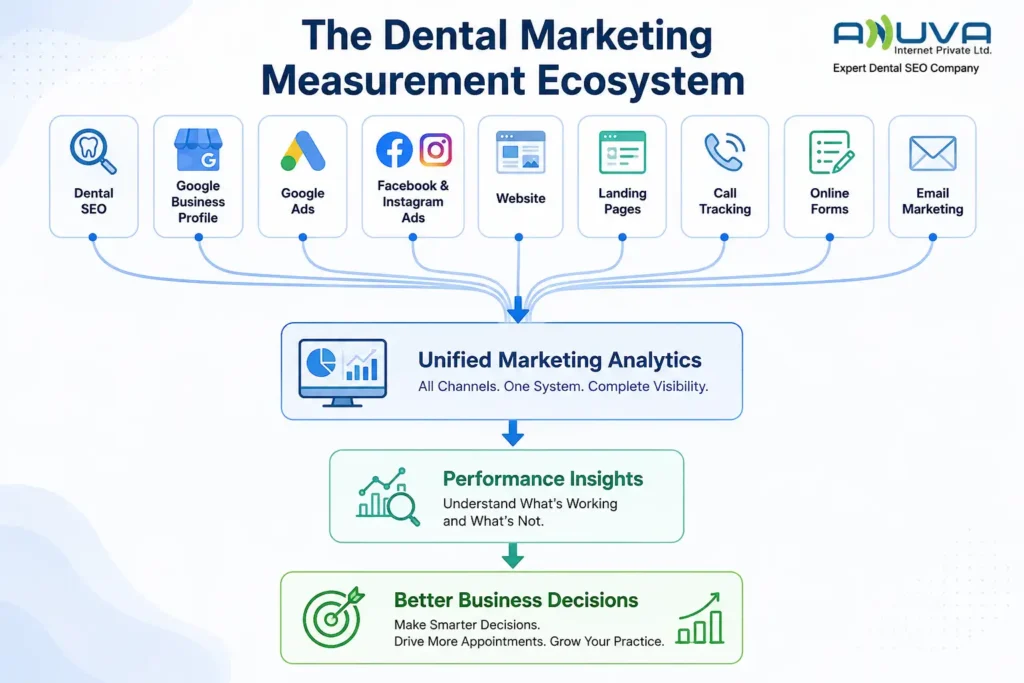
Dental marketing analytics is the process of collecting, organising, interpreting, and applying marketing data to improve patient acquisition and business performance. Rather than measuring isolated marketing activities, analytics connects information from multiple channels to provide a clearer understanding of how prospective patients discover, evaluate, and contact your practice.
Depending on your marketing strategy, analytics may include information from:
- Website activity
- Google Search
- Google Business Profile
- Google Ads
- Facebook and Instagram Ads
- Landing pages
- Phone enquiries
- Contact forms
- Online appointment requests
- Email campaigns
- Marketing automation
- Conversion tracking
When these sources work together, they provide a more complete picture of the patient journey.
The EDSC Growth Intelligence Framework™
Collecting marketing data is relatively straightforward. Turning that data into better business decisions is where many reporting systems fall short.
At Expert Dental SEO Company, we developed the EDSC Growth Intelligence Framework™ to help dental practices move beyond traditional reporting and toward continuous marketing improvement. Rather than treating analytics as a monthly reporting exercise, the framework creates an ongoing cycle of measurement, interpretation, optimization, and growth.
The objective is simple:
Measure what matters, understand why it matters, and use those insights to improve future marketing performance.
Stage 1 – Collect Reliable Marketing Data
Every business decision depends on the quality of the underlying information. The first stage of the framework focuses on ensuring that marketing data is collected accurately across the channels your practice uses.
Depending on your marketing ecosystem, this may include:
- Website analytics
- Google Search performance
- Google Business Profile insights
- Google Ads
- Facebook and Instagram Ads
- Landing pages
- Online appointment requests
- Contact forms
- Phone enquiries
- CRM integrations
- Email marketing
- Marketing automation platforms
Reliable reporting begins with reliable measurement. Without consistent tracking, it becomes difficult to understand which marketing efforts are contributing to practice growth.
Stage 2 – Connect the Patient Journey
Prospective patients rarely interact with only one marketing channel. A typical journey may involve several touchpoints before an appointment is requested.
For example, a prospective patient may:
- Discover your practice through Google Search
- Read treatment information on your website
- Return after seeing a Facebook advertisement
- Review your Google Business Profile
- Read online reviews
- Submit a consultation request
Looking at each interaction separately provides only part of the story. Connecting these touchpoints creates a more complete understanding of how marketing influences patient decision-making.
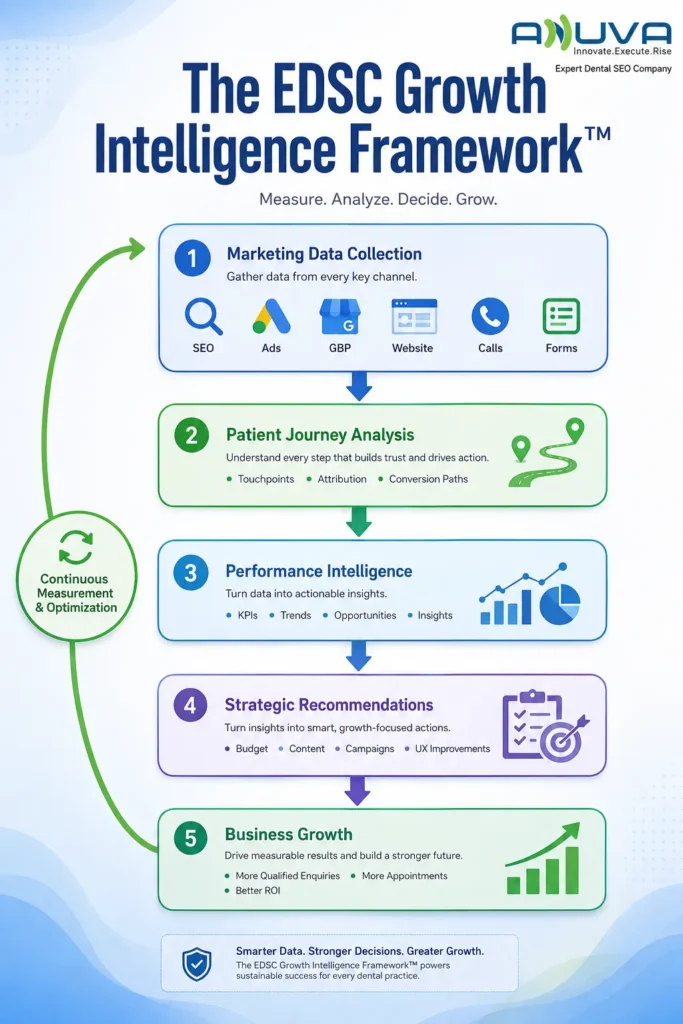
Stage 3 – Identify Performance Trends
Individual metrics become more valuable when viewed over time. Rather than reacting to short-term fluctuations, we analyse trends that indicate meaningful changes in marketing performance.
Looking at a single month’s performance rarely tells the complete story. Sustainable marketing growth is usually revealed through long-term patterns rather than isolated fluctuations. By comparing performance across multiple reporting periods, practices can identify emerging opportunities, recognize declining trends before they become significant problems, and make more informed decisions about future marketing investments.
Examples include:
- Growth in qualified enquiries
- Changes in consultation requests
- Landing-page conversion trends
- Organic search visibility
- Paid advertising efficiency
- Local search engagement
- Audience behaviour
- Seasonal performance patterns
Trend analysis helps distinguish temporary variation from opportunities that deserve strategic attention.
Stage 4 – Prioritize Improvement Opportunities
Analytics should guide action. After reviewing available data, we identify areas that may offer the greatest opportunity for improvement.
Examples include:
- Underperforming landing pages
- High-performing campaigns that could be expanded
- Treatments with increasing demand
- Declining conversion rates
- Geographic opportunities
- Budget allocation improvements
- Technical measurement gaps
- Patient journey friction points
Not every metric requires immediate action. Prioritizing improvements helps practices focus time and resources where they can have the greatest impact.
Stage 5 – Measure Business Outcomes
Ultimately, marketing exists to support practice growth. While marketing metrics remain important, they should be connected to broader business outcomes whenever possible.
Examples include:
- Qualified patient enquiries
- Consultation requests
- Appointment volume
- Treatment-specific enquiries
- Patient acquisition trends
- Marketing efficiency
- Return on marketing investment
- Long-term practice growth
This final stage closes the loop between marketing activity and business performance, creating a continuous improvement process rather than a static reporting cycle.
Our Dental Analytics & Reporting Services
Our analytics services are designed to provide clarity rather than complexity. Instead of delivering lengthy reports filled with disconnected metrics, we organize information into practical insights that support better marketing decisions. Each service contributes to a broader understanding of how prospective patients discover, evaluate, and choose your dental practice.
Marketing Performance Audits
Before meaningful reporting can begin, it’s important to evaluate how marketing is currently being measured. Our Marketing Performance Audits review the existing reporting ecosystem to identify strengths, gaps, and opportunities for improvement.
Depending on your current setup, the audit may evaluate:
- Website tracking configuration
- Conversion tracking
- Google Analytics implementation
- Google Search Console integration
- Google Business Profile insights
- Advertising platform measurement
- Call tracking
- Form tracking
- Landing-page performance
- Attribution accuracy
- Dashboard quality
The objective is to determine whether your existing data supports confident business decisions—or whether important pieces of the patient journey are being overlooked.
GA4 & Website Analytics
Your website serves as one of the primary touchpoints in the patient journey. Google Analytics 4 (GA4) provides valuable information about how visitors interact with your website before becoming patients.
When configured appropriately, GA4 can help answer questions such as:
- Which pages attract the most visitors?
- Where do users leave the website?
- Which marketing channels generate the most engaged visitors?
- How do visitors navigate through treatment pages?
- Which landing pages contribute to conversions?
- How do mobile and desktop experiences compare?
Rather than focusing solely on traffic volume, we interpret website behaviour to identify opportunities for stronger engagement and improved conversion performance.
Google Business Profile Insights
For practices that depend on local visibility, Google Business Profile provides another valuable source of marketing intelligence. Insights from your profile can help identify how prospective patients interact with your practice before visiting your website or contacting your office.
Depending on available data, reporting may include:
- Search visibility trends
- Maps visibility
- Direction requests
- Phone call activity
- Website visits from GBP
- Photo engagement
- Local search behaviour
- Seasonal activity patterns
Combined with website analytics and local SEO reporting, these insights provide a clearer understanding of how local search contributes to patient acquisition.
Call Tracking & Lead Attribution
Many dental practices receive enquiries through multiple channels, including phone calls, contact forms, online appointment requests, and messaging platforms. Without effective attribution, it becomes difficult to understand which marketing efforts are generating those enquiries. Call tracking and lead attribution help connect patient enquiries back to the marketing activities that influenced them.
Depending on your systems and processes, attribution may include:
- Organic search enquiries
- Paid search campaigns
- Facebook and Instagram advertising
- Google Business Profile
- Landing pages
- Referral sources
- Campaign-specific tracking
- Form submissions
- Phone enquiries
The goal is not simply to count leads but to understand the journey that produced them, enabling more informed marketing decisions over time.
Conversion Tracking
Understanding how prospective patients interact with your marketing is only part of the equation. To evaluate marketing effectiveness, practices also need visibility into the actions visitors take after engaging with your website, advertisements, or local business listings. Conversion tracking helps connect those interactions with meaningful business outcomes.
Rather than measuring every website interaction equally, we focus on the actions that indicate genuine patient interest.
Depending on your marketing objectives, conversion tracking may include:
- Appointment request submissions
- Consultation requests
- Contact form completions
- Phone call enquiries
- Click-to-call actions on mobile devices
- Online scheduling interactions
- Treatment-specific enquiries
- Downloadable patient resources
- Live chat conversations
- Newsletter subscriptions (where applicable)
Reliable conversion tracking provides the foundation for understanding which marketing activities contribute to qualified patient opportunities.
Marketing Dashboards
Marketing data is often spread across multiple platforms. A practice may review website analytics in one system, advertising performance in another, and Google Business Profile insights somewhere else. This fragmented approach makes it difficult to identify broader trends or evaluate overall marketing performance. Marketing dashboards bring key performance information together into a centralized view.
Depending on your reporting requirements, dashboards may include:
- Website traffic trends
- Organic search performance
- Google Business Profile activity
- Google Ads performance
- Facebook and Instagram campaign results
- Conversion metrics
- Call tracking
- Lead volume
- Landing-page performance
- Channel comparisons
The objective is not simply to display more information. It is to organize data in a way that supports faster, more informed business decisions.
Performance Reporting
Reports should provide context not just numbers. At EDSC, performance reporting is designed to explain what changed, why it changed, and what opportunities may exist moving forward. Our reporting approach emphasizes clarity and actionable insight over technical complexity.
A comprehensive marketing report may include:
- Executive performance summary
- Channel-by-channel performance review
- Visibility trends
- Patient enquiry trends
- Conversion analysis
- Campaign highlights
- Opportunities for improvement
- Recommended next steps
This structured approach allows practice owners and marketing teams to quickly understand the current state of their marketing efforts without needing to interpret dozens of disconnected metrics.
Continuous Growth Analysis
Marketing performance changes over time. Search behaviour evolves. Competition increases. Advertising platforms introduce new features. Patient expectations shift. Continuous analysis helps practices adapt to these changes while maintaining consistent marketing performance.
Rather than reviewing isolated monthly reports, we evaluate longer-term trends that help identify sustainable growth opportunities.
Examples include:
- Improving conversion pathways
- Expanding successful campaigns
- Identifying emerging treatment demand
- Improving local visibility
- Refining advertising audiences
- Enhancing landing-page performance
- Strengthening patient acquisition efficiency
- Improving overall return on marketing investment
Continuous improvement transforms reporting from a historical record into a strategic planning tool.
What should be included in a dental marketing report?
A comprehensive dental marketing report should connect marketing activities with business outcomes. Typical reporting includes website performance, search visibility, Google Business Profile insights, paid advertising results, conversion tracking, qualified patient enquiries, lead attribution, landing-page performance, and practical recommendations for future improvement.
Marketing Reports vs. Marketing Intelligence
Many agencies provide marketing reports. Fewer provide marketing intelligence. While both involve collecting and presenting data, their purpose and value are fundamentally different. A report explains what happened.
Marketing intelligence helps explain why it happened, what it means, and what should happen next. The distinction is important because better decisions come from interpretation—not from data alone.
Although the terms are sometimes used interchangeably, reporting and marketing intelligence represent different levels of business value. Reports primarily organize historical information, while marketing intelligence transforms that information into practical recommendations that guide future strategy. The objective is not simply to know what happened, but to understand why it happened and determine the most effective next steps for continued growth.
Feature | Traditional Marketing Reports | EDSC Growth Intelligence™ |
Primary focus | Activity metrics | Business outcomes |
Reporting style | Historical summaries | Action-oriented insights |
Website traffic | Reported | Interpreted in context |
SEO rankings | Listed | Connected to enquiries and conversions |
Advertising metrics | Clicks and impressions | Cost efficiency and lead quality |
Attribution | Limited | Multi-channel perspective |
Recommendations | Often minimal | Prioritized improvement roadmap |
Decision support | Passive | Strategic guidance |
Goal | Inform the client | Improve future performance |
Marketing intelligence enables dental practices to make more confident decisions about marketing priorities, resource allocation, and long-term growth strategies.
Why Dental Practices Choose Expert Dental SEO Company
Marketing analytics should do more than explain what happened last month. It should help practice owners make better decisions about where to invest their time, budget, and marketing resources moving forward.
At Expert Dental SEO Company, we approach reporting as a strategic business tool rather than an administrative task. Our focus is on translating complex marketing data into practical recommendations that support patient acquisition and long-term practice growth.
We Measure Business Outcomes Not Just Marketing Activity
Many marketing reports focus on isolated metrics such as rankings, impressions, or website traffic. While those indicators provide useful context, they are only part of the picture.
Our reporting philosophy centers on business outcomes, including:
- Qualified patient enquiries
- Consultation requests
- Appointment opportunities
- Treatment-specific demand
- Marketing efficiency
- Return on marketing investment
- Sustainable practice growth
This business-first perspective helps practices evaluate marketing performance in terms that matter to owners and leadership teams.
We Connect Every Marketing Channel
Patients interact with multiple touchpoints before choosing a dental practice. Our reporting approach brings these channels together into one cohesive measurement system.
Examples include:
- Dental SEO
- Google Business Profile
- Google Ads
- Facebook & Instagram Ads
- Website performance
- Landing pages
- Email campaigns
- Marketing automation
- Phone enquiries
- Contact forms
Rather than reviewing each platform independently, we analyze how they work together throughout the patient journey.
We Turn Data into Decisions
Collecting information is only the first step.
The real value comes from understanding:
- What changed?
- Why did it change?
- What should be improved?
- Which opportunities deserve investment?
- Which campaigns should be expanded?
- Which marketing activities should be refined?
Every report is designed to answer these questions with practical, evidence-based recommendations.
Continuous Improvement Is Built Into Our Process
Marketing performance evolves continuously. Search algorithms change. Advertising platforms introduce new capabilities. Competitors adjust their strategies. Patient expectations shift. Our reporting process reflects this reality by emphasizing ongoing optimization rather than one-time analysis.
Each reporting cycle creates new opportunities to improve marketing effectiveness and strengthen patient acquisition over time.
Our Analytics & Reporting Process
Every reporting engagement follows a structured methodology designed to improve both measurement accuracy and marketing performance.
Step 1 – Discovery & Goal Alignment
We begin by understanding your practice’s objectives.
This includes reviewing:
- Practice growth priorities
- Current marketing channels
- Key performance indicators (KPIs)
- Existing reporting tools
- Business goals
- Target treatments
- Geographic focus
Clear objectives create the foundation for meaningful reporting.
Step 2 – Measurement & Tracking Review
Next, we evaluate how marketing data is currently collected.
Depending on your setup, this may include reviewing:
- Google Analytics 4
- Google Search Console
- Google Business Profile
- Google Ads
- Meta Ads Manager
- Conversion tracking
- Contact forms
- Call tracking
- CRM integrations
- Marketing automation platforms
This step helps identify missing or inaccurate measurement before reporting begins.
Step 3 – Performance Analysis
After validating data quality, we analyze performance across your marketing ecosystem.
This includes evaluating:
- Organic visibility
- Paid advertising
- Local search
- Website engagement
- Conversion pathways
- Patient enquiries
- Audience behavior
- Campaign effectiveness
Our objective is to understand the complete patient-acquisition journey—not just individual marketing channels.
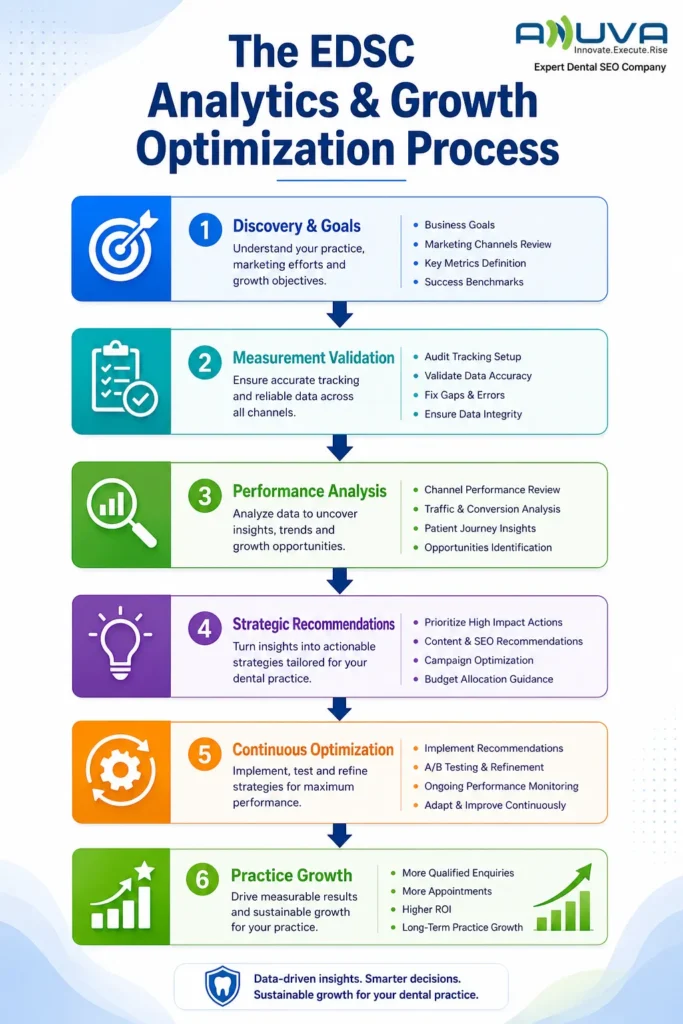
Step 4 – Strategic Recommendations
Reporting becomes valuable when it leads to action.
Based on our analysis, we provide prioritized recommendations that may include:
- SEO opportunities
- Landing-page improvements
- Advertising optimizations
- Conversion enhancements
- Content recommendations
- Local SEO improvements
- Budget allocation guidance
- Patient journey improvements
Recommendations are prioritized according to potential business impact.
Step 5 – Continuous Growth Optimization
Marketing is an ongoing process. As new data becomes available, we monitor trends, evaluate results, and identify opportunities for continuous improvement.
This ongoing cycle supports:
- Better decision-making
- Stronger patient acquisition
- Improved marketing efficiency
Sustainable long-term growth
Frequently Asked Questions
Marketing analytics helps practices understand which activities contribute to qualified patient enquiries, appointments, and long-term growth. Instead of relying on assumptions, practices can make informed decisions using measurable performance data.
Reporting presents performance data. Analytics interprets that data to identify trends, opportunities, and recommendations that support future decision-making.
Comprehensive reporting typically includes website analytics, SEO, Google Business Profile, Google Ads, Facebook and Instagram Ads, landing pages, phone calls, contact forms, email campaigns, and conversion tracking where applicable.
Yes. Better measurement helps identify which channels, campaigns, and marketing activities contribute most effectively to qualified patient enquiries, allowing practices to allocate resources more efficiently.
Most practices benefit from monthly reporting combined with quarterly strategic reviews to evaluate longer-term trends and identify new opportunities.
No.
GA4 provides valuable website behavior insights, but it works best when combined with platforms such as Google Search Console, Google Business Profile Insights, advertising platforms, call tracking systems, and CRM data.
Key Performance Indicators (KPIs) are measurable metrics used to evaluate marketing success.
Examples include qualified enquiries, appointment requests, conversion rates, cost per acquisition, and return on marketing investment.
Yes.
Performance analysis helps identify campaigns, landing pages, audiences, or marketing channels that may benefit from optimization or strategic adjustment.
Attribution connects patient enquiries to the marketing activities that influenced them, helping practices better understand which investments contribute to business growth.
We combine technical measurement with strategic interpretation.
Our goal is not simply to provide reports but to help dental practices make better marketing decisions that support measurable patient acquisition and long-term business growth.
Every practice should monitor KPIs that directly relate to business growth rather than relying only on traffic or visibility metrics. Common performance indicators include qualified patient enquiries, appointment requests, conversion rates, cost per qualified lead, return on marketing investment, landing page performance, call tracking, treatment-specific demand, and overall patient acquisition trends. The most useful KPIs are those that help practice owners make informed marketing and budgeting decisions over time.
Ready to Make Better Marketing Decisions?
The most valuable marketing reports don’t simply describe the past. They help shape the future.
Whether you’re investing in SEO, paid advertising, local search, social media, or a combination of marketing channels, clear measurement can provide the confidence needed to make smarter decisions and improve long-term performance.
Schedule a Marketing Analytics Strategy Session
We’ll review your current reporting systems, identify measurement gaps, and recommend practical improvements that provide greater visibility into your marketing performance and patient-acquisition strategy.
Request a Marketing Performance Audit
Receive a professional evaluation of your analytics setup, attribution systems, conversion tracking, dashboards, and reporting processes, along with prioritized recommendations for improving marketing intelligence.