

Dental PPC Services
Paid Advertising Built to Generate Qualified Patient Enquiries
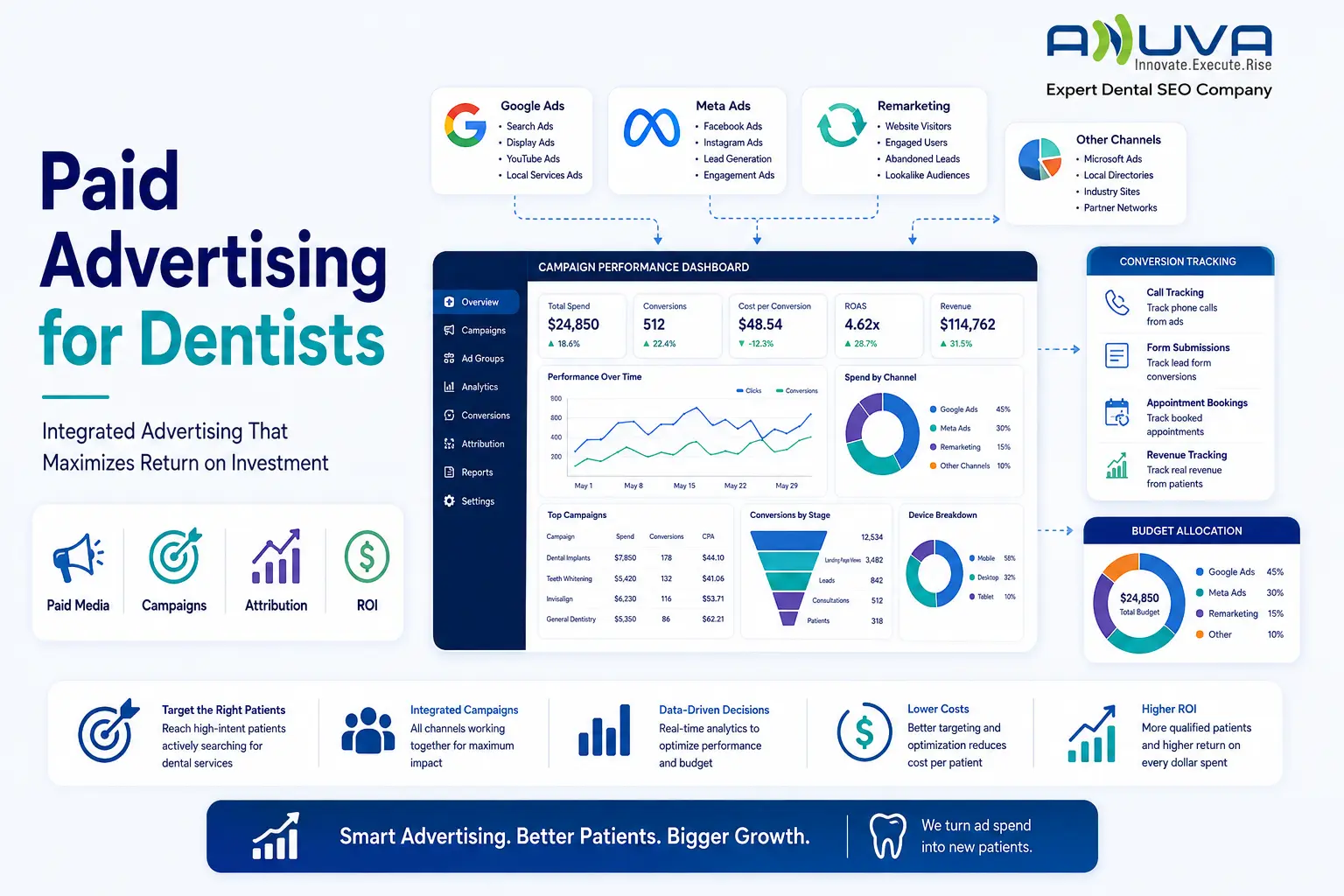
Dental Paid advertising can put your dental practice in front of prospective patients at important moments in their decision-making journey. Someone searching for an emergency dentist may need care immediately. Someone researching dental implants may be comparing treatment options and providers. Someone seeing an Invisalign campaign on Facebook or Instagram may be beginning to consider treatment and need more information before booking a consultation. Each situation requires a different message, channel, destination page, and conversion path.
At Expert Dental SEO Company, we do not treat paid advertising as a simple process of launching ads and increasing budgets. We build paid-acquisition strategies designed to help your practice reach the right audience, present the right message, and create a clear path from interest to appointment request. Our Dental PPC Services combine the components that influence advertising performance:
- Google Ads for high-intent treatment searches
- Dental Facebook and Instagram Ads for awareness, audience development, and remarketing
- Treatment-focused campaign planning
- Relevant landing pages
- Clear calls to action
- Conversion and call tracking
- Budget management
- Ongoing campaign improvement
The objective is not simply more impressions or clicks. It is helping your practice generate more qualified patient enquiries from advertising investment. Whether the strategy includes Google Ads for Dentists, Facebook/Meta advertising or multiple paid channels, the objective is to make the media investment purposeful, measurable and aligned with the practice’s broader acquisition goals.
Why Dental Practices Need a Smarter Paid Advertising Strategy?
Why Clicks Don’t Always Become Patients?
Many dental practices judge paid advertising by impressions, clicks, or website traffic. While these metrics can indicate campaign activity, they do not necessarily reflect business growth. A campaign that generates hundreds of clicks may still produce very few qualified patient enquiries if the targeting, messaging, landing page, or conversion process is weak.
Successful dental paid advertising should be measured by meaningful patient outcomes rather than advertising activity alone. A prospective patient must first see the right advertisement, arrive on a relevant treatment page, gain confidence in your practice, and then complete an enquiry, book an appointment, or call your office. If any stage of this journey creates confusion or friction, advertising performance will suffer regardless of how many visitors your campaign attracts.
At Expert Dental SEO Company, we evaluate paid advertising as a complete patient-acquisition system rather than a collection of isolated campaign metrics. Our objective is to help practices generate more qualified patient opportunities by improving every stage of the advertising journey from targeting and messaging to landing pages, conversion paths, and ongoing optimization.
Many dental practices turn to paid advertising because they want faster visibility. That can be a sensible goal. Unlike long-term organic marketing, dental paid campaigns can reach prospective patients soon after launch when the campaign, targeting, and destination experience are well aligned. However, faster visibility does not automatically create better results.
A campaign can spend budget on irrelevant searches, reach people outside the practice’s service area, send visitors to generic pages, or generate leads that are difficult to turn into appointments. The difference is not simply the advertising platform. The difference is the strategy behind it. A well-planned paid-media strategy for dental practice should answer:
- Which treatments should we promote?
- Which patient audiences are most valuable?
- Should we prioritize Google Ads, Facebook Ads, or both?
- What geographic area should campaigns reach?
- Where should prospective patients land after clicking?
- What action should the page encourage?
- How will calls, forms, and bookings be tracked?
- How will we know whether the investment is improving patient acquisition?
At EDSC, we help dental practices answer these questions before campaigns are built or expanded. This allows paid advertising for dental clinic to function as part of a broader acquisition system instead of becoming an isolated monthly expense. Paid advertising for dental office provides opportunities to place targeted messages in front of relevant audiences, but performance depends on demand, targeting, competition, offer, creative, landing experience, budget and follow-up.
What Are Dental PPC Services?
Dental PPC Services are paid advertising strategies designed to help dental practices reach prospective patients through platforms such as Google Ads, Facebook, and Instagram. They combine targeting, treatment-focused messaging, landing pages, conversion tracking, and ongoing optimization to generate qualified patient enquiries rather than simply increasing website traffic.
PPC commonly refers to pay-per-click advertising, where advertisers pay when someone clicks an ad. In practice, a successful dental paid-media strategy involves far more than clicks. It includes campaign planning, audience and keyword targeting, ad messaging, relevant landing pages, conversion tracking, budget management, and ongoing optimization. The goal is to connect advertising investment with meaningful patient actions, such as:
- Phone calls
- Appointment requests
- Online bookings
- Treatment consultations
- New-patient enquiries
- Emergency care calls
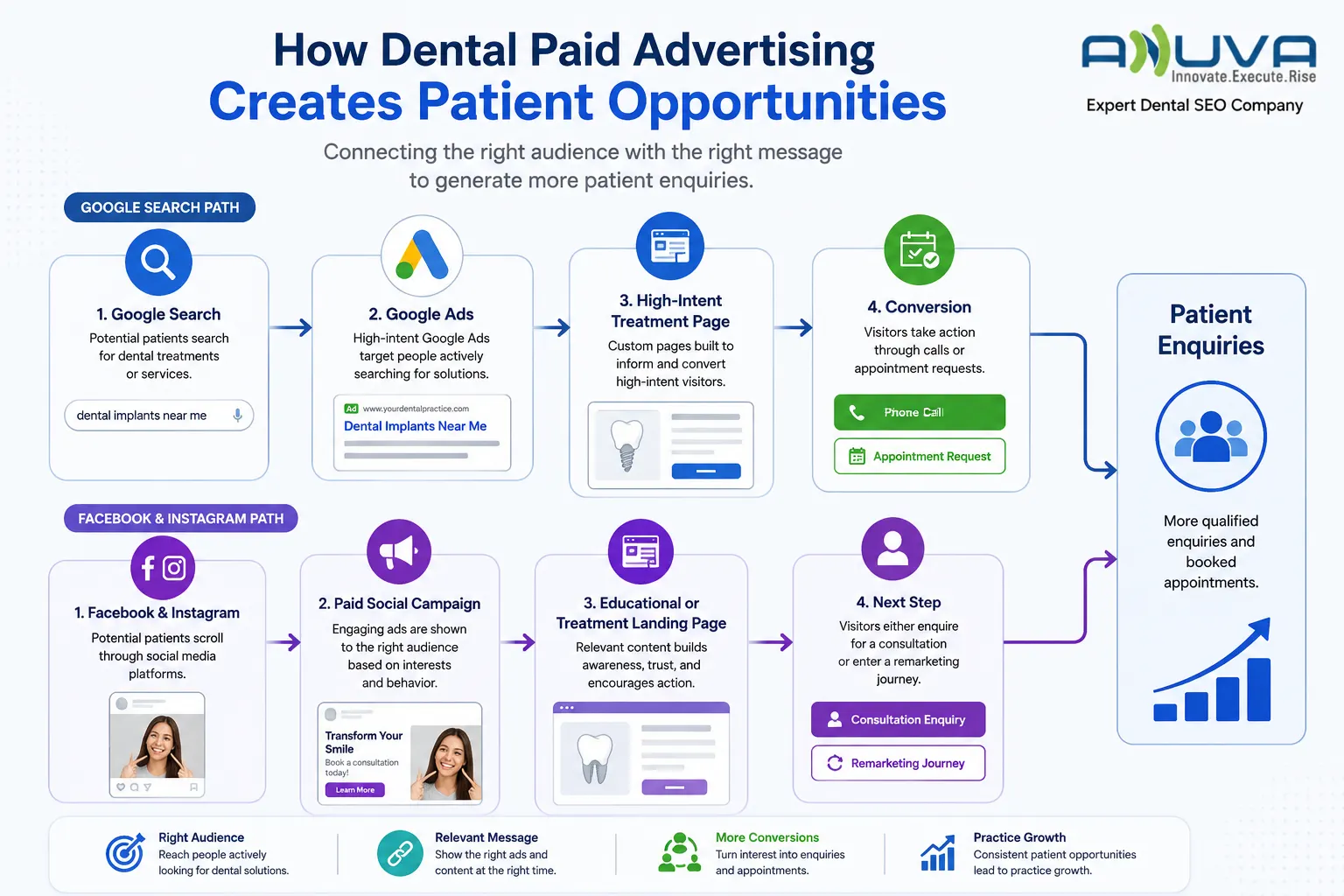
Google Ads, Facebook Ads & the Right Channel for Your Practice
Google Ads and Facebook Ads can both support dental patient acquisition, but they play different roles.
Google Ads usually captures existing demand. When someone searches for “emergency dentist near me,” “dental implants consultation,” or “Invisalign provider,” they are actively looking for a solution. Search advertising can help your practice appear at that moment of intent.
Facebook and Instagram Ads can help create and re-engage demand. They are useful for introducing treatment options, promoting practice education, reaching carefully defined audiences, sharing patient-focused content, and reconnecting with people who previously visited your website or engaged with your brand. The best channel depends on your goals.
If your priority is… | Strong starting point |
Capturing urgent or high-intent treatment searches | Google Ads |
Promoting a new treatment or awareness campaign | Facebook and Instagram Ads |
Reaching people who visited but did not contact the practice | Remarketing |
Supporting high-value consultation campaigns | A coordinated Google Ads, paid social, landing-page, and follow-up strategy |
Building long-term patient demand | Paid advertising alongside SEO, Local SEO, content, and reputation-building |
No channel should be selected simply because it is popular. The right approach depends on your treatment focus, local market, patient journey, budget, conversion assets, and growth objectives.
Why Paid Advertising Campaigns Underperform?
Most underperforming campaigns do not fail because paid advertising is ineffective. They fail because one or more important parts of the acquisition journey are disconnected.
Broad or Unfocused Targeting
Campaigns that target broad, low-intent, or poorly matched audiences often generate activity without producing relevant patient enquiries. Effective targeting should reflect the treatments you provide, your geographic service area, and the patients you want to attract.
Generic Ad Messaging
A generic message rarely gives a prospective patient a reason to choose your practice. Advertising should connect clearly to the treatment, patient need, or next step that prompted the click or engagement.
Irrelevant Destination Pages
An ad for dental implants should not send visitors to a general homepage where they must search for information. Relevant landing pages reduce friction and help patients understand the treatment, evaluate the practice, and request a consultation more easily.
Weak Conversion Paths
Even a highly relevant campaign can underperform when the next step is unclear. Phone numbers, forms, appointment links, trust signals, and treatment-specific calls to action should be easy to find and use—particularly on mobile devices.
Incomplete Tracking
Without reliable tracking, it is difficult to determine which campaigns, keywords, audiences, and landing pages create meaningful patient opportunities. Clicks alone do not explain whether an advertising investment is contributing to practice growth.
The EDSC Patient Acquisition Framework™
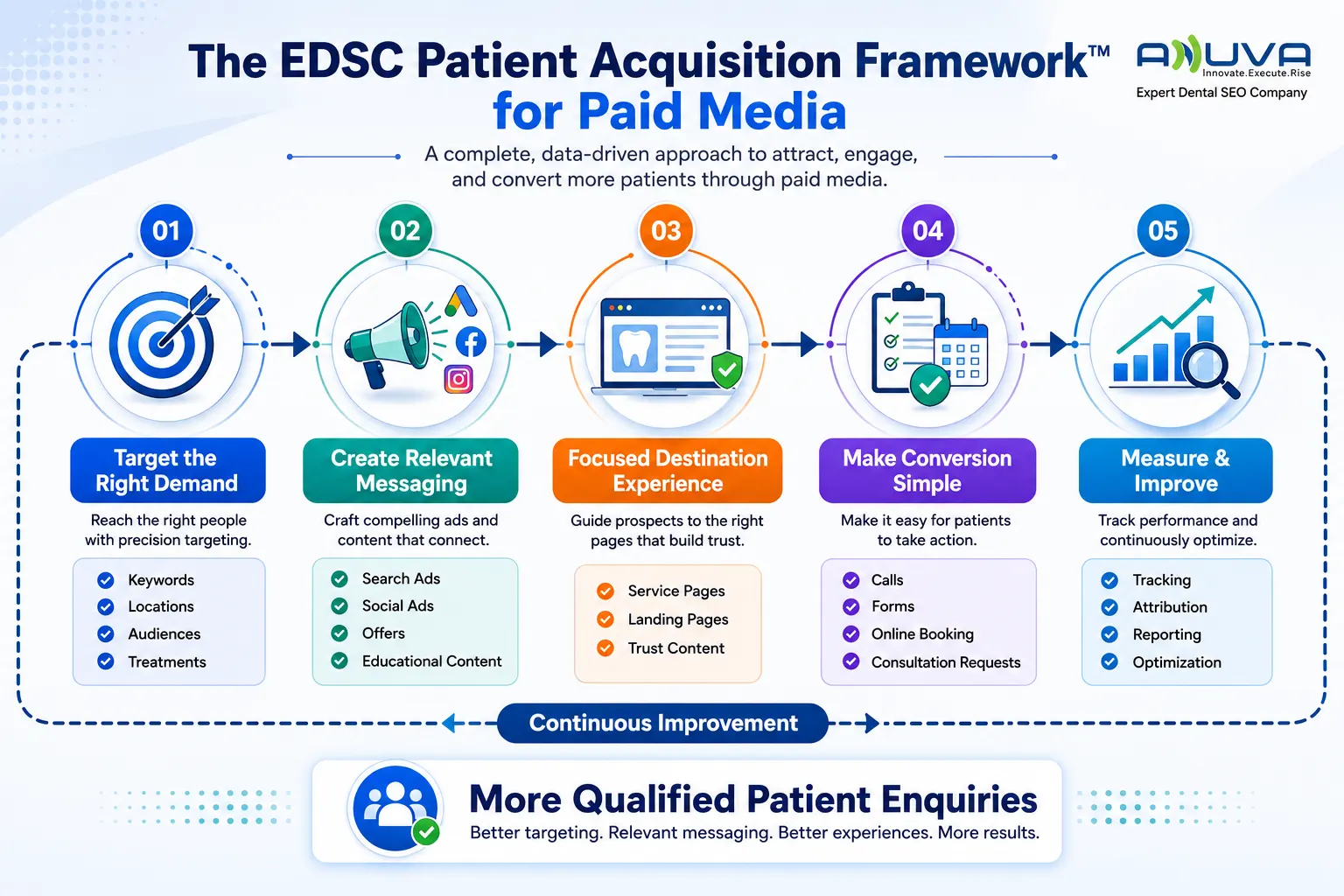
Paid advertising works best when it is treated as part of a complete patient-acquisition system. A keyword, advertisement, or social campaign may create initial interest. But a prospective patient still needs to understand the offer, trust the practice, reach a relevant page, and feel confident taking the next step.
The EDSC Paid Advertising Framework™ provides a structured way to plan, launch, measure and improve paid campaigns around the practice’s actual business priorities. The framework connects five stages of patient acquisition:
- Target the Right Demand
Identify treatments, locations, audiences, and search behavior that align with your goals. - Create Relevant Messaging
Match the advertisement to the patient’s need, treatment interest, or decision stage. - Deliver a Focused Destination Experience
Send visitors to a relevant service page or landing page that answers their questions and supports action. - Make Conversion Simple
Use clear calls to action, mobile-friendly forms, click-to-call options, online booking, and trust signals. - Measure and Improve
Track meaningful actions, review performance, and refine the system based on evidence.
This approach allows us to evaluate advertising as a patient-acquisition process rather than a collection of isolated campaign metrics.
Our Dental Paid Advertising Services
Our Dental PPC Services are designed to strengthen every stage of the paid patient-acquisition journey.
Paid Advertising Strategy & Channel Planning
Every campaign begins with strategy. Before we recommend a platform, budget, or campaign type, we consider:
- Priority treatments
- Ideal patient profiles
- Geographic service area
- Local competition
- Search demand
- Existing marketing channels
- Landing-page readiness
- Practice capacity
- Desired conversion actions
- Measurement requirements
This allows us to recommend whether your practice should focus on Dental Google Ads, Instagram and Facebook Ads for Dentists, Remarketing, or a coordinated paid-media approach.
Google Ads Management
Google Ads helps practices reach prospective patients who are actively searching for dental care. Campaigns may focus on:
- Emergency dentistry
- Dental implants
- Invisalign
- Cosmetic dentistry
- New-patient appointments
- High-value specialty treatments
- Location-specific dental searches
Our Google Ads strategy includes campaign planning, keyword targeting, ad messaging, geographic controls, negative-keyword management, landing-page alignment, conversion tracking, and ongoing refinement.
Facebook & Instagram Ads
Facebook and Instagram Ads can help practices create awareness, reach defined audiences, promote treatment education, and reconnect with potential patients who have previously interacted with the practice. Depending on your goals, paid-social campaigns may support:
- Treatment-awareness campaigns
- New-patient offers
- Consultation campaigns
- Educational content promotion
- Video and visual storytelling
- Remarketing audiences
- Lead-form campaigns
- Brand-building initiatives
The objective is not to interrupt people with generic advertisements. It is to provide relevant, patient-focused messaging that moves the right audience toward a clear next step.
Remarketing Campaigns
Not every prospective patient will book an appointment during their first visit. Someone may need more time to compare providers, discuss treatment with a family member, review financing options, or understand the procedure. Remarketing can help your practice stay visible to eligible audiences who have previously visited relevant pages or engaged with your content. A thoughtful remarketing strategy may include:
- Treatment-specific follow-up messaging
- Educational resources
- Consultation reminders
- Patient testimonial content
- Relevant offers where appropriate
- Audience segmentation
- Frequency management
Remarketing should support the patient journey without becoming intrusive or repetitive.
Treatment-Focused Landing Pages
A paid campaign should send prospective patients to the most relevant destination. For example:
- Implant campaign → implant consultation landing page
- Invisalign campaign → Invisalign evaluation page
- Emergency campaign → urgent-care appointment page
- Cosmetic campaign → cosmetic dentistry consultation page
Treatment-focused pages help reinforce message relevance, communicate the next step clearly, and provide the information patients need before contacting the practice. We connect paid media with landing pages that include:
- Clear treatment-focused headlines
- Patient-friendly explanations
- Practice differentiators
- Reviews and credentials
- Relevant imagery
- Frequently asked questions
- Mobile-friendly calls to action
- Appointment-request options
Conversion Tracking & Attribution
A campaign cannot be improved effectively when its results are unclear. We help establish tracking around meaningful actions, such as:
- Qualified phone calls
- Appointment requests
- Contact-form submissions
- Online bookings
- Consultation enquiries
- Campaign source
- Landing-page performance
- Treatment-focused conversion paths
The objective is to give your practice a clearer view of which marketing efforts create patient opportunities.
Budget Allocation & Optimization
Not every treatment, audience, location, or campaign should receive the same budget. Increasing advertising spend is not always the fastest way to improve campaign performance. In many cases, better results come from improving the quality of the campaign before increasing the budget. Refining audience targeting, strengthening keyword selection, improving advertisement relevance, enhancing landing-page experience, and reducing unnecessary spend can often generate more qualified enquiries without significantly increasing advertising costs.
A disciplined optimization process focuses on directing budget toward the treatments, locations, audiences, and campaigns that consistently produce meaningful patient opportunities. By continuously reviewing campaign performance and reallocating investment based on real data, practices can improve return on advertising spend while creating a more predictable patient-acquisition system. We help practices make more informed allocation decisions by considering:
- Treatment value
- Search or audience demand
- Competition
- Geographic opportunity
- Landing-page readiness
- Historical performance
- Available conversion data
- Practice growth priorities
Rather than increasing spend automatically, we focus on improving how available budget is directed.
Paid Media Reporting & Continuous Improvement
Paid advertising requires ongoing review. We monitor relevant performance indicators and use available data to identify opportunities for improvement, including:
- Enquiries by source
- Campaign and ad performance
- Landing-page conversion behavior
- Geographic results
- Device performance
- Audience engagement
- Cost per enquiry
- Opportunities to refine targeting, messaging, and budgets
Clear reporting should help your practice understand what is happening and what actions are being taken to improve performance.
Dental PPC vs Organic SEO
Paid advertising and Dental SEO can both support patient acquisition, but they serve different roles.
Feature | Paid Advertising | SEO / Organic Search |
Traffic source | Paid placements | Organic search results |
Budget model | Media spend plus management/creative costs | Primarily investment in website, content, technical and authority work |
Visibility | Can begin after campaigns become active | Generally develops over time |
Control | Greater control over targeting, budget and campaign parameters | Less direct control over rankings |
Longevity | Visibility generally depends on continued campaign activity | Successful assets can continue attracting organic visibility, subject to ongoing conditions |
Measurement | Often supports detailed campaign-level measurement when tracking is configured | Measurement can include search visibility, traffic, enquiries and other signals |
Best use | Useful when paid reach supports defined business or campaign goals | Useful for building longer-term organic visibility |
Neither paid advertising for dentists nor SEO for dentists should be viewed as competing strategies. They solve different business challenges and are most effective when used together. Paid advertising provides immediate visibility for high-intent searches and targeted campaigns, while SEO builds long-term authority, organic visibility, and sustainable patient acquisition. Practices that combine both approaches often create a stronger and more resilient marketing system capable of generating consistent patient opportunities over both the short and long term. The strongest strategy is often not PPC or SEO. It is using both according to your practice’s immediate and long-term growth priorities.
Why Dental Practices Choose EDSC?
Paid advertising should not feel like an unpredictable monthly expense. When it is planned strategically, connected to relevant patient journeys, and measured against meaningful outcomes, it can become a valuable part of your practice’s acquisition system.
At Expert Dental SEO Company, we help practices use paid media with a clearer purpose: attracting qualified patient opportunities while improving the efficiency of every advertising dollar.
We Choose Channels Based on
Your Goals
We do not assume that every practice needs the same platform or campaign type. Google Ads may be the strongest option for one practice seeking immediate treatment demand. Facebook and Instagram Ads may help another practice build awareness for a cosmetic or orthodontic campaign. A combined approach may be appropriate when a practice needs both immediate intent capture and ongoing audience development. Every recommendation should reflect your:
- Treatment priorities
- Target patients
- Geographic market
- Current visibility
- Conversion assets
- Budget
- Appointment capacity
- Long-term growth goals
We Connect Advertising to Conversion
An advertisement is only the beginning. The paid-acquisition journey also includes the destination page, trust signals, appointment path, contact experience, and follow-up process. We connect advertising with:
- Relevant landing pages
- Mobile-friendly design
- Clear calls to action
- Patient-focused messaging
- Reviews and credentials
- Conversion tracking
- Website and CRO improvements
This helps ensure that campaign activity has a meaningful opportunity to become a patient enquiry.
We Focus on Measurable Business Outcomes
Clicks and impressions can provide useful context, but they are not the final measure of success.
We focus on the indicators that help practices understand patient-acquisition performance:
- Qualified phone calls
- Appointment requests
- Consultation enquiries
- Online bookings
- Cost per relevant enquiry
- Campaign and treatment performance
- Conversion opportunities
- Areas for budget improvement
Our goal is to provide useful clarity not technical reporting for its own sake.
We Continuously Improve Campaign Performance
Paid advertising changes constantly. Patient behavior shifts. Competitors change budgets. Search demand evolves. Platforms introduce new tools and automation. We monitor performance, identify opportunities, and refine campaigns over time. This may include adjustments to targeting, keyword strategy, creative messaging, landing pages, budgets, audiences, or conversion paths.
We Specialize in Dental Patient Acquisition
Dental advertising is not the same as advertising a retail product or a general local service. Patients may be dealing with urgency, discomfort, treatment anxiety, financing questions, or a significant healthcare decision. They often compare reviews, provider credentials, office location, treatment information, and appointment availability before contacting a practice. Our campaigns are developed around this patient journey not generic advertising templates.
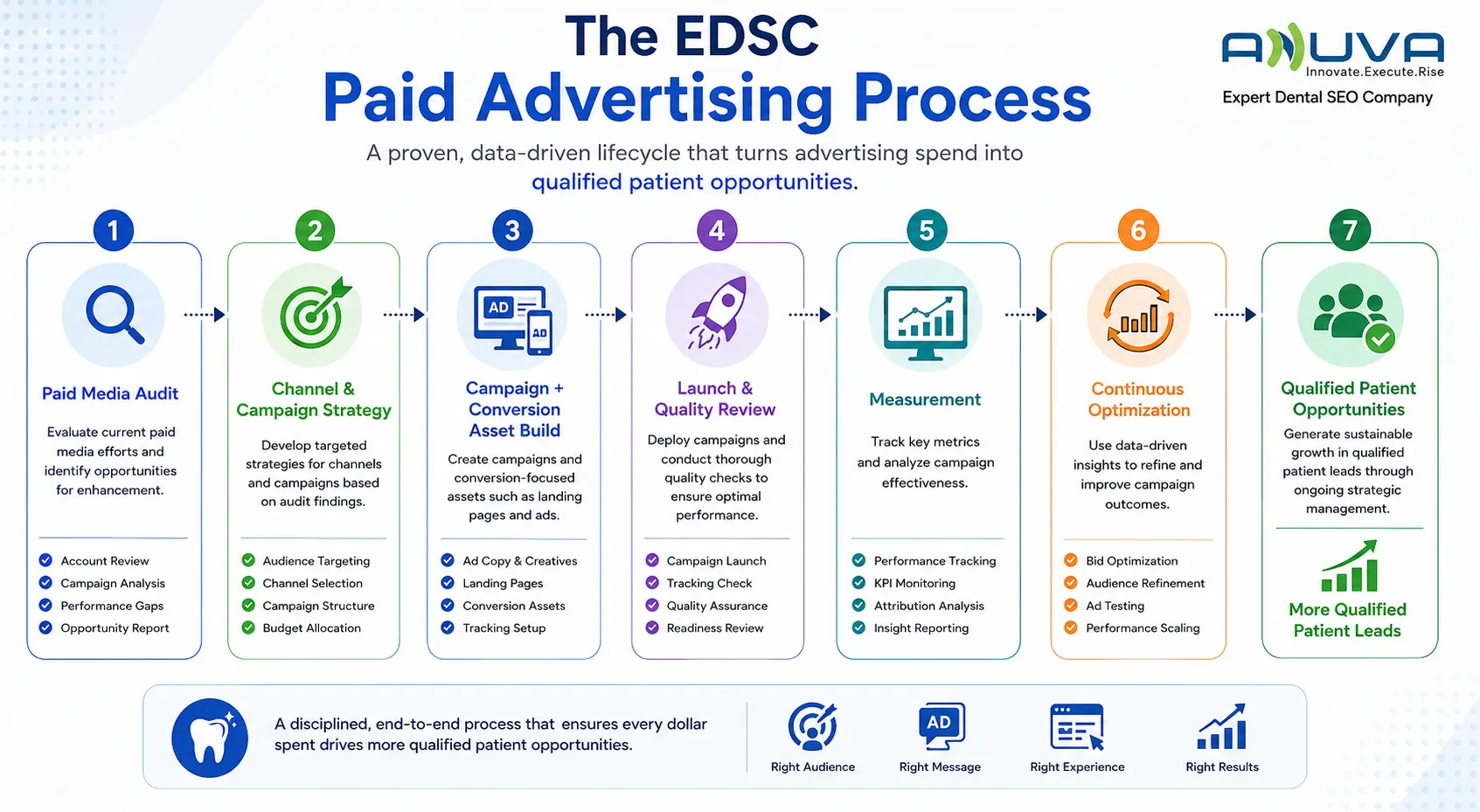
Our Paid Advertising Process
Paid Media Audit & Discovery
We begin by understanding your practice, current advertising, services, patient priorities, local market, and growth objectives. Where campaigns already exist, we review areas such as:
- Campaign structure
- Targeting
- Keywords or audiences
- Advertising messages
- Geographic settings
- Landing-page relevance
- Conversion actions
- Tracking setup
- Budget allocation
This establishes a clear starting point.
Channel & Campaign Strategy
Based on the audit, we create a practical paid-media roadmap. The strategy may identify:
- Google Ads opportunities
- Facebook and Instagram campaign opportunities
- Treatment and offer priorities
- Remarketing needs
- Landing-page recommendations
- Conversion goals
- Budget direction
- Reporting requirements
Each recommendation should support a clear patient-acquisition objective.
Campaign & Conversion Asset Development
Once the strategy is approved, we develop the agreed campaign components. This may include:
- Campaign setup or restructuring
- Search keywords or audience targeting
- Ad copy and creative direction
- Landing-page recommendations
- Conversion tracking
- Call tracking
- Appointment-request pathways
- Remarketing audiences
Every component is designed to work together.
Launch & Quality Review
Before campaigns scale, we verify that the patient journey is working as intended. This includes checking:
- Targeting and geographic settings
- Ad and landing-page alignment
- Form and booking functionality
- Call-to-action clarity
- Tracking implementation
- Mobile experience
- Campaign relevance
This quality review helps reduce avoidable friction before ongoing optimization begins.
Measurement & Continuous Optimization
After launch, we review available performance data and refine the strategy based on evidence. The process may include:
- Search-term and audience analysis
- Ad and creative testing
- Landing-page improvement
- Budget adjustments
- Negative-keyword refinement
- Geographic optimization
- Remarketing updates
- Conversion review
- Reporting and strategy recommendations
How long does dental PPC take to generate results?
Dental PPC campaigns can begin generating traffic and patient enquiries after launch. However, reliable performance usually requires ongoing refinement of targeting, messaging, landing pages, tracking, and budget allocation. The exact timeline depends on the treatment, market competition, advertising budget, and conversion readiness of the practice.
See the Work Behind the Paid Advertising Strategy
Paid advertising performance varies by treatment, market, competition, budget, landing experience, tracking and starting point. Our work can include paid-search strategy, paid-social strategy, campaign structure, targeting, budget planning, landing-page coordination, conversion tracking and ongoing optimization. Where appropriate, we can share relevant campaign examples and supporting work so you can see how the approach has been applied to real dental practices. Want to see relevant examples?
Frequently Asked Questions
Dental PPC is the broader paid-advertising category. Google Ads is a major PPC platform used to reach people actively searching for dental services. Dental PPC may also include Facebook and Instagram Ads, remarketing, landing pages, tracking, and conversion optimization.
It depends on your goals. Google Ads often captures existing patient demand through active searches, while Facebook and Instagram Ads for Dental Practice can support awareness, treatment education, audience development, and remarketing. Some practices benefit from a coordinated approach using both.
Yes. Paid advertising can support consultation campaigns for treatments such as dental implants, Invisalign, cosmetic dentistry, and other services where prospective patients actively research options. Success depends on appropriate targeting, messaging, landing pages, trust signals, and follow-up.
A dedicated landing page is often recommended because it can closely match the treatment, advertisement, and patient intent. A relevant page may reduce friction and make it easier for visitors to request an appointment or consultation.
Useful measures can include qualified calls, appointment requests, online bookings, consultation enquiries, cost per enquiry, campaign performance, landing-page conversions, and other indicators aligned with your practice’s goals. Clicks and impressions provide context but should not be the only success measures.
Yes. PPC can provide immediate visibility for relevant searches or campaigns, while SEO builds sustainable organic visibility over time. Using both can create a more balanced patient-acquisition strategy when budgets and goals allow.
Dental PPC costs vary depending on your location, competition, treatment focus, and advertising objectives. More competitive treatments and larger metropolitan markets generally require higher advertising budgets than smaller local campaigns. However, the success of a PPC campaign for dental office is determined by more than budget alone. Effective targeting, relevant landing pages, strong conversion paths, and continuous optimization often have a greater influence on return on investment than simply increasing advertising spend. A well-managed campaign should focus on generating qualified patient opportunities rather than maximizing clicks or impressions.
Total cost normally includes media spend plus the management, creative, landing-page and measurement work required for the campaign. The appropriate budget depends on treatment, market, competition, objectives, practice capacity and available demand.
No. Paid advertising can create opportunities to reach targeted audiences, but lead and appointment volume depends on demand, targeting, competition, offer, landing experience, budget, tracking and follow-up.
The appropriate channel depends on the treatment, audience, geography, campaign objective, creative requirements and available data. Dental Google Ads and Facebook/Meta Ads for dental practice serve different purposes; they should be evaluated against the practice’s specific goals rather than treated as interchangeable.
Ready to Make Your Paid Advertising More Purposeful?
Your practice should not have to choose between fast visibility and intelligent marketing. A well-planned paid-media strategy can help you reach prospective patients at the right stage of their decision-making journey, provide relevant information, and create clearer pathways to appointment requests.
At Expert Dental SEO Company, we connect Google Ads, Facebook Ads, landing pages, tracking, conversion rate optimization, and ongoing improvement into a coordinated paid-acquisition system.
Paid advertising should do more than generate clicks. It should connect a defined treatment or business priority with the right audience, message, destination and measurable next step. We can review your current paid-media strategy, identify opportunities and gaps, and determine which channels and campaign priorities make sense for your practice.
Schedule a Paid Advertising Strategy Session to discuss your goals.