

Schema Markup Services for Dentists
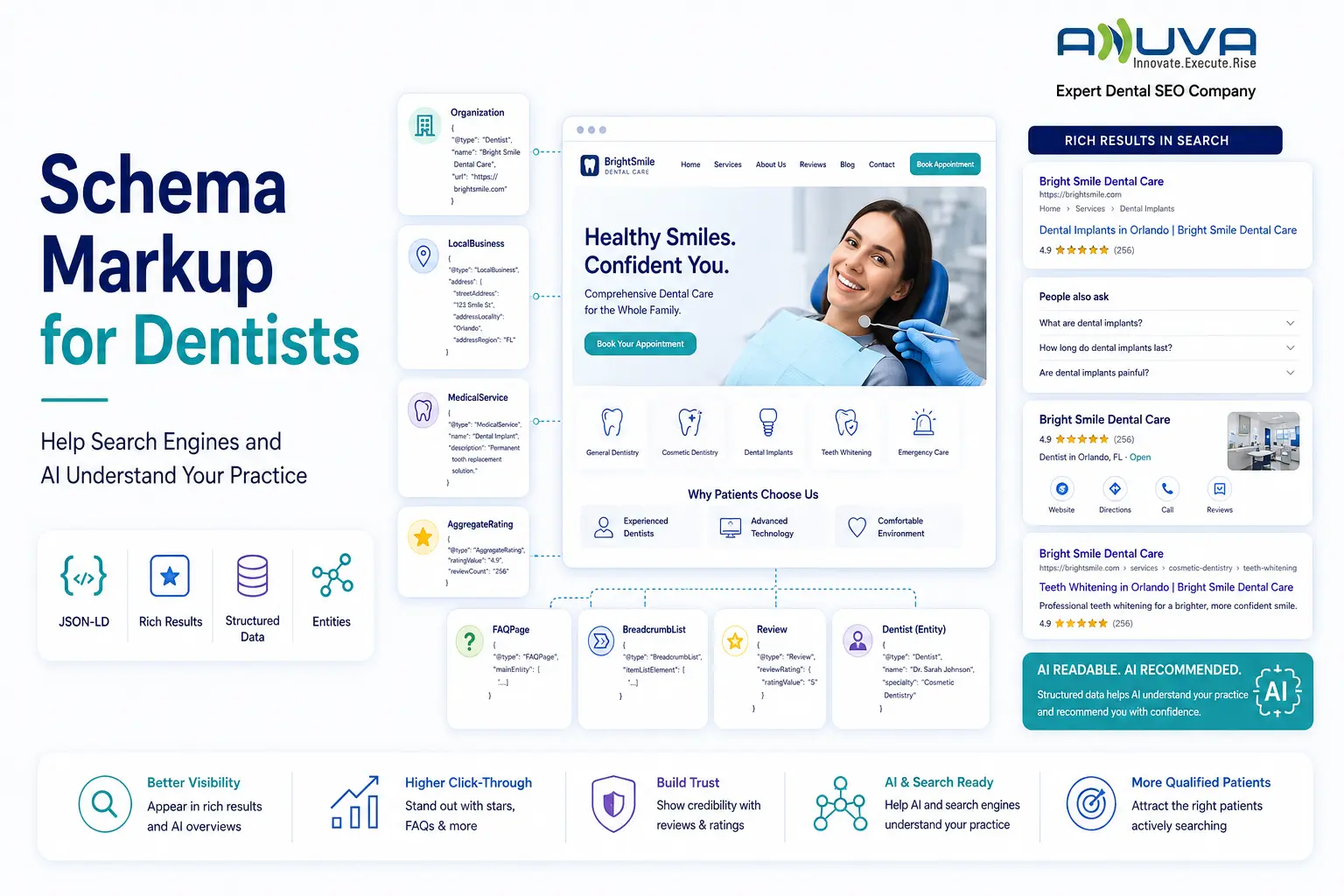
Why Search Engines Need Structured Data
Your dental website contains valuable information about your practice, services, team, location, and patient resources. People can usually understand that information by reading the page. Search engines and AI-powered systems, however, rely on additional context to interpret the meaning and relationships behind your content.
That’s where structured data becomes valuable. Schema markup provides standardized information that helps search systems better understand your website, your practice, and the content you publish.
At Expert Dental SEO Company, we implement structured data that supports clearer interpretation of your website while complementing your broader SEO and digital marketing strategy. Rather than replacing great content, schema helps organize and describe that content in a way that search technologies can process more effectively.
Not sure whether your website is using structured data effectively?
Schedule a Structured Data Audit, and we’ll review your implementation, identify opportunities, and explain how structured data fits into your overall digital strategy.
What Is Schema Markup?
Schema markup is a standardized vocabulary used to describe the meaning of information on a webpage. It provides structured details about your business, services, professionals, FAQs, articles, and other content.
For a dental practice, schema may help describe information such as:
- Practice name
- Business location
- Contact details
- Office hours
- Dental services
- Dentist profiles
- Frequently asked questions
- Articles
- Breadcrumb navigation
- Organization details
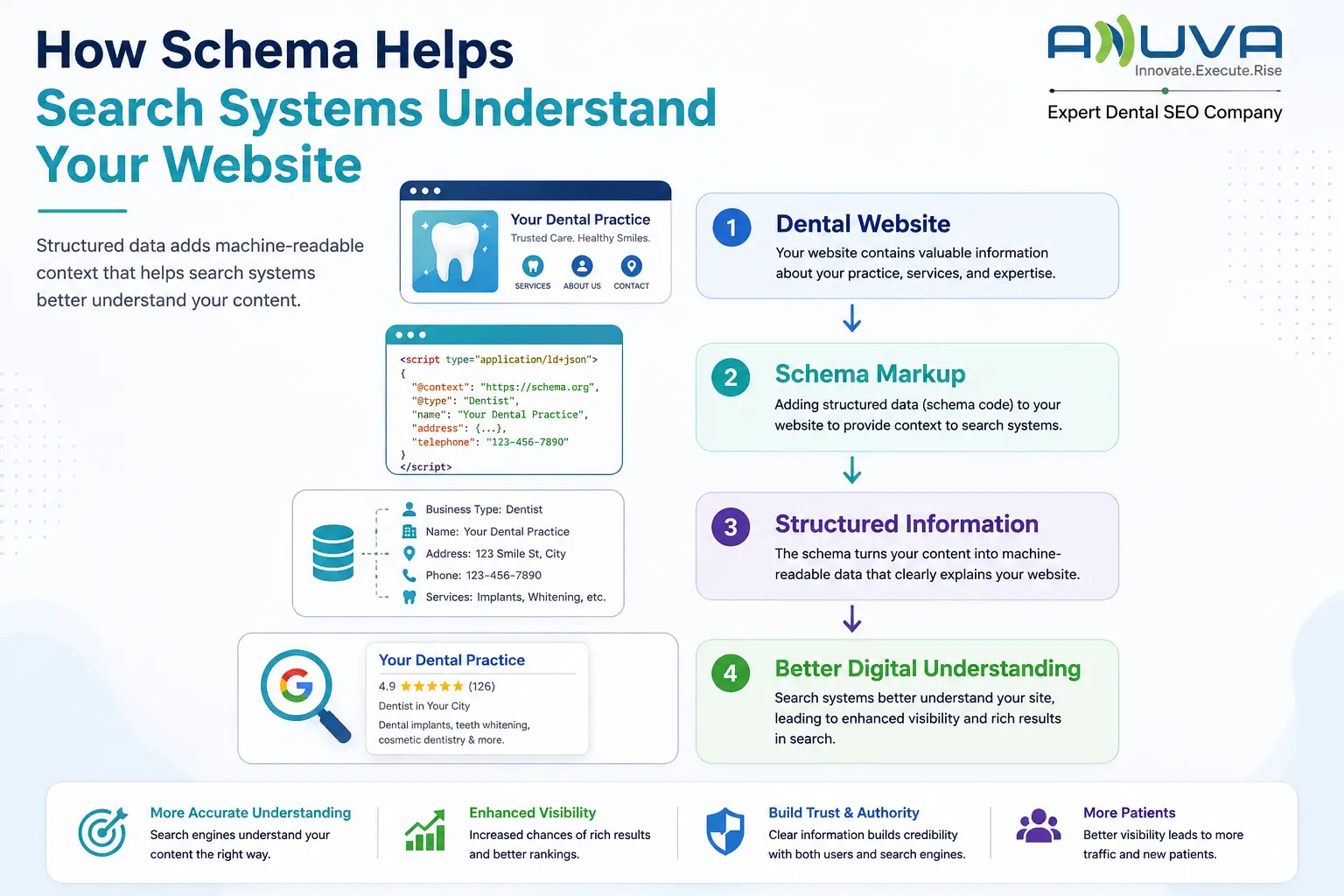
Structured data helps search engines interpret these elements more consistently and understand how different pieces of information relate to one another.
What is schema markup for dentists?
Schema markup is structured data added to a dental website that helps search engines and AI-powered systems better understand information such as the practice, services, dentists, office location, FAQs, and articles. It provides machine-readable context that complements the visible content on the page.
Why is schema markup important for dental websites?
Schema markup helps organize information in a standardized format that search engines can interpret more easily. It supports clearer understanding of your dental practice, services, and website content while complementing broader SEO and technical optimization efforts.
Why Schema Matters for Modern Search
Search technology continues to evolve.
Instead of simply matching keywords, modern search systems attempt to understand:
- Who you are
- What services you provide
- Where you operate
- How different pages relate
- Which topics your website covers
- How information connects across your site
Structured data helps provide additional clarity. When combined with helpful content, sound technical SEO, and a well-organized website, schema contributes to a stronger foundation for digital understanding.
Rather than viewing schema as an isolated technical feature, we consider it part of a comprehensive strategy that supports:
- Website organization
- Content clarity
- Local business information
- Professional credibility
- AI Visibility
- Long-term digital authority
Why Structured Data Supports AI-Powered Search
Modern AI-powered search systems rely on more than visible webpage content. They also evaluate how clearly information is organized, connected, and described.
Structured data helps provide standardized context about your practice, services, locations, educational resources, and website structure. When combined with helpful content, logical site architecture, and sound technical SEO, schema contributes to clearer digital understanding across modern search technologies. Rather than replacing content, structured data enhances how search systems interpret the information already published on your website.
The EDSC Structured Data Framework™
Structured data is most effective when it is planned as part of your website’s overall architecture—not added as an afterthought. Many dental websites use only basic schema or rely entirely on default plugins. While these tools can provide a useful starting point, they often don’t fully describe the practice, its services, its professionals, or the relationships between different types of content.
At Expert Dental SEO Company, we’ve developed the EDSC Structured Data Framework™ to help dental practices implement schema in a way that supports clarity, consistency, and long-term digital growth. As part of the broader EDSC Growth Framework™, this framework integrates structured data with content, technical SEO, local optimization, and AI Visibility.
Our philosophy is simple:
Structured data doesn’t replace great content—it helps search engines and AI systems better understand great content. When schema is implemented thoughtfully, it complements the information already on your website and helps create a more organized digital presence.
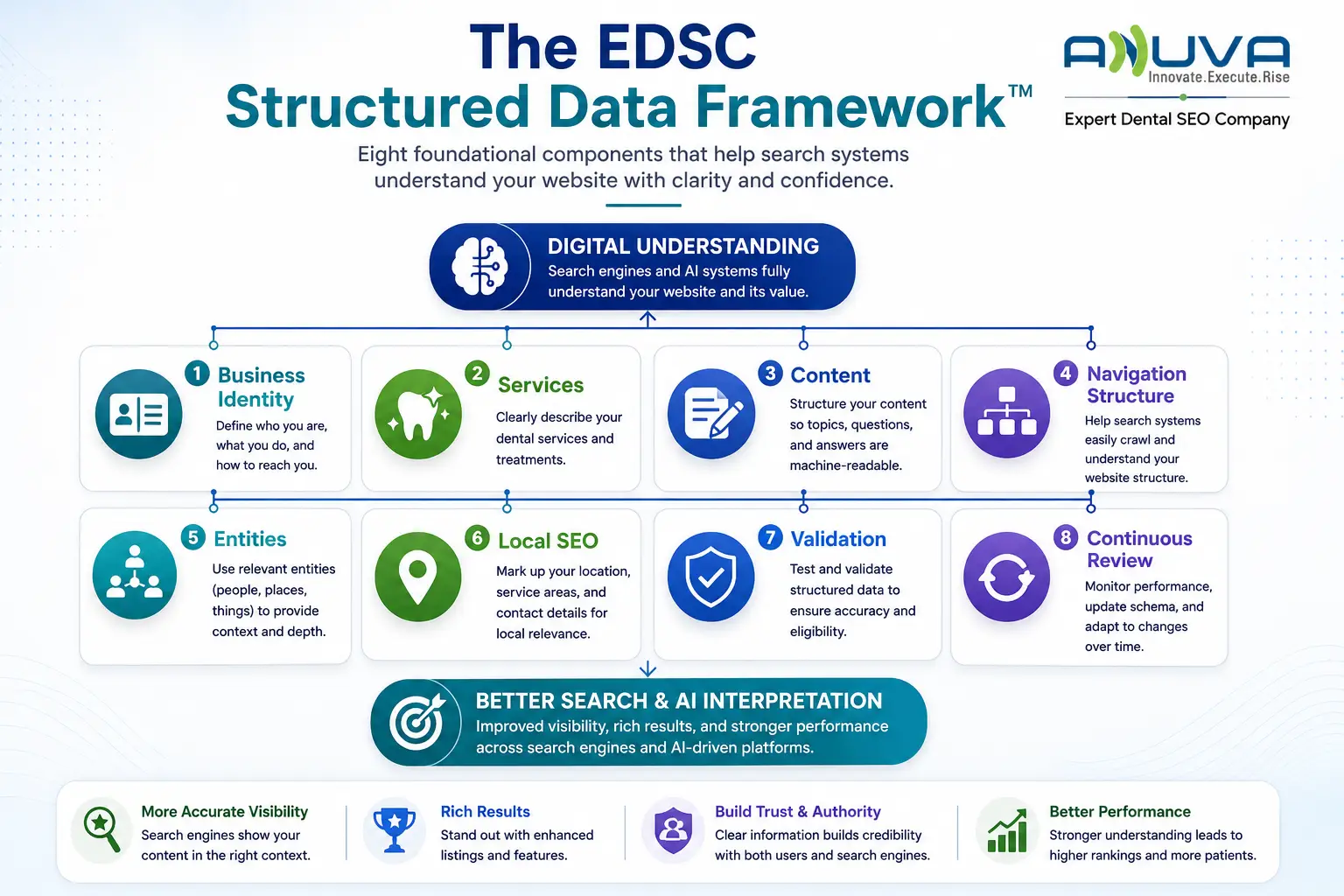
The Eight Pillars of Structured Data
Our framework focuses on helping search technologies understand your practice through consistent, well-organized structured information.
Pillar 1 – Business Identity
Search systems should clearly understand who your practice is.
We implement structured information that accurately describes your business, including:
- Practice name
- Website
- Contact information
- Office location
- Business hours
- Organization details
Consistent business identity helps reinforce your digital presence across platforms.
Pillar 2 – Service Understanding
Your website may describe many treatments and services. Structured data helps clarify these offerings by providing standardized information that complements your service pages.
Examples include:
- Cosmetic Dentistry
- Dental Implants
- Invisalign
- Emergency Dentistry
- Family Dentistry
The goal is to improve clarity—not replace well-written service content.
Pillar 3 – Content Classification
Not every page serves the same purpose. Different content types benefit from different structured descriptions.
Examples include:
- Articles
- FAQs
- Service pages
- Organization pages
- Breadcrumbs
- Educational resources
Proper classification helps search systems better understand the role of each page within your website.
Pillar 4 – Website Organization
Schema also supports the relationships between pages. Combined with strong internal linking and clear navigation, structured data helps communicate how different sections of your website connect.
Examples include:
- Home
- Services
- Treatment Guides
- FAQs
- Blog
- Contact
A logical website structure benefits both visitors and search technologies.
Pillar 5 – Entity Relationships
Modern search systems increasingly rely on understanding entities rather than isolated keywords.
Structured data helps describe important entities such as:
- Dental practice
- Dentists
- Services
- Locations
- Organizations
- Educational content
This contributes to a more coherent digital representation of your practice.
Pillar 6 – Local Business Signals
For local dental practices, accurate business information is especially important.
Structured data can reinforce details such as:
- Office address
- Phone number
- Opening hours
- Geographic location
- Service area
These signals complement your broader Local SEO efforts.
Pillar 7 – Validation & Accuracy
Structured data should be accurate, complete, and technically valid.
We review implementations to identify issues such as:
- Missing required properties
- Incorrect values
- Duplicate markup
- Conflicting schema
- Validation errors
Maintaining high-quality structured data helps ensure consistency across your website.
Pillar 8 – Continuous Improvement
Structured data is not a one-time implementation.
As your website grows with new services, educational resources, FAQs, and treatment pages, your structured data should evolve as well.
Regular reviews help ensure your implementation continues reflecting your website accurately.
Schema Works Best as Part of an Integrated SEO Strategy
Structured data is one component of a successful digital marketing strategy.
For the strongest long-term results, schema should work alongside:
- Technical SEO
- Helpful educational content
- Internal linking
- Local SEO
- AI Visibility optimization
- Website architecture
- Entity optimization
- Content authority
- User experience
Each element strengthens the others, creating a more complete digital foundation.
What types of schema should a dental website use?
The appropriate schema depends on the content and structure of the website. Common examples include Organization, Local Business, Dentist or healthcare-related business information where applicable, Service, FAQ, Article, Breadcrumb, and Website schema. The goal is to accurately describe the content and relationships on the site rather than adding every available schema type.
What does schema markup do?
Schema markup adds structured information to a webpage so search engines and AI-powered systems can better interpret its content. It helps describe businesses, services, articles, FAQs, and other page elements using standardized vocabulary, complementing the visible content already on the site.
Our Schema Markup Services
Effective schema implementation requires more than installing a plugin or copying code from a template.
Every dental practice has a unique combination of services, providers, locations, educational resources, and website architecture.
At Expert Dental SEO Company, we develop structured data strategies that accurately reflect your practice while supporting your broader SEO, AI Visibility, and technical optimization efforts.
Structured Data Audit
Every implementation begins with understanding your current website.
We perform a comprehensive structured data audit to evaluate:
- Existing schema markup
- Missing schema opportunities
- Validation issues
- Duplicate implementations
- Inconsistent structured information
- Website architecture
- Technical SEO compatibility
This audit establishes a clear roadmap for improving the structured information across your website.
Organization & Practice Schema
Your practice should be represented consistently throughout your website.
We implement structured information describing important business details such as:
- Practice name
- Business information
- Website
- Contact details
- Office hours
- Branding
- Practice identity
Accurate business information helps create a more consistent digital presence.
Service Schema
Each service page should clearly describe the treatments your practice provides.
Depending on your website structure, we may implement structured data supporting services such as:
- Dental Implants
- Invisalign
- Cosmetic Dentistry
- Emergency Dentistry
- Family Dentistry
- Preventive Dentistry
- Restorative Dentistry
This structured information complements the educational content already available on each page.
FAQ Schema
Frequently asked questions help patients make informed decisions.
Where appropriate, we implement structured FAQ markup for pages containing genuine question-and-answer content.
Typical FAQ topics include:
- Treatment eligibility
- Recovery
- Appointment preparation
- Costs
- Insurance
- Oral health guidance
The goal is to organize helpful information—not to artificially increase search visibility.
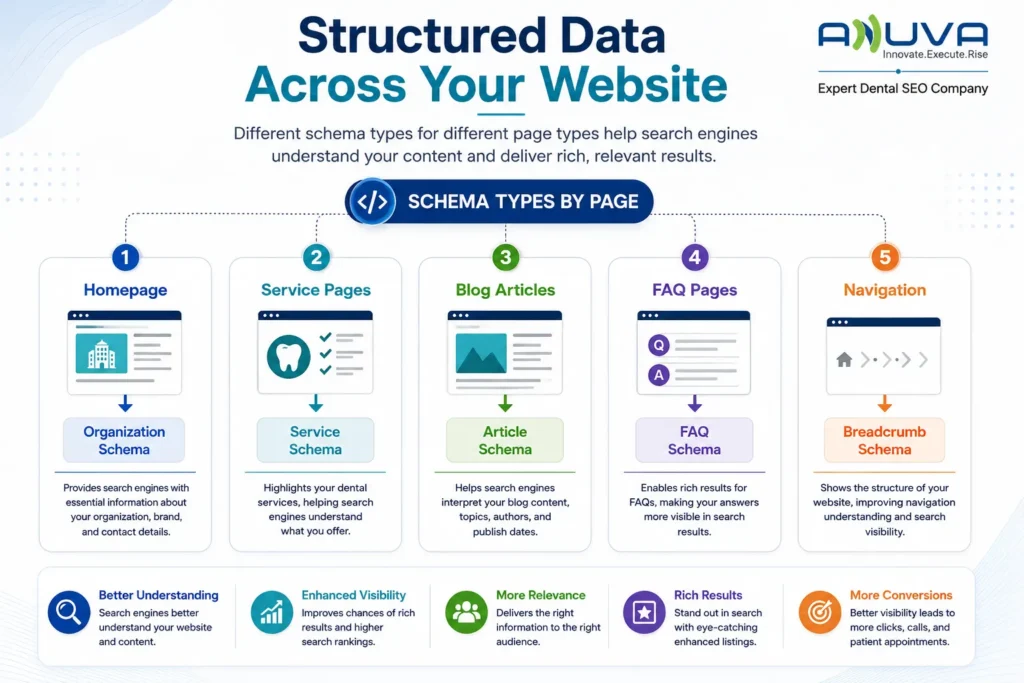
Article & Educational Content Schema
Educational content forms an important part of your digital authority.
We implement structured data that helps classify:
- Blog articles
- Educational resources
- Treatment guides
- Patient information pages
- Resource content
This complements the EDSC Content Authority Framework™ by helping search technologies understand the purpose of each educational resource.
Breadcrumb Schema
As websites grow, navigation becomes increasingly important.
Breadcrumb schema helps communicate page hierarchy and relationships across your website.
This supports:
- Better content organization
- Easier navigation
- Clearer website architecture
- Improved contextual understanding
Breadcrumbs work alongside internal linking to reinforce logical site structure.
Structured Data Validation & Maintenance
Schema implementation is not a one-time task.
As your website grows, structured information should be reviewed regularly.
We perform ongoing validation to identify:
- Technical errors
- Missing required properties
- Outdated information
- Duplicate markup
- Schema conflicts
- Opportunities for improvement
This helps maintain an accurate and consistent structured data implementation.
Common Schema Implementation Mistakes
Many dental websites unknowingly contain structured data issues that reduce clarity.
Common examples include:
- Missing required properties
- Outdated business information
- Duplicate schema
- Conflicting markup
- Incorrect page classification
- Invalid structured data
- Automatically generated markup that doesn’t match visible content
- Missing relationships between entities
Regular audits help identify and resolve these issues while keeping structured data aligned with the current website.
Authority & Reputation Enhancement
Authority is influenced by more than website content alone.
We help strengthen your practice’s reputation by highlighting signals such as:
- Professional memberships
- Awards
- Dentist credentials
- Community involvement
- High-quality patient reviews
- Educational contributions
These trust indicators support both patient confidence and overall digital authority.
What services are included in schema markup implementation?
Professional schema implementation may include structured data audits, organization schema, service schema, FAQ schema, article schema, breadcrumb schema, local business schema, validation, and ongoing maintenance. The objective is to help search engines and AI-powered systems better understand the information already published on your website.
Schema Markup vs HTML Content
Schema markup and webpage content serve different purposes. One is designed for people. The other provides additional context for search technologies. Both are important.
Feature | Schema Markup | HTML Content |
Audience | Search engines & AI systems | Human visitors |
Purpose | Structured description | Education & communication |
Visibility | Typically not visible on the page | Visible to visitors |
Content | Machine-readable data | Text, images, videos |
Supports SEO | Yes, as part of technical optimization | Yes, through relevance and usefulness |
Replaces Good Content? | No | No |
Supports AI Understanding | Yes | Indirectly |
Semantic Relationships | Strong | Limited |
Best Results | Combined with high-quality content | Combined with structured data |
Schema is most effective when paired with clear, comprehensive, patient-focused content. Together, they create a stronger foundation for both users and modern search technologies.
Why Dental Practices Choose Expert Dental SEO Company
Schema markup can be highly valuable—but only when it’s implemented thoughtfully. Many websites rely entirely on default plugins or generic templates that provide only basic structured information.
At Expert Dental SEO Company, we take a strategic approach. We review your website, understand your practice, evaluate your content, and implement structured data that accurately represents your business while complementing your SEO, content marketing, and AI Visibility efforts.
Here’s why dental practices choose us.
🦷 We Build Structured Data Around Your Practice
No two dental practices are identical.
Different services, providers, locations, specialties, and educational resources require different structured information.
Rather than applying identical markup to every client, we tailor structured data to reflect the unique characteristics of your practice and website.
🎯 We Prioritize Accuracy & Consistency
Structured data is only useful when it accurately reflects the information visible on your website.
Our implementation emphasizes:
- Consistent business information
- Accurate service descriptions
- Logical content classification
- Clean website architecture
- Ongoing validation
This helps create a more reliable digital presence across your website.
🔗 We Integrate Schema Into Your Overall Strategy
Structured data works best when it supports not replaces other optimization efforts.
Our schema implementations are designed to complement:
- Dental SEO
- Local SEO
- AI Visibility
- Content Marketing
- Website Design
- Reputation Management
Instead of treating schema as an isolated technical task, we integrate it into your complete digital strategy.
📊 We Follow Industry Standards
Structured data continues to evolve as search technologies develop.
Our implementations are guided by recognized schema standards and current technical best practices.
When appropriate, we review:
- Required properties
- Recommended properties
- Structured data consistency
- Validation results
- Website architecture
- Compatibility with other technical SEO elements
This disciplined approach helps maintain a reliable technical foundation.
🚀 Structured Data Evolves With Your Website
As your practice grows, your website changes. New services are introduced. Educational resources expand. FAQ pages increase. Additional locations may be added. Structured data should evolve alongside these changes.
We periodically review implementations to help ensure your structured information continues reflecting the current state of your website.
As new treatment pages, educational articles, provider profiles, locations, and patient resources are added, structured data should expand alongside them. A scalable schema strategy helps maintain consistency across your website while ensuring new content is accurately represented as your digital presence grows.
Our Schema Implementation Process
Effective schema implementation begins with understanding your website not adding code. Our structured process helps ensure that schema supports your content, website architecture, and long-term digital strategy.
Step 1 – Structured Data Audit
We begin with a technical review of your website.
This includes evaluating:
- Existing schema
- Validation status
- Content organization
- Website structure
- Business information consistency
- Schema opportunities
The audit establishes priorities before implementation begins.
Step 2 – Schema Strategy
Based on the audit findings, we determine which structured data types are appropriate for your website.
Recommendations may include:
- Organization schema
- Local Business schema
- Service schema
- FAQ schema
- Article schema
- Breadcrumb schema
- Website schema
The focus is always on implementing markup that accurately reflects your published content.
Step 3 – Implementation
Once the strategy is approved, we implement structured data across the relevant pages of your website.
Depending on your content, this may include:
- Practice information
- Service pages
- Educational resources
- FAQ sections
- Articles
- Navigation elements
Every implementation is aligned with the visible information already available to visitors.
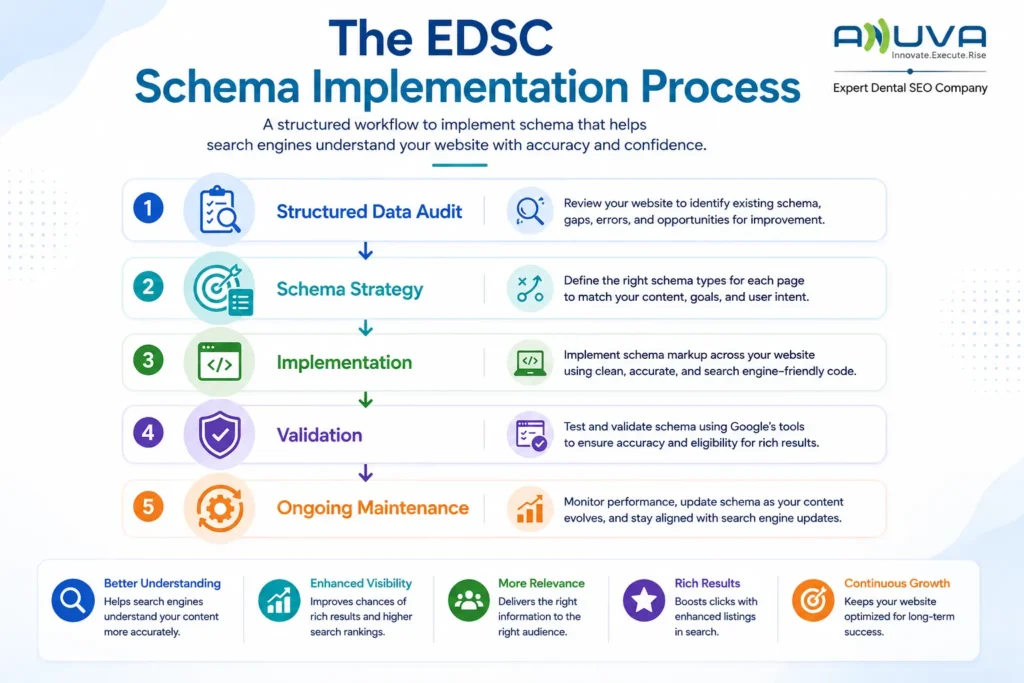
Step 4 – Validation & Quality Review
After implementation, we validate the structured data to identify any issues.
This includes reviewing:
- Syntax
- Required properties
- Duplicate markup
- Conflicting schema
- Technical accuracy
Quality assurance helps maintain consistency and reliability.
Step 5 – Ongoing Maintenance
Structured data should remain aligned with your evolving website.
As content is added or updated, we review opportunities to expand or refine your schema implementation.
This ongoing process supports a well-maintained technical foundation.
Does schema markup improve SEO?
Schema markup can help search engines better understand the content and structure of a website by providing standardized, machine-readable information. While schema alone does not guarantee higher rankings or rich results, it complements high-quality content, sound technical SEO, and clear website architecture.
Frequently Asked Questions
Most dental websites can benefit from appropriate structured data because it helps describe business information, services, and educational content in a standardized format. The specific schema types should match the website’s actual content and structure.
No. Structured data may make certain types of search enhancements eligible, but search engines decide when and whether to display rich results. Eligibility depends on multiple factors beyond schema implementation alone.
Generally, no. Schema markup is machine-readable code that provides additional context to search engines and AI-powered systems. Visitors typically interact with the visible content of the page rather than the structured data itself.
Schema should be reviewed whenever significant changes are made to your website, such as adding new services, updating business information, publishing new content, or redesigning important sections.
No. Structured data complements high-quality content it does not replace it. Helpful, accurate, patient-focused content remains the foundation of an effective dental website.
Common examples include Organization, Local Business, Service, FAQ, Article, Breadcrumb, and Website schema. The appropriate implementation depends on the specific content available on each page.
Ready to Build a Stronger Technical Foundation?
Your website should communicate clearly with both prospective patients and modern search technologies.
At Expert Dental SEO Company, we implement structured data that accurately represents your practice, complements your content, and strengthens the technical foundation of your website.
Schedule your Structured Data Audit today, and let’s create a more organized, understandable, and future-ready digital presence.